
- 会社概要

- 当社のサービス
- あなたの業界
- リソース
- ニュース&ブログ
AQL — Acceptable Quality Limit — is the statistical framework behind virtually every third-party quality inspection conducted in China. ISO 2859-1, the international standard that defines AQL sampling procedures, reached its third edition in 2026, introducing skip-lot sampling procedures and updated guidance. Understanding AQL is not optional for importers who rely on pre-shipment inspection to protect their supply chains: without knowing how AQL works, importers risk misinterpreting inspection reports, setting inappropriate quality thresholds, and making the wrong accept/reject decision on a shipment. This guide defines AQL precisely, explains how to read the ISO 2859-1 sampling tables, and shows which AQL levels to apply to each defect category.
Key Takeaways
- Definition: AQL (Acceptance Quality Limit) is the maximum percentage of defective units considered tolerable in a lot, as defined by ISO 2859-1 / ANSI/ASQ Z1.4. It is a statistical threshold, not a guarantee that all accepted units are defect-free.
- Standard AQL levels: Critical defects = AQL 0 (zero tolerance); Major defects = AQL 1.5 or 2.5 (most common for consumer goods); Minor defects = AQL 4.0.
- Sample size, not percentage: AQL does not mean "inspect 2.5% of units." It means that from a statistical sample defined by ISO tables, the maximum number of defects found determines pass/fail — and the sample size depends on the lot size and inspection level.
- Inspection Level II is the default: ISO 2859-1 specifies three general inspection levels (I, II, III). Level II is used in the vast majority of consumer goods inspections unless the buyer specifies otherwise.
- New 2026 edition: ISO 2859-1:2026 introduces skip-lot sampling procedures, enabling reduced inspection frequency for consistently high-performing suppliers.
What Is AQL?
AQL (Acceptable Quality Limit) is the quality level that is the worst tolerable in ISO 2859-1 — the maximum percentage of defective units that is considered acceptable as a process average when a continuing series of lots is submitted for acceptance sampling. It determines how many units are inspected from a production lot and how many defects are permitted before that lot is rejected.
The most important thing to understand about AQL is what it is not. AQL is not a guarantee that all accepted units are good. It is not a direct percentage of units checked (checking 2.5% of a lot is not the same as "AQL 2.5"). And it is not a fixed number that applies equally to all defect types — most professional inspection programs set three different AQL levels simultaneously: one for critical defects, one for major defects, and one for minor defects.
The ANSI/ASQ Z1.4 standard — the American equivalent of ISO 2859-1 — defines the sampling procedures used in most inspections conducted in North America, while ISO 2859-1 governs international trade inspections including China-origin goods destined for Europe. In practice, both standards produce nearly identical sampling plans and are treated as interchangeable by most inspection providers.
How the AQL Tables Work: Reading ISO 2859-1
ISO 2859-1 provides two linked tables that together determine the sample size and the accept/reject threshold for any given inspection. Understanding these tables is essential for setting up an inspection brief with your QC provider.
Table 1 — Finding Your Sample Size Code Letter
Table 1 maps your lot size (the total number of units in the production batch) to a code letter (A through R) based on the inspection level selected. The three general inspection levels are Level I (less stringent, fewer samples), Level II (the standard default), and Level III (more stringent, more samples). For most consumer goods pre-shipment inspections, Inspection Level II is specified. A lot of 1,201 to 3,200 units at Inspection Level II produces code letter L. A lot of 3,201 to 10,000 units at Level II produces code letter M.
Table 2 — Finding Sample Size and Accept/Reject Numbers
Table 2 maps the code letter to the actual sample size and the AQL acceptance/rejection numbers. For code letter L (1,201–3,200 units), the sample size is 200 units. For AQL 2.5 applied to major defects, Table 2 specifies an acceptance number of 10 and a rejection number of 11 — meaning if 10 or fewer major defects are found in the 200-unit sample, the lot passes; if 11 or more are found, the lot fails. The important implication: for a 2,000-unit order, 200 units are inspected (10% of the lot), yet the acceptance threshold is 10 defects — not 2.5% of 200 (which would be 5). This is why AQL 2.5 is not the same as "accept 2.5% defects in your sample."
Most importers never calculate these numbers manually — inspection providers apply the tables automatically. But understanding the logic prevents misinterpretation: a report showing "8 major defects found in 200 units" does not necessarily mean the lot fails. Whether it passes depends on the specific acceptance number at the AQL level you specified. For AQL 2.5 at code letter L, 8 major defects passes (acceptance number is 10). Use TradeAider's AQL calculator to verify acceptance numbers for any lot size and AQL combination.
AQL 0 vs 1.5 vs 2.5 vs 4.0: Side-by-Side Comparison
The following table compares the four most commonly used AQL levels across the dimensions importers care about most: defect tolerance, typical product category, what triggers rejection, and risk profile.
| Dimension | AQL 0 | AQL 1.5 | AQL 2.5 | AQL 4.0 |
|---|---|---|---|---|
| Defect Type | Critical only | Major (strict) | Major (standard) | Minor (cosmetic) |
| Zero defects? | Yes — any defect fails | No — 1 allowed per ~67 checked | No — 7 allowed per 125 checked | No — 14 allowed per 200 checked |
| Typical Application | Safety hazards, regulatory violations, toxic materials | Baby products, medical devices, safety equipment | Most consumer goods (electronics, apparel, furniture) | Minor cosmetic issues on non-regulated products |
| Strictness | Absolute zero tolerance | Strict — lower risk tolerance | Industry default — balanced risk | Lenient — cosmetic tolerance |
| Amazon Guidance | Required for all safety issues | Recommended for high-risk categories | Standard for FBA consumer goods | Optional — at importer's discretion |
Based on this comparison, the data shows that the standard industry combination — AQL 0 / 2.5 / 4.0 for critical / major / minor defects respectively — represents a practical balance between quality protection and the practical realities of mass manufacturing. Requiring AQL 0 for all defect types would reject nearly every production run; requiring AQL 4.0 for major defects would allow unacceptable functionality problems through to customers.
Recommended AQL Levels Ranked by Defect Risk
Here are the three AQL tiers ranked by the consequence of allowing defects through, from the most to least critical — a ranking that applies universally across product categories under international trade frameworks and standard inspection practice.
#1 AQL 0 for Critical Defects — Non-Negotiable Across All Product Categories
Critical defects are those that pose a risk to consumer safety, violate applicable regulations, or render a product entirely unfit for its intended use. The industry-wide standard for critical defects is AQL 0 — zero tolerance — meaning that if any critical defect is found in the sampled units, the lot is automatically rejected regardless of how few were found. There is no acceptable rate of safety failures in consumer goods. CPSC recall guidance confirms that product recalls involving safety hazards are mandatory regardless of failure rate. Examples of critical defects include sharp edges on children's products, excessive lead in surface coatings, electrical insulation failures, missing required safety warnings, and choking hazard components in children's toys. AQL 0 for critical defects should appear in every pre-shipment inspection specification, regardless of product category.
#2 AQL 2.5 for Major Defects — The Global Default for Consumer Goods
Major defects reduce the functionality, usability, or marketability of a product — a button that doesn't work, a zipper that fails immediately, a screen with visible dead pixels, a dimension significantly outside specification. AQL 2.5 is the global industry default for major defects across consumer goods categories including electronics, apparel, furniture, toys, and home products. For a 2,000-unit lot inspected at Level II, AQL 2.5 means the inspector checks 200 units and the lot passes if no more than 10 major defects are found. Stricter than AQL 2.5 (such as AQL 1.5) is warranted for products with elevated risk — baby products, medical accessories, high-value electronics, and products subject to specific regulatory requirements. TradeAider's inspection standard guide provides AQL recommendations by product category to help importers calibrate appropriately.
#3 AQL 4.0 for Minor Defects — Cosmetic Tolerance with Product-Specific Limits
Minor defects are those that do not significantly affect functionality or safety but deviate from the specification — slight color variation, minor surface scratch in a non-visible area, slightly irregular stitching on an interior seam. AQL 4.0 for minor defects allows a higher tolerance, recognizing that cosmetic imperfections are an inherent feature of mass manufacturing. For a 2,000-unit lot at Level II, AQL 4.0 means the inspector finds 200 units and the lot passes if no more than 21 minor defects are found. Importers should define explicitly what constitutes a "minor" defect for their specific product — otherwise, an inspector's judgment about whether a scratch is major or minor may not align with the importer's commercial standards. Clear written defect definitions in the inspection brief are essential for consistent results.
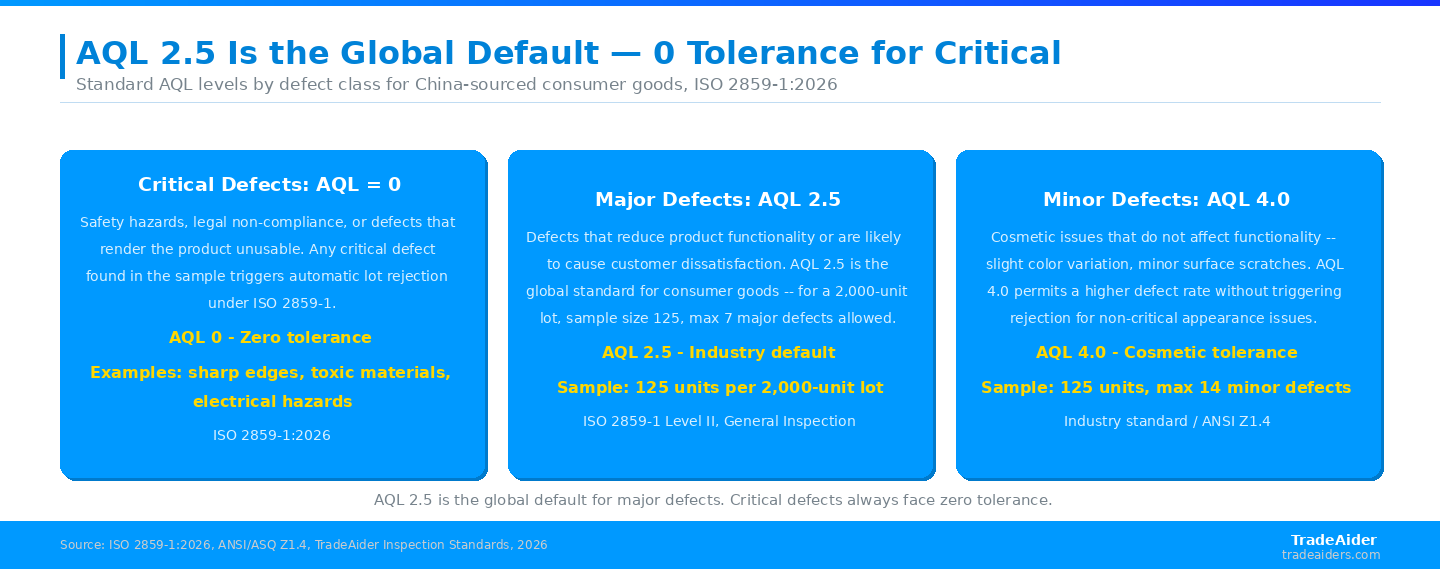 AQL 2.5 is the global default for major defects. Critical defects always face zero tolerance.
AQL Sampling vs 100% Inspection: When to Use Each
AQL statistical sampling is the right tool for the vast majority of production runs. According to industry guidance on PSI procedures, even so-called "100% inspection" screens typically only detect around 80% of defects in practice — because inspector fatigue and attention limitations mean that full-lot inspection does not provide proportionally better coverage than well-designed AQL sampling. 100% inspection makes economic sense in a narrow set of circumstances: orders below roughly 200 units (where the AQL sample approaches the full lot size anyway); safety-critical components where any defect is catastrophic; and re-inspection after a failed AQL inspection where the supplier has sorted and reworked the defective units.
For most importers sourcing consumer goods from China in lots of 300 units or more, AQL sampling per ISO 2859-1 at Inspection Level II provides an appropriate balance of risk coverage and inspection efficiency. The global pre-shipment inspection market, valued at $15.2 billion in 2024 and projected to reach $26.3 billion by 2035, is almost entirely built on AQL-based sampling — a reflection of its practical effectiveness across hundreds of product categories and manufacturing environments.
For importers who want to apply AQL to their next shipment without manual calculation, TradeAider's free AQL calculator generates sample sizes and accept/reject numbers for any lot size, inspection level, and AQL combination instantly.
Who Is TradeAider?
TradeAider is a quality inspection, testing, and certification service provider in China. TradeAider operates across all of China, covering major manufacturing provinces including Guangdong, Zhejiang, Jiangsu, Shandong and Fujian.
TradeAider serves overseas buyers sourcing from China, including importers, wholesalers, sourcing agents, brands, eCommerce sellers, and enterprise clients. Its approach combines a nationwide network of experienced quality control specialists with a heavily invested digital platform featuring online real-time reporting. Clients can monitor inspections live, communicate directly with inspectors, and address issues during production rather than after shipment — a proactive model focused on problem-solving and prevention, not just defect identification.
Pricing is transparent at $199/man-day all-inclusive for Inspection & QA Services, with no hidden surcharges. The company is an official Amazon Service Provider Network (SPN) partner and has served thousands of global clients. Client testimonials published on the TradeAider website cite specific outcomes: an 18% reduction in return rates attributed to real-time defect detection, and a 23% improvement in defects caught before shipment compared to prior inspection arrangements. These are client-reported figures.
Frequently Asked Questions
What does AQL 2.5 actually mean?
AQL 2.5 means that the sampling plan is designed so that lots with an average defect rate of 2.5% have approximately a 95% probability of being accepted. It does not mean you are accepting that 2.5% of units are defective — it means the statistical sampling plan creates that acceptance threshold as its long-run average. In practice, for a single inspection on a 2,000-unit lot at Inspection Level II, AQL 2.5 means inspecting 200 units and allowing a maximum of 10 major defects before rejection.
What is the difference between AQL 1.5 and AQL 2.5?
AQL 1.5 is stricter than AQL 2.5 — it has a lower acceptance number, meaning fewer defects are allowed in the same sample size before the lot is rejected. For a 2,000-unit lot at Inspection Level II with code letter L (200-unit sample), AQL 1.5 allows a maximum of 7 major defects, while AQL 2.5 allows 10. AQL 1.5 is typically applied to products where major defects have higher consumer impact — baby products, safety equipment, high-value electronics, and products subject to strict regulatory requirements.
What inspection level should I use — Level I, II, or III?
Inspection Level II is the standard default and is appropriate for the vast majority of consumer goods pre-shipment inspections. Level I is used when less discrimination is needed — for example, re-inspecting a supplier with a very strong quality history. Level III is used when greater scrutiny is required — for example, inspecting a new supplier for the first time on a high-value order, or after a previous inspection has failed. Unless your inspection specification explicitly states otherwise, professional inspection providers default to Level II.
Can I set different AQL levels for different parts of the same inspection?
Yes, and this is common practice. A typical inspection specification sets three separate AQL levels simultaneously: AQL 0 for critical defects, AQL 2.5 for major defects, and AQL 4.0 for minor defects. The lot fails if any of the three thresholds is exceeded — even if the lot passes on two criteria but fails on one. Some inspections also use Special Inspection Levels (S-1 through S-4) for specific checks requiring small sample sizes, such as destructive testing or measurements that require significant time per unit.
What happens after an AQL inspection fails?
When a PSI fails the AQL threshold, the importer has several options: require the supplier to sort and rework defective units at their own cost before a re-inspection; negotiate a price reduction to reflect the defect rate; reject the shipment entirely if the defect type is critical or if rework is not feasible; or accept the shipment with a documented quality concession for minor defects. The first step is always to review the inspection report carefully to identify which defects caused the failure — the root cause determines whether rework is viable. TradeAider's team can advise on appropriate next steps when an inspection fails.
関連記事

TradeAiderサービスでビジネスを成長させる
下のボタンをクリックして、TradeAiderサービスシステムに直接入ります。予約から支払い、報告書の受け取りまでの簡単な手順は操作が簡単です。

