Product Inspection Report
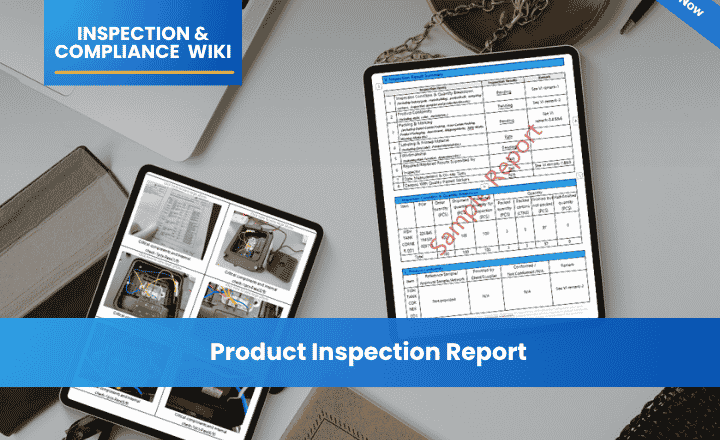
A product inspection report is a record of the findings from a quality inspection. It documents the products and quantities inspected, the checks performed, defects identified, and results against the agreed inspection criteria.
For buyers sourcing products from China, the report provides documented evidence of the condition of the inspected goods at a specific point in production or before shipment.
The exact format varies by inspection provider, product category, inspection stage, and buyer requirements. However, most reports contain several common fields that help buyers understand what was inspected and how the findings were evaluated.
Key Fields in a Product Inspection Report
| Field | What It Means |
|---|---|
| Product Information | Product name, model, SKU, purchase order, or other details identifying the goods. |
| Inspection Date and Location | When and where the inspection took place. |
| Inspection Stage | The stage at which the goods were checked, such as Pre-Production Inspection (PPI), During Production Inspection (DUPRO), or Pre-Shipment Inspection (PSI). |
| Order Quantity | The total quantity stated in the order or inspection information. |
| Inspected Quantity | The number of units actually checked. In a sampling inspection, this is usually smaller than the total lot quantity. |
| Sample Size | The number of units selected for inspection under the applicable sampling plan. |
| Inspection Criteria | The specifications, approved samples, drawings, checklists, or other requirements used to evaluate the goods. |
| Defect Classification | The severity category assigned to identified defects, commonly Critical, Major, or Minor when these categories are specified in the inspection criteria. |
| Defect Count | The number of defects or defective units recorded, according to the report's counting method. |
| AQL and Ac/Re | Sampling parameters and acceptance/rejection numbers used when an AQL-based sampling plan applies. |
| Inspection Findings | Observations, measurements, test results, and other evidence collected during the inspection. |
| Photographic Evidence | Images supporting observations, measurements, or recorded defects. |
| Overall Result | The final inspection status determined under the agreed criteria and reporting procedure. |
Not every inspection report contains all these fields. For example, an inspection focused on production progress may emphasize process conditions and work-in-progress findings, while a pre-shipment report may include more information about finished goods, packaging, labeling, and sampling results.
Common Quality Inspection Terms
1. Sample Size
The sample size is the number of units selected for inspection from the defined lot.
In a sampling inspection, the inspector examines the selected units and evaluates the findings under the applicable inspection plan. The sample size is not the same as the total order quantity, and sampling does not mean every unit has been inspected.
2. Defect and Defective Unit
A defect is a specific nonconformity against an applicable requirement. Examples may include a scratch, an incorrect dimension, a missing component, or a function that does not work as specified.
A defective unit is an individual product that contains one or more defects, based on the inspection's counting rules.
These terms are related but not interchangeable. One product may contain multiple defects, so the defect count and the number of defective units may differ. Buyers should check how each report records and counts findings.
3. Defect Classification
When the inspection criteria use severity classifications, defects are commonly grouped into three categories:
- Critical Defect: A defect defined by the applicable criteria as involving a serious safety, regulatory, or other critical concern.
- Major Defect: A defect that materially affects the product's intended use, function, saleability, or specified requirements.
- Minor Defect: A defect that does not substantially affect intended use but still falls short of the specified quality requirements.
The actual classification depends on the product, agreed requirements, and defect definitions. A defect should not automatically be assigned a severity category without reference to the applicable criteria.
For more information, see Defect Classification: Major, Minor, and Critical Defects Explained.
4. AQL, Ac, and Re
AQL stands for Acceptance Quality Limit. In acceptance sampling, it is a parameter used to select sampling plans and associated acceptance criteria. It should not be interpreted as a guarantee that a shipment contains no defects or that every unit has been checked.
Two other terms commonly appear in AQL-based inspection reports:
- Ac (Acceptance Number): The specified number of counted nonconformities or defective units at or below which the lot may be accepted under the applicable sampling plan.
- Re (Rejection Number): The specified number at or above which the lot is rejected under that plan.
The exact counting basis depends on the sampling plan. Ac and Re must be interpreted together with the sample size, AQL, inspection level, lot size, and applicable standard or agreed procedure.
For background on sampling terminology, see the AQL (Acceptable Quality Limit) and ANSI/ASQ Z1.4 Table entries in the TradeAider Wiki.
5. Pass, Fail, and Hold
An inspection report may use terms such as Pass, Fail, or Hold to communicate its overall result. The precise meaning and decision rules should be defined by the inspection provider's reporting procedure and the agreed inspection criteria.
| Result | General Meaning |
|---|---|
| Pass | The inspection result meets the applicable acceptance criteria. |
| Fail | One or more applicable acceptance criteria have not been met. |
| Hold | A final decision is pending because clarification, further evaluation, additional evidence, or buyer instructions are required. |
A Pass result does not necessarily mean every unit in the lot is defect-free, especially when the inspection uses sampling. It means the result met the applicable criteria within the scope of that inspection.
Likewise, a Fail result should be understood in context: the report should identify the relevant findings and the criteria that were not met.
What Determines the Inspection Result?
The overall result depends on the inspection scope and the rules agreed before the inspection. Depending on the product and inspection type, these may include:
- Product appearance and workmanship
- Dimensions and measurements
- Function and performance checks
- Materials, components, and accessories
- Packaging, labeling, and shipping marks
- Defect classifications and acceptance criteria
- AQL sampling parameters, where applicable
- Specific buyer requirements or mandatory checks
An AQL sampling result is only one part of an inspection when other requirements also apply. A lot that meets the sampling criteria may still require further review if a separate specification, functional check, packaging requirement, or other agreed criterion has not been met.
The report should therefore be read against the applicable inspection criteria rather than relying on a single number or overall status alone.
Why Inspection Reports Matter
A product inspection report creates a documented record of what was checked and what was found. Buyers can use it to:
- Compare actual findings with product specifications and approved samples.
- Understand the types and severity of defects identified.
- Review measurements, test results, and supporting photographs.
- Communicate specific findings to the supplier.
- Support a decision about whether further action is needed before shipment.
The report is evidence of the inspection performed at a particular time and within a defined scope. It is not a substitute for laboratory testing, certification, or other verification where those are separately required.
What Makes TradeAider's Inspection Reports Different?
With TradeAider, buyers do not have to wait until an inspection is finished to learn about product quality issues.
Real-time visibility during inspection
Through TradeAider's online Service System, clients can view real-time inspection updates, including identified quality issues and supporting evidence. This gives buyers an opportunity to assess findings and provide instructions while the inspector is still at the factory.
An official report within 24 hours
Following the inspection, clients receive an official inspection report within 24 hours, documenting the findings and the quality situation observed during the inspection.
Timely decisions while the inspector is onsite
When defects are identified, clients can decide how to proceed based on their requirements and the inspection findings. Depending on the situation, this may include accepting commercially acceptable products, asking the supplier to rectify defects while the inspector remains onsite, or rejecting products that do not meet the agreed acceptance criteria.
Where rectification and re-inspection are within the agreed service scope, TradeAider's inspectors can help supervise the process and verify the results. TradeAider also uses quality-passed stickers to identify products that have passed the applicable checks, in accordance with the agreed inspection procedure.
This approach helps buyers make decisions earlier, address issues before shipment, and reduce the risk of paying for or shipping products that do not meet their requirements.
Frequently Asked Questions
Is a product inspection report the same as a quality certificate?
No. An inspection report records findings from a particular inspection. A quality certificate or product certification serves a different purpose and may be issued under a separate scheme or by an authorized body.
Does a Pass result mean every product is defect-free?
No. In a sampling inspection, only the selected sample is inspected. A Pass result means the lot met the applicable acceptance criteria under the sampling plan and inspection scope; it does not prove that every unit is free of defects.
What is the difference between a defect and a defective unit?
A defect is an individual nonconformity. A defective unit is a product containing one or more defects under the report's counting rules. Consequently, the number of defects may differ from the number of defective units.
Does AQL specify a universal acceptable defect percentage?
No. AQL is a sampling-plan parameter, not a universal guarantee or a direct statement of the actual defect percentage in every shipment. The applicable plan and acceptance rules determine how inspection findings are evaluated.
Which documents are used to evaluate products during inspection?
Depending on the order, these may include the purchase order, product specifications, approved sample, drawings, packaging and labeling requirements, inspection checklist, and agreed defect classification criteria.
Sources & References
- International Organization for Standardization (ISO). ISO 2859-1:2026 — Sampling procedures for inspection by attributes — Part 1: Sampling schemes indexed by acceptance quality limit (AQL) for lot-by-lot inspection. Geneva: ISO, 2026. https://www.iso.org/standard/2859-1
- American Society for Quality (ASQ). Quality Glossary of Terms & Definitions. https://asq.org/quality-resources/quality-glossary
- TradeAider. Pre-Shipment Inspection Service. https://www.tradeaiders.com/services/pre-shipment
- TradeAider. Defect Classification: Major, Minor, and Critical Defects Explained. https://www.tradeaiders.com/wiki/defect-classification-major-minor-and-critical-defects-explained
Related Knowledge Base
TradeAider