
Rework, Sorting, and Re-Inspection in Quality Control
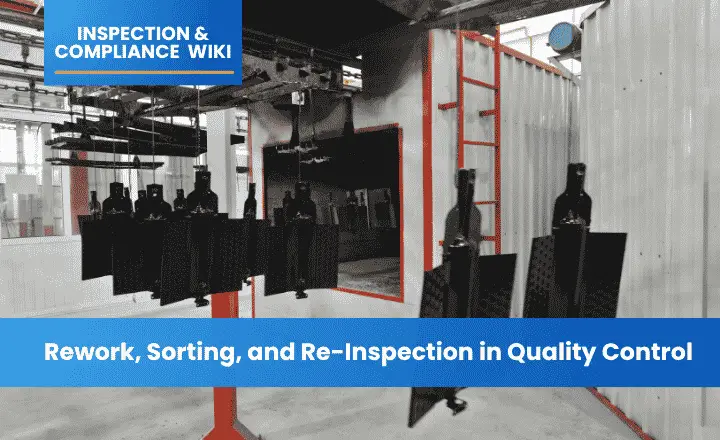
When a product inspection identifies nonconformities, the next step depends on the type of defect, the affected quantity, and the buyer's requirements.
Common quality control terms used in these situations include rework, sorting, and re-inspection. Although they are often used together, they describe different activities:
- Rework means correcting a product so it meets the specified requirements.
- Sorting means checking and separating products according to defined criteria, such as conforming and nonconforming units.
- Re-inspection means checking products again after an earlier inspection, correction, or other action.
Understanding these distinctions helps buyers and suppliers communicate clearly about corrective actions and the status of affected products.
What Is Rework in Quality Control?
Rework is an action taken to correct a nonconforming product so that it meets the original specified requirements.
Depending on the product and the defect, rework may involve replacing a component, correcting a label, removing excess material, adjusting an assembly, or repairing a finish.
Example: During an inspection of a batch of kitchen accessories, some units are found to have incorrectly positioned labels. The supplier corrects the affected labels according to the approved artwork and labeling requirements.
Rework should be performed using an appropriate method and followed by verification to confirm that the relevant requirements have been met.
Rework does not automatically mean that the product is acceptable. If the correction is incomplete, introduces another defect, or fails to meet the original requirements, further action may be necessary.
What Is Sorting in Quality Control?
Sorting is the process of checking products and separating them into categories according to defined criteria.
In product quality control, sorting is often used to identify which units meet the requirements and which need correction, further evaluation, or rejection.
Sorting may be based on visual checks, measurements, functional checks, or other specified inspection methods.
Example: A batch of 1,000 storage boxes is found to contain units with cracked lids. The supplier checks the batch, separates the affected units from those that meet the specified requirements, and records the results.
Sorting can help prevent identified nonconforming units from being mixed with acceptable products. However, its effectiveness depends on whether the inspection method can reliably detect the problem being checked.
Sorting alone does not correct a defect. If an affected unit is repaired, it must be verified against the applicable requirements before it can be treated as conforming.
What Is Re-Inspection in Quality Control?
Re-inspection is an additional inspection conducted after an earlier inspection or after actions have been taken to address identified issues.
It can be used to verify whether:
- Reworked products meet the applicable requirements.
- Previously identified defects have been corrected.
- Sorted products have been properly classified.
- The relevant acceptance criteria are now met.
The scope of re-inspection depends on the original findings and the agreed procedure. It may focus on corrected characteristics, affected units, or a broader set of requirements when necessary.
Example: After a supplier replaces defective components in a batch of assembled products, the inspector checks the affected units to verify the replacement and confirms that the specified function works as required.
A re-inspection does not automatically overturn the original inspection result. The outcome depends on the new findings, the scope of the follow-up check, and the applicable acceptance criteria.
Rework vs. Sorting vs. Re-Inspection
| Activity | Main Purpose | What Happens | Typical Example |
|---|---|---|---|
| Rework | Correct nonconforming products | The product is repaired or adjusted to meet the specified requirements | Replacing an incorrect component |
| Sorting | Identify and separate products by condition | Units are checked and classified according to defined criteria | Separating cracked products from acceptable units |
| Re-inspection | Verify condition or corrective results | Products or characteristics are checked again | Checking repaired products to confirm they meet specifications |
These activities can be used separately or in combination. For example, a supplier may sort an entire batch, rework the affected units, and then arrange re-inspection to verify the results.
How These Activities Work Together
A typical quality control sequence may look like this:
- Identify the issue. An inspection reveals one or more nonconformities against the agreed criteria.
- Define the affected scope. Determine which products, quantities, or characteristics may be affected.
- Decide on the action. Depending on the issue, the buyer and supplier may agree to sorting, rework, rejection, or another appropriate disposition.
- Carry out the action. The supplier performs the agreed work and records the results where required.
- Verify the outcome. Re-inspection or another suitable verification method is used to check whether the applicable requirements have been met.
- Confirm the status. The products are handled according to the findings and the agreed acceptance and release procedure.
This is a general sequence, not a mandatory process for every defect. The appropriate action depends on the product, the nature of the nonconformity, and the buyer's instructions.
The Role of Inspection in Corrective Actions
An inspection report records the findings within the scope of an inspection. When nonconformities are identified, clear documentation helps buyers and suppliers understand what needs to be addressed.
A follow-up inspection can provide evidence of whether specified corrections have been completed and whether the checked products meet the applicable requirements.
For buyers working with third-party inspection providers, it is important to clarify:
- Which defects or characteristics require follow-up.
- Whether sorting or rework is included in the agreed service scope.
- Which products and quantities must be checked again.
- What acceptance criteria apply after correction.
- Who is authorized to approve the final disposition or release of the goods.
The supplier is generally responsible for carrying out agreed manufacturing corrections. A third-party inspector can verify findings and, where included in the service scope, help supervise corrective actions and re-inspect the relevant products. The inspector's findings should support the buyer's decision rather than replace the buyer's agreed acceptance requirements.
How TradeAider Supports Follow-Up Inspection
TradeAider provides third-party inspection services to help buyers understand product quality findings during production and before shipment.
Through its online Service System, clients can view real-time inspection updates and identified issues while an inspection is underway. An official report is provided within 24 hours after the inspection, documenting the findings and supporting evidence.
When defects are identified, buyers can provide instructions on the required next steps. Where corrective-action supervision and re-inspection are included in the agreed service scope, TradeAider's inspectors can help supervise corrections while onsite at the factory and verify the results through follow-up checks.
This gives buyers an opportunity to address identified issues before shipment rather than relying solely on a report received after the inspection has ended.
Learn more about TradeAider's Quality Inspection Services and During Production Inspection.
Frequently Asked Questions
Is rework the same as repair?
Not always. Rework generally means correcting a product to meet the original specified requirements. Repair may restore a product to an acceptable condition without necessarily making it fully conform to every original requirement. The applicable product specifications and acceptance criteria determine whether the result is acceptable.
Does sorting mean all defective products have been corrected?
No. Sorting identifies and separates products according to defined criteria. Defective units may still require rework, rejection, or another agreed disposition.
Is re-inspection always required after rework?
Not every situation requires the same verification process. However, when products have been corrected to address identified nonconformities, an appropriate check is important to establish whether the relevant requirements have been met. The scope should be agreed according to the defect and the risk involved.
Can a batch pass after rework and re-inspection?
It may, if the follow-up findings meet the applicable acceptance criteria and the required release procedure is satisfied. The original failure should not be treated as automatically resolved simply because rework has been performed.
Who decides whether corrected products can be shipped?
The decision follows the buyer-supplier agreement, the applicable acceptance criteria, and the agreed release procedure. An inspection report provides evidence of the findings, but the inspector's role and authority should be defined in the service scope.
Sources & References
- American Society for Quality (ASQ). Quality Resources: Quality Glossary. https://asq.org/quality-resources/quality-glossary
- TradeAider. Quality Inspection Services. https://www.tradeaiders.com/quality-inspection-services
- TradeAider. During Production Inspection. https://www.tradeaiders.com/services/during-production
Related Knowledge Base
Random Sampling Inspection vs. 100% InspectionProduct Inspection ReportApparel Quality InspectionProduct Recalls and Defect Management: Post-Market Surveillance for ImportersDefect Rate Calculations: Monitoring Factory Quality PerformanceQuality Inspection Agreement (QIA)During Production Inspection (DUPRO)Pre-Shipment Inspection (PSI)Defect Classification List (DCL)MIL-STD-105E: History and Evolution of Modern Quality Control SamplingDefect Classification: Major, Minor, and Critical Defects ExplainedInspection Levels I, II, and III
TradeAider