
Licensed merchandise quality control connects the product you are making with its approved artwork, physical specifications, relevant test evidence and actual bulk goods. Start with the current version of each record and identify who can approve it. Then check whether production still matches those references. An attractive, correctly printed product can have an unresolved material or testing question; a passing laboratory report can describe a different build. Keep each gap visible until the responsible party supplies the necessary decision or evidence.
What to align before licensed goods leave the factory
- The authorized artwork and intended product, market and use.
- The approved physical sample, materials and production specification.
- The relevant testing records, current bulk findings and owners of open items.
Separate licensing rights, brand approval and product compliance
Licensed merchandise needs separate decisions about permission, product approval, compliance and shipment. A licensor is the party granting permission to use intellectual property; a licensee receives that permission under an agreement. The buyer coordinating a factory should establish the actual licensee and authorized approval route before treating a supplier’s design file as a production instruction. A logo on a quotation does not establish that route.
WIPO’s licensing guidance explains that licensing allows use of intellectual property while ownership remains with its owner, and discusses quality control in trademark licensing. The actual agreement and relevant jurisdictions determine the authorized use. For your order, obtain confirmation of the permitted product category, territory, channel and period from the authorized licensing contact; do not infer these from a similar item already being sold.
Keep a simple responsibility list. The licensing contact confirms rights and program approvals. The product or compliance owner identifies applicable requirements and resolves technical coverage questions with the appropriate laboratory or specialist. The factory controls production to the agreed specification and discloses substitutions. The inspector compares identified goods with the agreed references and reports what was actually checked. The designated buyer or recipient makes the shipment decision within their authority.
When these people disagree, record the disputed requirement and its owner. A buyer’s acceptance of a color difference does not remove an applicable safety obligation. Likewise, an inspection result cannot grant a missing license. An urgent delivery date is a scheduling constraint, not evidence that an approval exists. Agree how unresolved questions will reach the decision maker before they become a last-minute factory argument.
For the physical inspection part of this work, the inspection reference guide helps frame the checks and lot assessment to discuss. Keep that inspection scope alongside the licensing and testing responsibilities, so the report is used for the decision it can support.
Lock the artwork and its approval record
An artwork approval should identify the exact design and the use that was approved. Retain the submitted file, its revision, the approval receipt, any conditions and the approver’s identity. Connect that record to the product reference and production order. A screenshot saying “approved” is difficult to use if nobody can tell which attachment, packaging panel or product variation it covers.
Indiana University’s licensing FAQ provides a concrete program example: its requirements include physical samples for proposed products and artwork review and approval before production, if approved. It also limits licensees to products identified in their agreement. These are IU’s program requirements. For another property, obtain that program’s current instructions rather than copying the university’s process as a universal rule.
Build an approved-reference register that the buyer, factory and inspector can use without guessing. The following fields are a working record format, not a licensor-issued approval form. Give each attachment a stable name or identifier, and show whether it is approved, conditional, superseded or still awaiting review. Where two records conflict, identify who will resolve the conflict instead of silently choosing the newer file.
| Reference | Identify the controlled version | Keep with the record |
|---|---|---|
| Artwork and use | Design revision, product reference, placement and applicable use | Authorized approval receipt, date and conditions |
| Physical sample | Sample identifier, construction and agreed appearance | Custodian, approval status and linked specification |
| Materials and process | Current component list, finishes and production methods | Supplier declarations and authorized change history |
| Retail and shipping pack | Pack revision, contents, labels and carton marks | Applicable approval record and packing instructions |
Transfer the full approved file where permitted, not a low-resolution image forwarded through several messages. Confirm practical comparison points such as artwork position, orientation, dimensions, required text and agreed color reference. If a physical sample and digital file show different details, ask which controls that feature. Keep outdated instructions away from the production station while retaining them in the change history.
Tie the approved sample to materials and production methods
An approved physical sample is useful only when its relevant construction can be reproduced and identified in production. Record the current materials, components, dimensions, assembly and decoration method in the specification. For a soft toy, that might include the shell, filling and attachments; for drinkware, the body, lid, seals and surface finish. Select the details that affect this product rather than using a generic merchandise checklist unchanged.
Brand programs can add requirements beyond the buyer’s appearance specification. Disney’s public Product Integrity portal states that Disney-branded products, including promotional products, must meet applicable safety laws, regulations, industry standards and any additional Disney requirements. That public statement does not reveal every private protocol. Obtain current instructions through the authorized program relationship; appearance approval alone does not establish that those requirements have been met.
Ask the factory to connect its current component list to the approved sample and planned production. Identify which items are purchased, where substitutions need review and how the factory records a changed source or specification. A material description such as “same plastic” is too vague to resolve whether a revised component matches the reference. Obtain the actual grade or specification information needed by the technical reviewer.
Agree how the physical comparison will be made. A photograph can locate a graphic but may be inadequate for judging texture or an agreed color tolerance. A sealed reference sample can show appearance, but it cannot reveal every chemical property. State the relevant measurement method, visual reference and acceptance criteria before the visit. Where the available reference cannot support a check, identify the missing information rather than creating a tolerance at the factory.
Carry these distinctions into the sampling plan. Grouping different constructions or production runs into one lot needs an agreed basis; sharing a character design does not by itself make the goods equivalent. The AQL sampling calculator helps select a sample under an agreed acceptance quality limit, or AQL, plan. Its calculation does not establish material equivalence, the applicable product tests or permission to use the artwork.
Map test coverage to the current merchandise
Test coverage means the relationship between the product being supplied, the requirements being assessed and the configuration actually tested. Start with the intended use, user group and destination. A licensed shirt, soft toy and food-contact bottle can need different assessments. Ask the product or compliance owner to identify the applicable legal requirements and current brand-program requirements before deciding which reports are relevant.
For a specific US example, CPSC’s Children’s Product Certificate guidance describes third-party testing by a CPSC-accepted laboratory and certification by the domestic manufacturer or importer for children’s products subject to applicable children’s product safety rules. Applicable exceptions and determinations must also be considered. This is a scoped children’s-product requirement, not a certificate required for every licensed item. A brand’s artwork approval is not the statutory testing or certification evidence.
Use a coverage matrix to expose questions, not to manufacture a passing conclusion. Populate it from identifiable current specifications and the actual reports. The template below deliberately leaves technical conclusions to the responsible reviewer. Record a report’s tested configuration and relevant methods and criteria; a filename containing the character name is insufficient evidence that the current product is covered.
| Current item or requirement | Evidence to connect | Question and responsible reviewer |
|---|---|---|
| Product and intended use | Current model, construction, user group and destination | Do the identified requirements fit this use? Product/compliance owner |
| Material or component | Current specification versus tested sample description | Does the tested configuration represent this component? Technical owner/laboratory |
| Test or program requirement | Report reference, method, criteria and applicable program instruction | Is the required assessment covered? Compliance/program owner |
| Change or missing record | Change description and evidence available | What review, additional evidence or testing remains? Named owner |
Do not let an empty matrix cell become “not applicable” without a basis. Distinguish a missing document from a confirmed coverage gap and from a requirement the responsible reviewer has determined does not apply. If a report covers a component, establish whether and how that evidence supports the finished product assessment. Keep the reviewer’s explanation with the record so the next recipient can understand the conclusion.
Once the references and remaining questions are clear, agree the physical visit separately. TradeAider’s Pre-Shipment Inspection services apply when the order quantity is 100% complete and at least 80% packed for export. This packing threshold does not mean production can be only 80% complete. Specify the inspection checks, resources and reporting limits; a factory inspection does not replace laboratory testing or the actual program approval route.
Compare bulk goods with the controlled references
Bulk inspection should establish which goods were presented and how the sampled goods compare with the controlled references. Record the order, product variants, quantity, packing status and lot identification. Check whether the supplier has presented all relevant variants or only a convenient selection. If some goods are unavailable, state the exclusion and its effect on the agreed scope.
NIST’s explanation of acceptance sampling describes using a random sample to decide the acceptability of a lot; its main purpose is not to estimate the lot’s quality. Apply the agreed sampling and acceptance plan to the identified lot. A sample-based inspection does not mean every unit has been examined, nor does a passing lot result supply a missing artwork authorization or test conclusion.
Turn approved references into observable checks. Compare the graphic, text, placement and product identity; inspect the agreed construction, workmanship, dimensions, function and packing details. Choose checks suited to the item: a keyring attachment and a bottle closure have different practical concerns. Include required retail labels, warnings, inserts or traceability markings against the agreed current instructions. Their presence can be observed without claiming that every legal assessment has been performed.
Document discrepancies with an identifiable sample, location, reference and measurement or photograph. “Wrong print” gives the factory less useful information than a marked comparison showing the affected graphic and the controlling revision. Keep observed defects separate from missing approval records. One is a physical finding; the other is an evidence question requiring the appropriate owner. Both may matter to the buyer, but they need different corrective actions.
For reworked or sorted goods, retain the original finding and identify what the factory changed. Agree the affected quantity and the follow-up checks with the buyer. Photographs of corrected examples do not by themselves demonstrate the condition of the whole affected population. If stock from different builds has been mixed, resolve its identification before presenting it as a single consistent lot.
Review changes through the affected approval and test paths
A production change should trigger a review of the records it may affect. Record what changed, why, when and in which goods. Then ask separately whether the authorized design or product approval remains valid, whether the technical evidence still represents the product, and which physical checks need updating. An unchanged stock code does not answer these questions.
In the US children’s-product context, CPSC’s material-change FAQ defines a material change by its possible effect on compliance and describes the affected testing and certification response. Component-only retesting depends on the stated conditions, including whether the change affects other parts or the finished product’s ability to meet other applicable requirements. This is not a universal instruction to retest every cosmetic change in all merchandise.
Use the actual change to route the question. A revised package layout may need review under the brand’s artwork process and an update to packing comparisons. A changed attachment, closure or material source may also require technical assessment of the relevant product evidence. The authorized program contact determines the program response; the technical owner and appropriate laboratory determine the relevant testing response under the applicable requirements. Do not ask the inspector to invent either conclusion.
Identify the first affected production run and whether earlier and revised stock can still be distinguished. Update the reference register with the decision, supporting record and effective version. Preserve the superseded evidence as history. If the reviewer needs more information, assign the request and leave the question open; “supplier says equivalent” is a statement to assess, not the assessment itself.
Before production continues with revised instructions, make sure the factory and the inspection team receive the same authorized version. If the change occurs after inspection, ask which earlier findings remain relevant and which checks must be repeated for the changed goods. Agree the necessary follow-up before relying on the earlier report for a shipment it no longer describes.
Close mismatches before handing over the shipment record
Keep the current merchandise build attached to separate artwork approval, relevant test coverage and actual bulk-inspection findings. If one record no longer represents the product, retain that gap and obtain its authorized review or verification. The practical reason is straightforward: a matching graphic cannot establish what an untested component would do, while a laboratory result cannot show whether the inspected cartons contain the approved artwork.
Illustrative scenario: A licensed drink bottle reaches the final inspection with the approved graphic, but the factory has fitted a revised lid. The available test record describes the earlier lid. The inspector can report the artwork match, identify the revised component and document the agreed physical checks. The buyer records the test-coverage question for the technical owner and laboratory, and asks the authorized program contact whether any product-approval review is needed. The lid change does not automatically prove failure or require every test to be repeated; its effect must be assessed. A visual pass alone cannot close that assessment. This is a hypothetical example, not a TradeAider client case.
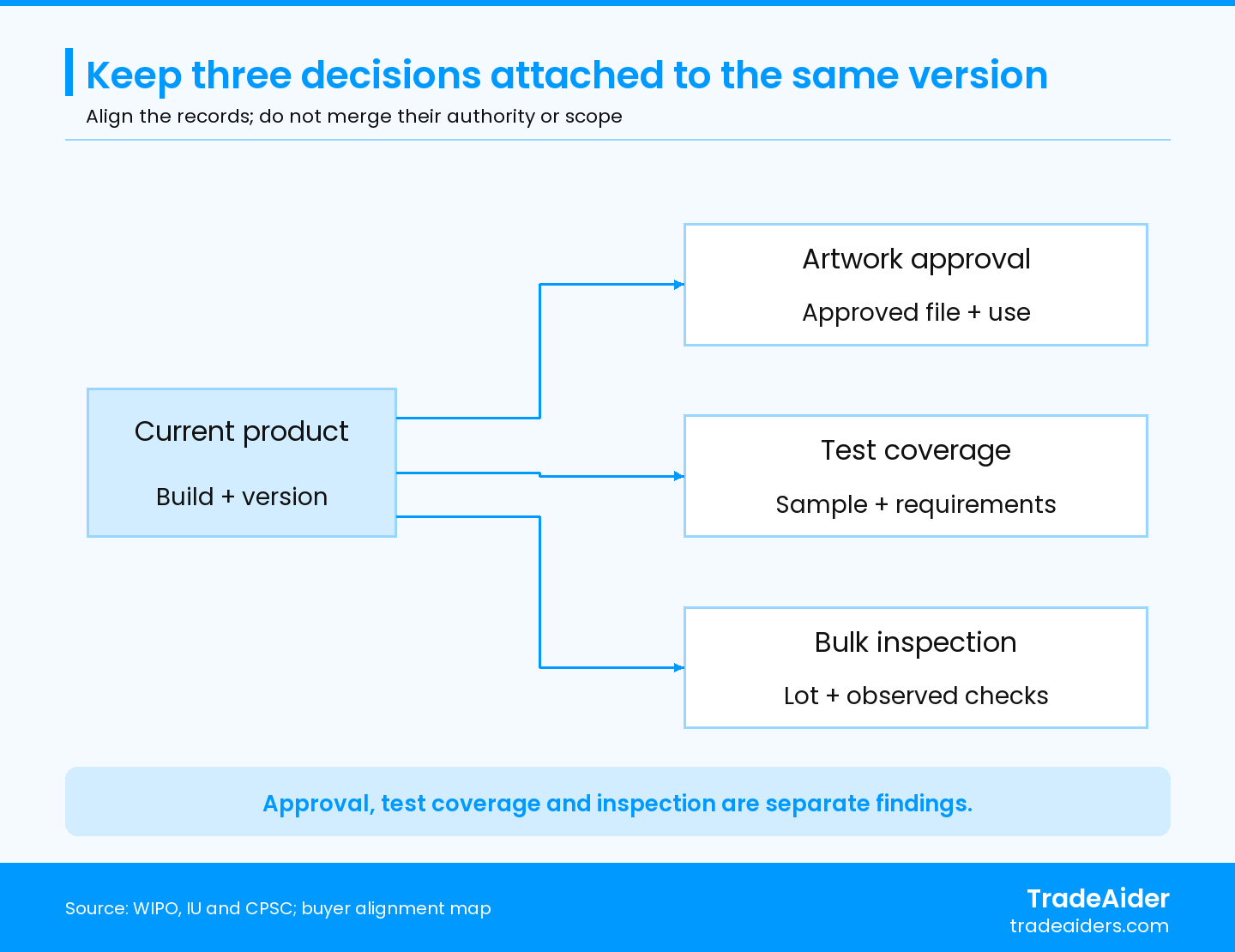
Buyer alignment map for the same current merchandise version. Artwork approval, test coverage and bulk findings answer different questions. Confirm the actual license, program and market requirements separately; a match in one record cannot replace another authority’s decision or an unperformed check.
Give each open item a product or lot reference, evidence requested, responsible person, next action and target date. When the action is complete, attach the review, approval or follow-up result that closes it. Confirm the final report recipient, required language, format and actual acceptance requirements. A retailer, licensee and marketplace may ask for different evidence; establish the applicable request rather than assuming one report is accepted everywhere.
The shipment record should let its recipient see what was approved, what was tested, what was inspected and what remains unresolved. Preserve restrictions, exclusions and unperformed checks when forwarding it. The designated decision maker then has a basis to request rework, further review or the agreed release steps, without turning an inspection summary into an unsupported statement of complete brand or regulatory approval.
To discuss the physical checks, contact the TradeAider team with the product, order, factory location, destination and expected timing you already have. An initial inquiry can begin with this available information. Before execution, agree the authorized references, current materials and known changes, relevant testing and program requirements, feasible methods, and the recipient’s reporting needs. This defines a useful inspection assignment while keeping unresolved approvals with their proper owners.
Frequently asked questions
Can I send a redacted test report to the inspector?
Agree document access and any redactions with the intended recipient before the review. Redactions must not hide the information needed to identify the tested product or assess the claimed coverage. Preserve the issuer’s original record and arrange authorized access to restricted information when needed. If sufficient evidence cannot be shared, record the resulting review limitation rather than treating the report as verified.
What if the license expires before the goods are delivered?
Ask the authorized licensing contact to confirm what the actual agreement permits for the remaining goods. Check any relevant delivery, distribution or sell-off provisions and obtain clarification through that route. The answer depends on the agreement and applicable circumstances. A completed factory inspection does not extend the license or decide whether the remaining stock may be sold.
Does approval of the retail package also cover online listing images?
Only treat it as covering those images if the approval and program scope actually say so. Identify the digital artwork, proposed use and any differences from the approved package, then ask the authorized contact whether a separate submission is needed. Retain that decision with the relevant version; an unchanged character image alone does not establish approval for every medium.
Related Articles

Grow your business with TradeAider Service
Click the button below to directly enter the TradeAider Service System. The simple steps from booking and payment to receiving reports are easy to operate.