
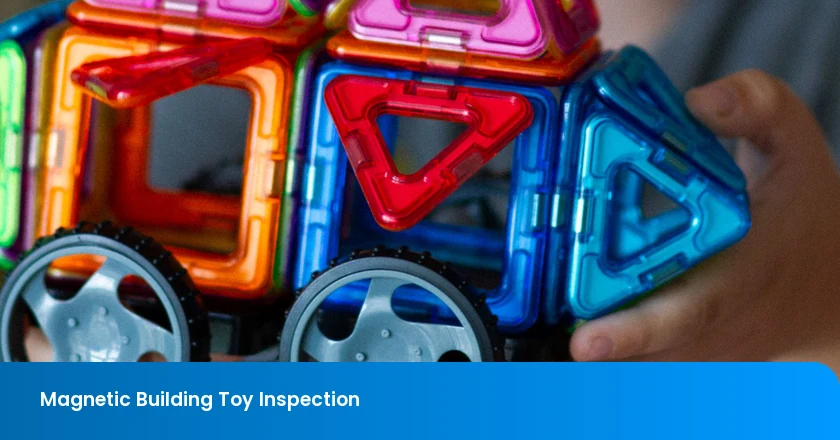
For magnetic building toys, the first acceptance question is whether the magnets remain safely contained in the actual constructions being supplied. Strong attraction between pieces does not answer that question, and a correct piece count cannot compensate for a cracked magnet pocket. Buyers need both production findings and product-matched laboratory evidence.
Magnetic building toy inspection should cover magnet retention, small parts, edge cracks, assortment, warnings and lab evidence. A factory visit can examine the finished sets and perform the agreed checks with suitable resources; it does not replace the applicable safety testing or certification. Identify the intended age, destination, component shapes and accessories before applying a report for one set to the whole range.
Six Checks to Put in the Inspection Plan
Define the inspection around the finished retail version, market and age group. Allocate coverage for different housings and accessories, not only the most common tile. Agree which checks can be completed at the factory and which need laboratory results, with sample quantities and criteria settled before the visit.
| Check | What to do | What determines the result |
|---|---|---|
| Magnet retention | Inspect the enclosure, run the specified tests and recheck magnet containment. | Approved construction and applicable retention and use-and-abuse requirements. |
| Small parts | Check supplied accessories and any detached magnets, fragments or other components. | The prescribed cylinder method and the product's applicable age and magnet requirements. |
| Edge cracks | Examine corners, seams and magnet pockets before and after testing. | Crack formation, accessible edges or points, and any loss of enclosure integrity. |
| Piece count | Sort each opened set by shape, size, color and accessory type. | The approved retail packing list and the claim on that exact package. |
| Warnings | Compare packaging, instructions and product markings with approved market artwork. | Correct age grading, required wording, visibility and product identification. |
| Lab evidence | Match the report's samples, construction and test scope to the ordered product. | Applicable methods, complete results and a justified link to current production. |
For each finding, record the set, component, test stage, method and observed result. Photographs should show the defect and enough of the original piece to identify it. Separate test-altered goods from saleable stock and account for loose magnets and fragments before leaving the inspection area.
Magnetic Connection Strength Is Not Magnet Containment
A large tile, narrow connector and wheeled accessory may use different enclosures. Ask the responsible technical reviewer how each is covered by the testing; a shared set name does not establish that coverage.
Magnet retention means keeping the magnet contained within its intended construction during the applicable tests. Compare the production housing, seams, fasteners, joining locations and pockets with the tested design. Incomplete closure, gaps or an exposed magnet need structural investigation rather than a demonstration that the tile still connects to another piece.
For retention evidence, establish which tension, torque, drop, impact or other use-and-abuse procedures apply to this construction and in what sequence. These need authorized testing with the prescribed fixtures and conditions. An improvised floor drop or hand pull cannot replace a missing method or justify a standards-based pass.
For U.S. toys, 16 CFR 1250.2 incorporates ASTM F963-23, subject to the rule's stated exclusions. Check the version applicable to the date of manufacture and the sections relevant to the particular toy. Other destinations need their own applicable standards and certification arrangements; a U.S. report does not automatically cover another market.
Containment must still be assessed after the required test stages. A split can expose a magnet or provide an escape route while the pieces continue attracting each other. That is why the report should separate enclosure condition from magnetic play function, with the affected shape and stage identified.
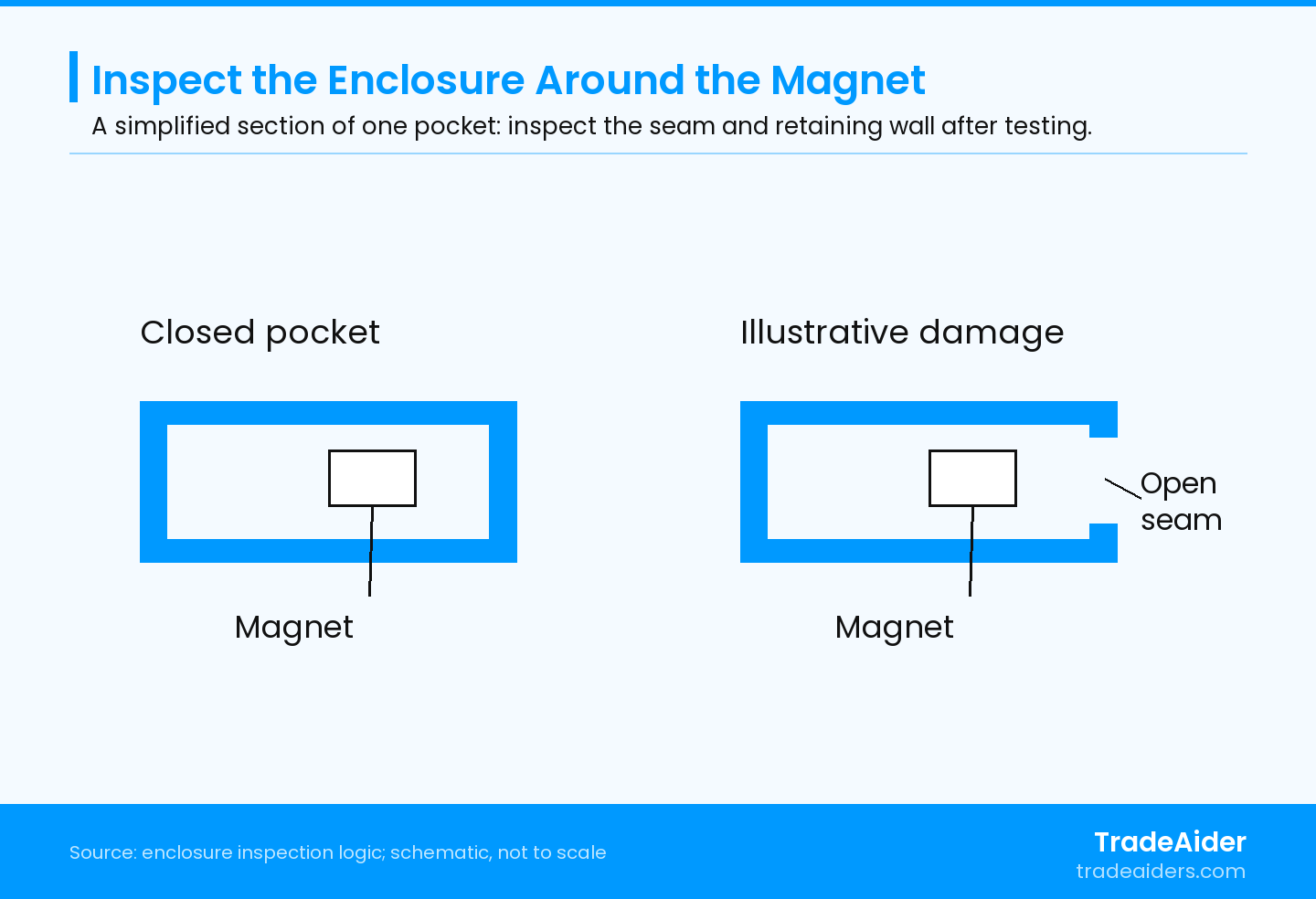
Schematic sections of one magnet pocket, not a product drawing or test result. The opening illustrates why enclosure damage needs examination even if magnetic connections still work; no dimensions or acceptance limits are shown.
Some designs allow magnets to rotate inside closed pockets. Movement or sound alone does not prove detachment, so compare it with the documented design. Conversely, a newly developed rattle after impact deserves investigation. Authorized teardown can help locate a broken pocket, but opening a piece creates a different sample condition; preserve the before-opening observations and identify any examination as destructive.
Assess What Can Separate from the Toy
The dimensions of an intact tile do not establish the result for a detached magnet, cap, fastener or plastic fragment. The relevant supplied and released components need their applicable assessment, linked to the sample and test stage. If a released item contains a magnet, a choking-size observation alone does not settle its separate magnetic hazard assessment.
For U.S. products within its scope, 16 CFR part 1501 addresses small-parts hazards in toys and other articles intended for children under three. Its cylinder procedure checks whether the object fits completely, in any orientation and without compression. Applicable detached pieces are examined after the required use-and-abuse tests as well as in the product's initial condition.
Require the prescribed cylinder procedure for applicable small-parts findings, with the component and stage identified. A coin comparison or ruler estimate is not equivalent. Preserve loose magnets and fragments with their original sample so the technical assessment addresses the correct component.
A product labeled for older children still needs its applicable magnet requirements assessed. Age grading must match the product and its intended use, and a warning does not repair a housing that releases a hazardous magnet. Escalate a released magnet promptly for technical assessment rather than treating it as an ordinary cosmetic defect within a sampling allowance.
Decide Whether a Crack Compromises the Enclosure
A crack matters because of its location and effect, not just its visibility. Distinguish a molding mark from an open seam, a surface chip from loss of enclosure integrity, and each from an accessible sharp feature. A report that says only “plastic crack” leaves the buyer unable to judge the necessary correction.
Pay particular attention where the magnet pocket approaches the edge. Identify whether damage is confined to a surface mark, opens the enclosure, releases a fragment or produces an accessible sharp edge or point. A fingernail catching on a line is an observation, not a standardized sharp-edge result. Where formal edge or point testing is required, use its specified equipment and method.
Reinspect after the agreed mechanical and transport tests, preserving photographs from before testing. Note the test stage at which damage first appears. If a corner chips away, recover and assess the chip as well as the remaining tile. The remaining product may have a new opening even when the missing plastic fragment looks insignificant.
For supplier follow-up, identify the affected shape and the exact corner or joint. A result described only as “plastic crack” gives too little information to compare mold cavities, weld locations or material changes. Keep those possible causes as investigation questions until the production records or examination support a conclusion.
Check the Assortment, Not Only the Advertised Total
An advertised total can be met with the wrong mix of squares, triangles, connectors or wheels. Acceptance should compare the assortment with the approved retail packing list and illustrated use. A duplicate shape does not replace a missing component merely because the final count is unchanged.
Confirm what the advertised count includes. Storage containers, instruction cards and separate wheel assemblies should not silently move in or out of the total between the approved specification and the package artwork. If one assembly counts as one retail piece, do not count its internal magnets as additional building pieces.
The assortment result should identify each required shape, size, color and accessory group. Agree how nested or preassembled items count before comparing the package claim. This makes a shortage or substitution visible without inflating the number by counting internal magnets as separate building pieces.
Build a representative configuration from the supplied instructions using only that set's contents. This can reveal missing connectors or incompatible parts that a total count overlooks. Compare fit and intended magnetic connections with the approved sample; do not introduce loose bench pieces to complete a model without recording the shortage.
After inspection, recount all components used in testing and follow the agreed repacking process. Test-damaged pieces and loose magnets must not be returned to a retail set merely to restore its count.
Warnings: Match the Age Group, Market and Actual Product
Warnings and age grading must describe the actual product and destination version across the box, instructions and required markings. Compare production print with the approved artwork, not only its digital file. A label correction addresses an information defect; it cannot repair an enclosure that releases a magnet.
U.S. choking-hazard labeling requirements include provisions for toys or games intended for children at least three but under six that contain small parts. This is a defined labeling scope, not permission to use the same warning on every magnetic toy. Determine the applicable wording and presentation before approving the artwork.
Check magnet-related instructions against the applicable toy requirements and approved product classification. Do not assume that an “educational” or “STEM” description establishes an exception. Ask for the technical basis if the supplier relies on a special provision; an ordinary building set should not inherit another product category's labeling treatment.
Keep model numbers, manufacturer or importer details, and required production-identification markings consistent with the goods and supporting documents. If a label is wrong, identify the affected retail versions and inspect the corrected packaging. Adding a warning sticker alone does not resolve a separate finding that a magnet escapes from its enclosure.
Does the Safety Evidence Cover Every Relevant Construction?
A report's passing cover page is useful only if its scope matches the ordered set. Check model photographs, housing construction, age group, components, methods and results. For magnetic hazards, clarify which magnets or magnetic components were assessed, their test condition and the relevant size and flux results. Unexplained blanks or “not applicable” entries need a technical explanation.
The separate U.S. magnet-product rule, 16 CFR part 1262, expressly exempts toys subject to part 1250. Do not request a generic magnet certificate in place of identifying the toy's requirements. The product classification determines the relevant route, even when both products contain similar-looking magnets.
Magnetic flux index combines the square of maximum flux density with magnetic pole-face area. It is different from the force needed to separate two building pieces. CPSC staff's flux-index measurement procedure uses kG²mm² and a less-than-50 kG²mm² criterion for a magnet that fits the small-parts cylinder. That staff procedure explains the measurement; it does not establish every toy test or determine whether a particular exception applies.
For covered U.S. children's products, 15 USC 2063 establishes third-party testing and certification obligations. Check the applicable CPSC-accepted laboratory scope and obtain the relevant Children's Product Certificate. A laboratory report supplies test results; the responsible certifier issues the certificate. Neither document can be replaced by an inspector's visual pass.
Compare current production with the tested construction, including housing design, joining process and magnet specification. If these changed, ask for the documented assessment of whether additional testing is needed. The title of a report for a similar tile is insufficient to establish coverage for a different pocket, resin or assembly method.
Hypothetical Example: Correct Count, Cracked Magnet Pocket
Suppose an opened building set contains every listed piece and matches the approved colors. After the specified drop sequence, one triangular piece develops a split beside its magnet pocket. The inspector photographs the location and finds a loose magnet on the protected collection surface. The full piece count does not alter that retention finding.
In this hypothetical example, the next steps are to isolate the affected goods, preserve the damaged piece and magnet, and investigate the relevant construction. After a proposed repair, recheck the changed product using the required sequence and obtain the applicable laboratory reassessment. Recounting the box or showing that a replacement triangle still connects to a square would answer different questions.
Resolve Structural Findings Before Accepting the Packed Set
Use the finding to choose the next action.
- A missing shape calls for correcting the assortment and recounting the affected sets.
- An incorrect warning calls for reviewing the artwork and checking the corrected packaging.
- A split housing or released magnet requires technical investigation and the relevant safety assessment, even when the set builds normally.
TradeAider's inspection standard explains sampling and customer-specific checks. Agree the inspection plan and defect treatment before the visit, with product-specific methods and safety findings identified separately from cosmetic grading.
For pre-shipment inspection, the order quantity is 100% complete and at least 80% packed for export. Provide the approved sample, component list, construction drawings, market artwork and test procedures so the finished goods and retail sets can be checked meaningfully.
Contact TradeAider to define the inspection scope, including the samples and equipment needed for the agreed factory checks. Request findings tied to identifiable pieces and test stages, and arrange any specialist laboratory work separately.
Frequently Asked Questions
Can weighing a sealed box replace counting its contents?
No. Weight can help screen for an unusual pack, but similar-weight pieces can be substituted and packaging variation can conceal a shortage. Establish any screening range with known correct sets and the actual packing materials. Open the required samples and reconcile their component mix. A box within the weight range should not be described as having a verified assortment unless that assortment was actually checked.
Does a magnet have to be glued in place to meet retention requirements?
Not necessarily. A design may retain a magnet through an enclosed pocket or another construction without fixing it with adhesive. Judge the approved assembly against the applicable requirements and test results. If adhesive is part of that design, verify its specified use rather than assuming any visible glue is adequate. A freely rotating but enclosed magnet and a magnet that can escape are different conditions.
Should opened or mechanically tested pieces be shipped with the order?
Only if their condition and the agreed disposition allow it. Destructively examined or damaged pieces should be segregated, and every loose magnet or fragment accounted for. Keep the inspected sample's identity and findings even when replacement pieces are supplied. Repacking must restore the specified retail contents without mixing damaged samples into saleable sets or losing the connection between a failure and its original component.
Is a report covering magnetic tiles enough for an added wheeled accessory?
Only if its documented scope actually covers that accessory and the relevant requirements. Check the report's component identification and photographs rather than relying on a family name. An added axle, wheel or connector can introduce a different assembly and additional assessment needs. Ask the responsible technical reviewer or laboratory to determine coverage and necessary testing before treating the accessory as included.
Related Articles

Grow your business with TradeAider Service
Click the button below to directly enter the TradeAider Service System. The simple steps from booking and payment to receiving reports are easy to operate.

