
- About Us

- Our Services
- Your Industry
- Resources
- News & Blog

A Christmas shipment date is not a quality plan. It becomes one only when the buyer works backward from the real vessel or forwarder cutoff and assigns a release decision to every period before it. The aim is not to create a universal lead-time promise. It is to preserve enough time to discover a mismatch, correct the affected range, reinspect it, and hand verified cartons to the forwarder without guessing.
This framework is for importers sourcing from China who have a seasonal launch date but need a compact way to control a private-label order. Confirm the actual testing route, factory production plan, retailer instructions, terminal deadline, and booking cutoff for the shipment in front of you. Those details determine the calendar; the 90-, 60-, 30-, and final-10-day gates give the calendar a usable control structure.
The Shipment Calendar Starts With a Releaseable Cutoff
A workable Christmas shipment quality control timeline reserves evidence, correction, and reinspection time before the vessel cutoff instead of treating the final inspection as the whole control plan. Start with one written cutoff record: the last time the forwarder can accept the released cartons, the required handoff documents, and the person who can change a booking. Then ask a harder question at each earlier date: “If this stage finds a problem, can the affected shipment range still be corrected and verified before that cutoff?”
The answer should produce a releaseable population, not a vague “production is on track” update. A releaseable population is the exact units or cartons that match the approved product, evidence set, and handling plan. It may be the whole order, a defined production range, or a mapped carton subset. If the population cannot be named, a late pass or fail becomes difficult to act on.
- 90-day gate: freeze what will be sold and identify any test or approval dependency.
- 60-day gate: make materials, artwork, production controls, and change ownership visible.
- 30-day gate: inspect a representative finished lot while a rework buffer still exists.
- Final 10 days: reconcile carton evidence, handoff records, and loading instructions against the released range.
Around 90 Days: Freeze the Sellable Configuration
At the 90-day gate, the buyer should freeze the sellable configuration and identify the records that must remain aligned through shipment. A golden sample is the approved physical reference used to compare production. It should be paired with the current specification, SKU or model list, artwork revision, packaging and carton requirements, destination, and any buyer or retailer instructions. That gives the factory and inspector one configuration to compare, rather than a collection of old approvals.
A useful reference point is that GS1 describes a predefined assortment as a fixed configuration of different retail consumer items. The operational lesson is broader: if a buyer intends to sell a fixed Christmas configuration, the records must keep describing that same configuration from sample approval to outgoing cartons. Photograph the approved reference, identify the revision, and define who can authorize a deviation.
This is also the moment to schedule a pre-production inspection if the order needs one. The review can compare materials, color references, components, packaging, production readiness, and the factory's internal control points against the approved reference. It cannot replace a product-specific test route, but it can expose whether production is about to start from mismatched inputs.
Put Product-Specific Testing on the Critical Path
Product-specific testing and certification requirements can create lead-time dependencies that must be identified before a seasonal production plan is committed. The applicable route depends on the destination and product category; identify it before committing the seasonal run rather than adding a generic test at the end. For applicable children’s products in the United States, Title 16, Part 1107 of the Code of Federal Regulations sets testing and labeling rules pertaining to product certification.
Testing is a dependency, not a decorative document. Put the laboratory lead time, sample-selection point, report owner, and any corrective path on the same calendar as production. For a product that includes food sold in the United States, the FDA notes that food labeling is required for most prepared foods; that is one example of why destination-specific requirements must be considered before packaging is printed. It does not create a universal food, retail, or import clearance rule for every Christmas shipment.
At the end of this gate, the buyer should be able to hand over one simple control packet: approved reference, product route, test status or planned sample date, current artwork files, production plan, and cutoff record. If any one of those items is unknown, the next gate should surface the risk rather than conceal it.
Around 60 Days: Turn the Plan Into Production Controls
At the 60-day gate, approved materials, artwork, and production controls need an owner, an evidence record, and a change path. The goal is not to make a larger spreadsheet. It is to make the important production decisions auditable: which material version is running, which artwork file is on the line, which SKU or carton range will be affected by a change, and who decides whether production may continue.
Ask the factory for an achievable plan, not merely a promised completion date. It should identify material arrival, first finished unit, packing start, expected completion, corrective capacity, and the dates at which a sample will represent the real shipment. A during-production inspection can then be scoped around the point at which early units, workmanship, labels, and packaging are visible but the factory can still correct the run.
TradeAider’s role in such a plan is practical: turn the buyer’s approved reference and production calendar into checks that can be observed at the relevant stage. The buyer still owns commercial decisions, product requirements, and the booking plan. The value of the inspection brief is that a finding names the affected range and evidence needed for a decision, rather than becoming an isolated photo after the available time has disappeared.
Make Material, Artwork, and Barcode Changes Visible
A material, artwork, or assortment change can require a fresh identity decision rather than an unchanged barcode or prior approval. For predefined assortments, the GS1 GTIN Management Standard states that changing, adding, or replacing an item requires a new GTIN under that rule. Confirm the appropriate identity decision with the relevant trading partner, marketplace, or channel; do not assume a readable legacy barcode proves that a changed product is correctly represented.
Use a one-line change record every time a material, color, warning, insert, label, or carton mark changes. Include the old and new revision, reason, approver, effective production range, affected carton range if known, and required follow-up. This record becomes particularly valuable when a factory uses remaining stock from an earlier revision. It lets the buyer decide whether the two versions can be released separately, must be repacked, or need a broader hold.
Around 30 Days: Inspect Finished Goods and Protect Rework Time
At the 30-day gate, sampling should support a defined lot decision while leaving time for correction and a meaningful reinspection. NIST explains acceptance sampling as using a random sample to decide the disposition of a lot. That does not supply a universal holiday sample size or release rule. It does underline the need to know which finished lot is being evaluated and what the buyer will do if the sample reveals a defect or a version mismatch.
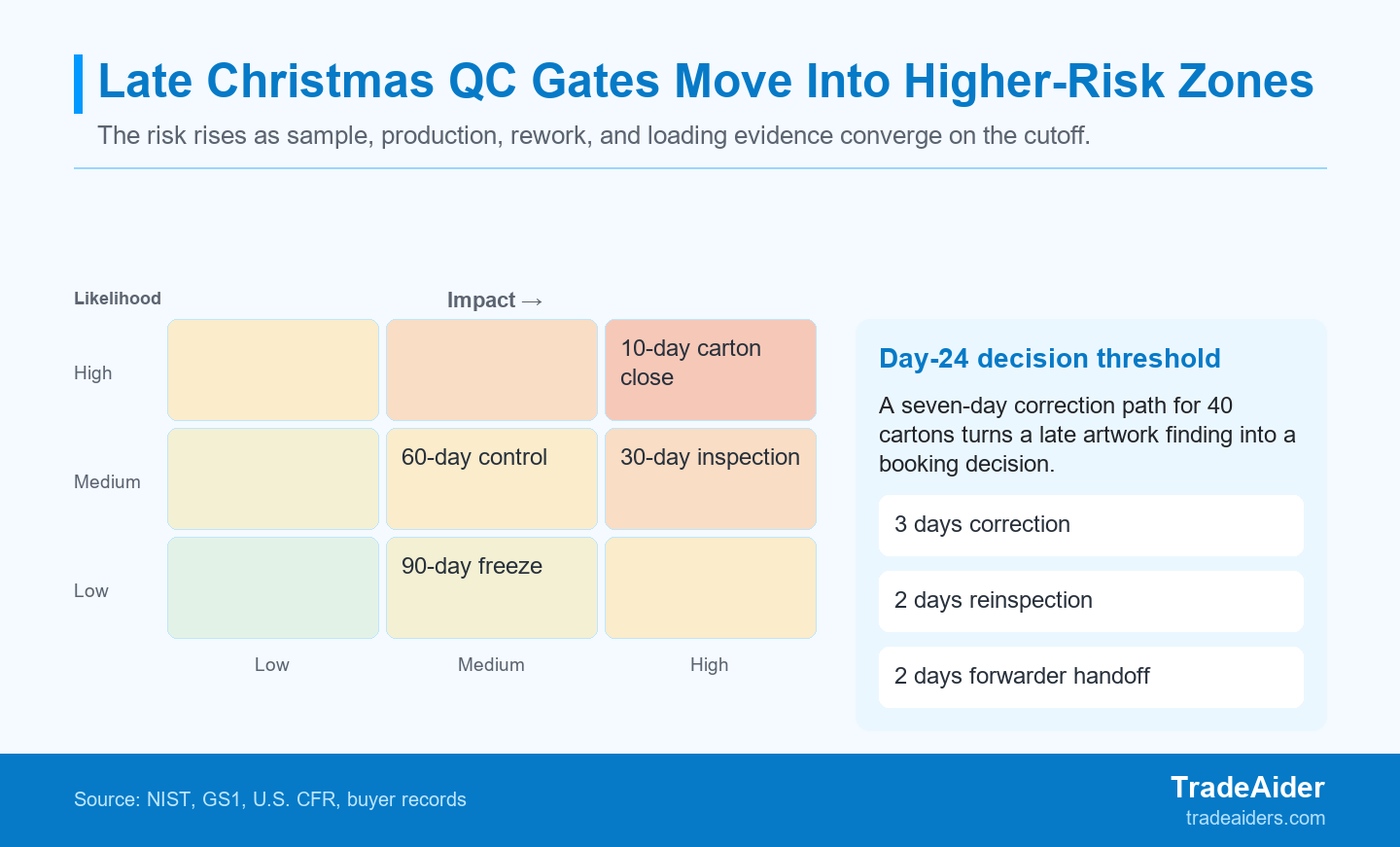
A late finding becomes a shipment decision when its correction, reinspection, and handoff path consumes the remaining buffer.
The rework buffer is the time still available to correct the affected range, verify the correction, reconcile records, and complete forwarder handoff before the cutoff. It is not the number of days between today and Christmas. A representative lot is a shipment range whose finished units, packaging state, and carton version actually represent what is planned for release. If packed cartons include an earlier artwork revision, a late material substitute, or an unmapped production range, a passed sample may not speak for the whole order.
Write the correction path before booking the final check: discovery; defect or version decision; factory correction; reinspection; carton-map reconciliation; handoff. If that path has no room, escalate before the inspection occurs. The buyer’s agreed inspection standard can define the expected checks and defect classification, while the countdown tells the team whether the result can still lead to a releaseable shipment.
Book PSI Against a Defined Release Population
A pre-shipment inspection is most useful when it compares the representative finished order with the buyer's defined release evidence. Pre-Shipment Inspection (PSI) means a final-stage check of the representative finished shipment. The selection should be tied to completed quantity, packing status, and the actual carton range intended for release—not to an early sample that no longer represents the outgoing order.
GS1 US explains that packaging levels describe how products are packed, sold, shipped, and scanned. In a seasonal PSI, record the retail unit, inner pack where applicable, and master carton as related but different evidence layers. The inspection brief should name the required photos, functional checks, label and barcode checks, carton marks, quantity reconciliation, and the approved reference used for comparison.
Book the final check when the buyer can still use its result. Ask in advance: which factory contact can authorize correction, what range is on hold if a finding occurs, how quickly can the factory produce corrected evidence, and who decides whether an affected carton subset can ship separately? A “pass” without those answers may still arrive too late to protect the launch.
The Final 10 Days: Close Carton Evidence Before the Cutoff
In the final 10 days, carton marks, counts, and traceability need to describe the same shipment version as the retail goods and release records. This is the time to reconcile the packing list, carton count, carton range or marks, selected photos, release decision, and handoff instruction. Do not let a carton label become the only proof of what is inside.
Barcode checks need the same discipline. GS1 US recommends recurring barcode validation and verification to reduce failed scans. In the final window, compare a scanned symbol with the correct approved product or packaging version, then retain the result with the relevant sample and carton evidence. A barcode that scans can still be associated with the wrong revision, pack level, or carton population.
The final gate should end with a short release statement: which order quantity and carton range are released, which evidence supports that decision, whether any range remains held, and who will give the forwarder the final instruction. This makes a partial release visible instead of allowing one unresolved carton group to travel silently with the rest.
Container Loading Preserves, Not Creates, Evidence
Container loading can preserve the selected carton population, but it cannot turn an undocumented or mismatched carton into release evidence. An SSCC, or Serial Shipping Container Code, is a serial identifier for a logistics unit. The GS1 Logistic Label Guideline identifies the SSCC as the mandatory element on a logistics label. That distinction helps a buyer keep logistics-unit identity separate from the product and release records that already needed to be checked.
Container loading supervision is therefore a final preservation stage: it can observe the selected cartons, count, loading condition, seal or handoff process, and evident handling issues. It does not substitute for an approved sample, product check, corrective decision, or completed PSI. If a carton’s version or release status is unknown before loading, pause the relevant range and resolve it before the container turns uncertainty into transit risk.
Illustrative Scenario: A Day-24 Artwork Change Uses the Rework Buffer
In an illustrative 2,400-unit Christmas order, an artwork change on day 24 can consume the buffer unless the affected 40 cartons are isolated and reverified. The example below is an operational framework, not a promise about any factory, port, carrier, or product category.
Why the Cutoff Changes the Release Decision
A cutoff is a decision gate: once the remaining correction, reinspection, and handoff time is exhausted, the buyer must rebook or change the shipment decision.
An e-commerce founder is preparing a private-label Christmas lighting order for a fixed seasonal launch. The buyer has a confirmed booking plan, but the exact last acceptable forwarder handoff date—not a generic transit estimate—is the controlling deadline. The illustrative order contains 2,400 retail units packed 12 per master carton, for 200 cartons. The order is meant to ship as one seasonal range, but its carton map can identify a defined subset if an issue appears late. The golden sample, packaging artwork, product route, production plan, and booking cutoff were approved before mass production. The factory also retained a record linking production range, artwork revision, and master-carton range.
On day 24 before the cutoff, the buyer finds that a revised warning panel has not reached 480 units in 40 cartons. The physical product is otherwise complete, but those cartons do not match the current approved artwork record. The factory estimates three days for correction, two days for reinspection, and two days to reconcile the carton map and hand the verified cartons to the forwarder. The documented path is therefore seven days, before allowing for any new finding or booking change. The calculation is simple: 3 correction days + 2 reinspection days + 2 handoff days = a seven-day critical path. The point is not that every relabeling task takes seven days. It is that the buyer can see whether the required work fits the actual remaining buffer for the 40-carton range, instead of treating the remaining calendar as blank capacity.
Hold the affected 40 cartons and preserve the documented original range while the buyer confirms whether the corrected range can still meet the booking plan. The 160 cartons outside the affected range do not automatically ship; they are reviewed against their own evidence and the buyer’s commercial shipment decision. Apply the current approved artwork, relabel the affected cartons, update the carton map, and record the revised production range. Keep the affected cartons physically and administratively distinguishable until the rework evidence and carton range agree.
Reinspect the 40-carton range against the revised artwork and carton map before it is added back to the shipment release population. Confirm that the physical warning panel, selected units, carton marks, quantity, and forwarder handoff record describe the same corrected range. This is an illustrative operational scenario, not a universal production or carrier timeline. If correction, reinspection, or handoff cannot fit the real cutoff, rebook or change the shipment decision rather than borrowing confidence from an expired calendar.
Give Every QC Stage a Countdown Brief
A countdown brief should state the milestone, release population, evidence owner, correction window, and escalation decision for each quality-control stage. One page is enough if it lets the factory, buyer, inspector, and forwarder see the same decision path.
- Milestone: the actual date and what must be true at that point.
- Release population: the order, production range, or mapped cartons affected by the decision.
- Evidence owner: the person responsible for the reference, report, photo set, carton map, or booking record.
- Correction window: the time reserved for correction, reinspection, and handoff.
- Escalation: who can hold, split, rebook, or release the shipment range.
Use the brief to request a scoped inspection rather than a generic holiday check. A buyer can share the golden sample, production plan, testing route, carton plan, and booking cutoff so the planned pre-shipment inspection checks match the stage at which evidence is actually available. That turns the Christmas shipment QC timeline into a working handoff between production control and release decisions.
Who Is TradeAider?
TradeAider can translate a peak-season production calendar and release evidence into a staged inspection scope. TradeAider is a China-based provider of quality inspection, testing, and certification services, and an Amazon Service Provider Network (SPN) partner, with coverage across major manufacturing regions including Guangdong, Zhejiang, Jiangsu, Shandong, and Fujian.
For a seasonal order, the useful starting inputs are the approved reference, product route, production plan, expected completion and packing dates, carton plan, and the actual booking cutoff. You can request a Christmas shipment QC scope that aligns pre-production, during-production, pre-shipment, and loading checks with those buyer-defined controls.
Frequently Asked Questions
Is 90 days always enough for Christmas shipment quality control?
No. Ninety days is a planning horizon, not a universal lead time; the product route, testing, production capacity, and booking constraints decide the actual countdown. Use the period to freeze the sellable configuration and surface dependencies early. If a test, material, artwork, factory slot, or forwarder handoff requires longer, move that dependency earlier instead of expecting final inspection to recover the missing time.
When should product testing enter a holiday shipment plan?
Put testing on the critical path as soon as the product route and final configuration are known, because a later material or design change can create a new evidence decision. Identify the destination, product category, required sample state, laboratory timing, report owner, and any action required after a result. Treat product-specific requirements as a controlled dependency; do not present a generic test as a blanket clearance.
How late can a pre-shipment inspection be booked?
Book pre-shipment inspection early enough to protect a defined correction and reinspection window after the finished order becomes representative of the shipment population. The right date depends on completion status, packing state, factory corrective capacity, scope, and the actual handoff cutoff. Before booking, ask what will happen if a selected carton range fails or carries the wrong revision; if there is no usable answer, the booking is already late.
Does container loading supervision replace pre-shipment inspection?
No. Loading supervision checks the selected cartons at dispatch; it does not replace finished-goods, documentation, or release evidence checks performed before loading. Use PSI to compare the representative finished order with the approved reference and release records. Use loading supervision to preserve the released carton population, observe the handoff, and surface evident discrepancies before the shipment leaves the factory or warehouse.

Related Articles



Grow your business with TradeAider Service
Click the button below to directly enter the TradeAider Service System. The simple steps from booking and payment to receiving reports are easy to operate.

