
- About Us

- Our Services
- Your Industry
- Resources
- News & Blog
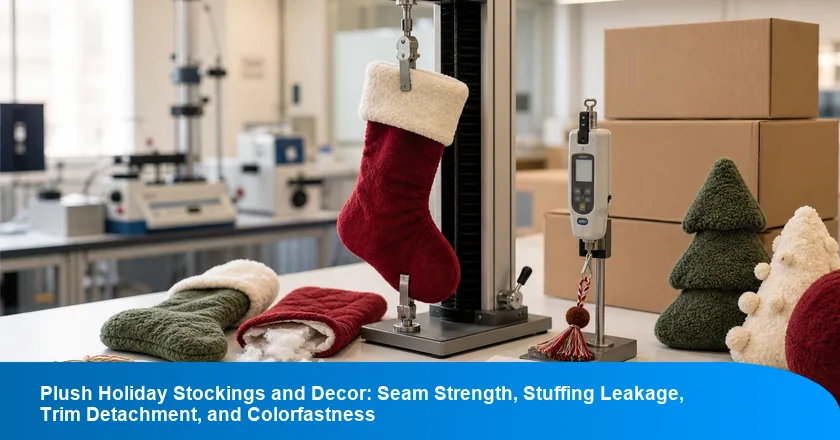
Plush holiday decor inspection works when each finished-goods finding can be connected to the approved textile build, the applicable label artwork, and the exact packed range. That connection turns a loose loop, transferred color, or slow-recovering cuff into a bounded release decision instead of a subjective visual debate.
Release Plush Holiday Decor by Construction, Not Appearance
Plush holiday decor should be released by the evidence attached to its exact textile build and packed range, not by an attractive visual sample alone. The expensive defect is rarely the first loose thread; it is the decision to treat a construction finding, a trim finding, and a packed-range record as unrelated events. That approach gives a buyer a bounded release decision when a stocking looks presentable but its loop, fill containment, label version, or post-compression shape is not yet supported.
- For sampling: identify the fabric, fill, trim, stitch construction, label artwork, and pack format before an inspector selects pieces.
- For defect decisions: record the failure path and its location, rather than grouping every issue under “poor workmanship.”
- For rework: hold the documented affected range until the corrected construction and packed product pass their agreed verification gate.
- For market readiness: keep destination-specific fiber-label and applicable safety evidence with the same approved build.
Build the Approved Softlines Reference Before Sampling
A Softlines Build Card makes inspection findings traceable when it identifies fabric, fill, trim, stitching, label, destination route, and packed configuration before sampling begins. It is the buyer-owned record for the approved fabric and pack configuration that define one saleable plush item. Without that reference, a report can record a loose bell or an open seam, yet leave the operations team unable to decide whether the issue is isolated, colorway-specific, supplier-wide, or linked to an older approved sample.
Start with the version that is actually going into retail cartons. Capture the outer fabric and pile direction, fill type and intended fullness, seam locations, loop or hanger construction, embroidery, appliqué, bells or other decorative components, care and fiber-label artwork, barcode or SKU mapping, carton count, compression method, and destination. Add photos or approved reference samples where the product has a distinctive face, stocking toe, cuff, or personalized placement. The objective is not a longer checklist; it is an evidence trail that lets a factory, sourcing team, and marketplace operator talk about the same physical build.
| Build-card field | What to compare in inspection | Decision it supports |
|---|---|---|
| Fabric, fill, and stitch | Seam closure, fill containment, pile direction, shape | Local repair or construction review |
| Trim and decoration | Attachment point, sharp edge, loose component, finish | Functional-risk and intended-use review |
| Artwork, label, and carton | Current destination version and traceable packed range | Release only the evidenced population |
Based on this comparison, the release question changes from “does the sample look festive?” to “which documented build and carton range does this evidence actually support?” That shift is especially useful when several colorways share a pattern but use different threads, trims, labels, or rework instructions.
Separate a Seam Finding From a Fabric Failure
ASTM D1683/D1683M measures sewn seam strength in woven fabrics, while ASTM D5034 supplies fabric breaking-strength context; neither source turns a visual check into a universal performance prediction. A seam opening is therefore not automatically a fabric failure.
For a plush stocking, document where the opening occurs: a cuff join, heel curve, toe seam, appliqué edge, hanging loop, zipper, or the point where a decorative bell is caught into the seam. Then compare it with the approved stitch type, seam allowance, reinforcement, and fill level. A thin fabric may need a different investigation from a seam that was skipped, poorly back-tacked, overfilled, or distorted after compression. The corrective action should follow the observed mechanism, not a generic instruction to “improve quality.”
Control the Four Failure Paths at Finished-Goods Inspection
Finished-goods plush inspection should separate seam opening, stuffing leakage, trim detachment, and color transfer because each finding points to a different corrective and release question. A useful report records the product location, colorway, build-card version, carton identifier, observed condition, and whether the issue can be tied to a defined production or rework range. That specificity lets the buyer decide what to repair, what to hold, and what evidence must be refreshed.
Inspect the product in the way its customer will encounter it: hanging from its loop, filled into its intended silhouette, unpacked after compression, and handled at cuffs, corners, closures, embroidery, and applied trims. Use the approved sample to distinguish a planned rustic finish from an unintended abrasion or loose thread. Where findings repeat, take enough photos to show both the close-up defect and its location on the full item, then map the observation to the relevant carton or work range.
For shipments where construction is still being made, a focused during-production inspection can identify recurring seam or trim conditions before they are multiplied across packed stock. It should use the same build card and defect language that will be used at finished-goods review, so the final report does not start from a different reference.
Stress Seams and Hanger Loops Where Stuffing Escapes
Stuffing leakage should be recorded at the specific seam, loop, closure, or stress point so the buyer can distinguish a local repair from a build-level construction issue. Check for visible fibers at needle holes, fill migration through the shell, poorly closed turning gaps, and leakage after normal shaping. If a loop is both a hanging feature and a trim attachment point, record whether the fill pressure, seam geometry, or reinforcement is associated with the opening.
A practical sequence is to inspect the face side and reverse side, gently shape the filled area to the approved form, lift the piece by its intended hanger where applicable, and look again at the stress points. Avoid inventing an acceptance threshold after defects appear; agree the handling method, sample plan, classification language, and escalation rule with the buyer before the inspection. The report then becomes usable for a targeted repair instruction: reinforce a loop construction, correct a closure method, reduce excess fill, or isolate the affected work range for verification.
Treat Trim Detachment as an Intended-Use Question
For relevant children's products intended for children under 3, the US small-parts ban is codified at 16 CFR part 1501; intended use and applicable market rules must be confirmed before applying that route to a decorative item. Read the official rule text. A bell, pom-pom, bead, or appliqué that detaches is a functional finding, but the next step depends on intended use and destination.
At inspection, separate three questions. First, is the trim attached as the approved build specifies? Second, does the condition affect ordinary use, appearance, or packaging? Third, does the product’s declared intended use require a further compliance route? A decorative bow missing from a mantel-only stocking may create a different operational decision from a small component on a product marketed for very young children. This is a scope boundary, not a legal conclusion. The buyer should retain the final classification and compliance decision with the relevant technical and market documentation.
Keep Colorfastness and Label Evidence With the Same Build
AATCC lists distinct textile colorfastness methods, including TM8 for colorfastness to crocking, so color-transfer evidence should be chosen for the product's intended exposure rather than generalized from one result. See the AATCC methods index. A red cuff that appears sound in a factory photograph may need a different evidence route depending on handling, contact, care expectations, fabrics it touches, and the destination requirements.
Keep the laboratory report or other agreed evidence with the production version it represents. Record the fabric color code, dye lot where available, pile direction, trim color, embroidery thread, and any contrast lining. If a stocking is sold in cream, red, and green, do not assume the red result automatically supports the other colorways; document why the evidence applies or does not apply. During finished-goods inspection, note visible color contamination, poor embroidery coverage, shade variation, odors, and wet or damaged packaging, then route those observations to the agreed decision owner rather than relabeling them as a test result.
Australian product-safety guidance says suppliers are legally responsible for product safety and should obtain relevant written compliance evidence when sourcing and testing products. A planned product testing service can help align the agreed evidence with the actual textile build; it does not replace the buyer’s responsibility for the product and market decision.
Use Fiber Labels as a Version-Control Check, Not a Guess
US, EU, Canadian, and UK sources each provide textile-labeling context, so fiber-label artwork should be verified against the exact product build and destination route rather than copied across markets by assumption. Consult the US rule, EU regulation, Canadian guidance, and UK guidance. Canada’s summary says a fibre that represents 5% or more of total fibre mass must show its generic name and percentage. Fiber-label artwork is an operational version-control check.
Confirm the exact finished composition, destination, required language and information, country-of-origin or responsible-business details where applicable, and any animal-derived component statement before release. At inspection, compare the sewn-in or attached label, retail pack, and carton marks with the buyer-approved artwork version. If fabric, fill, or destination changes, reopen the artwork check. Use those checks alongside a market-specific label review.
Let Compression Recovery Define the Final Release Check
A compressed plush range is release-ready only when recovery, construction evidence, label version, and carton identifier all agree with the approved build. Compression recovery is the return of a packed plush item toward its approved shape after unpacking. The release population is the documented product and carton range supported by one shipment decision. If an item recovers poorly, leaks fill, or exposes a weak attachment after unpacking, the issue is not merely cosmetic; it can break the link between the approved sample and the packed goods.
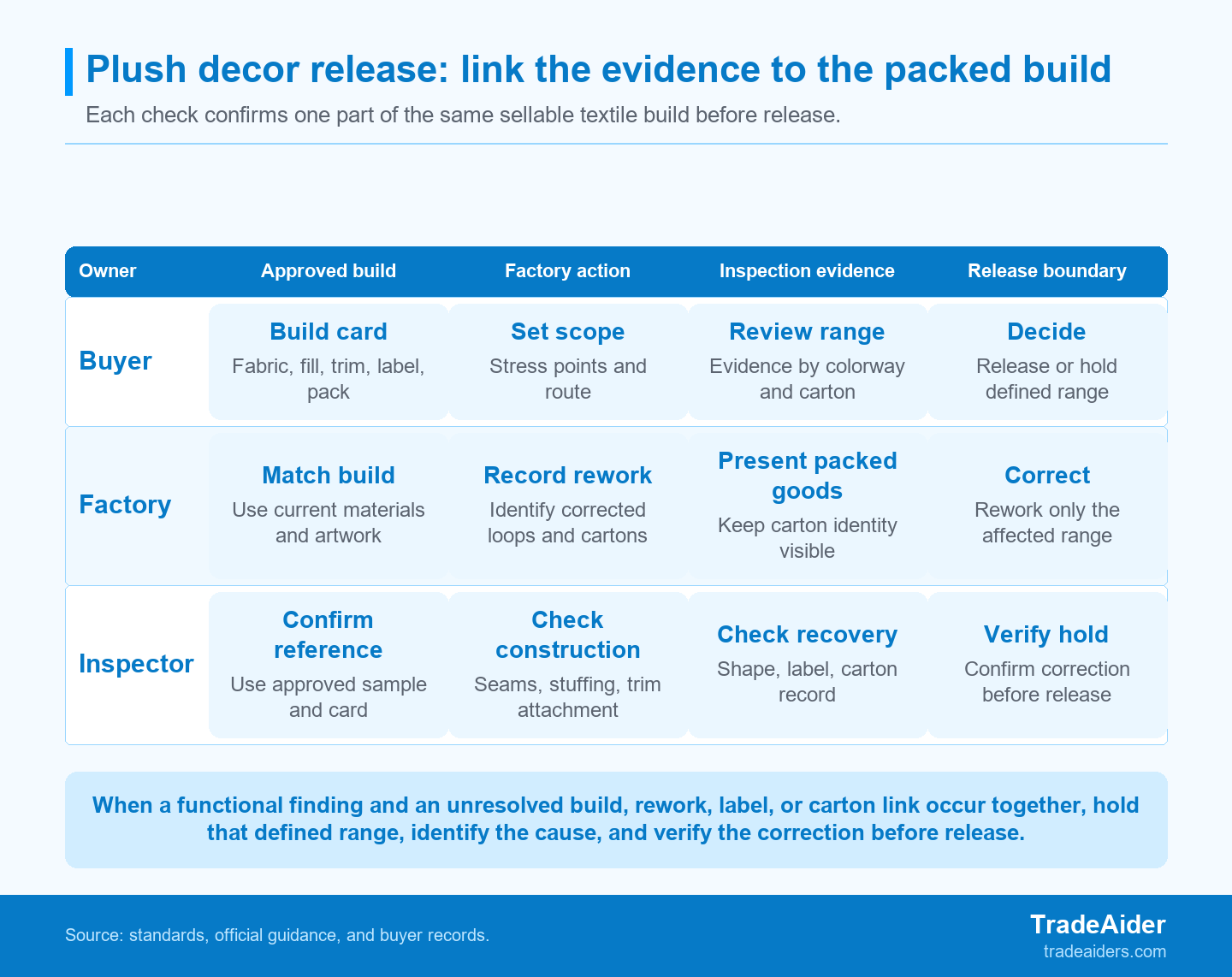
Use a defined hold when a functional finding and an unresolved build, rework, label, or carton link occur together.
Define the unpacking conditions in advance: carton range, time after opening, shaping method, approved reference, and the features to observe. Check whether the cuff sits correctly, the toe and heel regain their intended form, the pile has an acceptable presentation, the hanger loop remains usable, trim remains attached, and labels and retail packs are undamaged. Record the carton identifier on the photos. A recovery observation without a carton link is difficult to use when the factory has mixed earlier and later production.
When the finished quantity is ready, a pre-shipment inspection can apply the buyer’s agreed build reference, sample plan, defect classification, and carton traceability to the packed range. It is not a reason to collapse every finding into an order-wide reject: it is the point to confirm which goods can be released, which need rework, and which need a new verification. Where dispatch controls are also needed, container loading supervision can preserve the approved carton identity into loading. For export preparation, TradeAider describes PSI as being conducted when 100% of order quantity is completed and 80% packed for export.
Illustrative Scenario: Rework Fails Its Verification Gate
When a repaired plush range fails its finished-goods verification, the buyer can hold that documented range while continuing review of separately evidenced builds. This illustrative scenario shows why a visible correction is not treated as proof until the corrected construction, label version, recovery behavior, and carton records agree again.
Why the Hold Follows the Reworked Range
The illustrative hold follows the reworked carton range because its repair evidence no longer supports the attachment condition, not because every seasonal textile in the order is assumed defective. The range boundary remains useful only if the factory can identify it consistently in cartons, work records, and finished-goods photos.
A marketplace seller is preparing a holiday textile launch across two destination routes and needs a release record that can be understood by sourcing, quality, and listing teams. An illustrative order contains 3,600 plush stockings in three colorways, packed in 12-piece retail cartons, with one carton mark assigned to each documented production range. The factory repaired seam openings around bell-trim loops on the red colorway after an in-line review, while the cream and green colorways remained on their original documented builds.
The reworked red loops look closed in a visual check, but the same attachment area opens during the agreed finished-goods verification after the item is shaped from its packed condition. The cream and green colorways have separately recorded builds and carton ranges, and their sampled hanger-loop observations do not show the matching failure path. The red range has a functional attachment finding and a correction record that no longer supports release. The evidence does not show the same gap in the separately documented cream and green ranges, so an order-wide conclusion would exceed the available facts.
Hold the 720 reworked red stockings in their defined carton range, retain the related photos and repair records, and continue release review only for the separately evidenced cream and green ranges. Rework the affected loop construction, identify every reworked carton, and update the correction record to show the actual build, operator instruction, and applicable retail-label version.
Verify the corrected red range on finished packed product by checking loop construction, trim attachment, compression recovery, retail label, and carton identifiers against the revised build card before a shipment decision. This example does not determine regulatory classification, an acceptance threshold, or a test method. Those decisions depend on intended use, destination, product evidence, and the responsible technical owner.
Send a Holiday Textile PSI Brief Before Peak Dispatch
A usable holiday textile PSI brief identifies the approved build, stress points, trim risks, color reference, label artwork, carton plan, and buyer decision owner. Add the rework boundary, the planned compression-recovery observation, and the evidence that must be available at inspection. This lets the inspection scope answer a release question rather than produce a disconnected defect count.
For plush stockings and soft decor, include clear photos of the front, back, cuff, loop, trim, embroidery, label, and retail pack; list the colorways and carton ranges; and state which conditions need escalation before rework. Identify the destination routes separately where label artwork or product requirements differ. The buyer should also name the person who can decide whether a contained range may ship, needs correction, or requires additional review.
TradeAider can organize an inspection and QA scope around the buyer’s approved references, while the buyer retains ownership of product conformity, technical evidence, and release decisions. To align the brief before peak dispatch, request a holiday textile PSI scope.
Who Is TradeAider?
TradeAider provides inspection, testing, and certification service context in China, while buyers retain ownership of product-specific evidence and release decisions. It has coverage across major manufacturing provinces including Guangdong, Zhejiang, Jiangsu, Shandong, Fujian and other regions. Its service model includes real-time online monitoring through its platform and an all-inclusive published rate of $199/man-day for Inspection & QA Services. TradeAider is an official Amazon Service Provider Network (SPN) partner.
TradeAider reports client outcomes including an 18% reduction in returns and a 23% improvement in defects caught before shipment; these are client-reported results, not universal outcomes. For products that require testing evidence, TradeAider can coordinate product testing with labs; testing scope, samples, standards, and pass/fail criteria remain subject to the buyer’s product and destination requirements. See the TradeAider background.
Frequently Asked Questions
Is a Visual Seam Check Enough for Plush Holiday Decor?
No; visual seam checks identify visible conditions but do not independently establish construction performance for the approved textile build. They can identify visible openings, loose threads, or poor stitch appearance. Record the seam location, product state, colorway, and carton range, then use the buyer’s agreed handling and verification method to decide whether a repair is local or build-level.
Do Trim Checks Need a Small-Parts Review?
Trim checks need a small-parts review when intended use and applicable product rules make that route relevant; decor should not be treated as a toy by assumption. The US small-parts regulation provides the relevant rule text for that route. Start with the functional attachment finding, then confirm the product’s age grading, marketing, destination, and the responsible owner’s compliance route.
Which Colorfastness Check Fits a Plush Stocking?
Choose colorfastness evidence according to intended contact, care, and market needs rather than treating one rubbing result as universal approval. The AATCC methods index is a useful starting point for identifying distinct routes. Keep the evidence tied to the actual shell fabric, trim, colorway, and production version; finished-goods inspection can record visible transfer or shade issues, but it should not substitute an observation for the agreed technical method.
Can One Fiber-Label Artwork Serve Every Market?
One fiber-label artwork should not serve every market by assumption because the approved version must match the product build and destination route. The approved label should match the finished textile build and include the information and language applicable to that product. When the fabric, fill, label artwork, or market changes, reopen the artwork check and keep the updated version with the corresponding carton and product records.
Related Articles



Grow your business with TradeAider Service
Click the button below to directly enter the TradeAider Service System. The simple steps from booking and payment to receiving reports are easy to operate.

