
- Sobre Nós

- Nossos Serviços
- Sua Indústria
- Recursos
- Notícias e Blog
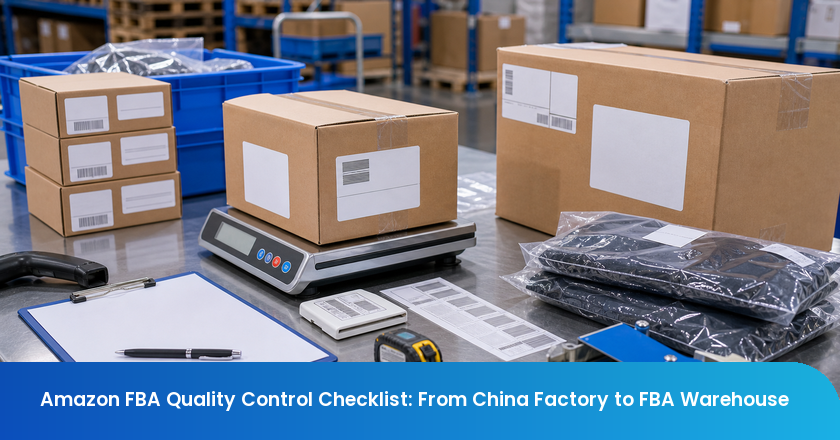
Amazon FBA quality control should verify product quality, SKU identity, barcode readability, prep requirements, carton labels, shipment-plan match, and evidence before the goods leave China.
The most expensive FBA quality problems often start before the shipment leaves the factory. A product may pass basic workmanship checks and still create warehouse delays, stranded inventory, relabeling cost, customer returns, or account-health pressure because barcode, prep, carton, or shipment-plan evidence was wrong.
In 2026, this checklist matters even more for US FBA sellers because Amazon's official FBA prep service guidance says Amazon no longer offers prep and item labeling services for FBA shipments in the US store from January 1, 2026. That shifts more responsibility back to sellers, suppliers, and pre-shipment control.
Key Takeaways
- Inspect before prep locks in: Product quality should be checked before incorrect labels or weak packaging enter the FBA flow.
- Match SKU identity across every layer: Product, unit label, FNSKU, carton, shipment plan, and inspection report must point to the same SKU.
- Prep is not cosmetic: Polybags, suffocation warnings, sets, fragile protection, bubble wrap, and label placement can decide warehouse acceptance.
- Carton labels matter: Each box should match the shipping plan and carry required FBA box identity evidence.
- Keep release evidence: Photos of units, labels, prep, cartons, and shipment-plan matching help sellers solve inbound issues faster.
Start With Product Quality Before FBA Prep
FBA prep can make a shipment look organized while hiding a product defect underneath. If units are polybagged, labeled, bundled, or sealed before quality inspection, the inspector may have to open packaging and then restore it. That creates extra work and may reduce retail-pack quality. The better sequence is product inspection first, then final prep and carton release.
Use AQL to decide whether the lot is sellable
AQL sampling under ISO 2859-1:2026 supports lot-level decisions before shipment. For FBA sellers, the defect classes should reflect customer and warehouse risk: nonworking product, missing accessory, incorrect label, damaged retail box, wrong color, weak packaging, sharp edge, poor finish, unreadable barcode, or missing warning.
The buyer should not rely on factory self-check photos alone. A pre-shipment inspection opens sampled units, verifies workmanship and function, records defects by class, and gives the seller evidence to accept, reject, rework, or reinspect the lot before inventory enters Amazon's network.
Check the full selling unit, not only the main item
Many FBA returns happen because the selling unit is incomplete. A unit may include accessories, inserts, batteries, manuals, cards, cables, tools, warranty notes, spare parts, or bundled items. The inspection must compare the physical unit to the listing promise and bill of materials. If one accessory is missing, the customer judges the whole unit defective.
For multipacks and sets, the release standard should define exactly what counts as one sellable unit. The inspector should open sampled packs, count components, verify labels, and photograph the assembled selling unit so the seller can confirm that FBA will receive the intended SKU.
Verify packaging before labels make mistakes harder to fix
Retail boxes, polybags, bubble wrap, inserts, and master cartons should be inspected before final carton closure. If labels are applied to the wrong SKU or a weak retail box is sealed into a master carton, the seller may face expensive rework later. Early inspection keeps the correction inside the factory where labor, materials, and carton access are still available.
A release report should show both the product and the pack. For FBA, pack evidence is not secondary. It affects inbound receiving, customer experience, return rate, and whether the seller can trace a problem back to the supplier or shipment.
SKU, Barcode, and FNSKU Control
Amazon's FBA shipping and routing guidance says products need scannable barcodes, and each box in a shipment needs an FBA Box ID label. Amazon's packaging and barcode pages also emphasize unit-level scannability and label requirements. The inspection task is to make sure the physical shipment matches the seller's FBA plan before pickup.
Unit barcodes should be readable and assigned to the right product
Amazon barcode requirements for FBA and Amazon product packaging requirements are seller-facing references for barcode and packaging expectations. For inspection, the practical control is to scan or visually verify unit labels against SKU, product title, condition, variant, and carton content. A readable barcode on the wrong product is still a serious defect.
The inspector should check label placement, print clarity, smudging, edge lift, duplicate labels, covered manufacturer barcode where required, and whether similar variants have been mixed. Sellers should provide barcode files or FNSKU references before inspection so the report can verify exact identity rather than simply noting that labels exist.
Mixed SKU cartons create inventory and support problems
Mixed SKU errors are especially damaging for FBA. If a carton label points to one SKU while units inside belong to another, inventory can be received incorrectly, stranded, or shipped to customers under the wrong listing. The inspection should connect carton marks, FBA box labels, packing list, unit barcode, and opened carton contents.
For shipments with similar colors, sizes, or bundles, the inspector should sample across carton groups and photograph each SKU's unit label and carton identity. This gives the seller evidence to isolate one affected SKU instead of questioning the entire shipment.
Label evidence should survive handling
Labels that are readable at the factory may fail later if they peel, wrinkle, scan poorly, or sit on curved, dirty, glossy, or flexible surfaces. The inspection should check adhesion, placement, contrast, and whether polybags or shrink wrap obstruct scanning. For cartons, labels should not cross seams, corners, or straps.
The release rule is simple: do not ship if the seller cannot match each physical unit and carton to the shipment plan with confidence. A labeling issue that takes 30 minutes to fix at the factory can become days of inbound delay or disposal cost after arrival.
Prep, Polybags, Sets, and Warnings
FBA prep is a quality control layer, not a warehouse afterthought. Because Amazon FBA prep service guidance now matters more for US sellers after the 2026 service change, sellers should confirm prep at the factory: polybag requirements, suffocation warnings, bubble wrap, set labels, fragile protection, expiration information where relevant, and whether the unit remains scannable after prep.
Polybags and warnings should match the product type
Polybags can protect units but also create compliance and scan issues. The inspection should verify bag size, closure, ventilation where relevant, suffocation warning if required by the seller's requirement, label visibility, and whether sharp corners or heavy items can break the bag. The buyer should provide the exact prep instruction rather than asking the inspector to infer it.
If the factory changes bag size, warning artwork, or label position after approval, the release evidence should show that change. For FBA, small prep changes can create receiving friction or customer dissatisfaction.
Sets should be marked and sealed as one sellable unit
Bundled products should be checked as one unit. The inspection should confirm set label, component count, accessory completeness, retail pack closure, and whether the bundle can be separated during handling. If a set label is missing or weak, the warehouse may treat components separately or create receiving confusion.
The seller should define whether sets are factory-sealed, bagged, boxed, shrink-wrapped, or banded. The inspection report should show the actual method and whether it matches the SKU listing and shipment plan.
Fragile protection must reflect parcel handling
Fragile FBA products such as decor, electronics, glass, ceramic, bottles, and boxed accessories need stronger pack checks than a simple carton photo. Inspectors should check internal movement, corner protection, void space, retail box strength, surface isolation, and whether the product remains presentable after normal handling.
When packaging is weak, the buyer should decide whether to repack at the factory, add protection, split affected SKUs, or reject the lot. The report should include enough photos for that decision.
Carton and Shipment Plan Match
Amazon FBA shipping and routing requirements says FBA shipments require scannable barcodes and FBA Box ID labels for boxes. For a China-to-FBA shipment, the seller should treat carton identity as a release gate. Cartons should match the shipping plan in quantity, SKU distribution, weight, dimensions, label placement, and box sequence.
Carton labels should match physical contents
A carton label is only useful if the contents match. The inspection should open selected cartons and compare units inside to carton marks, FBA labels, packing list, and shipment plan. For mixed-carton shipments, sample selection should include all relevant carton types instead of only the easiest cartons to access.
Photos should show carton exterior, FBA label, shipping mark, opened contents, and unit labels. That evidence helps sellers respond if inbound receiving later reports quantity mismatch or SKU confusion.
Weight and dimension issues should be caught before pickup
FBA shipments can be affected by carton weight, oversize handling, pallet configuration, and carrier routing. Inspection can verify declared carton dimensions and gross weight against supplier data. If labels or documents do not match physical cartons, the seller should correct the shipping plan before pickup.
Even when weight and dimensions are not part of product quality, they belong in the release checklist because incorrect shipping data can create logistics delays, extra fees, or shipment rejection.
Final release evidence should be organized by SKU and carton
A good report does not dump random photos. It organizes evidence by SKU, carton group, and inspection finding. For FBA sellers, this organization matters when solving problems later. If Amazon reports a receiving issue, the seller can compare warehouse feedback with factory release evidence.
The seller should keep the inspection report, label files, shipment plan, packing list, carton photos, and any reinspection evidence in the same order file. This creates a defensible timeline from factory to FBA warehouse.
Factory-to-FBA QC Checklist
| Checkpoint | Factory Evidence | Release Rule |
|---|---|---|
| Product quality | AQL sample defects, function photos, approved sample match | Accept only if critical gates and AQL limits pass |
| Selling unit | Accessories, manuals, inserts, bundles, set labels | Hold if the customer-facing unit is incomplete |
| Barcode/FNSKU | Readable unit label, correct SKU, covered old barcode where required | Do not ship mixed or unreadable labels |
| Prep | Polybags, warnings, bubble wrap, fragile protection, set sealing | Release only if prep matches seller instructions |
| Carton identity | FBA Box ID label, carton mark, packing list, opened carton contents | Correct shipment plan mismatch before pickup |
| Reinspection | Photos after rework, corrected labels, repacked cartons | Release affected SKU only after correction is verified |
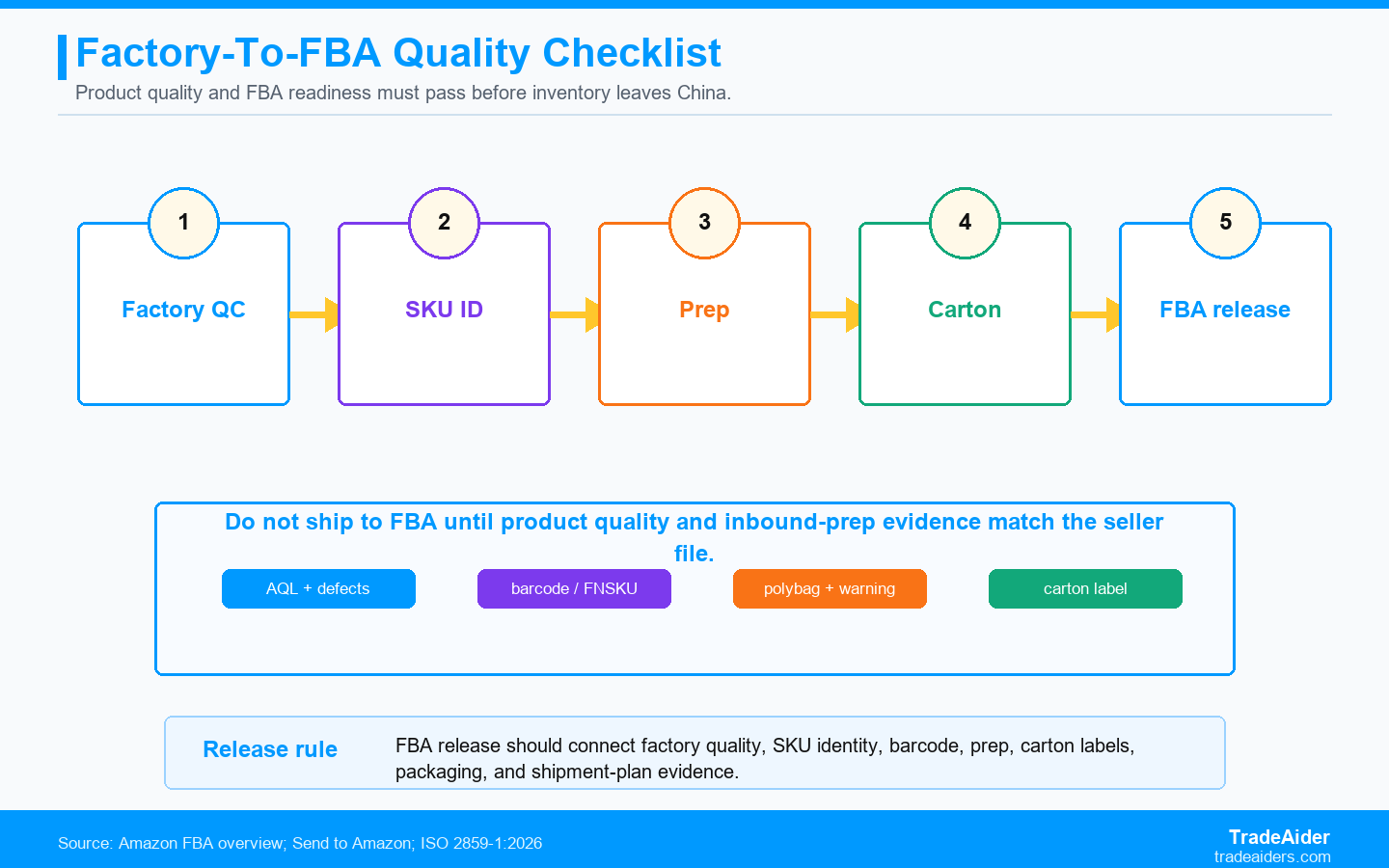
FBA release should connect factory quality, SKU identity, barcode, prep, carton labels, packaging, and shipment-plan evidence.
This table should be converted into the inspection booking checklist. The seller should not wait until the goods are ready for pickup to discover that labels, prep, or cartons do not match the shipment plan.
Where TradeAider Fits In Amazon FBA Quality Control
TradeAider can help FBA sellers inspect product quality, AQL defects, unit labels, FNSKU control, accessory completeness, prep evidence, carton marks, and packaging before a China shipment moves to an Amazon warehouse. The relevant service is usually pre-shipment inspection, sometimes combined with during-production checks for higher-risk or repeat-defect SKUs.
TradeAider's real-time reporting is especially useful for FBA because label and prep issues can often be corrected while the inspector is still on site. If a barcode is wrong, a carton group is mixed, or a bundle label is missing, the seller can request extra photos, authorize rework, and decide whether reinspection is needed before release.
Give the inspector the FBA evidence file
The inspection is only as precise as the evidence file. Sellers should provide SKU list, FNSKU or barcode references, product photos, approved sample, prep instructions, carton label requirements, shipment plan summary, packing list, and defect classes. Without those inputs, the inspection may confirm visible quality but miss the FBA-specific release problem.
If your shipment is moving from a China factory to Amazon FBA, send TradeAider the SKU list, barcode files, prep instructions, and shipment-plan details. The inspection can then verify the factory-to-FBA chain before the cartons leave China.
SPAR Scenario: The Product Passed but the FBA Labels Failed
Situation: An FBA seller ordered a repeat product from a China supplier and requested final inspection before pickup.
Problem: The sampled product passed function and workmanship checks, but opened cartons showed two similar variants with swapped FNSKU labels. The retail boxes looked nearly identical, so the error would likely have reached inbound receiving.
Action: The seller held the affected carton group, requested relabeling, and asked for reinspection photos showing unit labels, carton labels, and opened carton contents after correction.
Result: The shipment moved after a short factory correction instead of entering FBA with mixed inventory. The inspection report became the evidence file for supplier CAPA and future label control.
Amazon FBA QC Checklist Before Release
- Inspect product quality before final prep hides defects.
- Verify the full selling unit, including accessories and inserts.
- Match unit barcode, FNSKU, SKU, carton, and shipment plan.
- Check polybags, warnings, fragile protection, and set labels.
- Open cartons to verify physical contents against labels.
- Reinspect corrected labels or prep before releasing affected SKUs.
Who Is TradeAider?
TradeAider is a quality inspection, testing, and certification service provider in China. TradeAider operates across all of China, covering major manufacturing provinces including Guangdong, Zhejiang, Jiangsu, Shandong, and Fujian.
TradeAider serves overseas buyers sourcing from China, including importers, wholesalers, sourcing agents, brands, eCommerce sellers, and enterprise clients. Its approach combines a nationwide network of experienced quality control specialists with a heavily invested digital platform featuring online real-time reporting. Clients can monitor inspections live, communicate directly with inspectors, and address issues during production rather than after shipment - a proactive model focused on problem-solving and prevention, not just defect identification.
Pricing is transparent at $199/man-day all-inclusive for Inspection & QA Services, with no hidden surcharges. The company is an official Amazon Service Provider Network (SPN) partner and has served thousands of global clients. Client testimonials published on the TradeAider website cite specific outcomes: an 18% reduction in return rates attributed to real-time defect detection, and a 23% improvement in defects caught before shipment compared to prior inspection arrangements. These are client-reported figures.
Frequently Asked Questions
Can FBA prep replace product inspection?
No. FBA prep helps prepare units for warehouse receiving, but it does not prove the product is functional, complete, correctly made, or consistent with the approved sample. Product inspection should happen before or alongside final prep so defects, missing accessories, weak packaging, and wrong labels can be corrected at the factory.
What should be checked before shipping from China to FBA?
Check product quality, function, accessories, retail pack condition, barcode or FNSKU, prep method, warnings, set labels, carton labels, carton contents, shipment-plan match, carton dimensions, and release photos. For high-risk products, also verify testing or compliance evidence before shipment. The goal is to confirm both sellable quality and warehouse-ready identity.
When should FBA labels be checked?
FBA labels should be checked before final carton closure and again during final release. The inspector should verify that unit labels are readable, assigned to the right SKU, placed correctly, and not blocked by polybags or shrink wrap. Carton labels should match physical contents and the shipment plan before pickup.
What evidence should sellers keep after inspection?
Sellers should keep the inspection report, unit label photos, carton label photos, opened carton photos, shipment plan, packing list, barcode files, prep instructions, rework records, and reinspection evidence. This file helps resolve inbound receiving issues, supplier disputes, return root causes, and future CAPA planning.
Artigos Relacionados

Expanda seu negócio com o Serviço TradeAider
Clique no botão abaixo para entrar diretamente no Sistema de Serviço TradeAider. Os passos simples desde a reserva e pagamento até o recebimento de relatórios são fáceis de operar.

