
- Sobre Nós

- Nossos Serviços
- Sua Indústria
- Recursos
- Notícias e Blog
A supplier CAPA is not closed because a factory has sent a polished reply, promised retraining, or changed a procedure. CAPA—corrective and preventive action—is a documented process that should show what happened, what changed, and how the buyer will know that the change worked. For an importer, the practical test is simpler: can the record support the next release decision for the exposed product?
A CAPA Closes When It Supports One Release Decision
A supplier CAPA is decision-ready only when its evidence lets the buyer release, hold, narrow, or re-check a stated scope. That scope might be a component lot, a production line, a time window, a packed order, or the next run. If the file cannot say which of those is affected, a due date is only a date—not a closure condition.
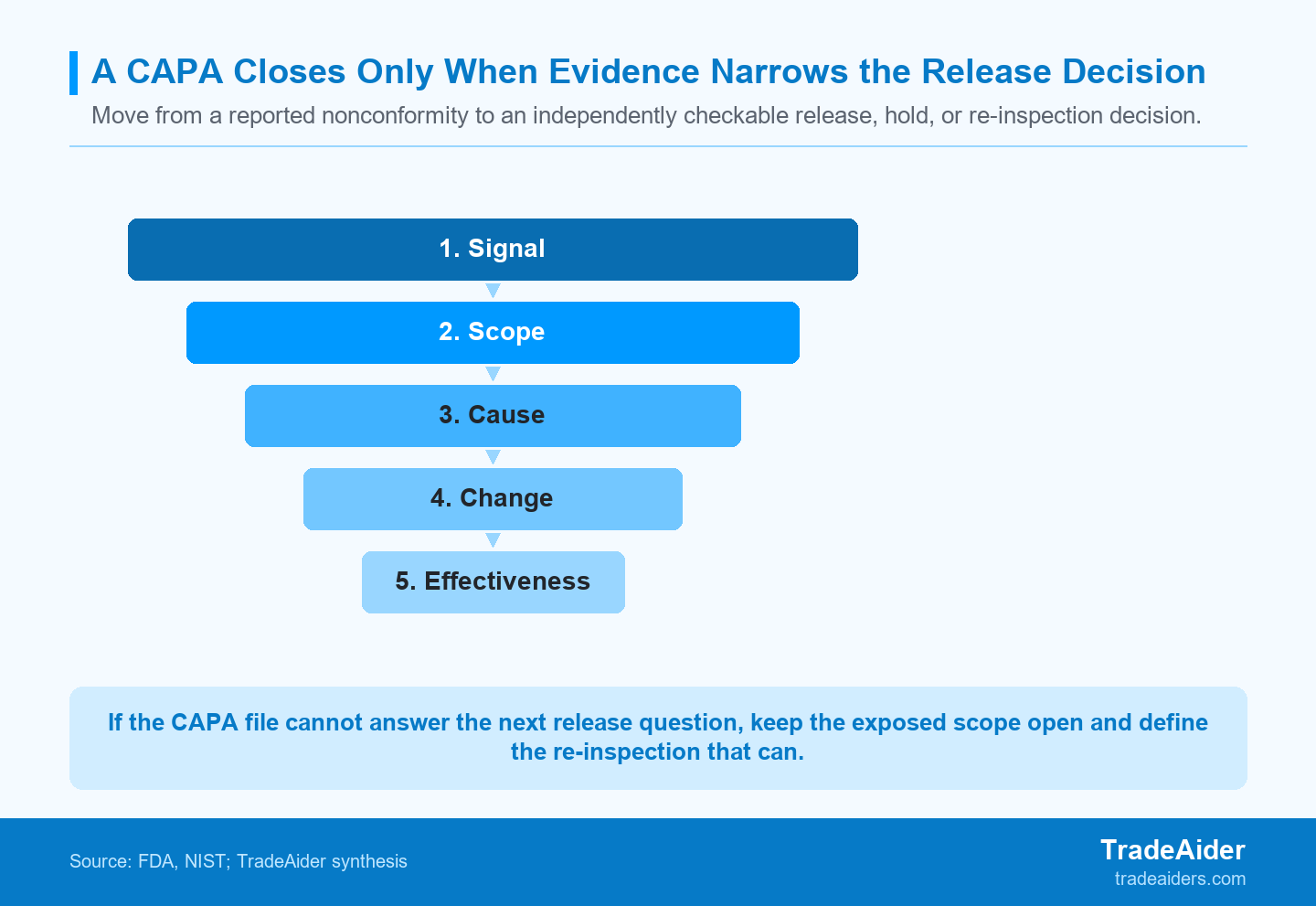
A CAPA becomes decision-ready only when its evidence narrows the next release question to a documented answer.
- Evidence first: ask for records that change a decision, not a narrative that repeats the finding.
- Separate roles: the supplier can own the action while the buyer retains the release decision.
- Use exposure: the next run, open work-in-process, and shipment readiness determine the useful deadline.
- Predefine re-inspection: specify the condition that needs an independent check before the supplier responds.
This is a buyer control model, not a universal regulatory protocol. Product specifications, purchase-order terms, destination-market rules, and the seriousness of the nonconformity still determine the final requirement.
Start With Evidence That Changes the Decision
The useful evidence sequence is: factual nonconformity, affected scope, cause investigation, controlled action, and an effectiveness check. An FDA corrective-action procedure uses that same broad sequence in a regulated setting, including documented investigation, action, ownership, target dates, and effectiveness verification. NIST describes process monitoring as comparing current observations with an established pattern and investigating observations that do not fit it; a process-control reference is therefore more helpful than a generic request for “root cause.” For consumer goods, use both as disciplined examples rather than a claim that every buyer must follow a medical-device system.
Ask the supplier to connect every attachment to one question. Photos can establish what was seen; production records can bound when it was made; a change record can show what was controlled; and a later observation can test whether the intended result occurred.
For marketplace and direct-to-consumer teams, the practical objective is to preserve enough product, order, lot, and production context to make the next quality decision inspectable. That is the bridge between a supplier response and TradeAider's e-commerce quality planning for China-sourced products.
Separate Containment From Corrective Action
Containment is a short-term step that limits further effect while the cause is investigated. It may mean stopping a line, separating a component lot, placing a packing window on hold, or preventing a known configuration from moving forward. Corrective action is different: it changes the source condition so the same issue is less likely to recur.
“We retrained the operators” can describe an action, but it does not identify the affected units, demonstrate what changed at the work point, or show that the condition is gone. Keep the two lanes visible in the CAPA: one lane protects currently exposed stock; the other proves whether the source condition has changed. This distinction prevents a temporary sort from being mistaken for a closed cause investigation.
Ask for Proof of Scope, Cause, and Change
Before accepting a CAPA, request four linked records: the affected SKU, component, line, lot, or time window; the evidence used to investigate the cause; the controlled change; and the record showing that change was applied. The needed evidence may be different for a stitching issue, a color mix-up, a packing defect, or an electrical performance concern. The buyer should not invent a universal test merely to complete the file.
Then write the effectiveness check in observable terms: what will be checked, against which approved requirement, on which scope, by whom, and what result changes the release decision. An inspection-standard framework is useful only when it turns the CAPA into that concrete check. “Pass re-inspection” is not enough; the inspection brief should name the actual product condition and the action if it is found again.
Assign an Owner to Each CAPA Decision
A CAPA fails quietly when “the factory” owns every field. NIST notes that conformity assessment can involve supplier, purchaser, and independent parties, each with a distinct role in demonstrating whether stated requirements are met. That does not force one staffing model, but it supports naming who acts, who reviews, and who makes the release call in the conformity-assessment process.
| Decision | Suggested owner | Evidence that owner must provide or approve |
|---|---|---|
| Contain exposed stock | Supplier production owner | Line, lot, component, or packing-window boundary |
| Investigate and change the process | Supplier quality owner | Cause evidence, controlled change, and implementation record |
| Review business exposure | Buyer quality or sourcing lead | Approved requirement, affected order scope, and release rule |
| Verify an open release question | Independent inspector, if commissioned | Observed result, scope checked, and exception evidence |
The table is not a substitute for a supplier quality agreement. Its value is exposing the handoff: the person who submits a CAPA is not automatically the person authorized to release the goods.
Set Due Dates From Exposure, Not Convenience
A useful CAPA deadline is tied to the first decision that cannot safely wait. If work-in-process is still on the line, containment evidence may be needed before production continues. If a repeat run is about to start, the cause investigation and controlled change may be needed before that run. If a finished lot is ready to ship, the immediate need may be a defined release check rather than a promise to finish a long-term corrective action later. Formal audit guidance provides a bounded parallel: the FDA MDSAP audit approach says corrective action should be appropriate to the risk of the nonconformity and reviews whether action was documented and effective.
For an importer, convert “risk” into exposure and consequence. A cosmetic label mismatch and an uncertain safety-related component issue may both need records, but they should not receive the same containment, evidence, or escalation path.
Set separate dates for containment, cause evidence, action implementation, and effectiveness verification. Do not force them into one arbitrary “CAPA due date.” Document the decision date as well: it shows which evidence had to exist before more units could move. Also state the product configuration, line, component, or packing window to which that date applies, rather than allowing a broad promise to drift across unrelated goods. When production is continuing, consider whether during-production inspection at the changed control point can answer the next question before additional units inherit the same exposure.
Define Re-Inspection Triggers Before the Supplier Responds
A re-inspection should be triggered by a decision that inspection can actually answer. NIST explains that acceptance sampling is for a lot-disposition decision, not for estimating the exact quality of the entire lot. So define the scope, check method, and possible result before arranging an inspection; otherwise, “re-inspect” becomes an expensive synonym for uncertainty. See NIST’s explanation of what acceptance sampling decides. A caution from a different regulated context is also useful: an FDA warning letter issued in 2026 cited premature CAPA closure and missing effectiveness checks.
Common triggers include missing or conflicting scope records, a material or process change that cannot be verified in documents alone, an open shipment-release question, a repeat finding after the claimed action, or a buyer requirement that calls for independent observation. Do not re-inspect every CAPA by default. If the exposed population is fully contained and the buyer can verify the action from trustworthy records, a document review may answer the decision more directly.
The lesson is not that consumer-goods buyers must use FDA procedures. It is that a new document or revised instruction is evidence of intent, not automatically evidence of an effective result.
Worked Scenario: A Handle-Seam CAPA Before the Next Run
A CAPA can narrow a re-inspection to the affected process window when scope evidence, change evidence, and a decision rule are all present. The following case is illustrative, not a client result or a universal seam-testing instruction.
Use the Evidence to Set a Conditional Release
A buyer can set a conditional release only after the CAPA records answer the stated scope and effectiveness question for the exposed product.
A U.S. home-goods brand sources foldable fabric storage cubes from China for marketplace and direct sales. Its illustrative order contains 1,800 units in three colors with sewn webbing handles. One color is packed, a second is still in production, and a repeat run is scheduled. A final inspection finds six units with visibly loose handle bar-tacks from one sewing line.
The supplier’s first response is “retrain the operators.” The buyer does not reject that action, but does not close the CAPA on it. Packing and line records identify 1 documented sewing line, 1 time window, and 2 affected product colors, while the supplier has not yet supplied a first-off record or evidence that the proposed change was controlled. The buyer therefore treats this as a bounded seam-control question, not proof that every unit or color has the same issue.
The decision is a conditional hold: isolate work from the documented window and keep the next run open until the supplier provides the setting or method change, the cause-investigation evidence, a named production owner, and the first-off or process record. Packed units outside the window are not automatically released or rejected; the buyer follows its traceability, approved requirement, and commercial terms. For the exposed scope that reaches final release, the buyer can plan a pre-shipment inspection for the revised release scope.
The effectiveness check is not a generic promise to inspect more. It names the product configuration, the documented line or time window, the approved seam observation or test, the reviewer, and the hold-or-release rule. If the file cannot establish that boundary, the buyer widens the decision rather than pretending the six observations are a defect rate. The order size, product, and seam details here are illustrative; they do not establish a universal test method, safety limit, or supplier fault finding.
Close the CAPA in the Next Inspection Brief
The next inspection brief should state the exposed scope, action evidence, effectiveness check, owner, and hold-or-release trigger. A useful brief also identifies the approved product reference, the timing of the check, the evidence to capture if the condition appears again, and who receives the result before goods move.
Before commissioning a check, prepare the nonconformity description, photos or samples where available, order and SKU context, affected production or packing records, supplier CAPA, buyer requirement, and the exact decision still open. That package gives an inspector a testable question instead of an invitation to audit the factory’s entire quality system. It also tells the supplier what document gap must be closed before a release decision is revisited. Add the decision date, the person who receives the finding, and the exact location where the evidence will be stored, so a later shipment conversation does not restart the investigation from memory.
When your team has a current supplier response and a defined exposure, ask TradeAider to review the CAPA evidence and inspection brief.
The key is to keep the request bounded. State whether you need confirmation of a changed process point, a check of a finished lot, evidence for a conditional release, or an observation that will decide whether the CAPA stays open. A clear brief protects the independence of the check and makes the result more useful to the buyer’s release owner.
Who Is TradeAider?
TradeAider provides inspection, testing, and certification services in China for buyers who need independent quality information before goods move. For a CAPA review, the useful starting point is not a generic promise to “check quality,” but a buyer-approved scope, the supplier’s evidence package, and the release question that remains open.
Its inspection work can be arranged around production readiness, during-production controls, finished-goods release, or other defined stages. The value of an independent observation depends on the brief: product reference, sample or method, evidence needed, condition to record, the decision date, and the owner who will act on the result. The buyer should also decide whether the result will close a process question, a specific finished lot, or both; that decision affects the document set and the timing of the inspection.
For a current supplier CAPA, compare the product reference, affected scope, open decision, and required output against the inspection brief before arranging an independent check. This prevents a generic visit from replacing the specific evidence needed to support the buyer’s disposition. Before arranging that verification, buyers can review TradeAider's China quality-control background.
Frequently Asked Questions
What evidence should a supplier CAPA include?
At minimum, a supplier CAPA should show the affected scope, investigated cause, controlled change, action owner, due date, and effectiveness evidence. Attachments should answer a decision question: which product is exposed, what changed, and what result confirms the change. A sample or re-inspection decision needs a stated lot or process scope; it should not be mistaken for an estimate of every unit's quality. A photo without a product or time reference, or a training record without a controlled-change record, is usually incomplete evidence for release.
Who should own CAPA closure for a supplier issue?
The supplier can own the corrective action, but the buyer should own the release decision and name who verifies the evidence. An independent inspector may verify a stated product or process condition, but should not silently replace the buyer’s approval authority. Put each person’s decision, due date, and required record in the CAPA so responsibility cannot be inferred after a shipment moves.
How should CAPA due dates be set?
Set each due date from exposure: current stock, the next production run, and the consequence if the condition repeats. Use separate dates for containment, cause evidence, implementation, and effectiveness verification. A supplier may need a longer-term improvement plan, while the buyer still needs an immediate decision about work-in-process or a shipment that is ready to leave.
When should a supplier CAPA trigger re-inspection?
Trigger a re-inspection when the buyer needs an independent lot or process decision that documents alone cannot answer. Examples include conflicting production records, an unverified process change, a repeat finding, or a release condition tied to physical product observation. If records already resolve the bounded decision, a document review may be faster and more appropriate than automatically ordering another inspection.
Can a CAPA close before all stock is re-inspected?
Yes, but only if the closure record clearly separates completed corrective work from stock that still needs a defined release check. The CAPA can be conditionally closed for the verified action while an exposed lot remains on hold or awaits re-inspection. Do not use a conditional closure to erase the open lot decision; record its scope, owner, timing, and release rule separately.
Artigos Relacionados



Expanda seu negócio com o Serviço TradeAider
Clique no botão abaixo para entrar diretamente no Sistema de Serviço TradeAider. Os passos simples desde a reserva e pagamento até o recebimento de relatórios são fáceis de operar.

