
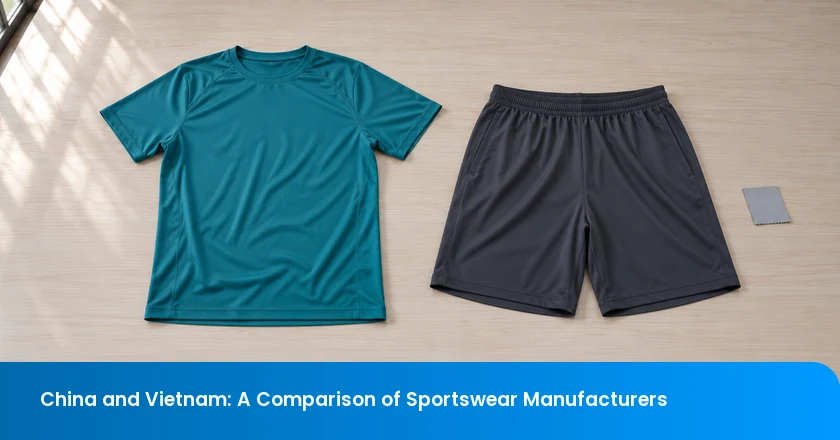
China and Vietnam offer different starting points for sportswear sourcing: China combines garment production with an important upstream textile supply base, while Vietnam has a substantial apparel assembly industry serving major brands. For a material-intensive new design, an established China fabric-and-garment route may simplify development. For a repeat program with approved inputs, a qualified Vietnam production route may offer an attractive alternative. The choice depends on how those industry strengths translate into the actual garment, calendar and landed cost.
A lower sewing quotation can be useful, but it does not settle the comparison if fabric, testing, transport or duty assumptions differ. For a new launch, material readiness and a suitable pilot may outweigh a nominal price difference. For a repeat program, a newly qualified alternative may become more attractive once development uncertainty has been removed.
Start with sportswear production evidence
Both countries appear in major-brand apparel production. In its fiscal 2026 annual filing, NIKE reports approximately 34% of total NIKE Brand apparel manufacturing in Vietnam and 12% in China. These percentages describe one brand’s apparel production mix. They are not national market shares, available factory capacity or quality scores.
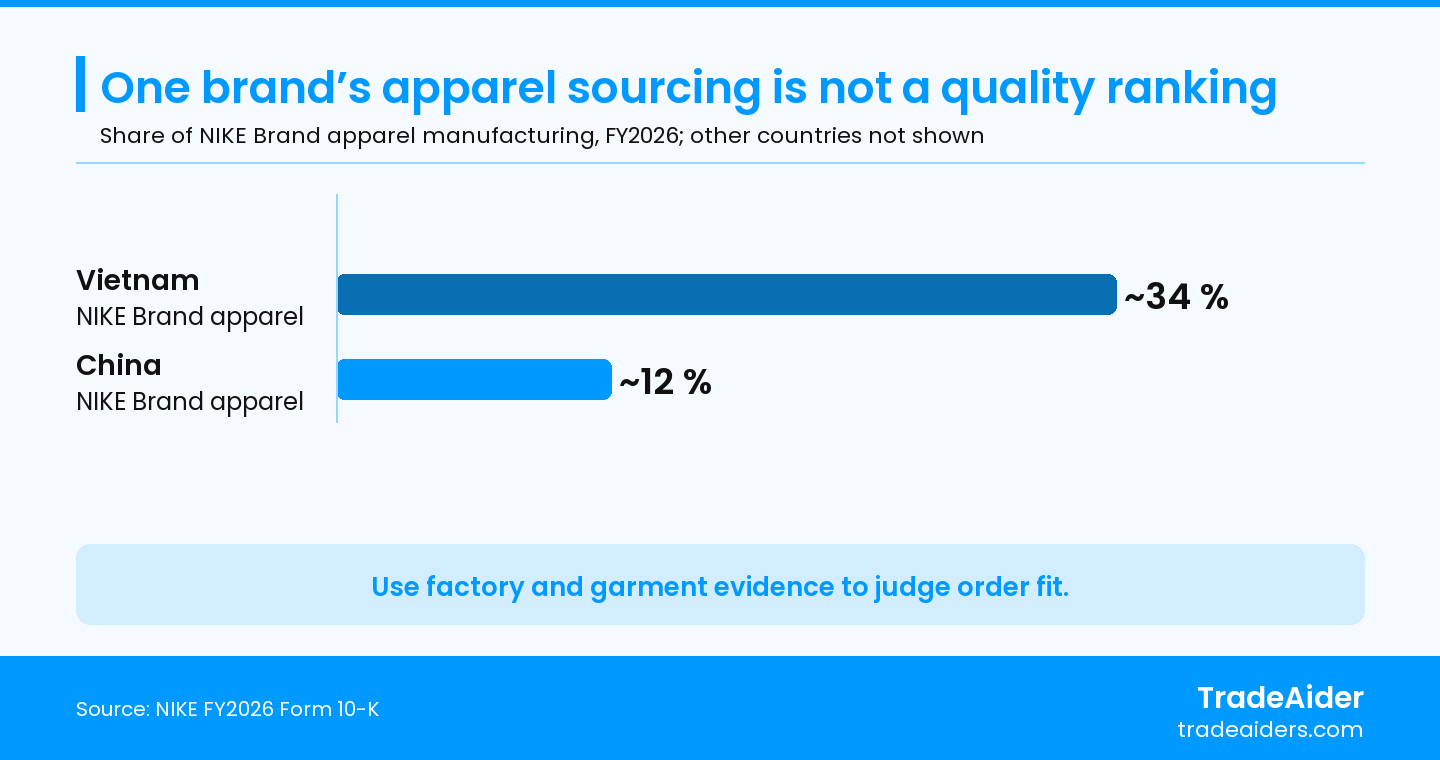
NIKE Brand apparel manufacturing, fiscal 2026, approximate shares. Other countries are not shown. This is one brand’s production mix, not national market share or a factory-quality ranking.
For a sportswear buyer, the useful conclusion is that both locations deserve consideration. The figures do not support labeling China as inherently premium or Vietnam as inherently basic. A running top, compression garment and woven training jacket can require different materials, equipment and operator skills even within the same supplier group.
The USITC’s 2024 apparel competitiveness report, reviewing trade patterns during 2013–2023, describes China as both an apparel exporter and a textile supplier to garment makers in other countries. Its discussion of the 2020 production recovery highlights access to domestically produced textiles. This gives the country comparison an upstream dimension: moving garment assembly does not necessarily move the fabric source. The same report records rising China sourcing costs associated with high wages and labor shortages during the reviewed period. For Vietnam, it reports industry observers’ assessment that efficient supply-chain management and large-scale production supported cost competitiveness, flexibility and speed to market. These are historical industry observations, not current factory quotations or guarantees for every sportswear supplier.
For a technical sportswear range, the practical implication is to compare two different strengths: access to the required fabrics and finishes, and the ability to assemble approved garments efficiently at the intended volume. China’s upstream role makes an established material-development route worth examining; Vietnam’s production scale makes a qualified repeat-program route worth examining. Neither establishes stretch recovery, seam quality or delivery readiness without evidence for the proposed order.
Country context helps form a shortlist; the actual factory determines whether the shortlist fits your product. Ask which facility will develop, cut, sew and finish the order. An approved sample from one facility does not establish that a different production site can reproduce it. Compare the proposed production arrangements rather than relying only on a group name or a customer-logo presentation.
Compare the fabric and trim supply route
Moving sewing to Vietnam does not necessarily remove China from the supply chain. World Bank WITS data for 2023 lists China among Vietnam’s leading sources of textiles and clothing imports. This historical, broad product group is neither sportswear-only nor fabric-only, and it cannot establish where a particular factory buys its inputs.
For each China and Vietnam offer, map the actual route from knitting or weaving through dyeing, finishing and garment assembly. Identify the mill, approved fabric revision and location of each material process. Include elastics, mesh panels, zippers, heat transfers and other trims that could delay an otherwise ready garment.
A China offer using an approved nearby mill may simplify your particular development route. A Vietnam offer with confirmed suitable materials and an established mill relationship may be equally workable. These are advantages of the proposed arrangements, not guarantees attached to a country name. Request material availability, minimum dye quantities and replacement arrangements from both suppliers.
Clarify the supplier’s commercial role as well. An integrated offer may include material development and purchasing, while a cut-make-trim arrangement leaves more input responsibility with the buyer. Ask who owns fabric approval, material losses and replacement purchases. Compare equivalent responsibilities: a broader package and a sewing-only price cannot establish a country cost difference.
This also changes the meaning of diversification. Two sewing facilities in different countries may still depend on the same fabric mill or finishing process. If continuity is the reason for adding a country, examine shared upstream dependencies. An alternative sewing location helps less with a fabric interruption when both factories are waiting for the same material.
Compare sportswear skills and process capability
Sportswear capability means making the specified garment consistently, including its fit and performance after use and care. Compare pilot garments from the proposed production line against the same approved references. Relevant checks may include seam construction, skipped stitches, panel alignment, dimensional consistency, stretch and recovery, opacity, colorfastness and performance after washing.
Match these checks to the product. A loose woven jacket and a close-fitting stretch top need different evidence. Ask how the supplier will control elastic tension, seam bulk, heat-transfer application or other construction details that matter to your design. Equipment lists help identify possibilities, but a suitable pilot demonstrates how materials, machines and operators work together.
Test names also need care. The historical ASTM D2594-20 public summary distinguishes stretch from fabric growth and cautions against commercial-shipment acceptance use because between-laboratory precision is poor. It illustrates why a familiar method number is insufficient. Select an appropriate current method for the actual fabric and decision; do not adopt this historical summary as your acceptance procedure.
Have the responsible technical person align the method, specimen condition, direction, care treatment and acceptance criteria before comparing results. Otherwise, a stronger-looking number may reflect different test conditions. For skills and productivity, compare the proposed line’s pilot output, recurring defects and ability to maintain the approved construction. Nationality alone provides no answer to those questions.
Compare labor economics and landed cost
A fair cost comparison starts with equivalent garments and complete commercial scope. Align fabric specification, construction, color and size mix, quantity, packaging, testing and delivery terms before ranking the China and Vietnam offers. No current comparable factory quotations or wage-and-productivity dataset is supplied here, so this comparison does not declare a universal labor-cost winner.
The historical cost pressures in China and scale advantages reported for Vietnam help explain why buyers compare the two locations. They do not establish today’s cost per acceptable garment. For your order, consider the sewing work involved, line efficiency, training needs and rework assumptions. Ask each supplier to explain the quoted construction and exclusions. A price for a simpler seam or a different fabric is a different offer.
Landed cost means the buyer’s cost to bring the garments to the agreed destination under the chosen terms. List garment price, buyer-paid development or tooling, testing, inspection, freight, insurance, duty and other applicable charges without counting an item twice. State the Incoterm—the rule allocating specified transport tasks, costs and risks—so both quotations use an understandable boundary.
Make the quotation usable after selection. Record its validity period, currency, payment schedule and assumptions about material ownership. Ask what happens if quantities or delivery dates change after material has been purchased. These terms help distinguish an initially attractive number from a workable order commitment, and they can differ between two suppliers in the same country as much as between countries.
Separate confirmed amounts from estimates. If origin eligibility or freight is unresolved, leave it as an open item and compare the offer under clearly stated assumptions. An apparent saving that depends on unconfirmed duty relief should not silently become the base purchasing budget.
Match order size, development and delivery
Order fit depends on the proposed factory’s development resources, material commitments and available production capacity. Neither China nor Vietnam has a universal minimum-order or lead-time advantage. Compare minimum order quantities by style, color and fabric, rather than asking only for a total garment minimum.
For a smaller launch, ask whether stock material is acceptable or a custom dye lot is essential. Confirm who pays for unused material and whether repeat orders can obtain the same shade and finish. A factory willing to sew a small quantity may still depend on a mill minimum that makes the project uneconomic.
For repeat programs, compare the route’s ability to reproduce the approved size range and material, not merely to repeat a purchase-order number. Agree how the factory will communicate material substitutions, process changes and capacity transfers. A repeat style can need renewed evaluation when a finish or production line changes. Keeping an alternative supplier active also requires current samples and realistic order availability; an old quotation is not reserved capacity.
Build the delivery calendar backward from the required arrival date. Separate material readiness, sample approval, cutting, sewing, finishing, inspection, packing and transport. Compare the actual origin-to-destination route, booking assumptions and contingency time. A promised sewing duration is not an end-to-end delivery commitment.
Once production begins, agreed garment measurements and workmanship observations can help a buyer discuss issues while work is still underway. TradeAider’s during production inspection explains this inspection stage. For the actual order, agree which approved garment, measurement points, construction details and visible findings the visit will cover. Timing should relate to the work available to inspect.
Check market access and origin conditions
Destination-market treatment can change a sourcing comparison. The European Commission states that the EU–Viet Nam Trade Agreement entered into force on 1 August 2020. Its existence alone does not establish the preferential rate or origin of a particular sportswear shipment.
The Commission’s agreement memo, last updated in 2020, explains that apparel preferences involve fabric-origin conditions. This historical explanation shows why the upstream route matters; it does not replace the current product-specific origin rule, tariff schedule or proof requirements for an order.
Ask the importer’s customs specialist to establish classification, destination, applicable date, relevant processing and material origin before including a preference in the comparison. Preserve the supporting records for the actual garment. Sewing in Vietnam is a location fact; preferential origin is a separate conclusion that depends on the applicable rules.
Apply the same discipline to a China route: use the actual classification, destination and current treatment. Keep product obligations—such as applicable chemical, labeling or performance requirements—separate from the duty calculation. Both sourcing routes need a product suitable for the destination, even when their customs treatment differs.
Assess responsible production at facility level
Responsible sourcing extends beyond the sewing address. The OECD’s garment and footwear guidance addresses identifying and responding to potential negative impacts across enterprise activities and supply chains. It provides a due-diligence basis, not a certification or a country ranking.
For either route, examine the named garment and upstream facilities. Relevant questions include labor practices, working-hour records, subcontracting, chemical handling and environmental controls for the processes involved. Review the scope and date of available assessments, outstanding findings and evidence of corrective action.
Keep product claims equally specific. A supplier’s country or an attractive sustainability statement does not establish recycled content, harmless chemistry or responsible working conditions. Request evidence matching the claimed material, facility and order. If an assessment excludes the dyeing facility, do not describe it as covering the whole fabric route.
Compare China and Vietnam on common criteria
The matrix below summarizes the country differences established above and their purchasing implications. Production figures and industry observations retain their stated periods; final qualification still belongs to the actual factory and order.
| Decision factor | China route | Vietnam route |
|---|---|---|
| Major-brand apparel case | 12% of NIKE Brand apparel manufacturing in fiscal 2026; evidence of an established production role. | 34% in the same NIKE dataset; a larger role for this brand, not a national quality ranking. |
| Upstream textile position | USITC describes a textile supply base serving domestic and overseas garment production. Examine whether it fits the required finish. | China is among leading sources in WITS’s broad 2023 textile/clothing import data. Trace imported inputs before assuming an independent route. |
| Labor economics and scale | USITC’s historical review identifies high wages and labor shortages as sourcing-cost pressures. Compare current productivity and complete quotes. | Industry observers cited by USITC identify efficient supply-chain management and large-scale production. Check whether the order fits the proposed line. |
| Development and delivery | An approved domestic material-and-sewing route can reduce cross-border input coordination for that order; confirm actual mill readiness. | An approved assembly route can suit repeat volume, but imported material, when used, adds an upstream delivery stage to the calendar. |
| EU destination | Calculate the actual garment’s current treatment for the China route; do not transfer a Vietnam preference assumption to this offer. | The EU–Viet Nam agreement creates a possible preference route, subject to the garment’s current tariff, origin and proof requirements. |
| Sportswear qualification | Use the specified fabric, construction and pilot to establish capability; national input depth does not prove garment performance. | Use the same technical references; production scale or a brand’s sourcing share does not prove this factory’s performance. |
Choose the route that meets the garment, calendar and commercial requirements with the unresolved items visible. If either supplier changes the fabric, production site or delivery assumptions, reopen the affected comparison. A useful country strategy remains connected to the orders it is intended to serve.
Illustrative example: choosing a stretch training-top route
This is a hypothetical example, not client data. A brand needs a stretch training top for a dated launch. Its China factory has the approved fabric route and a suitable pilot. A Vietnam factory offers a lower sewing price, but fabric delivery is unconfirmed and wash-and-recovery evidence is pending. For the launch, the lower sewing quote does not yet establish a better offer. The buyer retains the qualified China route while asking the Vietnam factory to confirm material availability, complete the agreed pilot evaluation and reserve suitable capacity. If the missing evidence cannot be obtained in time, the alternative remains a development option rather than a launch commitment. For a later repeat order, the facts change. The Vietnam route now has approved fabric, a suitable pilot, confirmed capacity and an offer on comparable landed terms. The buyer compares price and delivery again and can allocate the repeat order differently if that route is more suitable. The recommendation changes because readiness and commercial comparability change. It does not establish that China always handles launches or Vietnam always handles repeats. Reverse the initial evidence and the launch decision could reverse too.
What should decide your sportswear sourcing choice?
- Use country production evidence to shortlist, then qualify the actual garment facility and material route.
- Compare equivalent fabric, construction, order size, calendar and landed terms.
- Count market-access benefits only after the applicable origin and tariff conditions are established.
- Reassess the choice when an alternative becomes qualified or the order requirements change.
Discuss checks for the planned order
For an initial inspection inquiry, send TradeAider the product and order information available, factory location, destination, timing and known concerns. You can identify missing technical details during the discussion. Before a visit, agree the approved garment references, sampling, checks, available equipment and reporting of limitations. Contact our team to discuss a feasible inspection scope and a report of the agreed product findings.
FAQ
How can a buyer keep a split China–Vietnam order consistent?
Use common approved size specifications, measurement instructions and color references for both facilities. Review each route’s pilot against those references, then compare production findings by site. If a shade or measurement differs, identify the affected material or process before combining the results. Passing one factory’s sample does not establish consistency across the split order.
What if the pilot passes but bulk production moves to another line?
Ask the factory to identify the change and evaluate the new line before relying on the earlier pilot. Have the technical owner determine which garment features need renewed checks, then assess output from the proposed line. Keep its findings separate from the earlier pilot so the purchasing decision reflects the production arrangement actually being offered.
How should a material substitution after quotation affect the comparison?
Reopen the affected parts of the offer before accepting the substitution. Compare the replacement’s composition, construction and relevant performance with the approved fabric, and ask the technical owner which evaluations must be repeated. Update material availability, price and origin assumptions where affected. Retain the earlier quotation separately; its approval does not automatically extend to the revised garment.

Artigos Relacionados



Expanda seu negócio com o Serviço TradeAider
Clique no botão abaixo para entrar diretamente no Sistema de Serviço TradeAider. Os passos simples desde a reserva e pagamento até o recebimento de relatórios são fáceis de operar.