
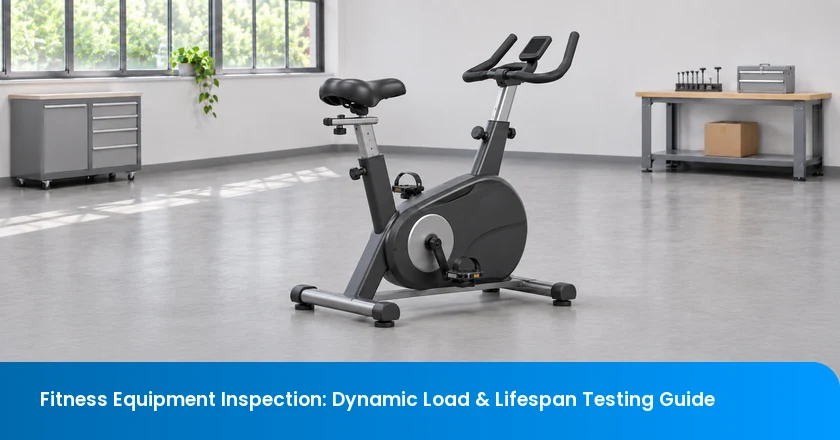
Fitness equipment inspection combines checks of the actual machine with the evidence needed for its intended use. Dynamic load and endurance testing examine behavior under defined forces, movement and repetition. A short functional run cannot establish lifespan, and a cycle-test report cannot establish the present condition of every machine in a shipment or gym.
For treadmills, stationary bikes and strength machines, identify the construction and use setting first. Then agree the applicable methods, samples, loads, operating conditions and acceptance criteria. Keep those results connected to installation, maintenance and later changes so each decision uses the right evidence.
Why inspection needs more than a working display
A working display demonstrates only part of a machine’s operation. Inspection helps identify specified defects and deterioration, such as looseness, damaged guards, worn interfaces or unstable assemblies. It does not establish hidden structural endurance or eliminate injury risk. The important question is whether the checks address the way this machine carries and controls load.
Hazards can extend beyond the intended user. The CPSC recall issued in 2021 for Peloton Tread+ model TR01 describes adults, children, pets and objects being pulled underneath its rear. This historical, model-specific example shows why surrounding access and moving interfaces matter alongside the running surface. It is not evidence of the failure rate or maintenance history of all treadmills.
For purchasing and operation, separate observed damage from a suspected cause. A cracked bracket, slipping belt or loose pedal needs an identifiable finding and a controlled response. Do not attribute every failure to poor maintenance, or assume that replacing the visibly damaged part resolves the underlying design, assembly or use problem.
Separate shipment checks from durability validation
Shipment inspection and controlled durability validation answer different questions. Inspection records the condition and agreed checks on selected units. A durability program exercises identified specimens under stated conditions. Neither substitutes for the other, and neither alone establishes years of safe service.
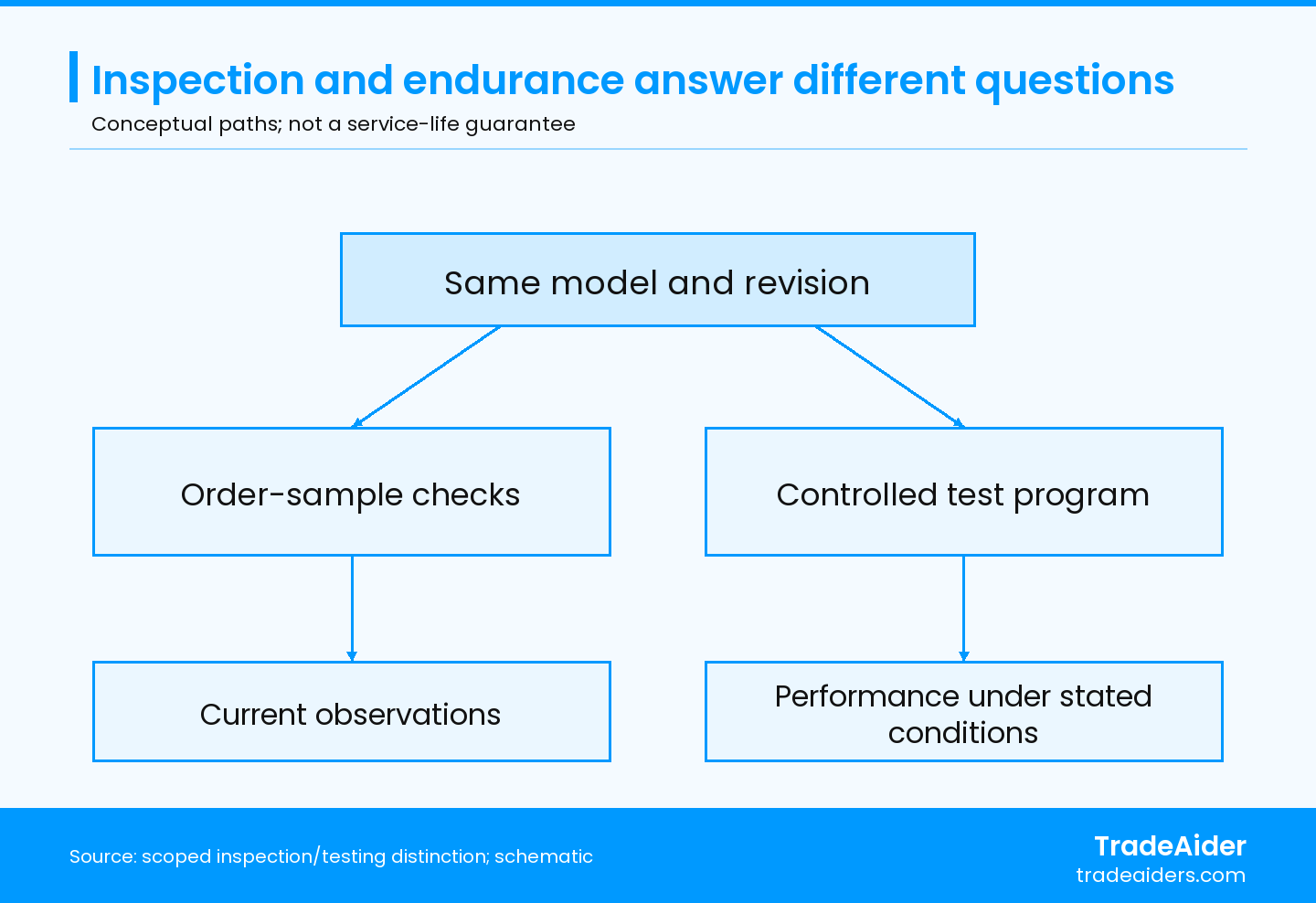
Conceptual evidence paths, not a certification scheme. Order-sample observations and controlled testing answer different questions; neither output alone establishes years of safe service.
TradeAider’s pre-shipment inspection includes quantity, appearance, dimensions and weight, packaging and accessories, specified functional checks and reporting on shipment samples. Agree which checks are feasible for the equipment and site. A long-duration fatigue program is a separate assignment from observing selected finished units during an order inspection.
At qualification, ask whether controlled test evidence covers the ordered model and revision. At shipment, compare production units with that approved construction and the agreed criteria. During service, assess the actual installed machine and its history. Combining these stages gives a more useful picture than putting every result under one undifferentiated “passed inspection” label.
Match the standard to the machine and intended use
Choose standards from the machine, intended users, setting and destination requirements. ISO 20957-1:2024 supplies general safety requirements and test methods for indoor stationary training equipment; other parts of the series can modify those requirements. Its title is not a blanket approval for outdoor equipment or a certificate covering every product risk.
For treadmills, ISO 20957-6:2021 provides additional requirements and methods intended to be used with the general part. Its scope includes powered and non-powered/manual treadmills. Record the exact editions and referenced methods selected for the project rather than mixing a convenient old report with a different current requirement.
Public standard summaries help select the right documents; the responsible technical owner still needs the applicable full method to specify the program. Check published status, equipment class and any product-specific precedence. A catalogue entry, a draft and a test report are different records. No single list of standard numbers establishes all-market compliance.
Facility obligations also need their own review. The U.S. Access Board’s ADA exercise-equipment provisions address clear floor space positioned for transfer or use from a wheelchair under the applicable scoping. That facility-accessibility question is separate from whether a product withstands an endurance program. Keep layout and access requirements in the installation brief.
Distinguish static, dynamic and endurance loading
Static, dynamic and endurance loading are related but distinct. A static test applies a defined load in a prescribed configuration without repeated operating motion. Dynamic loading changes force or movement over time. Endurance testing repeats a defined sequence to examine deterioration. Passing one does not establish the result of the others.
For a treadmill, the relevant questions may include repeated running-surface loading, incline movement and the behavior of its supporting structure. For a bike, examine how pedaling and resistance act through the crank, frame, seat and handlebar adjustments. A strength machine has a different load path through resistance elements, cables, pulleys and supports. The load path is the route by which force passes through those parts.
Specify how the load is applied, not just a headline user-weight rating. Magnitude, direction, contact position, movement and adjustment settings can change which part is stressed. A mass placed at an arbitrary point cannot stand in for every prescribed loading arrangement.
Use controlled equipment and competent personnel for loading programs. Do not improvise a test by dropping an unspecified heavy object onto a treadmill or asking someone to operate a potentially failing machine. The method should define the fixture, safeguards and observations needed for the particular question.
Define the test program before running cycles
A repeatable program starts with defined conditions. ASTM F2106-25 describes treadmill test methods used with F2115 and other referenced documents. Its public scope includes endurance loading, static loading, incline systems, controls, motorized drive, documentation and warnings. That overview does not supply all detailed procedures or acceptance values; obtain them from the applicable method.
Fix the model and revision, use category, specimen configuration and loading arrangement before running the program. State the movement profile, operating rate, required cycles, duty and rest periods, environment, observation intervals and acceptance criteria. Record interruptions, adjustments and repairs so they cannot silently change the meaning of the result.
A duty cycle describes how operation and rest are distributed. Running continuously, resting between sequences and changing resistance or incline can expose different behavior. The technical plan must say which condition represents the required assessment and how the result will be judged.
Retain the starting condition, equipment identity and relevant measurements, then record damage and function at the specified stages. If a crack, excessive movement, temperature concern or other stop condition appears, follow the agreed procedure and preserve the finding before repair. A restarted counter should not conceal a failed specimen or an altered program.
Check the frame, joints and load path
Start with the structure that carries the intended loads. ISO 20957-2:2024 addresses additional safety requirements for stationary strength-training equipment with stacked weights and alternative resistance systems. That equipment scope is different from a treadmill, so a familiar treadmill procedure cannot serve as a universal strength-machine test.
For the actual machine, identify frame members, welds, fasteners, adjustment locks, supports and anchorage where applicable. Inspect for specified cracks, deformation, unintended movement, missing parts or interference before and after the prescribed program. An accessible visual check cannot establish hidden fatigue life or replace a suitable structural assessment.
Keep joint condition separate from cosmetic finish. A coating mark may be cosmetic, while movement at a load-bearing connection needs investigation against the drawing and criteria. Record the location and operating configuration. Tightening a loose joint before documenting it can erase information about assembly or retention performance.
Follow the moving parts and safety functions
Moving parts and safety functions need model-specific checks. ISO 20957-5:2016 addresses stationary exercise bicycles and upper-body crank equipment in addition to the general safety requirements. Identify the drive and intended use before selecting the applicable bicycle part; the marketing name “spin bike” does not resolve its technical classification.
On treadmills, examine the specified running-belt condition and tracking, rollers, accessible guards, handrails, controls and incline operation. On bikes, follow the pedals and cranks, seat and handlebar adjustments, resistance mechanism and guarded drive. On strength equipment, examine the specified cable routing, pulley movement, attachments and adjustment or selection mechanisms. Check the actual configuration rather than copying every item onto every machine.
Verify stop controls and any safety-key or interlock functions through the model’s controlled procedure. Judge the required stopping behavior against its criteria; do not replace that assessment with a claim that every machine must stop instantly. Preserve the operating setting and observed response in the report.
For powered equipment, visible cord, plug and housing condition is only the accessible part of electrical assessment. Damaged insulation, overheating signs or a burning odor require a safe response, not continued operation to complete a checklist. Internal electrical work and specialist tests belong with competent personnel using the appropriate isolation and test procedures.
A reusable inspection and durability brief
Use the brief below to turn a general durability request into agreed work. Complete it for each relevant model and construction, with the technical owner responsible for missing methods or acceptance criteria. Resolve those gaps before the corresponding test or pass decision.
| Define | Fill in for this model | Purpose |
|---|---|---|
| Machine and use | Model/revision: ___; setting/users: ___ | Match supplied construction and intended use |
| Method and scope | Standard/version: ___; checks: ___ | State what each result must establish |
| Specimens | Quantity/identity: ___; configuration: ___ | Allocate inspection, stressed and destructive samples |
| Load and motion | Force/mass: ___; position: ___; movement: ___ | Apply the prescribed arrangement and units |
| Duration and conditions | Rate/cycles: ___; rest/environment: ___ | Retain sequence, interruptions and permitted adjustments |
| Judgment and reporting | Criteria: ___; stop conditions: ___; owner: ___ | Record before/after condition, failures and disposition |
TradeAider’s product testing process describes needs alignment, planning, sample identification, implementation, review and reporting. Use that process to discuss the required assessment and its feasibility. Agree any long-duration or specialist work separately, including where it will occur and which samples it needs.
The completed brief should let the buyer distinguish an observation that can be made during shipment inspection from a result requiring a controlled test setup. Confirm how the report identifies the tested construction and any limitation that changes the purchasing decision.
Interpret a lifespan result within its conditions
A lifespan result remains conditional on the specimens and program. Converting cycles into years requires a justified model of use, load, environment and maintenance. Do not silently turn a laboratory cycle total, or a short functional run, into an unconditional promise of service life.
Read what actually happened: the completed sequence, interruptions, repairs, observations and post-test function. Distinguish “completed the prescribed program within its criteria” from “not tested,” “test stopped” and “failed.” A supplier’s summary may omit the condition that determines whether the result covers your order.
Check construction coverage as well. A result for an earlier bracket, cable, drive or control arrangement may need technical review before it supports a revised product. Identify the change and have the responsible specialist decide which evidence remains applicable and which assessment must be repeated.
For a shipment decision, compare the production construction and sample findings with the relevant qualification evidence. A report for one specimen does not reveal the condition of every manufactured unit. Conversely, clean sample findings do not supply missing long-duration evidence. Keep unresolved coverage visible when deciding whether to release, correct or hold the order.
Illustrative example: a changed incline bracket
This is a hypothetical example, not client data. A supplier changes a treadmill’s incline bracket but submits a report for the previous construction. The revised sample powers on and its controls respond. During the defined repeat-use program, however, a crack develops at the bracket. The short functional result has not resolved the structural issue.
The buyer holds the affected release decision for technical disposition and links production lots to the bracket change. The supplier investigates the failure, identifies the corrective construction and provides controlled samples. The responsible technical owner determines the relevant repeat validation; production units are then reassessed against the approved correction and applicable checks before the decision is reconsidered.
If the supplied report omits the load arrangement, cycle conditions or crack criteria, first obtain those details and complete the technical plan. Do not invent a universal cycle count to fill the gap or mark the missing assessment as passed. The observable outcome needed is evidence that the revised construction meets the agreed program, with the affected production status resolved.
Maintain equipment according to use and condition
Inspection frequency should reflect the machine and its use. In Great Britain, HSE’s work-equipment inspection guidance bases inspection need and frequency on risk, exposure and manufacturer recommendations, with appropriate competence and records. This supports risk-based planning; it is not a worldwide mandatory daily, monthly, quarterly or annual gym calendar.
Follow the model’s cleaning, lubrication, adjustment, inspection and replacement instructions. Consider usage intensity, environment and condition rather than applying one maintenance recipe to every belt, bearing or resistance system. When a safety-related fault is suspected, stop use, prevent access and have competent personnel assess and correct it before the appropriate return-to-use decision.
Give staff clear responsibilities. Operators need to recognize unusual movement, slipping, noise, damaged guards, loose adjustments and fault indications, and know how to report and isolate a problem. Service tasks need the competence, tools and authorization appropriate to the work. Do not ask general staff to open electrical enclosures as a routine calendar exercise.
Keep records that identify the machine, date, use or condition concern, work performed, parts changed, findings and return-to-use decision. Retain the relevant instructions and reports with that history. Records help connect recurring faults and changed parts to the next action; their existence does not guarantee warranty acceptance or legal protection.
User guidance and layout complete the operating plan. Preserve required clearances and access, explain adjustment and stop controls, and keep unauthorized users away where needed. Review the plan after significant damage, a modification, relocation or a recurring fault rather than waiting for the next scheduled entry.
Before treating a machine as ready for use
- Match the actual model, construction and use to the applicable methods.
- Separate current sample findings from controlled load and endurance evidence.
- Resolve failed or missing conditions before the affected acceptance decision.
- Keep installation, maintenance and return-to-use responsibilities with the equipment record.
Turn the equipment question into an inspection scope
Begin a TradeAider inquiry with the equipment and order information available, the China supplier/site, intended setting and current quality concerns. Share drawings, instructions or existing reports where available. Before service, agree feasible checks, samples, criteria and reporting, with long-duration or specialist work separately defined. Contact our team to discuss a suitable scope and a report of the commissioned findings.
FAQ
Can an original test report clear a used machine for service?
Assess its present condition and history; the old report does not establish remaining life. Confirm the machine identity, modifications, service record and available instructions, then arrange the appropriate condition and functional assessment. Unknown history may leave important gaps even when the original model completed a test program. Keep any unresolved issue visible before returning or introducing the machine to service.
Can the same specimen be used for endurance testing and then shipped?
Define specimen disposition before testing and keep stressed or destructive samples out of ordinary sale unless specifically authorized and justified. Some programs deliberately consume fatigue life or cause damage that a quick visual check cannot resolve. Identify and segregate those specimens, state their permitted use and retain their history. Do not mix a test unit back into untouched shipment stock simply because it still operates.
Does a component replacement need another assessment?
Assess whether the replacement affects load paths, controls, safety functions or existing evidence. A like-for-like service action under the manufacturer’s instructions differs from substituting a different material, geometry, rating or control arrangement. Have the responsible technical person define the necessary checks and any repeat validation. Record the installed part and decision; neither a universal full retest nor automatic acceptance suits every replacement.

Artigos Relacionados



Expanda seu negócio com o Serviço TradeAider
Clique no botão abaixo para entrar diretamente no Sistema de Serviço TradeAider. Os passos simples desde a reserva e pagamento até o recebimento de relatórios são fáceis de operar.