
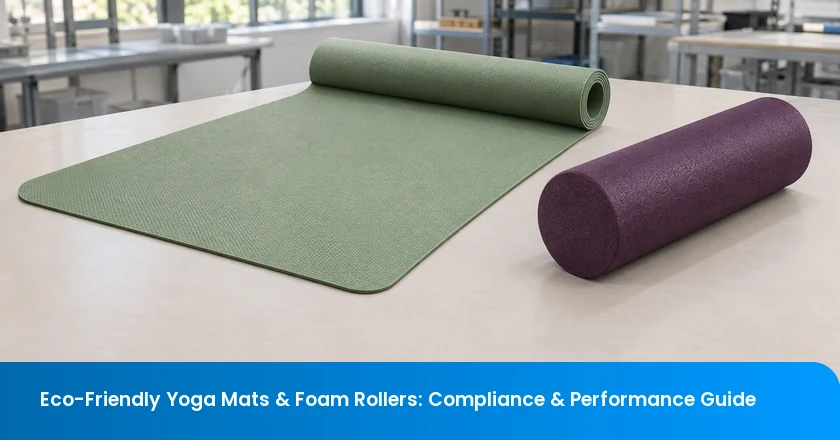
Choose yoga mats and foam rollers by connecting the complete material construction to evidence for the environmental claims, applicable chemical requirements and physical performance. A useful supplier proposal identifies what the product contains, which configuration was assessed and how its performance was measured. Those details let an importer or brand compare products and define an order that can be checked.
Start with the intended user and exercise setting. A thin mat used for balance poses and a firm roller used under concentrated body load need different physical evaluations. Both also need a clear basis for statements about recycled content, material origin or end-of-life options.
What to decide before selecting the product
- Identify the complete construction, including facings, adhesives, cores, printing and accessories.
- Match the legal assessment to the destination, intended age and powered or unpowered design.
- Check what each environmental claim and certification actually covers.
- Compare rebound, compression and durability results using defined methods and comparable conditions.
Define what the mat or roller must demonstrate
Evaluate environmental claims, applicable chemical requirements and physical performance as separate questions, then connect their evidence to the exact yoga mat or foam roller being purchased. State intended use and acceptance criteria before comparing suppliers.
The purchasing brief should describe the exercise, expected loading, contact conditions, cleaning method, storage and sales markets. Ask which parts of the product each report or certificate covers. Keep an approved sample and its construction revision so later changes can be assessed against a known reference.
Specify the benefit the customer is being promised. A claim about recycled content needs evidence of the material source and quantity. A cushioning claim needs an appropriate physical assessment. A statement about restricted substances needs the relevant substance and method information. This makes each evidence request concrete enough for the supplier to answer and for the buyer to evaluate.
Compare the complete material construction
Identify every relevant material layer and component, including foam or rubber formulation, cork or textile facing, core, adhesive, coating, printing and accessories. A material family name does not establish recycled origin, chemical results or finished-product performance.
Request a bill of materials (BOM), meaning the controlled list of components and materials, with enough detail to identify the supplied construction. Where a formulation is confidential, agree how the technical assessor will obtain the information needed for its work. The purchasing team still needs an identifiable material reference and change-notification arrangement.
| Material description | Information to request | Purchasing check |
|---|---|---|
| PVC compound | Polymer, plasticizer and additive references, facing and surface treatment | Assess the actual formulation and intended contact |
| TPE or other polymer foam | Specific polymer family, blend, cell structure and density reference | Match the test method to the identified material |
| Natural-rubber construction | Rubber compound, processing and additive references | Assess the finished compound and supported origin claim |
| Cork-faced composite | Cork layer, backing, binder and adhesive | Check both the facing and complete laminate |
| Jute or cotton textile component | Fibre composition, coating and certified product scope if claimed | Identify the exact textile and other attached materials |
| Claimed recycled input | Material identity, recycled proportion and supply-chain evidence | Match the claim to the relevant component or whole product |
TPE means thermoplastic elastomer and describes a material family. Obtain separate evidence for any recycled-content statement. For a composite mat, identify what proportion of the product the advertised cork, cotton or recycled layer represents before approving whole-product wording.
Identify the rules for the destination and intended user
REACH is the EU framework for managing chemical risks, including restrictions and communication of substance information. Select the applicable duties and tests for the actual materials and article. Build the laboratory brief around the formulation, accessible surfaces, use and contact conditions. European Commission REACH overview.
Ask the technical reviewer to identify the relevant substance entries, limits, material basis and methods. A report should name its sample, tested substances, results, units, detection or reporting limits and applicable criteria. Match that sample to the purchased color, compound, facing and adhesive system. Identify any additional duties associated with treatments or claims before using them on packaging.
RoHS restricts hazardous substances in electrical and electronic equipment. An ordinary unpowered mat or roller does not enter that scope simply because it is sports equipment. Assess a powered or electronic variant against its own applicable requirements. European Commission RoHS scope.
CPSC defines children’s products as consumer products designed or intended primarily for children 12 or younger. Product design, marketing and recognized use affect classification. Establish that classification before applying children’s-product duties to US sales. CPSC children’s-product guidance.
UBA’s 2021 report describes testing sports articles including yoga mats and finding substances of concern in some sampled goods. It recommends learning about product chemicals and passing substance information through the supply chain. Use that historical finding as a reason to obtain material-specific evidence for the current order. UBA sports-article investigation.
Make environmental claims specific and supportable
US Federal Trade Commission (FTC) guidance calls for specific, substantiated environmental benefits and support for non-toxic claims. Recycled-content claims should identify the relevant recovered material and proportion. Recyclability depends on appropriate collection and processing availability. Renewable-material wording and degradability or compostability claims need suitable evidence and qualifications applicable to the actual product and disposal conditions. Certification still leaves the marketer responsible for the claims it makes. FTC Green Guides summary.
Turn a broad proposal into a precise evidence request. Identify whether the claim concerns the rubber backing, textile cover, foam core, complete item or packaging. Ask for the calculation basis and supporting records for a recycled-content statement. For an end-of-life claim, identify the collection route, accepted materials and processing conditions. Review the proposed artwork and online description together so a narrow benefit is communicated consistently.
The Commission’s guidance on Directive (EU) 2024/825 explains that generic environmental claims require recognized excellent environmental performance relevant to the claim. Clear, prominent specification on the same medium changes whether a claim is generic. The new rules apply from September 27, 2026. Review consumer-facing wording and labels against the applicable provisions when approving EU artwork. Commission services guidance on environmental claims.
For supplier comparisons, keep the claimed benefit and its evidence together. A verified material attribute can inform selection alongside service life, product function and the available disposal route.
Read each certification for its actual scope
Match the certificate holder, product description, materials, validity and permitted claim to the goods being offered. Check the record through the scheme’s verification route or issuing body. The following schemes address different parts of the sourcing question.
| Scheme | Evidence purpose | Check for this purchase |
|---|---|---|
| OEKO-TEX STANDARD 100 | A label for textiles tested for harmful substances. | Match the certified article and scope to the offered mat, cover or textile component |
| Global Recycled Standard | Recycled materials and chain of custody, with additional processing-related social, environmental and chemical criteria. Scheme scope. | Check product coverage and the applicable claim and labeling rules |
| GOTS | Textiles made with organic fibres and the textile processing supply chain, with environmental and social requirements and independent certification. Scheme scope. | Identify the certified textile product and whether the offered component is included |
| FSC | Labels describe the source of forest-based materials. Label meanings. | Check the actual certified material, product and label claim for the forest-derived component |
For a cork-faced mat with rubber backing and a cotton carrying strap, identify which component each certificate lists. Keep any chemical or performance assessment of the complete laminate linked to that same construction. Confirm eligibility and wording with the scheme’s current rules before placing its mark or claim on the selling unit.
Specify physical tests for the material and finished product
A useful performance specification names both the property and the conditions under which it is measured. A quick return after an impact, residual deformation after sustained loading and a change after repeated loading describe different aspects of behavior.
Choose methods within their stated material scope
ASTM D3574-25 covers slab, bonded and molded flexible polyurethane foams. Its test results describe the material under the particular test conditions and may differ from other use environments. Polyurethane foam method scope.
ASTM D3575-20 applies to flexible closed-cell materials made from olefin polymers or blends. It covers test procedures, with product requirements specified separately. Olefin foam method scope.
Have the laboratory identify the applicable standard family, edition and method for the supplied material. If specimen preparation or finished-product geometry requires a departure, record it and explain how the result will be used in the purchasing decision.
Separate rebound, compression set and fatigue
ISO 8307:2018 specifies determination of resilience by ball rebound for flexible cellular polymeric materials. Ball-rebound method scope.
ISO 1856:2018 specifies compression-set methods for flexible cellular materials and applies to latex and polyurethane foams thicker than 2 mm. Compression-set method scope.
Define the property, sample configuration, conditioning, load or deformation, duration or cycles, recovery time, measurement and acceptance criterion for each test. Rebound, residual deformation after compression and fatigue-related change answer different questions.
A compression-set assessment examines remaining deformation after a specified compression and recovery procedure. A fatigue assessment examines change after repeated loading. Compare reports using the same property definition and compatible conditions, then decide whether the measured change meets the agreed requirement for that product.
Define yoga-mat checks around the intended exercise
For yoga mats, assess the specified thickness, size, cushioning response, grip under the intended surface and moisture conditions, tear or abrasion concerns, layer bonding and cleaning or aging effects relevant to the intended use.
Distinguish movement between the user and the mat from movement between the mat and the floor. Identify the contact surface, preparation and moisture condition for a grip comparison. Evaluate a layered mat as the supplied assembly, including edges and bonded surfaces. Record observations after the agreed cleaning or conditioning procedure so purchasing can connect the result to the care instructions and use claim.
Define foam-roller checks around loading and construction
For foam rollers, assess length, diameter, firmness and deformation under the intended loading, core and shell integrity, roundness after recovery, repeated compression, surface durability and cleaning effects. Compare results only when method and conditions are comparable.
A solid foam roller and a foam-covered rigid-core roller need construction-specific checks. Define where and how the load is applied, which dimensions or damage are measured and when recovery is observed. Review cracks, separation or lasting shape change against the agreed criteria. Select firmness for the promised use and user group, with the relevant finished-product evidence available before approving the specification.
Keep separate lines in the test brief for material specimens and finished-product checks. Each result should identify its sample and method, allowing the buyer to see which product claim it supports and which question remains open.
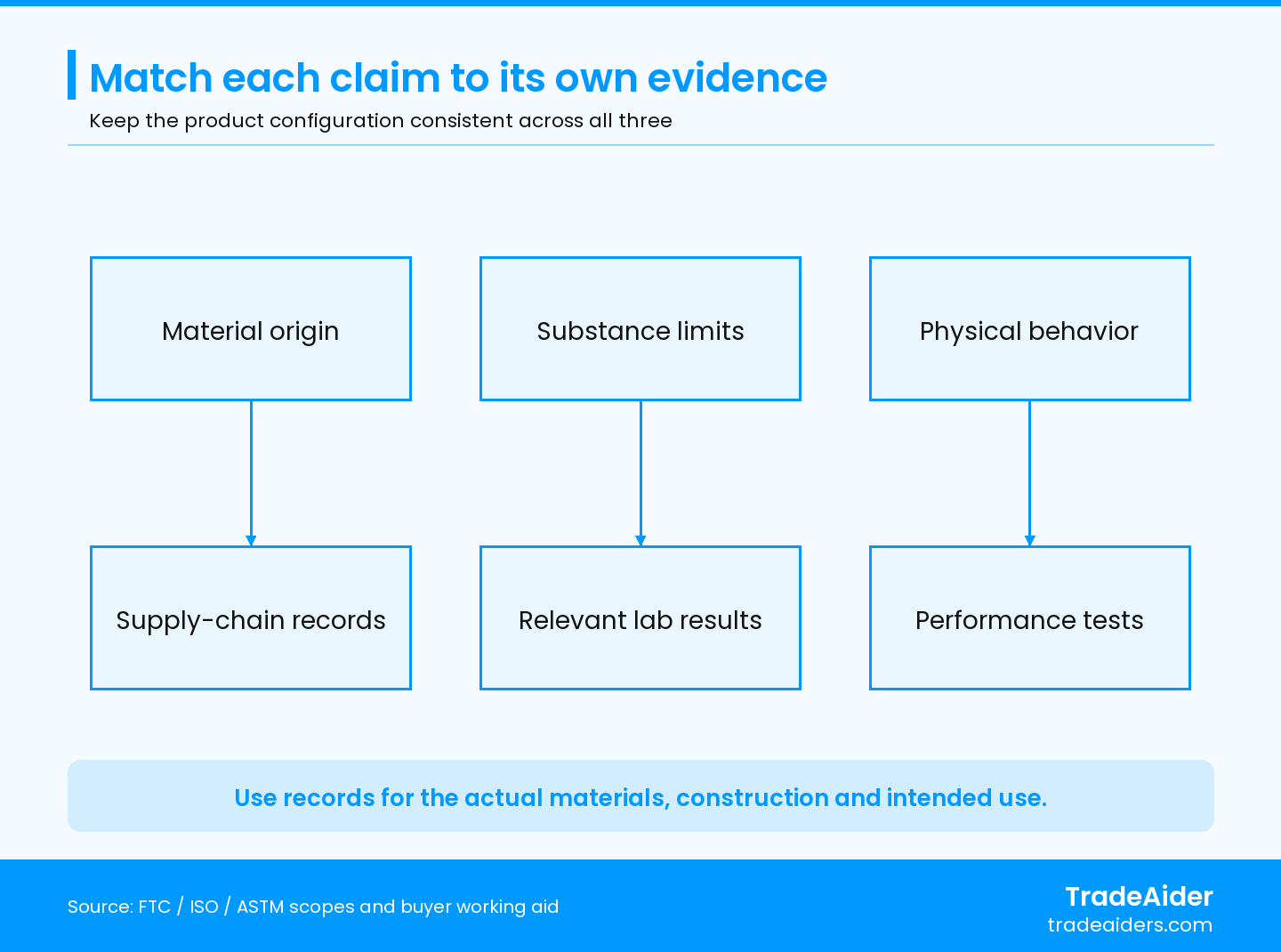
Buyer working aid. Match each evidence type to the same mat or roller construction and intended use.
Carry the approved construction into production and shipment
Keep the approved formulation, construction and references connected to material receipts, production lots and change records. Assess a change in foam, adhesive, facing or core for its effect on chemical, claim and performance evidence.
Agree material identification, first-piece checks and change notification before production. Check mat lamination and cutting, roller core assembly and foam application where relevant. Record the affected configuration when a material or process changes, and decide which documents or tests need updating before relying on the old evidence.
TradeAider pre-shipment inspection is scheduled when the order quantity is 100% complete and at least 80% packed for export. Agree the references, sampling, feasible checks and report for the actual mat or roller order.
Include agreed dimensions, appearance, construction, functions, quantity, labels and packaging in the inspection brief. Define which physical checks can be performed with the available equipment and which evidence must already come from the laboratory or supplier file. Review packing pressure and the agreed recovery observation where rolled or compressed packing could affect the delivered condition. Record unperformed checks and unresolved findings for the buyer’s disposition.
Illustrative comparison of two foam-roller proposals
In this illustrative comparison, one foam-roller supplier offers a ball-rebound result for a material sample while another offers recovery data without the load and recovery time. The buyer cannot rank finished-roller durability from those figures and asks for comparable product-specific testing before selecting on that basis.
First identify the material, construction and intended use of each proposal. Obtain the complete methods and sample descriptions, then agree the relevant finished-roller loading, recovery observation and acceptance criteria. Enter the missing conditions as open actions in the performance row of the sourcing record below.
When matched results become available, compare deformation, damage and recovery against the agreed product requirement. If a supplier cannot identify the tested sample or method, keep the durability comparison unresolved and request new evidence. This hypothetical example illustrates a purchasing decision with missing information. It makes no claim about actual suppliers or measured customer results.
Complete a mat-and-roller sourcing record
Record each product’s intended market and use, construction, substance assessment, environmental claim, certification scope, performance method and lot inspection result. Turn a missing input into a named action before making the corresponding purchasing decision.
Use a separate record for each construction or clearly identified variant. Enter actual references and results in the blanks, including the responsible person and due point. For the illustrative comparison, the performance row remains open until the missing method conditions and comparable results are supplied.
| Decision area | Reference or evidence to enter | Result and next action |
|---|---|---|
| Product and use | Mat / roller, destinations, intended user, exercise and construction revision ___ | Confirmed configuration / missing input ___. Owner ___ |
| Material and substances | BOM, compound references, applicable assessment and sample-linked report ___ | Covered materials / unresolved item ___. Action / due point ___ |
| Environmental claim | Exact wording, component or whole-product scope and supporting records ___ | Supported benefit / qualification needed ___. Owner ___ |
| Certification | Scheme, holder, product coverage, validity and claim permission ___ | Matched coverage / missing verification ___. Action ___ |
| Physical performance | Property, sample, method, conditions, recovery time and acceptance criterion ___ | Result / comparability gap ___. Next test / owner ___ |
| Production and shipment | Lot, changes, agreed inspection, labels and packing references ___ | Findings / pending evidence ___. Disposition / follow-up ___ |
Prepare a focused inspection request
Start with available product and order information, factory, destination, timing and known concerns. Share existing samples, specifications and reports. Before inspection, agree technical references, sampling, feasible on-site checks, equipment and report outputs. Contact our team to discuss the mat or roller inspection and a report of the agreed checks, findings and limitations.
FAQ
Does a strong smell prove that a mat is non-compliant?
Treat an unusual odor as an observation to investigate. A smell check cannot identify or quantify all relevant substances, and an odor-free sample does not establish chemical compliance. Record the affected product, material, lot and packaging condition, then ask the technical reviewer which investigation or testing is appropriate before deciding how to handle the goods.
Can a certified cover be used to describe the whole mat or roller?
Only make a whole-product certification claim when the actual certified scope and scheme rules support it. Identify the covered textile or other component clearly when the certificate is limited to that part. Check the final label and sales description against the same scope, including any conditions the scheme places on use of its mark.
Does a take-back program establish that a product is recyclable?
A take-back offer needs a documented collection and processing route before it supports a recyclability statement. Ask which constructions the program accepts, where collected goods go and what processing is actually available. Keep the statement limited to the supported route and availability, and provide the customer with instructions that match how the program operates.
Artigos Relacionados

Expanda seu negócio com o Serviço TradeAider
Clique no botão abaixo para entrar diretamente no Sistema de Serviço TradeAider. Os passos simples desde a reserva e pagamento até o recebimento de relatórios são fáceis de operar.

