
- Sobre Nós

- Nossos Serviços
- Sua Indústria
- Recursos
- Notícias e Blog
EU GPSR listing-to-carton verification is a controlled comparison between a seller's approved marketplace evidence and the finished product, packaging, and export-carton identifiers observed in China. A China Pre-Shipment Inspection (PSI) can document physical consistency, but it cannot certify that a listing, technical file, or product is legally compliant.
A China PSI can document physical consistency against an approved evidence pack, but it cannot certify legal compliance.
A PSI is conducted when 100% of the order quantity is completed and at least 80% is packed for export. That timing is valuable because the inspector can see the shipment version, not merely an early sample. It is also a boundary: the visit can compare what is physically present with the buyer's approved references, while legal analysis, technical documentation, and the live marketplace account remain with their accountable owners.
The Boundary a China PSI Can Prove
GPSR places product-safety and distance-sale information obligations on economic operators and establishes specific obligations for online marketplaces. Regulation (EU) 2023/988 therefore provides the regulatory context for a seller's evidence pack; it does not turn an inspection report into a legal determination.
- Definition: A PSI creates an observation record for selected finished goods, labels, packaging, and cartons.
- How it works: The buyer supplies controlled references, then the inspector records matches, mismatches, and the carton or lot context.
- Risk: A physical match can be overstated as proof that every legal, technical, or marketplace duty has been met.
- Decision: Use the inspection to hold or recheck a shipment version; keep compliance and account decisions with the responsible owner.
A usable inspection scope begins with a modest claim: the inspector will compare named physical items against named approved evidence. That claim is strong because it can be photographed, traced to a carton, and checked again after rework. It becomes unreliable when it expands into a promise that the inspector has validated a risk analysis, appointed an EU responsible person, or confirmed what consumers can see in a marketplace account.
The EU rules give the boundary practical weight. The Regulation addresses product safety, manufacturer information, product identifiers, distance sales, responsible persons, and online marketplaces. A buyer should use that context to decide what needs a physical factory check, what needs a legal or technical review, and what must be verified inside the seller's own marketplace workflow.
Build a Listing-to-Carton Evidence Pack
A listing-to-carton evidence pack gives an inspector one approved reference for product identity, economic-operator details, warnings, instructions, packaging, and carton traceability. The European Commission describes the GPSR as a framework intended to ensure that only safe products are available on the market. An inspection pack helps a seller organize the physical evidence that supports, but does not replace, that broader responsibility. European Commission product-safety guidance
Use a version-controlled folder or spreadsheet rather than a collection of screenshots in different message threads. The pack should identify the SKU or model, the approved product and packaging images, the exact warning or instruction version, manufacturer and responsible-person details supplied by the seller, the selected listing fields to compare, carton marks, lot or batch references, and any market-specific test or document references. Each file needs a version date or version code so an inspector can report a mismatch instead of guessing which artwork applies.
Separate Listing Facts From Physical Proof
The listing and the shipment can share identifiers and warning text, but a factory visit cannot confirm what remains visible in a marketplace account after publication. Article 19 of Regulation (EU) 2023/988 addresses information that should be clearly and visibly indicated when products are offered through distance sales, including manufacturer information, product identification, and applicable warnings or safety information. A PSI can compare buyer-provided versions of those fields with physical materials; the seller still needs to check the final online offer and destination-market presentation.
Make the comparison concrete. Instead of asking an inspector to “check GPSR,” ask for a comparison between a named product identifier on the buyer's evidence sheet and the identifier visible on selected units, packaging, and cartons. The same rule applies to a supplied contact block or warning: record whether the selected physical version matches the approved source, then escalate any legal or marketplace question that the factory visit cannot answer.
Lock the Approved Artwork Before Final Packing
An earlier artwork and sample check reduces the risk of discovering a repeatable printed-material mismatch at final packing. A Pre-Production Inspection service can help a buyer compare approved samples, materials, and pre-production references before the cost of changing a label, insert, or package spreads across finished cartons.
The early control should not try to decide legal sufficiency either. Its job is narrower: freeze the buyer-approved version, identify its physical comparison points, and make later rework visible. If a supplier changes a contact block, warning layout, model code, or package dimension, request a revised reference and preserve the earlier version. That gives the final inspector a clear basis for reporting a physical difference rather than an ambiguous instruction to use the “latest” artwork.
What a China PSI Can and Cannot Confirm
The useful comparison is not compliant versus non-compliant; it is physical consistency versus legal, technical, and online-record responsibility. Access2Markets notes that products placed or made available in the EU must comply with Regulation (EU) 2023/988 and that an EU-based responsible economic operator is required for each covered product. Access2Markets general product-safety guidance
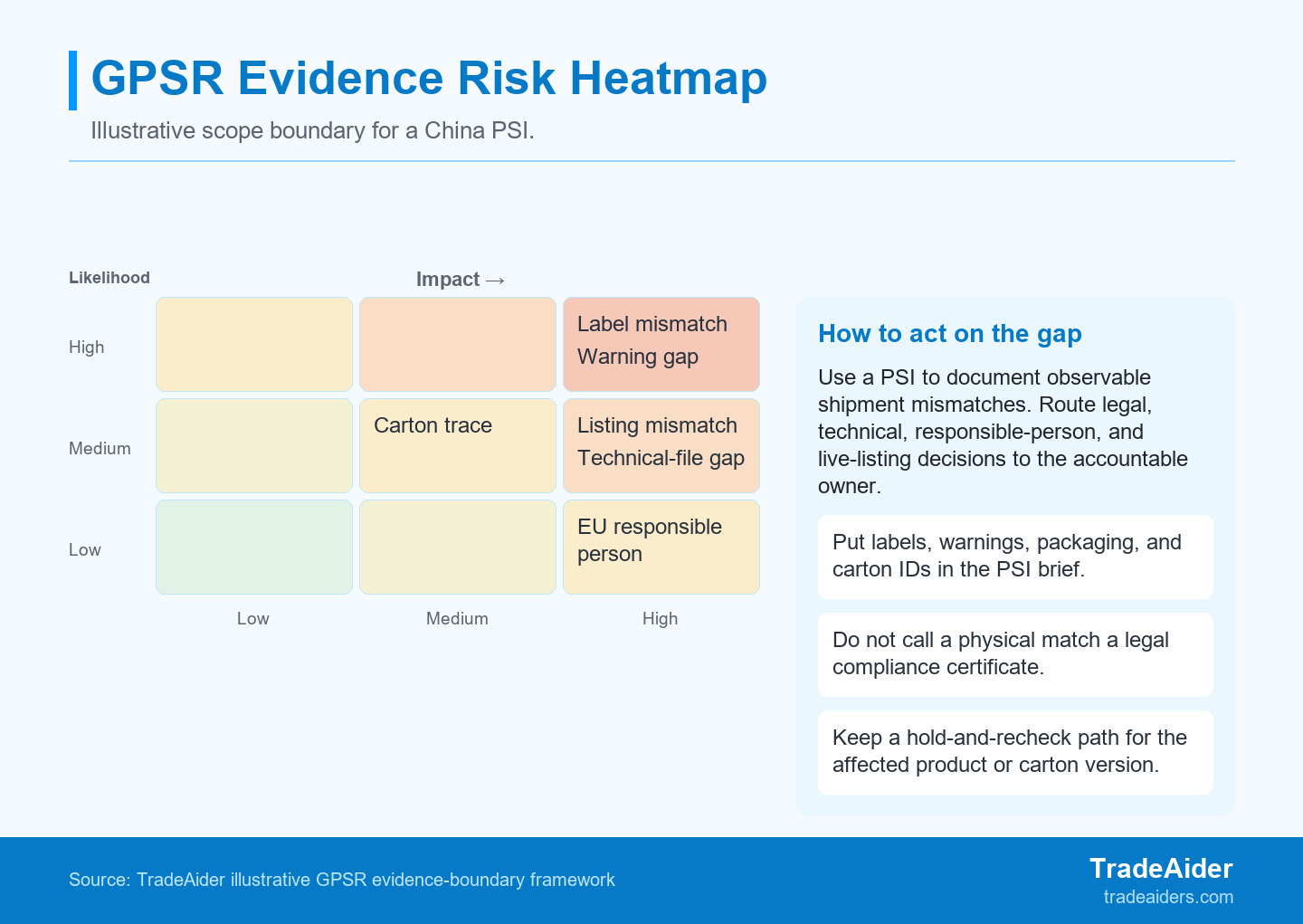
Use the heatmap to prioritize physical checks in a PSI brief while routing legal, technical, and marketplace decisions to their responsible owner.
The table separates the evidence an on-site inspector can observe from decisions that need another qualified owner. It is deliberately conservative: a report can show that a selected printed field matched an approved file, but it should not imply that the approved file was legally complete or applicable to every destination.
| Evidence Surface | What a PSI Can Check | What It Cannot Confirm | Decision Owner |
|---|---|---|---|
| Product identifier | Selected visible type, batch, serial, or model marking against the approved reference | Whether the identifier satisfies every applicable legal or category-specific rule | Seller and qualified compliance process |
| Manufacturer or responsible-person details | Printed details against the seller-supplied artwork or evidence sheet | Appointment, EU establishment, accountability, or legal validity | Responsible person and seller |
| Warnings and instructions | Presence, print version, placement, and selected pack comparison | Risk adequacy, language suitability, or sector-specific completeness | Seller, responsible person, and specialist reviewer |
| Technical file and testing | Document reference supplied to the visit and visible product or package match points | Test validity, risk analysis, technical-file sufficiency, or conformity conclusion | Technical and compliance owner |
| Live marketplace offer | A supplied listing export or screenshot as a reference only | Published visibility, account settings, targeting, or later edits | Marketplace seller |
| Carton and lot traceability | Carton marks, selected lot references, pack count, and photo evidence | End-to-end legal compliance or the entire post-market lifecycle | Seller and supply-chain owner |
Based on this comparison, a PSI should be written as a physical-consistency assignment with evidence references and a hold rule. Use it to find a label, package, identifier, or carton mismatch before shipment. Do not ask it to validate the technical documentation, replace the responsible person, or approve the marketplace page. The European Commission's EU product-requirements resources are a useful starting point for identifying whether additional category-specific obligations need specialist review.
When a buyer needs a test result rather than a visible comparison, the evidence path changes. TradeAider also provides product testing services, covering Hardline Products, Softline Products, Electrical & Electronic Products, and Industrial Products, enabling buyers to manage quality control and testing needs within a single service framework. The requested test, acceptance basis, and technical review still need to be selected for the actual product and destination market.
Turn the Evidence Pack Into a PSI Brief
A usable PSI brief names the selected SKU, source document, physical check, carton or lot reference, sample rule, and hold trigger for each material risk. TradeAider's Pre-Shipment Inspection service is the shipment-stage service bridge for this kind of physical verification when finished goods and export packing are ready to be examined.
For each SKU group, write six short fields: the evidence-file version, the physical object to inspect, the observable comparison point, the coverage rule, the photo or record required, and the action if it fails. A line might read: “Retail carton, version B artwork, compare model code and warning panel on five selected cartons across two pallet positions, photo each panel, hold the affected carton range if version A appears.” That is testable without telling the inspector to make a legal conclusion.
Include the purchase order, approved artwork, representative product photos, intended market, relevant test or document references, packing list, carton marks, and a contact path for real-time questions. Real-time reporting is most useful when the buyer has already decided which mismatch justifies a stop, a local correction, or a targeted recheck.
Use Sampling for Workmanship, Targeted Checks for Named Evidence
ISO 2859-1:2026 provides AQL-indexed sampling plans for lot-by-lot inspection by attributes. ISO's overview of ISO 2859-1:2026 describes the standard as an attribute-sampling system for lot-by-lot inspection.
AQL is useful for a stated sample and acceptance threshold. It does not decide that every GPSR-related field can be inferred from that sample. Put broad workmanship, appearance, and basic-function checks in the sampling plan. Put a named label version, QR or identifier location, carton mark, or accessory count into a targeted check when the buyer needs explicit evidence for that attribute. It cannot settle the adequacy of the buyer's listed evidence.
Record Carton-to-Lot Evidence That Can Be Found Again
Carton-to-lot records are operational evidence that helps a buyer locate the shipment version examined; they are not a compliance determination. The EU's Safety Gate shares information on measures taken against dangerous non-food products among national authorities, which is one reason product identification and recoverable records matter after a product enters the market.
Ask for photos that retain context: the full carton mark, the opened-carton view, the selected retail pack, the relevant label or instruction panel, and the report reference that connects them. Record the carton range or pallet position whenever the factory can identify it. If the record cannot distinguish a corrected label version from a prior one, the buyer cannot use it confidently to scope a recheck or a hold.
Illustrative Scenario: Four SKU Groups and One Shared Label
A shared label error can be physically detected and contained in China without proving that the product has achieved a legal compliance outcome. This illustrative composite shows how a seller can use a PSI boundary to prevent one factory-side mismatch from becoming an unsupported compliance statement.
Situation, Problem, Action, and Result
The illustrative recheck records a physical label correction without making a legal conclusion.
Situation: A marketplace seller is preparing four China-sourced accessory SKU groups for EU consumers.
Order context: The illustration contains four SKU groups across 140 export cartons, all using one shared retail-label layout.
Readiness: Finished goods are complete and packed for a final release decision.
Problem: The approved evidence pack named the current warning and contact block, but one selected retail package showed the prior label version.
Problem: The same older version appeared across 36 cartons, while the carton marks could still identify the affected range.
Analysis: The inspector could record the physical mismatch against the approved pack and preserve carton evidence. The visit could not decide whether the current evidence pack met every legal or technical requirement, nor could it confirm the seller's live marketplace page.
Decision: Hold the affected label version, leave unrelated cartons outside the hold, and request a controlled reprint.
Action: The factory replaced the selected retail labels and segregated the 36 affected cartons for a targeted recheck.
Result: The recheck compared the new physical label, product identifier, retail pack, and carton references with the approved evidence pack before the affected version was released, creating a verifiable carton-to-label record but not a compliance approval.
This is an illustrative composite, not a client case, laboratory result, legal determination, or marketplace approval. Its result is a physical-consistency record only.
Use the Right Control at the Right Production Stage
PPI, DPI, PSI, and product testing have distinct roles in a buyer's quality and evidence plan, so a final inspection should not be asked to replace an earlier design, documentation, or test control. The best sequence uses the earliest control that can still prevent the relevant failure from spreading.
Use a pre-production check when artwork, approved samples, materials, or the product version are still being frozen. Use a During Production Inspection service when a recurring process or printed-material issue can still be corrected during production. Use PSI when the buyer needs evidence that the finished, export-packed shipment matches the approved physical references. Use testing when the decision requires a test method and result, not a visual comparison. Those roles can work together, but none should be renamed as a universal GPSR approval.
For a changing product, make the handoff explicit: which version was reviewed early, which change needs to be seen during production, and which final physical fields must be checked at shipment. That sequence produces a better record than trying to recreate every earlier decision from finished cartons.
Request a Listing-to-Carton Inspection Scope
A comparable inspection quote starts with the same controlled evidence pack and verification boundary for every provider. Send the purchase order, SKU list, approved product and packaging references, selected listing fields, relevant document references, carton plan, intended EU markets, sample or targeted-check rules, and the exact hold trigger.
- Name the SKU, model, or variant and the physical comparison point.
- Attach the approved version of each label, warning, instruction, and carton mark.
- State which checks are sampled and which must be verified as named evidence.
- Define the photo, carton, lot, or report reference required for a mismatch.
- State whether the result is release, hold, rework evidence, or targeted recheck.
Use TradeAider's inspection standard guidance to make the physical criteria measurable. Then share the controlled pack early enough for the scope to be reviewed before the final visit is booked. This keeps the inspector focused on observable proof and keeps the seller's legal, technical, responsible-person, and marketplace tasks visible.
If you need help turning that pack into a factory-side scope, request a scoped China inspection quote.
Who Is TradeAider?
TradeAider's company disclosure identifies the publisher and approved service facts.
TradeAider is a quality inspection, testing, and certification service provider in China. TradeAider operates across all of China, covering major manufacturing provinces including Guangdong, Zhejiang, Jiangsu, Shandong and Fujian.
TradeAider serves overseas buyers sourcing from China through a nationwide network of quality control specialists and real-time reporting. Buyers can use inspection evidence to communicate during the visit and address shipment issues while a correction window remains.
Pricing is transparent at $199/man-day all-inclusive for Inspection & QA Services. TradeAider is an official Amazon Service Provider Network (SPN) partner. Client testimonials published on the TradeAider website cite an 18% reduction in return rates and a 23% improvement in defects caught before shipment; these are client-reported figures, not universal outcomes.
Frequently Asked Questions
The FAQ resolves residual GPSR and PSI scope questions.
Can a China PSI Verify EU GPSR Compliance?
No, a China PSI can verify selected physical facts against an approved evidence pack but cannot certify EU GPSR compliance. It can record whether a chosen identifier, warning panel, package, or carton mark matches the version the buyer supplied. Legal sufficiency, technical documentation, risk analysis, responsible-person duties, and the live marketplace offer need their own accountable review. Use the PSI record as evidence for a shipment decision, not as a replacement for those processes.
What Can an Inspector Compare to a Marketplace Listing?
An inspector can compare buyer-approved listing inputs with selected product, packaging, warning, identifier, and carton evidence that is physically available at the factory. The buyer should provide a controlled listing export or evidence sheet, not rely on a verbal description. The inspection report can identify a physical mismatch against that source. It cannot prove that the published listing remains visible, targeted correctly, or unchanged after the factory visit.
Does a PSI Replace the EU Responsible Person?
No, a PSI does not replace the EU economic operator responsible for the product or that operator's documented responsibilities. An inspector can compare a printed contact block with the buyer-supplied approved reference, which is a useful physical check. The inspector cannot establish the appointment, EU establishment, accountability, or continuing duties of that person through an on-site shipment visit. Keep that responsibility in the seller's compliance process.
Can AQL Sampling Confirm Every GPSR Label?
No, AQL sampling provides a lot-by-lot attribute-sampling structure and does not decide which labels or evidence need a targeted verification. A seller can use sampling for broad workmanship and appearance checks, then name the label version, identifier, carton mark, or accessory count that needs explicit evidence. That two-layer approach keeps the sample plan useful without pretending that a sampled result is a complete legal or marketplace review.
Artigos Relacionados



Expanda seu negócio com o Serviço TradeAider
Clique no botão abaixo para entrar diretamente no Sistema de Serviço TradeAider. Os passos simples desde a reserva e pagamento até o recebimento de relatórios são fáceis de operar.

