
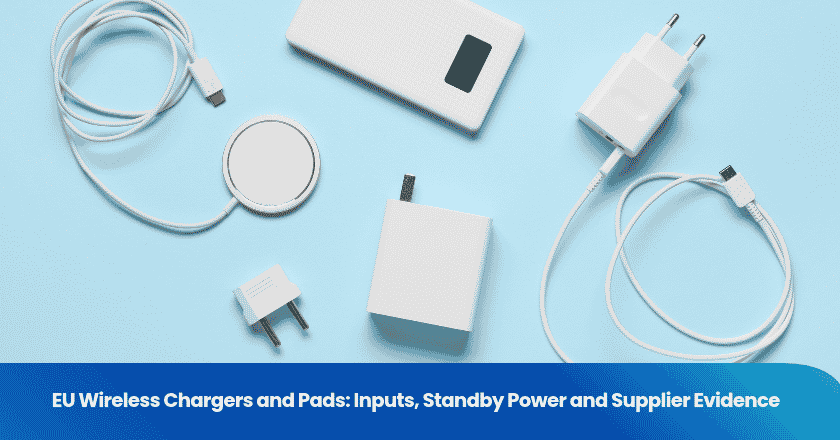
For EU wireless charging products, verify the input design and the standby test as separate decisions. First identify the actual power path and any applicable input-interface exception. Then check whether the supplier measured standby power at the correct AC or DC input, using the required configuration. A USB-C socket, a Qi logo or one low wattage cannot answer all three questions. Regulation (EU) 2025/2052 generally applies from December 14, 2028; model approval and supplier evidence should be prepared before affected products reach the EU market.
Regulatory position checked: October 30, 2026. The comparisons below concern the covered wireless charging products. External power supplies and cables can have additional obligations within the same retail bundle.
Three checks before approving a wireless charging model
- Identify the integrated or separate supply and which cable ends can be disconnected.
- Assess the input-interface rule independently of the standby measurement route.
- Match the report to the model, voltage, settings, measurement point and actual order revision.
Identify the wireless product and its power path
Article 2 of Regulation (EU) 2025/2052 defines wireless chargers and charging pads around inductive power transmission not exceeding 50 W, a separate consumer-product load and enclosure, and no electric power source apart from AC input power. A wireless charger contains an integrated power supply; a charging pad does not. Article 2 definitions.
An external power supply (EPS) is the separate mains-to-output power-conversion unit. In a typical mains-fed charging-pad arrangement, the EPS supplies DC to the pad. Follow the complete power path: the absence of an AC socket on the pad does not make its external supply disappear. Conversely, a product’s catalogue name does not establish where its power-conversion circuitry is located.
Request a connection drawing and photographs showing the charging surface, input, adapter and every cable connection. Ask the supplier to identify any internal battery, integrated mains supply, mounting arrangement and intended receiving device. A magnetic attachment for a phone does not by itself establish that the charging product is fastened to a support or secured in a specific location.
The European Commission’s dedicated product overview confirms that wireless chargers and charging pads are included in the new measure. Use the legal definitions for edge cases: a battery-powered accessory or a product above the defined inductive-transmission range needs a specific scope review. Do not extend a conclusion from a visually similar desk charger.
Put the identified configuration into the inspection references before discussing a generic “wireless charger check.” TradeAider’s inspection standards provide the inspection context; the buyer and technical owner still need to identify the actual model, drawings, ratings and intended checks for this order.
Check the DC input rule and its specific conditions
Annex II point 3(e)(2) requires the specified wireless chargers and charging pads to be powered by interoperable EPS and fitted at the DC input with a USB Type-C receptacle associated with a USB Type-C or USB-PD port. The provision excludes products intended for equipment under point 3(c) and products fastened to a support or secured in a specific location; it also contains an exception where mains-socket prongs are integral to the equipment body. Annex II input-interface provision.
For an ordinary movable, mains-fed desk pad without an applicable exception, plan for the specified interoperable EPS and USB Type-C DC input. USB Power Delivery (USB-PD) is the named power-negotiation interface in the regulation. The requirement is more specific than “a Type-C-shaped socket”: the receptacle has to be associated with the relevant port, and the supplying EPS must meet the applicable interoperability requirements.
| Question for this model | Evidence to request | Effect on the input decision |
|---|---|---|
| Is it fastened to a support or secured in a specific location? | Installation drawings, instructions and the actual mounting arrangement | Document whether the product itself is fastened to a support or secured in a specific location; a stand’s presence alone does not establish either condition. |
| Is it intended for equipment within Annex II point 3(c)? | Named receiving equipment, exact provision and design/testing/use evidence | Verify that the specific category and its conditions match; do not accept a generic “special use” letter. |
| Are mains-socket prongs integral to the equipment body? | Product photographs and mechanical/electrical drawings | Check the introductory exception in point 3(e); a cord with a wall plug is a different arrangement. |
| If none of those conditions applies, what is the proposed compliant design? | DC-input drawing, supported port/protocol and supplying EPS specification | Resolve the input design before relying on the product’s standby result. |
A manufacturer can identify a standby measurement route for a hard-wired product without proving that the same product satisfies the input-interface rule. In particular, the AC-input limit for a pad with a cable fixed at both ends is not permission to retain that cable where the input provision requires a USB Type-C receptacle. Record the two conclusions in separate fields.
The EUR-Lex summary gives December 14, 2028 as the general application date. Use that date to plan the model assessment and any redesign. Do not import spare-part or high-power EPS transition arrangements into a wireless-product decision without checking whether the provision actually applies to that product and obligation.
Choose the standby limit at the correct measurement point
Annex II points 1(n) and 1(o) set a 0.50 W standby limit at the DC input for charging pads except those connected to the EPS by a DC cable hard-wired at both ends. Wireless chargers with an integrated supply and pads with that both-ends-fixed connection have a 0.80 W limit at the AC input. Annex II standby limits.
| Actual arrangement | Limit and measurement point | What the result includes |
|---|---|---|
| Charging pad other than one connected to its EPS by a DC cable fixed at both ends | No more than 0.50 W, at the DC input | The pad input consumption; the external EPS’s conversion losses are outside that DC reading. |
| Wireless charger with its supply integrated into the same unit | No more than 0.80 W, at the AC input | The specified complete mains-fed product. |
| Charging pad connected to the EPS by a DC cable fixed at both ends | No more than 0.80 W, at the AC input | The specified supply-and-pad arrangement; assess the input-interface obligation separately. |
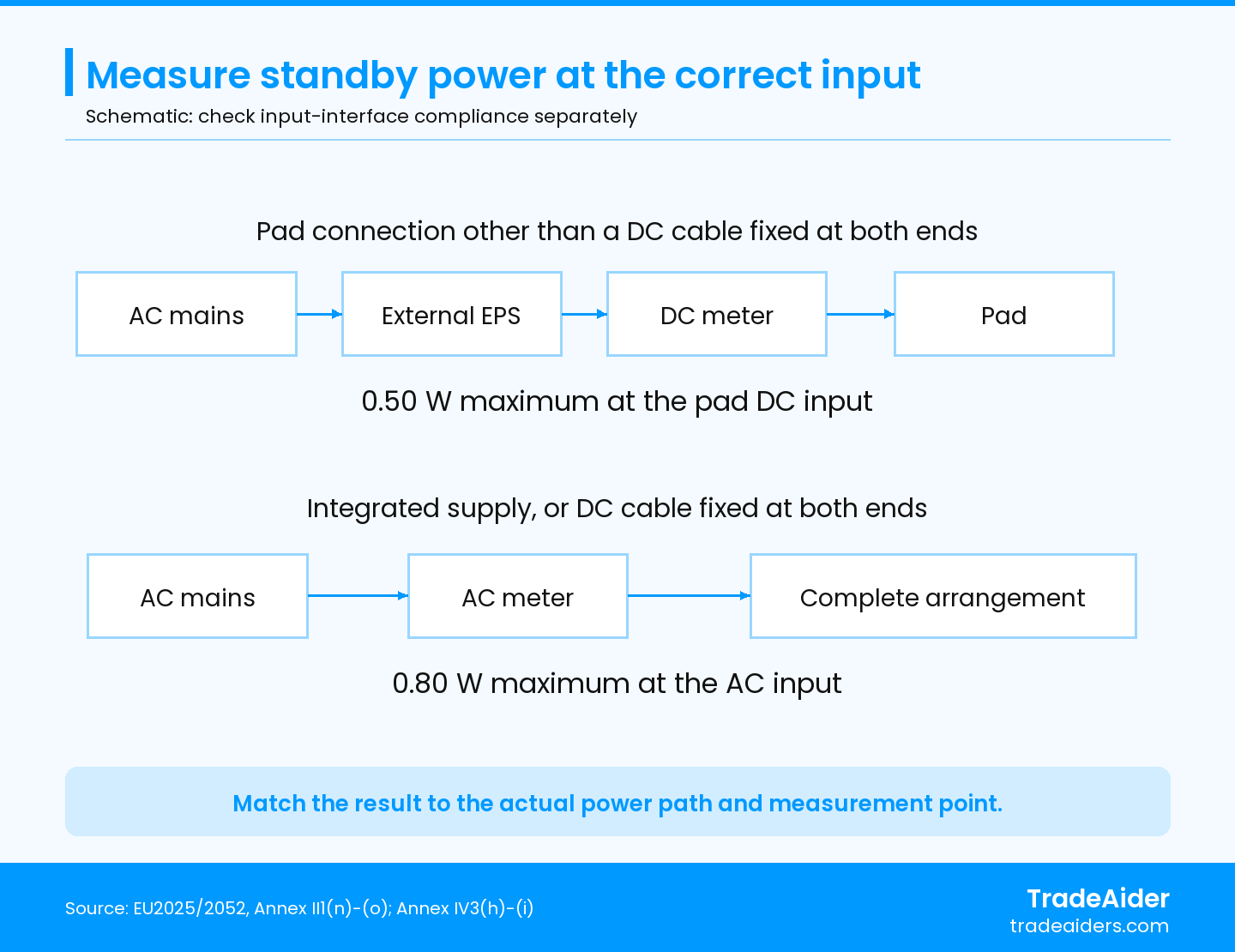
Use the measurement route for the actual connection: the DC-input pad limit is0.50 W; integrated-supply chargers and pads with the DC cable fixed at both ends use the0.80 W AC-input route. The input-interface obligation remains a separate check.
A cable fixed only at the pad, with a detachable connection at the EPS, belongs in the first row rather than the both-ends-fixed row. The DC measurement location can therefore be at the pad’s receptacle or at the plug of its fixed power-supply cable, as specified by the method. Photograph both cable ends so a later reviewer can reconstruct the boundary.
“Standby” is also a defined state, not simply any reading taken when no phone is charging. The definition referenced by Regulation 2025/2052 comes from Article 2(3) of Regulation (EU) 2023/826 and concerns equipment providing only the specified reactivation and/or information or status-display functions while dependent on mains power. Record the product state and functions present during the measurement. Use the wireless-product limits above rather than importing a different product’s general standby allowance.
Choose a batch sample separately from the technical test configuration. An AQL calculator can support an agreed order-sampling plan, but an AQL acceptance result does not establish which standby limit applies or whether the supplier measured at the right input. Those questions remain model-level technical checks.
Keep the test configuration reproducible
Annex IV point 3(i) requires the specified DC-input pad measurement in the factory setting with no object placed on the pad, at the appropriate DC connection point, using a source that supports the specified voltage and power. For adaptive supply operation, measurement uses the voltage set by the pad, and standby consumption is averaged for at least 10 minutes. Annex IV measurement requirements.
The DC-input route applies whether the pad is sold with an EPS or without one. A “pad only” listing does not remove the need to define the power source used for testing. For a pad that can negotiate several voltages, a source that supports only one of them may not reproduce the required setup. Ask for the supported levels, the source model and the voltage actually selected by the pad.
The integrated-supply and both-ends-fixed AC route uses standardized methods for household-appliance standby power measurements under Annex IV point 3(h). Do not assume that the DC route’s particular ten-minute condition is the complete AC method. The laboratory should identify the applicable method and its conditions rather than supply a single unexplained screenshot of a power meter.
For multifunction products, Annex II point 1(p) and Annex IV point 3(j) permit components performing other main functions to be disconnected or disabled for the measurement only when this does not affect wireless power transmission. This is a qualified test provision. It does not authorize arbitrary removal of circuitry to obtain a lower number.
For example, if a combined lamp and charging pad is tested with the lamp function disabled, ask exactly what was disabled, how it was disabled, and why the change leaves power transmission unaffected. Keep the factory-setting record and the permitted auxiliary-function change together. Do not describe a modified test state as the unchanged retail product, and do not assume every indicator is a separate main function.
A reproducible record should identify the firmware or control settings, receiver/object state, selected input voltage, measurement point, averaging period and treatment of other functions. Preserve the setup drawing and the underlying result, not only a pass box. Where a report does not state the boundary, classify it as incomplete evidence and request clarification before treating it as a failure or a compliant result.
Request supplier evidence for the exact model
A supplier evidence file is useful only when the model identity, hardware and software revision, connection arrangement, test state and measurement boundary can be matched to the product being purchased.
Name the technical assessor, testing laboratory and order-inspection provider separately. The supplier’s technical file and an order-inspection report serve different purposes; identify which record supports the model-level input and standby results and which records describe observations of the purchased batch.
Annex II point 6(g) identifies the technical-documentation information for integrated-supply wireless chargers, including manufacturer details, model identifier and declared standby power. Point 6(h) adds pad-specific information such as input voltage or range, supported power-delivery protocol, the test EPS identifier and input-compliance documentation, where applicable. The following request makes those legal fields usable in a purchasing file.
| Request field | Supplier response to complete | Buyer follow-up |
|---|---|---|
| Product and revision | Model: ___; manufacturer details: ___; hardware/firmware: ___; supply arrangement: ___ | Match the identifier and actual sample to the drawings and report. |
| Input design | Applicable condition/exception: ___; receiving equipment: ___; installation or integral-prong records: ___ | Ask engineering to confirm the exact condition; retain missing evidence as pending. |
| Power source and voltage | Input voltage/range: ___; protocol: ___; EPS model: ___; supported and selected voltages: ___ | Confirm the tested source and selected operating state are appropriate for the pad. |
| Standby setup and result | AC/DC point: ___; cable-end arrangement: ___; method: ___; period: ___; declared/result values in W: ___ | Compare the result with the limit for that same boundary and method. |
| Tested functions | Factory settings: ___; object/receiver state: ___; other functions disabled and justification: ___ | Resolve any change that could affect wireless transmission before accepting coverage. |
| Current order and report use | Covered IDs/revisions: ___; PO/SKUs: ___; approved references: ___; recipient requirements: ___ | Explain variant differences and agree what the order inspection will actually check. |
If the supplier claims Qi certification, verify the exact product in the Wireless Power Consortium’s certification guidance and database process. Match the product identity and certificate rather than treating a printed logo or “Qi compatible” wording as conclusive. The WPC also places responsibility for applicable product-safety regulations with manufacturers; its certification does not establish EU ecodesign conformity for the purchased configuration.
Keep the report’s scope attached to the version it assessed. If a supplier lists several models, ask what differs and how those differences were evaluated. An interchangeable retail name, common enclosure or similar coil layout does not explain whether the input circuitry, voltage negotiation or standby controls are equivalent.
Carry approved configurations into the actual order
A model change can invalidate the relevance of a previous configuration record even when the retail product name stays the same; review the changed power path, ratings, settings and supporting evidence before applying the previous conclusion to a new order.
Use pre-shipment inspection to compare the actual goods with the approved model, input arrangement, markings and other agreed references. For PSI, the order quantity should be 100% complete and at least 80% packed for export. The 80% condition concerns packing, not production completion; plan time for corrective action if the shipment contains an unapproved configuration.
Illustrative example: A buyer approves a detachable-input pad for an EU order. The supplier sends a report showing 0.62 W measured at the AC mains input of the adapter-and-pad combination, and calls it a pass against 0.80 W. That number does not establish the required DC-input result for the pad. The buyer should not relabel it as a DC failure either: the measurement includes a different boundary.
The technical owner requests the pad model, source and voltage details, factory settings and the DC-input measurement required for that configuration. The file remains “standby evidence pending” until those records support a conclusion. If the production order then substitutes a cable fixed at both ends, reopen both the standby-route assessment and the input-interface assessment; a changed route is not an automatic exemption.
Record which SKUs and quantities use each revision so an inspector can identify mixed configurations. If a discrepancy appears, photograph the actual connections and markings, identify the affected goods and ask the buyer to decide whether to hold them while engineering reviews the change. A corrected carton description cannot resolve an internal circuit or software mismatch.
After an approved correction, keep the supplier’s corrective evidence and arrange any necessary reinspection or additional technical testing. Update the reference only after the responsible technical owner accepts the change. The example describes a decision process, not a measured TradeAider client result or a guarantee that one inspection will resolve every compliance question.
Agree inspection scope and report use
An order inspection can compare goods with agreed references and record observed findings; it cannot by itself replace ecodesign conformity assessment or prove that every applicable product rule has been satisfied.
Observable agreed checks may include model and revision markings, cable detachability at each end, the visible input connector, supplied adapter identity, packing and functional checks supported by the agreed setup. Report missing references, unavailable equipment and unfinished checks explicitly. A visual Type-C check does not verify its associated port implementation, and a brief power-on demonstration does not establish standby performance.
The European Commission’s CE-marking guidance explains the manufacturer’s responsibilities for conformity assessment, the technical file and declaration of conformity, alongside importer and distributor responsibilities. Keep that legal assessment distinct from the order’s observed inspection findings. A CE mark does not indicate that the EU or another authority has approved the product as safe.
Before booking, confirm who will receive the report, its intended use and any language, format or institution requirements. Provide the approved model references and specify which configuration observations and measurements are requested. Where the evidence is incomplete, agree how that limitation will be reported and who can authorize the next action; an unclear test should not disappear inside a general pass conclusion.
For an initial inquiry, send TradeAider the product and order information already available, factory, destination, intended timing and known configuration concerns. Technical requirements can be clarified during scope discussions and must be agreed before inspection. Contact our team to discuss a suitable inspection scope and a report of the agreed checks, observed findings and limitations.
FAQ
Is Qi certification enough to demonstrate EU ecodesign conformity?
No. Qi certification is evidence for its certification program, while EU ecodesign conformity requires the applicable legal assessment for the exact purchased product. Check the certification identity if the supplier makes that claim, then obtain the separate input-design and standby evidence required for the EU configuration. Neither a Qi logo nor a successful charging demonstration fills a missing legal test record.
Does every product sold as a wireless power bank qualify?
No. A wireless power bank needs its own scope review because the regulation’s wireless-product definitions include specific power-source and configuration conditions. An internal battery changes the power-source facts and should be disclosed in the product description. Ask the technical owner to assess the real functions and applicable rules rather than applying a mains-fed desk-pad conclusion to a battery accessory.
Can a both-ends-fixed cable be treated like a detachable cable?
No. A cable fixed at both ends follows the specified AC-input standby route, while the product’s input-interface obligation still requires a separate assessment. Inspect both ends and preserve photographs; a cable fixed at the pad but detachable at the EPS is a different arrangement. If a supplier changes the cable design after testing, review the new configuration before carrying the previous evidence into the order.
Artigos Relacionados


Expanda seu negócio com o Serviço TradeAider
Clique no botão abaixo para entrar diretamente no Sistema de Serviço TradeAider. Os passos simples desde a reserva e pagamento até o recebimento de relatórios são fáceis de operar.