
- Sobre Nós

- Nossos Serviços
- Sua Indústria
- Recursos
- Notícias e Blog

Office furniture quality inspection fails when it checks a category instead of the exact build that will be packed and shipped. A task chair, height-adjustable desk, conference table, and mobile pedestal do not share one meaningful test list. Each has its own load paths, moving parts, adjustment claims, visible surfaces, assembly risks, and export pack. The buyer therefore needs a controlled product reference, defined check methods, and a clear link from every result to the units or cartons it represents.
A useful inspection can show what was observed under the agreed conditions. It cannot turn a brief stability check into long-term durability evidence, prove one chair fits every user, or replace a required laboratory report. The practical goal is narrower and more valuable: identify the current build, test the right questions at the right stage, and give the buyer enough traceable evidence to choose release, correction, reinspection, or further testing.
Inspect the Product Configuration, Not the Category Label
Office furniture quality inspection should begin with the exact chair, desk, table, or storage configuration because products sharing a category name can have different structures, adjustments, hardware, surfaces, and packing methods. Here, product configuration means the exact SKU together with its construction, component set, finish, mechanism, and packing revision. The first inspection task is to freeze those references, not to start shaking a convenient showroom sample.
The buyer should supply a revision-controlled drawing or specification, bill of materials where relevant, approved sample or signed appearance reference, mechanism and hardware list, dimensions, packaging file, label artwork, and known defect history. A useful NIST furniture compliance guide separates mandatory regulations from voluntary standards and organizes requirements by furniture scope. That distinction matters before inspection: the product category and destination determine which references belong in the file, while the buyer's approved specification defines the commercial build being purchased.
| Office furniture type | Configuration to lock | High-value on-site checks | Evidence that may sit outside inspection |
|---|---|---|---|
| Task or executive chair | Base, casters, gas lift, tilt mechanism, controls, armrests, upholstery | Adjustment travel, lock function, wobble, caster movement, visible assembly | Formal strength, durability, emissions, or conformance testing |
| Desk or table | Top, frame, legs, braces, cable parts, controls, height range | Dimensions, stability, surface flatness, adjustment, hardware engagement | Rated-load, electrical, or long-cycle performance evidence |
| Pedestal or storage unit | Cabinet, drawers, slides, locks, casters, handles, counterweights | Drawer travel, alignment, lock operation, stability, finish, carton fit | Product-specific stability or market compliance evidence |
| Panel or benching system | Panels, connectors, brackets, power or cable components, layout revision | Fit, alignment, hardware count, assembly sequence, finish matching | System-level structural, electrical, or acoustic evidence |
The table is a routing tool, not a universal acceptance standard. A powered desk needs checks that an unpowered table does not. A mobile pedestal creates caster, drawer, lock, and stability questions that a fixed bookcase may not. Even two chairs with the same upholstery can represent different products if their gas lifts or tilt mechanisms changed.
For Chairs, Trace the Mechanism and Adjustment Range
A chair check should connect the frame, base, casters, gas lift, tilt mechanism, controls, upholstery, and stated adjustment range to the same production build. That chain prevents a passing seat-height check on one mechanism from being applied to cartons containing another. It also forces the report to name which controls were operated, the specified travel or lock positions, and any drift, noise, looseness, or interference observed.
OSHA's workstation chair guidance treats the backrest, seat, armrest, base, adjustability, and suitable casters as connected parts of a workstation. For an importer, the value is not to copy each guidance point into a factory checklist. It is to translate the approved product promise into observable checks: does the backrest adjustment travel through the specified range, does the base match the approved design, and do the casters fit the intended floor application?
Short on-site checks should also be described honestly. Sitting in one chair, operating the lever five times, or applying a brief hand force may reveal a visible problem. It does not reproduce a formal cyclic durability or load test. If the purchase requirement names a BIFMA standard or another performance method, the buyer should request the applicable test evidence and confirm that the tested model and current production configuration match.
For Desks and Storage, Trace Loads, Clearances, and Moving Parts
Desk and storage inspection should follow the actual construction, installed hardware, work-space dimensions, drawers, doors, locks, cable features, and any height-adjustment system rather than borrowing chair criteria. The approved file should identify the intended use, critical dimensions, permitted movement, finish zones, and any rated load that the buyer expects to verify through a prescribed method.
For desks, check the top and frame together. Measure the approved width, depth, height, leg spacing, cable openings, and adjustment range. Confirm that legs, braces, motors, controls, and fasteners match the drawing. Operate height-adjustable units through the agreed range with the approved test condition, then note synchronization, collision protection if specified, abnormal sound, and visible instability. Do not invent a load test on site; use the buyer's method or escalate the question.
For storage, open and close drawers or doors in the specified sequence, check slides and stops, confirm locks and keys, observe gaps and alignment, and verify the installed caster or glide type. OSHA's work-space guidance links clearances to user postures rather than treating one desk dimension as universally suitable. That is the correct inspection boundary: verify the buyer-approved dimensions and features, while the design owner decides which user population and workplace layout they are intended to support.
These references should be settled before mass production. A pre-production inspection service can be relevant when the buyer needs the approved sample, drawings, components, finish references, and packing inputs compared before a large build begins. The local decision is whether the factory is starting with the right configuration, not whether a later final sample happens to look acceptable.
Use Five Evidence Layers for Office Furniture
A useful office furniture inspection separates configuration, structure and function, ergonomic features, surface and assembly, and packaging and lot identity because no single pass result answers all five questions. The represented population is the identifiable group of units or cartons to which a result can reasonably be applied. If a check cannot be tied to that group, the overall pass must not silently clear it.
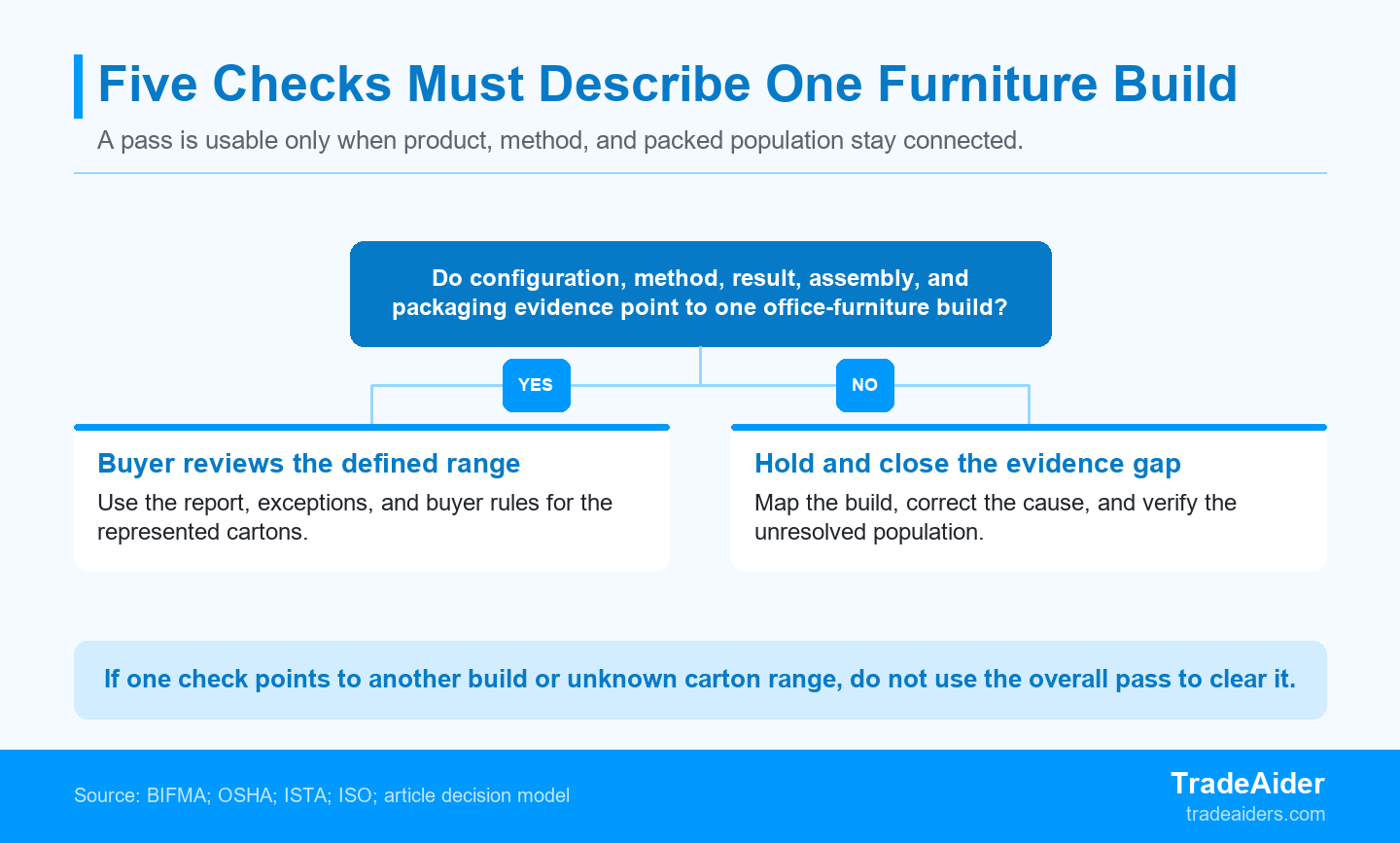
A pass can support review only when all five checks describe the same office-furniture build and packed population.
This five-layer test is a decision filter. Configuration asks whether the inspector saw the correct build. Structure and function ask what the unit did under the stated method. Ergonomic features ask whether specified dimensions and adjustments exist, not whether everyone will be comfortable. Surface and assembly ask whether the product can be built consistently and meets the appearance reference. Packaging and lot identity ask whether that acceptable condition will survive in the cartons being considered for release.
- Configuration: Which SKU, component revisions, finish, mechanism, and pack were checked?
- Structure and function: What method, condition, expected result, and actual result were recorded?
- Ergonomic features: Which approved adjustment, support, dimension, or clearance was verified?
- Surface and assembly: Did appearance, hardware, instructions, fit, and repeatable build agree?
- Packaging and lot identity: Which finished units and cartons does the evidence represent?
TradeAider can use the buyer's controlled references to observe and report agreed checks, but the method and decision rules need to exist before the visit. Buyers who are still defining defect classes and sampling logic can review the inspection standard before converting product risks into the final scope.
Start With Structure and Function Under a Defined Method
On-site checks can reveal wobble, loose fasteners, misalignment, poor drawer travel, unstable bases, and malfunctioning adjustments, but only when the applied method and expected result are written in advance. A directionless “stability check” can mean a light hand push to one person and a measured load at a defined point to another. Those observations are not comparable.
Write the characteristic first. For a conference table, that may be excessive rocking after installation on a level surface. For a chair, it may be seat-height drift after the control is operated under the agreed load condition. For a pedestal, it may be drawer binding, failure of a stop, or movement when a drawer is extended. Then define the setup, action, duration or cycles where appropriate, acceptance boundary, and reporting record.
The same discipline applies to sample distribution. One perfect front carton tells little about a 12-SKU shipment produced across several lines or dates. Select units across the actual lot structure, and make sure high-risk mechanisms or finishes are not hidden inside one convenient sample. Inspection effort should follow the ways the build can differ, not just the total carton count.
Verify Ergonomic Features Without Promising Universal Fit
Inspection can confirm that specified seat, backrest, armrest, caster, height, and work-space features are present and operate across the approved range, but it cannot prove one configuration fits every user. An ergonomic feature is a specified dimension, support, clearance, or adjustment intended to affect user fit or posture. The inspector can verify the product feature; the buyer or design owner must define the intended user and workplace context.
OSHA's workstation purchasing guide separates chair adjustability, base and caster characteristics, support, and work-surface considerations. That source is useful as a scope reminder, not as a substitute for the purchase specification. If the buyer promised a particular seat-height range, armrest travel, lumbar adjustment, or desk clearance, the report should show the measured or observed result against that approved range.
User trials and formal ergonomics evaluations answer other questions. A production inspection should not convert one inspector's comfort opinion into a claim that the chair suits a workforce. It can record sharp contact edges, controls that are difficult to reach, adjustment mechanisms that jam, or measured dimensions outside the approved file. Those findings support a product decision because they are observable and repeatable.
Then Check Finish Consistency and Assembly Repeatability
Surface and assembly evidence should connect appearance zones, color or grain direction, edge treatment, hole alignment, fastener engagement, instructions, and hardware kits to the same SKU revision. A scratch on the underside of a desk does not have the same customer impact as damage across the primary work surface. The defect standard should therefore name viewing conditions, appearance zones, and severity rather than relying on “good finish.”
Inspect color and gloss against controlled references under consistent lighting. Check veneer or laminate direction, edge-band gaps, glue marks, dents, contamination, paint coverage, weld finish, upholstery tension, seams, and exposed fasteners. Record the location and scale of a defect so the buyer can tell whether it is isolated workmanship or a repeated process issue.
Assembly simulation is most useful when it tests a real uncertainty: a new frame, revised hole pattern, alternate fastener, complicated instruction, or history of customer assembly complaints. Use production parts and current instructions. Record missing hardware, excessive force, tool requirements, hole mismatch, stripped threads, instability after assembly, and the final build identity. A successful build supports only the component and carton group represented by that evidence.
Separate Inspection Findings From Compliance Evidence
A physical inspection can compare materials, labels, warnings, and model identity with approved references, but it does not replace laboratory testing, certification, or a market-specific legal review where those are required. The inspection brief should name the destination and product claim, then separate what can be observed on site from what needs a qualified document or test.
Composite wood is a clear example. The US EPA's TSCA Title VI guidance describes certification and labeling requirements for regulated composite wood products and finished goods containing them. An inspector may compare the material declaration, product label, supplier record, and current SKU. A smell check, surface review, or unlinked certificate does not establish emissions compliance.
The same rule applies to formal strength, durability, stability, flammability, electrical, or emissions claims: first identify the applicable product and market scope, then identify the standard edition, test method, tested model, configuration, laboratory, result, and any validity or change condition. If that question sits outside the on-site scope, use an appropriate product testing service rather than rewriting a visual check as proof of certification.
Changes deserve special attention. A new panel supplier, adhesive, foam, upholstery, gas lift, caster, electrical control, or structural bracket may affect only some evidence, but the impact review should be documented. The buyer does not need to repeat every test automatically. The buyer does need to show why earlier evidence still represents the changed product.
Connect Packaging Protection to the Same Lot
Packaging is part of office-furniture quality evidence because a stable, well-finished sample can still arrive damaged when the carton, supports, hardware containment, panel separation, or packed orientation differs from the approved pack. Packaging checks should use the actual export configuration, not a clean sample assembled beside an unfinished carton.
ISTA Test Procedure 2C specifically covers individual packaged-products of furniture case goods for shipment and calls for the actual untested package and product when available. An on-site packaging review is not that laboratory procedure, but the scope distinction is valuable: the package and the product form one test object when the buyer wants evidence about distribution protection.
At the factory, compare carton dimensions, board and closure, corner and edge protection, panel separators, hardware-bag containment, moisture protection if specified, instruction placement, gross weight, handling marks, and packed orientation with the approved file. Open samples from different positions and dates where feasible. Check whether heavy parts can migrate, metal hardware can strike a finished panel, or loosely packed components can abrade surfaces.
Lot identity is equally important. Carton marks should connect the product code, finish, quantity, destination, and any batch information needed for follow-up. If the supplier repacks failed units, the report should distinguish corrected cartons from untouched and unresolved cartons. Otherwise, a successful recheck of a few repaired units may be mistakenly applied to a mixed population.
Illustrative Scenario: One Chair Family, Two Gas-Lift Revisions
A production chair that uses an unapproved gas-lift revision cannot be cleared by a conforming approved sample when the changed population is not yet mapped to finished cartons. The following scenario is illustrative and is not a TradeAider client case. It shows how a hidden component change can cross visible SKU boundaries.
Why the Approved Sample Could Not Clear Production
The approved chair proves the intended configuration, while the production finding represents a different mechanism revision; neither result establishes the performance or scope of the other population. An illustrative project buyer has 480 task chairs across four upholstery SKUs, packed one chair per export carton. The approved reference uses gas-lift revision A, a five-star base, and a specified seat-height range. Production is complete, but a factory change note says revision B was temporarily used after a shortage and lists only the component receipt date.
During an inspection of 20 assembled units, 3 chairs drift downward after the height control is operated and loaded under the agreed check. All 3 use revision B. The approved sample with revision A completes the same check, but the factory cannot map revision B to chair identities or carton numbers. Cartons show four upholstery colors, yet the mechanism change cuts across those colors, so SKU appearance cannot isolate the affected build.
Three findings do not prove that all 480 chairs fail, and the passing approved sample does not clear revision B. The missing component-to-chair map prevents the buyer from defining a smaller represented population. The buyer therefore holds the chair family, asks the factory to reconstruct component issue and production records, and rejects an overall pass or color-based release while the mechanism scope remains unknown.
Map the Changed Build, Correct It, and Reinspect
A defensible verification records the affected chair serial or lot, gas-lift revision, defined height-cycle check, corrected population, selected reinspection units, and carton range represented by the result. The supplier identifies the chairs built with revision B, restores revision A or obtains buyer approval for a validated alternative, reworks the affected chairs, and separates corrected cartons from unresolved units. The buyer can reconsider a conditional decision only after reinspection links the mechanism revision, chair identity, upholstery SKU, check result, correction status, and carton range. This illustrative example does not set a valid sample size, define a BIFMA method, estimate a real failure rate, or transfer release authority.
Read the Report by Method and Population
An office furniture report is decision-ready only when each important finding names the tested unit, method, result, severity, affected SKU or lot, supporting image, and the limit of what the check proves. “Chair unstable” is incomplete. A useful record identifies the chair, surface and setup, observed movement or failed requirement, component revision, defect classification, sampled population, and the buyer action that remains open.
Sampling must also follow the lot definition. The NIST handbook on lot acceptance sampling describes drawing a random sample from a lot and using its information to decide the disposition of that lot. This is why the report must state the lot, sample distribution, defect classes, and acceptance or rejection numbers. Sampling cannot repair a lot that was never defined.
Acceptance Quality Limit (AQL) is commonly used to index an attribute-sampling plan, but it should not be reduced to “a small percentage of defects is allowed.” The buyer needs the chosen standard or plan, lot size, inspection level, sample size, defect classifications, AQL values, and acceptance and rejection thresholds. A critical structural or safety concern may also require immediate escalation regardless of the cosmetic count, according to the buyer's agreed rules.
Read every overall result against four questions: What exact build was checked? What method and boundary were used? Which units or cartons does the result represent? What exceptions remain? If any answer is missing, the report can still be useful as a finding record, but it is not yet a complete release basis.
Place Checks Before Problems Become Packed Defects
Office furniture controls should be placed at the earliest stage where the named problem can be seen and corrected: references before production, mechanisms and assembly during production, and the finished packed lot before shipment. Final inspection is valuable for verifying finished goods, but it is expensive as the first time anyone checks a mechanism revision, hole pattern, upholstery batch, or carton construction.
| Control stage | Office-furniture decision | Useful evidence | Escalate when |
|---|---|---|---|
| Before production | Is the factory starting with the approved build? | Drawings, sample, finish, components, methods, packaging file | References conflict or a required test plan is absent |
| During production | Are mechanisms, joints, finishes, and hardware repeating correctly? | Line samples, component lots, assembly checks, early defect pattern | A change or repeated defect can affect later packed units |
| Before shipment | Do finished goods and actual export packs support the buyer's lot decision? | Distributed samples, functional results, quantity, cartons, marks, exceptions | The report cannot map findings or corrections to the release population |
A during-production inspection is useful when the buyer needs to observe component identity, assembly fit, adjustment mechanisms, upholstery or finish consistency, and early packaging before the supplier completes the lot. The visit should answer a defined process question and leave time for containment. It should not be sold as a substitute for a formal product test or the final packed-lot review.
Prepare the Inspection Brief
The inspection brief should identify the SKU matrix, drawings, approved sample and finish, component revisions, functional methods, defect classes, sampling instruction, packaging specification, labels, and buyer-owned escalation rules. It should also state production and packing status, factory address and contact, available equipment, sample distribution expectations, and which documents the inspector may compare.
For every high-risk check, write one complete instruction: characteristic, reference, setup, action, expected result, defect class, and evidence to capture. For example, “operate all specified chair adjustments” is not enough. Name the height range, tilt and lock positions, load or setup if approved, number of operations, unacceptable drift or interference, and required photo or video record. Use equally precise instructions for desk height travel, drawer locks, hardware kits, assembly, and carton protection.
Finally, name the decision owner. TradeAider reports observations and results against the agreed scope and can provide real-time visibility where it helps the buyer respond during the visit. The buyer decides whether an exception is accepted, corrected, reinspected, tested, or held. If the factory is authorized to perform immediate correction, the brief should say which defects may be corrected, how corrected units remain identifiable, and what recheck evidence is required.
Five Gates for a Defensible Office Furniture Decision
A defensible decision requires one defined configuration, five complete evidence layers, a stated method, a traceable packed population, and a report that preserves the buyer's decision boundary. Apply these gates in order:
- Identify the build: lock the SKU, components, finish, mechanism, and pack revision.
- Assign the evidence: separate on-site checks from formal testing and market obligations.
- Control the method: state setup, action, expected result, and defect rule before inspection.
- Map the population: connect samples, component changes, corrections, and cartons.
- Keep authority clear: use the report to inform the buyer's release, hold, or escalation decision.
If the finished order is ready and those inputs can be supplied, send TradeAider the SKU matrix, approved references, current packing status, check methods, defect rules, and known changes to request a scope-matched furniture pre-shipment inspection.
Frequently Asked Questions
What does an office furniture quality inspection include?
An office furniture quality inspection should cover the exact build, defined functional checks, specified ergonomic features, assembly, finish, packaging, and current lot identity. The scope changes by product: a chair needs mechanism and adjustment checks, while a desk or storage unit needs different dimensions, moving-part, load, and hardware checks. It should also state what requires separate laboratory, certification, or market evidence. The report must identify the sampled units and cartons represented by each important result.
Can on-site inspection alone prove BIFMA compliance?
On-site inspection alone cannot prove BIFMA compliance because formal conformance depends on the applicable standard, prescribed methods, and supporting test evidence. A factory visit can verify model identity, visible workmanship, specified dimensions, component revisions, labels, and defined functional observations. It should not claim that short checks reproduce formal strength or durability methods. Ask which standard edition, model, configuration, laboratory scope, report, and change conditions support the claim, then confirm that the evidence represents current production.
How many office furniture units should be assembled?
The assembly sample should reflect SKU variation, joint complexity, hardware revisions, past defects, and the commercial consequence of a failed build. A new frame, changed hole pattern, alternate fastener, or difficult instruction may justify more representative builds than a stable repeat order. Agree the assembly plan before inspection, include current production parts and instructions, and record which cartons the result represents. A passed build on one SKU does not automatically clear another SKU or a changed hardware population.
Should packaging failures affect the furniture release decision?
Packaging failures should affect release when they can damage furniture, lose hardware, mix revisions, or break traceability to the approved export pack. The buyer should distinguish a local carton issue from a repeated packaging-system problem and define whether the affected scope needs repacking, expanded checking, or a hold. After correction, the report should identify the repacked cartons and verify the new protection. A clean unpacked sample does not prove that an unverified export carton will protect it.
Who makes the final office furniture release decision?
The buyer or an authorized buyer representative makes the final release decision after reviewing the agreed inspection evidence and any unresolved exceptions. The inspection provider reports what was observed and tested within the approved scope. The supplier may correct issues and provide records, while a qualified laboratory may produce separate test evidence. None of those parties should silently change the buyer's defect rules or acceptance conditions after the result is known. Document any concession, hold, reinspection, or split release against the exact represented population.

Artigos Relacionados


Expanda seu negócio com o Serviço TradeAider
Clique no botão abaixo para entrar diretamente no Sistema de Serviço TradeAider. Os passos simples desde a reserva e pagamento até o recebimento de relatórios são fáceis de operar.

