
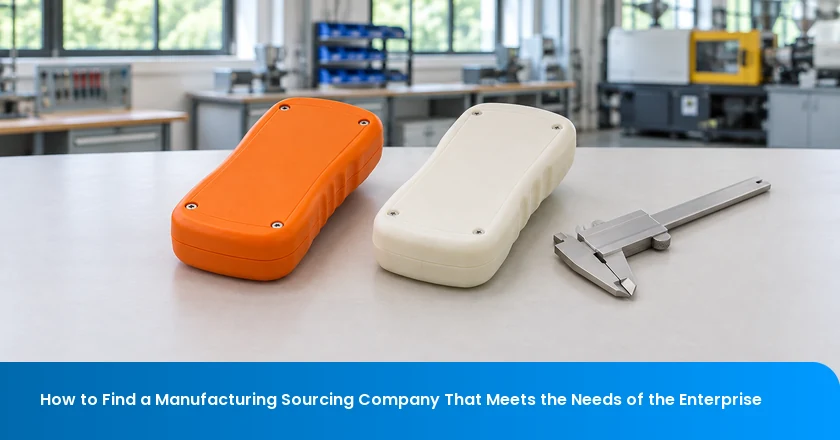
Find a manufacturing sourcing company by defining the production work and procurement support your enterprise needs, then testing candidates against that brief. Look for a credible route to the right manufacturers, clearly allocated services, comparable commercial terms and a trial that demonstrates the proposed arrangement. Use the results to agree an operating scope and decide how performance will be reviewed.
The strongest fit depends on the project. A team launching a custom molded component needs different support from a purchasing department consolidating repeat orders. Give candidates enough detail to explain what they can do, which factory resources they will use and where further technical work is needed.
Decisions to make before appointing a sourcing company
- Define mandatory manufacturing requirements and the service gaps your own team needs filled.
- Evaluate the proposed factory route, assigned people and outputs against the same project brief.
- Use a trial and a written agreement to establish how the selected arrangement will work.
What a manufacturing sourcing company can do for the enterprise
A manufacturing sourcing company can help an enterprise find and evaluate manufacturers, plan procurement, negotiate commercial terms and coordinate quality, logistics and supplier reporting. Agree the actual tasks and responsibilities for the project. Some companies mainly introduce suppliers, while others manage continuing procurement and manufacturing coordination.
Materials, components, equipment and finished products may all require sourcing support. The enterprise should identify the work it wants the provider to perform across that purchasing cycle. Supplier introductions, sample coordination, production follow-up and delivery planning require different resources and produce different outputs.
Using a partner can free internal staff from repetitive coordination and provide access to relevant manufacturing contacts. Better demand planning may also help align purchasing quantities and delivery frequency with production needs. These benefits depend on the provider’s actual coverage, the quality of the information exchanged and the enterprise’s own decisions.
Begin with the reason for outsourcing. If the main gap is identifying a suitable molding process and factory, assess technical sourcing knowledge. If qualified factories are already in place but replenishment is poorly coordinated, planning and communication may matter more. Retain an internal owner who can answer product questions, evaluate recommendations and authorize commitments.
Define the manufacturing and business needs before searching
Define the product, drawing revision, material, manufacturing process, critical requirements, expected demand, delivery pattern and service gaps. Separate mandatory needs from preferences and identify missing technical information before comparing providers. A requirement such as an approved material or functional fit should remain visible beside commercial targets.
Include the expected order pattern and the work already covered internally. A sourcing company needs to know whether it is supporting development, an initial production order or recurring supply. State the minimum order quantity (MOQ) you can manage, the expected replenishment pattern and any capacity increase that candidates should discuss.
NIST MEP’s US domestic supplier scouting connects purchasers with manufacturers having specific production and technical capabilities and business interest in supplying the item. Its capability-based approach illustrates why a manufacturing brief needs more detail than a product category and target price. The program’s supplier search concerns US domestic manufacturers. NIST supplier-scouting description.
For a custom component, supply the drawings, material specification and known inspection or testing requirements available at this stage. Identify unresolved tolerances or performance questions for technical review. Ask candidates how they would close those gaps, and compare firm commitments only after the requirements needed for that comparison are clear.
Build a shortlist through relevant manufacturing channels
The Canadian Trade Commissioner Service’s China sourcing roadmap treats internet research as preliminary, describes exhibitions as a contact channel and advises choosing suppliers whose operational size fits the intended sourcing needs. Use those distinctions when considering the factory network a sourcing company proposes for your project. China sourcing research and selection guidance.
Build a shortlist through relevant industry exhibitions, professional associations, manufacturing directories, referrals and targeted online searches. For each lead, record the product families served, manufacturing processes covered, operating locations and apparent service scope. A referral is most informative when the referring company used the provider for comparable work.
Use the same brief for initial conversations. Ask what manufacturing route the company would investigate, which parts of the project it would handle and which resources would be assigned. Keep candidates whose responses address the actual project, and record the reason for excluding those whose offer falls outside it.
Follow relevant industry developments as the shortlist forms. Changes in material availability, process technology or demand may change the type of factory needed. Ask candidates to explain how a development affects your requirements and delivery plan, supported by project-specific information where available.
Evaluate manufacturing knowledge and access to the actual factory
ASQ recommends cross-functional supplier selection considering relevant experience, quality systems, capacity, technical support and total cost. Formal quotations, site visits, references and sample evaluation can help assess fit. Involve purchasing, engineering, quality and production as needed when evaluating the manufacturers proposed by a sourcing company. ASQ supplier-selection guidance.
Ask the provider to explain how it would evaluate the processes that matter to your product. For an injection-molded enclosure, that could include the intended material, tooling route, molding equipment, assembly method and dimensional checks. Identify the actual proposed site and any subcontracted finishing or specialist work. Have the relevant technical owner assess the response.
Request a redacted example of comparable project work, the assigned contact’s responsibilities and a proposed factory-evaluation output. Examine whether the records identify the product requirements, observed capabilities, capacity assumptions and unresolved questions. Respect client confidentiality when asking for references, and focus on experience relevant to the assignment.
ISO 9001 specifies requirements to establish, implement, maintain and continually improve a quality management system. Compare that system evidence with the actual production tasks the factory must perform. Review the relevant entity and scope of a supplied certificate alongside the process and equipment information needed for this project. ISO quality-management standard overview.
TradeAider’s factory audit can support a focused assessment of the proposed factory’s production equipment, capacity, quality management and warehousing within an agreed scope. Give the assessor the manufacturing questions that need evidence. Keep the resulting factory findings connected to the enterprise’s wider sourcing-company evaluation.
Match the service scope to the work your team needs
Map supplier search, demand planning, quote negotiation, sample coordination, quality checks, logistics and reporting to named provider outputs and retained enterprise decisions. Clarify any subcontracted specialist work and exclusions. This reveals whether a proposal fills the enterprise’s actual operating gaps.
Use the following comparison when discussing scope. Adjust the allocation to the project and the parties’ agreement.
| Service task | Provider output to agree | Enterprise decision or input |
|---|---|---|
| Supplier search | Manufacturing shortlist with capability and location evidence | Which candidates advance to evaluation |
| Procurement planning | Quantity, capacity and replenishment proposal | Demand forecast and inventory commitments |
| Commercial negotiation | Comparable quotation and declared fees | Acceptable price, payment and delivery terms |
| Samples and development | Traceable samples, revisions and open technical questions | Approved product and production references |
| Quality coordination | Agreed check plan, findings and corrective follow-up | Acceptance requirements and disposition |
| Logistics | Agreed transport, packing and document coordination | Delivery route, responsibilities and release instruction |
| Supplier reporting | Delivery, quality, cost and unresolved-action updates | Improvement priorities and continuation decision |
For each selected task, identify the assigned person, expected output and escalation route. Clarify whether a service is included, separately charged or dependent on another provider. A business that needs ongoing purchasing support should compare the proposed reporting and planning resources as carefully as the initial supplier search.
Compare fees and quotations on the same commercial basis
Compare provider fees, goods prices, tooling, samples, travel, quality work, transport assumptions and change charges on the same basis. Ask who pays the sourcing company and which supplier commissions or rebates apply. A request for quotation (RFQ) should give candidates the same product revision, order assumptions and requested work.
Separate recurring order charges from development or tooling costs. Identify exclusions and payment triggers before ranking offers. Where freight, inspection or a specialist process remains unquoted, show that amount as unresolved and obtain the missing estimate. Compare the resulting complete scope when deciding whether a price difference represents value for the enterprise.
ITA explains that Incoterms allocate delivery-related tasks, costs and risks between sellers and buyers. Payment method and timing, ownership transfer and dispute resolution need other contract terms. Specify the chosen delivery rule, named place and version when it is used, and address the other commercial conditions in the agreement. ITA explanation of Incoterms and their scope.
Also ask how a material, quantity or delivery change would affect the quotation. A clear change-pricing method helps the team compare proposals for the conditions it is likely to encounter after appointment.
Use a trial to test the proposed manufacturing arrangement
The Canadian Trade Commissioner Service’s China sourcing roadmap warns that a high-quality sample does not remove the need for quality control during mass production. Evaluate the intended manufacturing route as well as the sample. Agree what the trial must demonstrate and which differences from the intended production route must be disclosed. Sample and production guidance.
A trial can also show how the sourcing company handles technical questions, updates the product file, communicates a delay and closes an observed discrepancy. Set the acceptance conditions, responsible reviewers and next decision before the work starts. Keep those conditions proportionate to the actual project.
Illustrative example. In this illustrative molded-housing project, a provider offers a polished prototype but cannot identify the planned injection-molding site or explain how production material and fit will be verified. Keep the production appointment conditional until the provider supplies a specific route and a trial result against the agreed requirements.
The enterprise needs a housing that fits an existing assembly and can be replenished through the intended molding process. Its engineering reviewer asks the provider to identify how the prototype was made, the proposed production material, tooling and factory, and the checks for the mating features. The sample’s appearance alone leaves those manufacturing questions open.
The provider supplies the proposed route and coordinates a production-relevant trial. The enterprise then compares the agreed material and fit requirements with the documented results and reviews how the provider handled the open questions. Any trial limitation, such as temporary tooling, remains visible in the appointment decision.
The observable outcome is an identified manufacturing arrangement and reviewed trial evidence for the required features. If the route remains unidentified or a mandatory fit requirement is unresolved, keep the production commitment open while the missing work is completed. This hypothetical example shows what the trial must establish for that project.
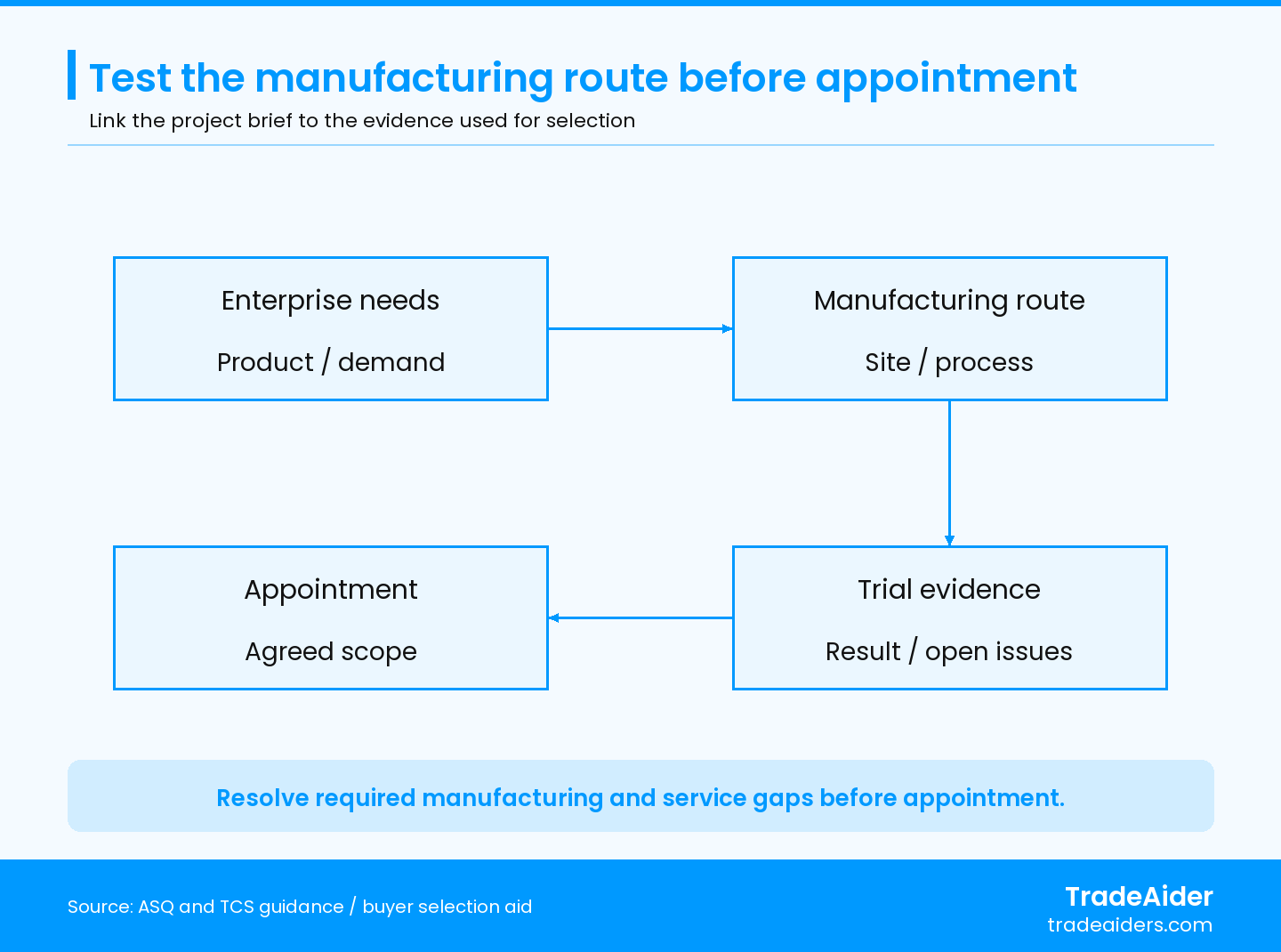
Selection aid. Keep the intended manufacturing route linked to the trial result used to appoint a sourcing company.
Turn the selected proposal into a clear operating agreement
Record the contracting parties, manufacturing scope, deliverables, approvals, fees, payment milestones, quality remedies, change controls, records access and exit arrangements in the operating agreement. Connect these terms to the proposal and trial findings so unresolved work is assigned before production commitments are made.
Identify the company selling the goods, the sourcing provider’s contractual role and the manufacturing sites covered. State who may approve a substitute material, change a production site, accept corrective work or authorize dispatch. Define how a proposed change reaches the person with the relevant decision authority.
WIPO’s supplier IP guidance recommends defining existing and newly created intellectual property, access and use, confidentiality, responsibilities, milestones and the return of materials when the relationship ends. Address these issues where the project involves designs, tooling information or development work. Have the relevant contract specialists establish the actual rights and terms for the arrangement. WIPO supplier IP agreement guidance.
Agree how the enterprise will receive the current working records, what happens to open orders on termination and how access to tooling or manufacturing information will be handled under the agreed rights. These details make continuity and an eventual provider change easier to manage.
Review performance as demand and manufacturing conditions change
Review actual delivery, quality findings, cost changes, issue response and agreed improvement actions. Reassess fit when demand, manufacturing sites, materials, key processes or the provider’s assigned resources change. Use the project’s agreed priorities to decide whether the relationship remains suitable.
For continuing procurement, compare promised and actual milestones using consistent definitions. Record what caused a delay, which corrective action was agreed and whether the next relevant order showed improvement. Discuss forecast changes early enough for the provider and factory to evaluate capacity and purchasing implications.
Long-term collaboration can include joint process improvement or development work where the parties agree the resources, objectives and commercial terms. Review the results against those commitments. Keep industry developments in view and update the sourcing plan when a change affects the enterprise’s product, supply continuity or cost assumptions.
Complete an enterprise-to-provider fit record
Record each mandatory enterprise requirement, the provider’s committed response, the evidence reviewed and the unresolved action before appointment. Use the result to choose proceed, clarify or decline for the specific project. Copy the record for each candidate and compare the responses against the same requirements.
| Enterprise requirement | Provider response and evidence | Decision or open action |
|---|---|---|
| Product, material and manufacturing process ___ | Proposed site, route and technical evidence ___ | Manufacturing gap and reviewer ___ |
| Demand, capacity and delivery pattern ___ | Capacity assumptions and planning response ___ | Unconfirmed condition and follow-up ___ |
| Required sourcing services ___ | Assigned people, outputs and exclusions ___ | Missing task or accepted allocation ___ |
| Commercial comparison basis ___ | Fees, incentives, tooling and delivery assumptions ___ | Unquoted item or agreed basis ___ |
| Trial and quality requirements ___ | Actual route, results and limitations ___ | Proceed, clarify or decline ___ |
| Agreement and continuity needs ___ | Approvals, rights, records and exit terms ___ | Condition to close before appointment ___ |
| Overall project fit ___ | Evidence references and remaining issues ___ | Decision maker, conditions and date ___ |
For the molded-housing example, enter the missing factory and production route in the first row and the required fit result in the trial row. Update the decision when that evidence is reviewed. Preserve any remaining conditions beside the appointment decision so the next person can act on them.
Prepare a focused factory assessment request
Start with available product and order information, proposed factory, destination, timing and manufacturing concerns. Agree the factory-assessment scope, references, feasible checks and report before the visit. Identify which questions concern equipment, capacity, quality management or warehousing, and share the relevant technical references already available.
Contact our team to discuss a focused factory assessment. TradeAider can report the agreed checks and findings for the enterprise to consider alongside its sourcing provider’s proposal and other project evidence.
FAQ
Can an enterprise start before every technical requirement is final?
An enterprise can start a sourcing discussion with available product references and known business needs, then clarify missing requirements before comparing binding proposals. Identify who will resolve an open material, tolerance or performance question and when that answer is needed. A candidate’s explanation of the missing work can help assess its understanding of the project.
Does a smaller order always need a larger sourcing company?
No. The useful choice depends on the provider’s relevant resources, order economics and willingness to support the actual manufacturing project. Ask how your work will be staffed and how the proposed factories handle that order pattern. Compare the response with the technical and service needs in the brief, including any expected growth or repeat-order support.
What should the enterprise retain if it changes sourcing companies?
Keep the current product, supplier, commercial and quality records, together with the access and transfer arrangements agreed for the project. Include approved revisions, open-order status, trial findings and unresolved actions so the next owner can continue the work. Confirm how the agreed rights apply to tooling, designs and supplier information before planning the handover.
Artigos Relacionados
Expanda seu negócio com o Serviço TradeAider
Clique no botão abaixo para entrar diretamente no Sistema de Serviço TradeAider. Os passos simples desde a reserva e pagamento até o recebimento de relatórios são fáceis de operar.