
- Sobre Nós

- Nossos Serviços
- Sua Indústria
- Recursos
- Notícias e Blog
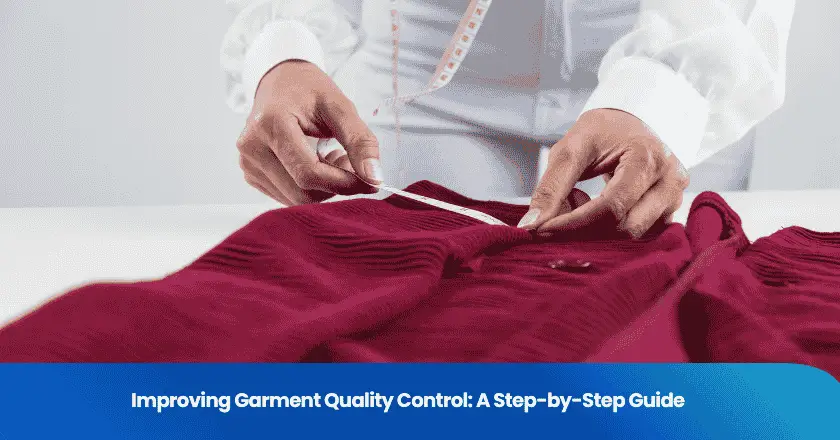
Improving garment quality control is a step-by-step program, not a single final check. It starts with a standard written as measurable criteria, continues through inspections placed at each production stage, and depends on trained people and written procedures to apply that standard the same way every shift. Tools and statistical methods then read the process rather than one batch, and the supplier and the inspection equipment decide whether the result holds. Each step changes what the next step can verify, so the release decision is only as strong as the step that is missing.
What Improving Garment Quality Control Actually Takes
Improving garment quality control is a sequence of steps, not a single final inspection: each step changes what the next step can verify. A benchmark tells an inspector what to accept; staged inspections apply that benchmark at the point where a fault can still be corrected; training and procedures keep the same benchmark in use across shifts; tools and statistics read the pattern behind the individual readings; and the supplier and the equipment decide whether that pattern holds on the next order. Published rules and methods set what some steps have to confirm, while the rest is buyer-side process discipline. The practical consequence is a release rule: hold a lot until the records for each step exist, and treat a missing step as a gap in the decision rather than a formality. Buyers who want to see who performs the checks before sharing production records can review TradeAider's company background.
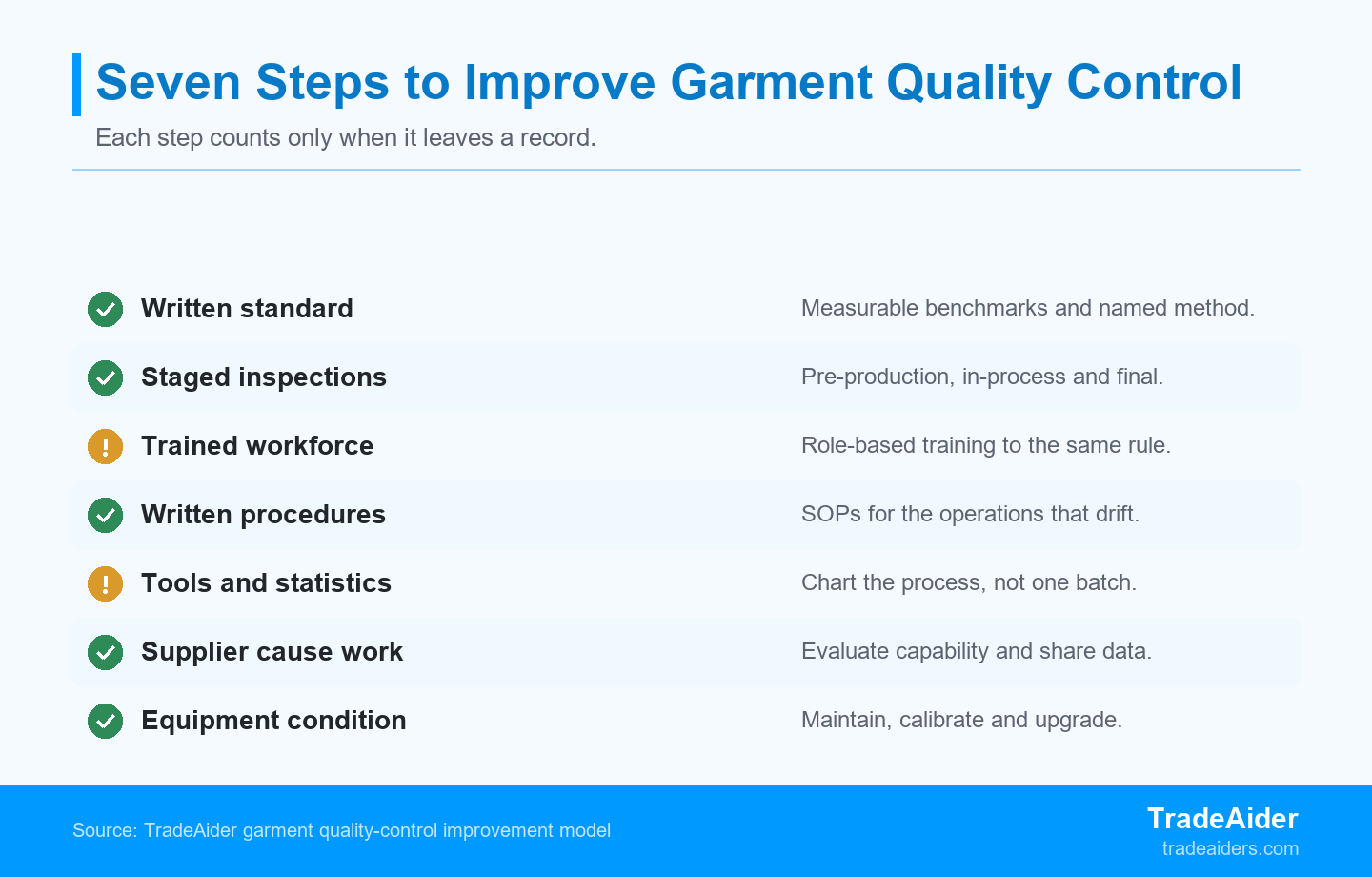
Each step counts only when it changes something measurable and leaves a record, so the standard and the staged checks come before the final inspection.
Step 1: Set and Document the Quality Standard
A quality standard only changes production when it is written as measurable criteria and given to the people who apply it on the line. Writing "good stitching" into a purchase order leaves the decision to each inspector; writing "no open seam longer than 5 mm on any seam" gives them a rule they can apply the same way. The standard should cover the characteristics the buyer is paying for, including dimensions, construction, color, finish and labeling, and it should name the method used to check each one. The two steps below turn that standard into something a factory can hit: define the benchmarks, then document the requirements and the records that prove them.
Define Measurable Quality Benchmarks
A benchmark is usable only when it names the characteristic, the unit and the tolerance, so two inspectors reading it reach the same accept-or-reject decision. An open seam is a characteristic, "longer than 5 mm" is the tolerance, and "on any seam" is the scope. With those three fields, two inspectors reach the same accept-or-reject decision, and a later reviewer can see why a piece was rejected. A benchmark without a unit or a tolerance is an opinion, and an opinion cannot be audited.
A test method carries its own scope and precision limit, so a benchmark should name the method and the result should be read inside that scope. ASTM D5034, the grab test for breaking force and elongation, is considered satisfactory for acceptance testing of most woven or nonwoven fabrics but is not recommended for knitted and other high-stretch fabrics. ASTM D4966, the Martindale abrasion method, is widely used, yet the standard says it is not considered satisfactory for acceptance testing of commercial shipments because between-laboratory precision is poor. Name the method, then read the result inside its stated scope rather than as a single pass-or-fail verdict.
Document the Requirements and Keep Them Current
A documented requirement is what survives a shift change, and the record has to identify the item, the lot or batch, and the method and sampling protocol used. That field set is not arbitrary. Under 16 CFR 1109.5, documentation for relying on a test report must identify the item tested, a lot or batch number, and the testing method and sampling protocol. The rule is written for US children's products, but the field logic transfers as a record discipline for any order: a record that names the item and the lot but not the method cannot be matched to the goods it covers. Keep the acceptance criteria separate from the laboratory methods, as the inspection-standard guidance sets out.
Labels are part of the documented requirement: fiber content, care instructions and chemical safety have to match the destination market before packing. In the US, the FTC textile labeling rules name the fibers that make up 5 percent or more of the fiber weight and group smaller amounts as other fiber, and 16 CFR part 423 requires a permanent care label that stays legible for the useful life of the product. The EU route differs in structure but not in consequence: the European Commission's textiles overview notes that over 70 percent of fashion products consumed on the EU market are imported and that market surveillance enforces product compliance rules in the internal market and at external borders, while REACH places responsibility on industry to manage the risks from chemicals and provide safety information. A substituted material or a new supplier is a new labeling and compliance question, so the label check belongs in the factory while the goods can still be corrected.
Step 2: Inspect at Each Production Stage
Inspections belong at each stage because a check placed later cannot recover what an earlier stage already fixed. A fabric fault found before cutting can be rejected or redirected; the same fault found at final inspection is already sewn into the garment. Place a check where the characteristic first becomes visible and where a correction is still cheap: materials and components before production, work in progress during production, and the finished batch before release. The three stages below answer different questions, and each one leaves a record the next stage can use.
Pre-Production Inspection: Materials and Components
Pre-production inspection evaluates materials and components before manufacturing begins. The roll of fabric, the trims, the thread and the labels are checked against the approved standard while they are still separate items, so a fault can be rejected or redirected rather than cut and sewn. Practical checks include a visual inspection of the roll for holes, stains and weaving faults, a shade check against the approved reference, and, where the order depends on performance, a laboratory test of the properties the buyer is paying for. The sample for any test should come from the bulk material the order will use, because a lab dip or a sample-room piece can behave differently from the production roll.
In-Process Inspection: Catch Drift While It Is Still Correctable
In-process inspection checks work while it is still being made, so a drift from the approved sample can be corrected within the same batch. The point is timing: a fault caught at the sewing line can be corrected before the run finishes, while the same fault caught at final inspection has already been repeated across the run. In-process checks look at the characteristics that move between the approved sample and the running batch, including stitch density and tension, seam strength, skipped or broken stitches, alignment, and the consistency of the fabric itself. Keep a written checklist at each defined point and record who checked, when, and on which batch, because that record is what a later reviewer uses to judge whether the check happened at all.
Final Inspection: Sample the Finished Batch
Final inspection applies an acceptance sampling plan to the finished batch, and the plan decides how many units to inspect and how many defects still allow acceptance. The acceptance quality limit, or AQL, is the defect level the plan treats as the baseline for the producer's product; the NIST Engineering Statistics Handbook defines it that way and adds that consumer's risk is the probability of accepting a lot whose defect level equals the lot tolerance percent defective. That is the practical reading of a passed inspection: the sample passed the plan, which is not the same as the batch being defect-free. Size the sample from the lot quantity with the AQL calculator before the inspection starts, and record the sample size with the result.
Some checks are set by the destination market rather than by the buyer. Clothing textiles for the US market are tested and rated for flammability under 16 CFR part 1610, with named fabric exemptions. The rule is set out in 16 CFR part 1610, so a final check has to confirm the correct result for the fabric actually used. For US children's products, testing continues periodically and after a material change in design or manufacturing process, so a result is tied to the version it tested. 16 CFR part 1107 sets that out, which means a material substitution is a new testing question, not a continuation of the earlier result.
Step 3: Train the Workforce and Build a Quality-First Culture
Training and culture decide whether the written standard is applied on the line, so they belong inside the quality program rather than beside it. A standard that only the QA manager understands will be interpreted differently by each operator, and a defect that nobody reports travels further before it is caught. Two things make the difference: training that ties each role to the rule it applies, and a culture in which reporting a defect early is the expected behavior rather than a criticism of the person who found it.
Run Practical, Role-Based Training
Training works when it is role-based and tied to the same accept-or-reject rule the inspector applies, so a trainee learns the standard rather than a general habit. A sewing operator needs to know which seam defects to stop on; a final inspector needs the sampling plan and the label checklist; a line supervisor needs to read the end-line record. Generic quality awareness does not produce a repeatable decision. Train each role against the written benchmark, use physical samples to show the accept and reject cases, and check the trainee against the same rule the line uses. Training then supports the standard instead of substituting for it.
Build a Culture That Reports Defects Early
A culture that reports defects early moves the cost of detection upstream, where correction is still cheap. The behavior to reward is the operator who stops the line for a seam fault, not the one who hides it to keep the count down. Practical signals include a first-off check at the start of each shift, a simple way to flag a suspected fault, and a rule that a reported fault is investigated before anyone is blamed. When early reporting is normal, fewer faults reach the end of the line at all, and the end-line record reflects the process rather than the rescue work.
Step 4: Put Standard Operating Procedures in Place
A standard operating procedure turns a standard into a repeatable sequence that does not depend on one experienced operator. Where the standard says what good looks like, the procedure says how the task is performed and checked, step by step. Written procedures matter most for the operations that drift: cutting, sewing, pressing, finishing and packing. They also give a new operator a way to reach the same result as an experienced one, and they give an auditor something concrete to compare against the line.
Write Procedures for the Processes That Drift
Write procedures for the operations that can drift, and keep each step short enough to be followed at the line. Start from the processes where a small change produces a visible defect: cutting tolerances, seam type and stitch density, pressing temperature, shade matching, and packing configuration. Describe each step as an action and a check, not as a paragraph of background. A procedure that runs to several pages will not be read at the workstation; a one-page sequence with the accept rule beside each step will be. Review it whenever a material, a machine or a method changes.
Keep Procedures Applied Across Shifts
Consistent application needs the procedure visible at the workstation, a named owner and an audit that checks adherence rather than intent. Put the current version where the work happens, retire the old copies, and give each procedure an owner who is accountable for keeping it current. Then check the line against the procedure at intervals, and record what was found. A signed document in an office is not evidence that the sequence is followed; an adherence check at the line is. When a check finds a gap, the fix belongs in the procedure or the training, not in a reminder to be more careful.
Step 5: Use Quality Tools and Statistical Methods
Tools extend detection, but the standard decides what counts as a defect and the record keeps the result retrievable. A camera system, a handheld meter or a chart all report against a threshold someone set, so the useful sequence is to define the defect and the record first and choose the tool afterwards. A program that adds a tool without a standard produces faster disagreement, not better quality. The two areas below are where tools and statistics add the most: automated and handheld detection, and the statistical reading of the process behind the individual results.
Automated Detection and Measurement Tools
Automated and handheld tools speed up detection, but they still need a defined defect and a trained operator to act on the result. Automated systems use cameras and sensors to flag stitching errors, tears or color variation across a large batch, and handheld devices measure fabric thickness, color or seam strength on the spot. Both extend what an inspector can cover. Neither replaces a written standard, because a tool reports what it was set to detect, and someone has to set that threshold and decide what to do with the result. Train the operator on the same accept-or-reject rule the manual check uses, so a tool result and a manual result mean the same thing.
Statistical Quality Control: Control Charts and Sampling
Statistical quality control reads the process rather than one batch: a control chart plots a quality characteristic with a center line and control limits, and a point outside the limits or a non-random pattern signals an assignable cause. The NIST Engineering Statistics Handbook states that a point outside the limits warrants an investigation to find and eliminate the cause, and that three-sigma limits are the practical equivalent of 0.001 probability limits, about 0.0027 in both directions for a normal distribution. A garment buyer does not need a formal chart: record the end-line defect rate per lot, read it as a trend, and ask what changed when it moves. That turns a series of separate inspection results into a warning that arrives before a whole order is at risk.
Step 6: Work With Suppliers on the Cause
Improving quality across orders means working on the cause with the supplier, not only rejecting the batch in front of you. Rejecting a batch corrects an output; the cause is still in the process, and it will produce the same defect again. Supplier work has two parts: evaluating whether the supplier can meet the standard at all, and collaborating on the causes that appear once production is running. The first is a capability question; the second is a working relationship. A factory audit service checks the operation against a standard when a buyer needs an independent view of capability.
Evaluate Supplier Capability Before You Rely On It
Evaluate supplier capability before you rely on it by reviewing the quality system, the equipment and the records behind the samples. A good sample proves that one piece can be made; it does not prove that the process can repeat it. Look at the incoming material control, the in-process checks the factory already runs, the maintenance and calibration records for the machines, and the way defects are recorded and corrected. Ask for the records, not only the answers. A supplier that cannot show the records is a supplier whose consistency is unknown.
Collaborate for Continuous Improvement
Collaboration improves when the buyer shares the standard, the target and the defect data, and plans changes with the supplier before they reach the line. Give the factory the benchmark, not only the complaint, and share the inspection results by lot so the supplier can see the same trend the buyer sees. Plan material and method changes together, because an unannounced substitution is a new quality question. A short review at the close of each order, using the records from both sides, is enough to turn a series of transactions into a working relationship that improves over time.
Step 7: Maintain and Upgrade Inspection Equipment
Inspection equipment that drifts produces wrong decisions, so its condition belongs inside the quality program. A measuring tool that reads two percent high will pass a defective batch or reject a good one, and a machine that has gone out of adjustment will manufacture to the wrong setting. Two habits protect the program: upgrade a tool when the standard it has to measure is finer than the tool can resolve, and keep the tools that are already in use on a maintenance and calibration schedule so their readings stay comparable over time.
Upgrade Tools When the Standard Demands It
Upgrade a tool when the characteristic it has to measure is finer than the tool can resolve. If the standard sets a seam tolerance the current gauge cannot show, or a shade difference the current light booth cannot reveal, the tool has become the limit on the decision. Match the tool to the standard rather than to the budget alone, and confirm that it can measure in the units and the range the benchmark uses. An upgrade is justified when it closes a measurement gap the standard already names, not when a new model simply becomes available.
Preventive Maintenance Keeps Results Consistent
Preventive maintenance and calibration keep a tool reading the same way over time, so the comparison between batches stays valid. Routine tasks such as cleaning, lubrication and adjustment prevent the slow drift that changes a result without anyone noticing. Keep a record of each maintenance and calibration event, with the date and the outcome, so a later reviewer can tell whether the readings either side of a change came from a tool that was known to be sound. A reading from an uncalibrated tool is a reading of unknown value, and it cannot support a release decision.
Putting the Steps Together
Roll the steps out in order and hold release until the stage records exist, because the release decision can only rest on the evidence the earlier steps produced. The order below follows the dependency: the standard before the checks, the checks before the records, and the records before the release. The table shows what each step changes and what it leaves behind.
| Step | What it changes | Record it leaves |
|---|---|---|
| Write the standard | Turns a preference into a measurable benchmark | The approved benchmark with its method and tolerance |
| Place the stage checks | Moves detection to where a fault can still be corrected | Inspection records per stage, per lot |
| Train the workforce | Makes the standard repeatable across people | Training records tied to the benchmark |
| Write the procedures | Removes dependence on one experienced operator | The current procedure and its adherence check |
| Use tools and statistics | Reads the process rather than one batch | Tool calibration and the process chart |
| Work on the supplier cause | Changes what the next order produces | Capability records and shared defect data |
| Maintain the equipment | Keeps measurements comparable over time | Maintenance and calibration records |
Release a lot only when the records for its steps exist; when one is missing, the honest position is to hold the affected styles rather than to release on the strength of the steps that passed.
- Before production, write the benchmark and document the record each step will leave.
- During production, check at each stage where a characteristic can still be corrected.
- Train each role to the same accept-or-reject rule and keep the procedure visible at the line.
- Read the end-line rate as a trend, and work on the cause with the supplier.
- Keep the inspection tools maintained and calibrated so the readings stay comparable.
When you are ready to move from a set of checks to a connected program, submit the style list, materials and target markets, the current quality standard and inspection points, the training and procedure documents in use, and the supplier and equipment records. The provider reviews the standard and the step sequence, aligns the inspection points and the methods, and defines the record fields you will use for release, returning a scoped garment inspection and supplier-quality proposal with a step-by-step checklist and record set. contact TradeAider about your garment QC plan
Illustrative Example: Improving QC Across Two Seasons
In an illustrative two-season program, writing the standard, adding staged checks, training the in-line inspectors and charting the end-line rate moved detection earlier and gave the release decision records to rest on. A mid-size importer sources knit tops and woven shirts from two factories in China. Two seasons of about 40,000 pieces per season run across 5 styles on two fabric bases. In season one the importer used only a final inspection, with no written standard, no in-process checks and no trained in-line inspectors.
Season one passed final inspection at AQL 2.5, yet customer returns concentrated on open seams and shade variation. No written benchmark named the seam tolerance or the shade reference, so inspectors applied their own judgment. The end-line defect rate was never recorded, so the importer had no baseline for season two.
The defects that reached customers were process conditions the final check could not recover, and without a written standard or an end-line record the importer had no way to see the drift before the goods shipped. The decision was to roll the seven steps out in order for season two: write measurable benchmarks, add pre-production, in-process and final checks, train the in-line inspectors, write procedures for seams and shade, chart the end-line rate, review supplier capability, and put the inspection tools on a maintenance and calibration schedule.
Write the standard with measured tolerances, assign one owner and one record to each step, and train the inspectors to the same accept-or-reject rule. Release a style only when the season's stage records exist and the end-line rate has stayed inside the baseline on the chart. This is an illustrative composite: it carries no measured client defect rate, no client result and no automatic approval of future seasons.
Frequently Asked Questions
What are the main steps to improve garment quality control?
Improving garment quality control runs as a connected sequence rather than a single final inspection. Write a measurable standard, inspect at each production stage, train the people, write the procedures, use tools and statistics, work on the cause with the supplier, and keep the equipment fit for purpose. The order matters because each step produces what the next step relies on. If one step is missing, the release decision rests only on the steps that left a record, so the practical rule is to hold a lot until its step records exist.
How many inspections does a garment order need?
There is no single number of inspections that fits every garment order, because the right count depends on where a fault can still be corrected. Place a check at each stage where a characteristic can still be corrected, including materials before production, work in progress during production, and the finished batch before release, then size the final sample from the lot quantity. A simple order may need three checks; a multi-style program needs a point for each operation that can drift. The right number is the number of stages whose result the release decision depends on.
Do tools and statistics replace the inspector?
No, a tool or a chart reads what the standard defines and cannot replace the inspector who applies the rule. An automated system reports what it was set to detect, and a control chart reports a pattern in the readings; both need a defined defect and a trained operator to decide what happens next. Use tools to extend coverage and statistics to read the process, but keep the written standard and the accept-or-reject rule as the source of the decision.
Should I change supplier if a defect keeps returning?
Not as a first response, because a new supplier working to the same unwritten standard can reproduce the same defect. Ask what process condition allowed the defect and whether the supplier changed it, then check the next lots against the same benchmark and record. Change supplier when a capability review shows the process cannot meet the standard, or when the supplier will not act on the cause. A capability review and a shared record give you the evidence to decide.
Artigos Relacionados

Expanda seu negócio com o Serviço TradeAider
Clique no botão abaixo para entrar diretamente no Sistema de Serviço TradeAider. Os passos simples desde a reserva e pagamento até o recebimento de relatórios são fáceis de operar.

