
- Sobre Nós

- Nossos Serviços
- Sua Indústria
- Recursos
- Notícias e Blog
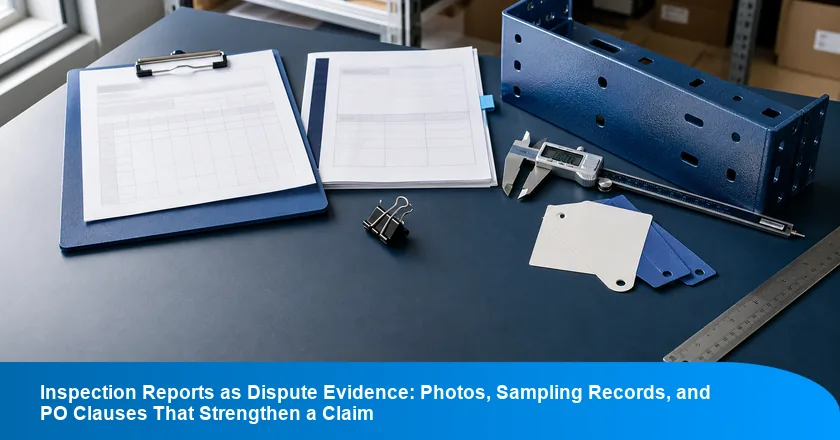
An inspection report can strengthen a commercial claim, but it cannot turn a photograph or a sample count into a verdict by itself. The file becomes useful when it connects four things: the purchase-order requirement, the product population actually checked, the observation record, and the decision or remedy the buyer is requesting. That connection gives a supplier something concrete to answer and gives the buyer a disciplined reason to hold, rework, release, or verify more goods.
The framework below is an operational evidence screen, not legal advice or a prediction of what a court, arbitrator, insurer, or platform will decide. Contract wording, governing law, notice timing, and later evidence still matter. Its value is simpler: it stops a buyer from claiming more than the report supports while making the supported part of the claim much easier to test.
A Strong Claim Starts With Four Linked Records
A stronger commercial claim connects an agreed rule, a bounded scope, an observation record, and a requested remedy. Think of the file as four questions that must stay connected: What was promised? Which goods does the record cover? What was actually observed? and What decision is being requested? A purchase order clause answers the first question; an inspection report and selection documentation bound the second and third; a written notice makes the fourth visible.
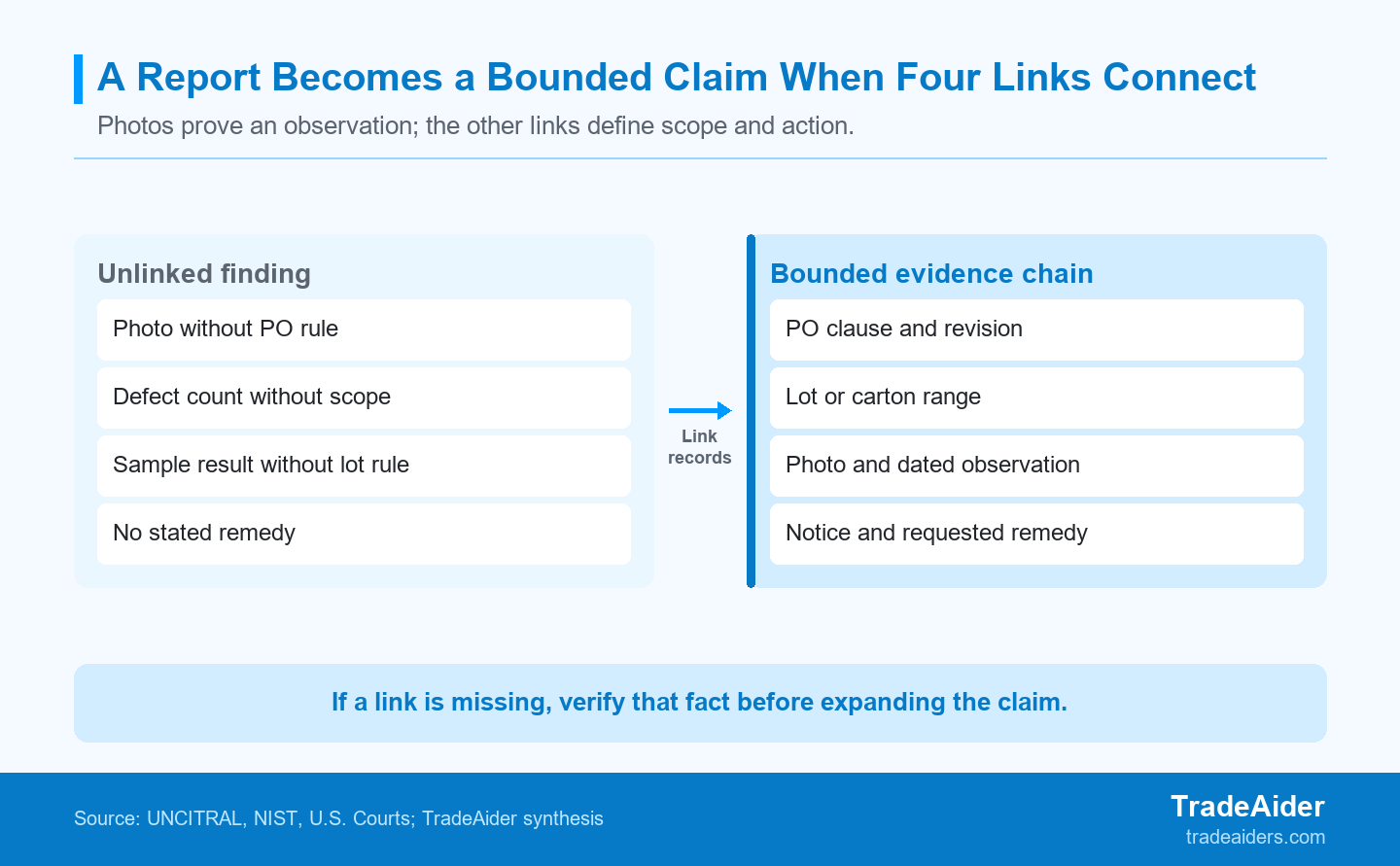
Photos document an observation; a commercial claim becomes bounded only when the agreed rule, scope, and requested action are also linked.
- Rule: retain the operative PO, drawing, approved sample, or revision.
- Scope: name the lot, carton range, configuration, production window, or shipment state.
- Observation: connect photos, measurements, and sampling records to that scope.
- Decision: state whether the buyer seeks a hold, sort, rework, replacement, credit discussion, or another check.
A practical score is four records present out of four. A 4/4 file supports a bounded commercial claim. A missing link does not prove the supplier is right; it identifies the next fact to verify. For example, a clear photo with no carton reference may support an observation but not a claim about every packed carton.
Start With the PO Clause, Not the Photo
UNCITRAL describes the CISG as applying in defined international sales settings and requiring the seller to deliver goods of the quantity and quality stipulated in the contract. See the CISG overview published by UNCITRAL. Whether that convention applies to a particular transaction is a separate legal question, but the operational lesson remains useful: retain the operative PO or approved revision before treating an inspection observation as a breach question. For a broader planning context, see quality planning for China-sourced e-commerce goods.
Preserve the version that governed production. That normally means the PO and its attachments, plus the version-controlled drawing, approved sample, email approval, material declaration, packing instruction, or quality agreement that the PO expressly incorporates. If the buyer changed a requirement after production began, state the effective date and the covered SKU or configuration. A dispute file becomes fragile when a later specification is treated as if it had governed the inspected goods.
For channel-sensitive orders, align the channel requirement, product configuration, and inspection checkpoint before final packing turns an unclear clause into a costly argument. That document discipline is especially important where the same product is sold through several marketplace listings or packaging variants. It also lets the buyer distinguish a product requirement from a marketplace preference before an inspection begins.
Turn the Requirement Into a Checkable Test
ICC describes Incoterms as defining delivery-related responsibilities involving delivery, risk, costs, and customs formalities. See the ICC's Incoterms explanation. A measurable product acceptance rule should therefore be written separately from delivery-risk allocation terms. An acceptance rule is the agreed condition that tells the buyer whether to accept, reject, hold, or verify more goods.
It should identify the product or component, the condition to check, the reference or method, the defect classification where relevant, and the result that changes disposition. For example, “shelves must meet drawing REV-C thickness at the specified measurement location before coating” is more testable than “good quality steel.” Likewise, “carton labels must match the approved artwork revision” is more usable than “correct packaging.”
An inspection-standard framework can help turn that clause into an inspection instruction rather than a broad quality slogan. It is most useful when it identifies the physical item, the reference document, the method, and the action that follows a result, rather than leaving an inspector to infer a standard from a product name.
Bind the Rule to a Lot, Configuration, and Time Window
UCC § 2-513 gives a buyer, subject to agreement and stated exceptions, a right to inspect goods at a reasonable time, place, and manner before payment or acceptance. See UCC § 2-513. It is a U.S. reference rather than a global rule for an international order, but it is a useful prompt to record when inspection occurred and what was available for inspection.
Operationally, scope should state the lot, configuration, and timing that the report actually covers. A buyer should be able to answer: which SKU, component version, factory location, carton range, production date, or shipment stage is included? This turns a rule into a claim about identifiable goods rather than goods that merely look similar, and it shows whether production or packing changed after the relevant PO version took effect.
Make Photos and Selection Records Reproducible
Photos and selection records answer different evidence questions and should be kept as linked, reproducible files. Photos help establish what was seen. Selection notes explain which units were chosen and what decision the result was meant to support. Keep both with the report reference, date, inspector or reporter, and product-scope identifier; otherwise, the file can become a collection of true but disconnected fragments.
Do not ask one record to do the other's job. A close-up can document a visible defect but may not establish the lot. A sampling sheet can define a selected population but may not show the exact observation that triggered the concern. Together, they make it easier for a supplier, buyer, or independent reviewer to reproduce the reasoning without filling gaps from memory.
Use Photos to Establish the Observation, Not the Whole Claim
Rule 901 requires enough support to show that an item is what its proponent claims it is, with examples including witness knowledge and process or system evidence. See the U.S. Federal Rules of Evidence Rule 901. It is a U.S. federal-rule reference, not a promise that a particular inspection photo will be admitted anywhere.
For this purpose, authentication means showing that a file is the item it is presented as. Capture the useful links: a wide shot showing the unit or carton reference; a closer image of the condition; a gauge, label, or approved sample where relevant; the report number; the date and location; and an explanation of how the item was selected.
Avoid annotations that cover the condition or replace the original file. If a photo is illustrative, label it that way rather than attaching it to a claimed lot.
Let Selection Records Define the Decision Boundary
A sampling record can support a stated lot disposition, but it should not be recast as an exact whole-order quality estimate. NIST explains that acceptance sampling is used for a lot-disposition decision, not to estimate the exact quality of the lot. Its companion explanation of a sampling plan describes a rule built around a sample size and acceptance or rejection criterion.
A sampling record is the note that identifies the lot, selected units, sample size, decision rule, and result. Record the limits of the result too: which cartons were available, which configuration was sampled, and whether it supports a hold, recheck, rejection discussion, or release. Do not convert “three observed units” into “all 1,600 units are defective” unless another file supports that expansion.
Write the Report as an Evidence Chain
A report is easier to challenge constructively when it makes the rule, scope, observation, and requested disposition visible in one chain. The summary should not say only “failed inspection.” It should identify the relevant PO clause or revision, the inspected population, the observed condition and supporting files, and the immediate decision the buyer is being asked to make.
For buyers using TradeAider, that same chain can be stated in the inspection brief before the visit begins. It keeps the requested independent observation tied to a specific release question rather than a general request for more photographs.
| Evidence link | What it should identify | Question it prevents |
|---|---|---|
| Agreed rule | PO clause, revision, drawing, sample, or acceptance rule | “Where did this requirement come from?” |
| Bounded scope | Lot, carton range, configuration, production window, and sampling basis | “Which goods does this finding cover?” |
| Observation | Photo, measurement, defect record, date, reporter, and report reference | “What was actually seen or measured?” |
| Requested remedy | Hold, sort, rework, replacement, credit discussion, or targeted verification | “What decision do you want next?” |
A pre-shipment inspection report is most useful when the brief already states that chain. The buyer then receives a report that answers a release question instead of a generic visit summary. It also makes a supplier response more focused: the supplier can challenge the referenced clause, scope, observation, or requested action rather than dismissing the entire report as subjective.
Issue a Notice That Preserves the Open Question
A written notice should identify the evidence-backed scope, the requested decision, and the fact that still needs verification rather than claiming more than the file shows. A useful opening sequence is: “Under PO revision X, the report observed condition Y in the documented scope Z. We request action A. The remaining question is B, and we will update the scope when the relevant traceability or re-inspection record is available.”
That wording is deliberately disciplined. It lets the buyer ask for an immediate hold or containment action without saying the condition applies to unsampled goods. It also prevents a supplier from responding only to the most dramatic photo while ignoring the agreed rule or the requested decision. Follow the contract's notice process and obtain qualified local advice for legal remedies, deadlines, or formal proceedings.
Before commissioning another visit, decide whether the open question concerns physical condition, a production window, a carton range, or supplier traceability. Then name the goods available for checking, the approved reference, the output to capture, and the decision owner. A repeat visit that does not close one of those questions can add photos without reducing uncertainty.
If production or packing is still moving, use a during-production check before the next exposure to answer a defined process or product question early. The brief should say which evidence would narrow, release, or widen the hold; “inspect again” is not a sufficiently clear instruction.
Worked Scenario: A Storage-Rack Report Meets a PO Revision
A staged decision is more credible when the buyer separates the observed carton range from the still-unverified exposure. The following case is illustrative, not a client case, supplier finding, defect-rate estimate, or legal conclusion.
Separate What the File Supports From What It Still Needs
An illustrative staged-release decision can hold a documented carton range while a buyer verifies whether related cartons share the same exposure. A U.S. multi-channel home-organization brand has ordered 1,600 powder-coated steel storage racks in two shelf widths. A signed PO revision requires a 1.20 mm shelf panel before coating for one specified configuration. Final packing is underway when an inspection report records gauge readings from three sampled racks in carton series R-07.
The photos show the gauge, the component, the carton marking, and the report reference. The supplier says those photographs do not prove every rack is out of specification. On that point, the supplier is identifying a real boundary: the observation is linked to the sampled cartons, not automatically to all cartons. The sampling record also identifies the configuration, selection record, sample size, and acceptance rule, but it does not claim to calculate a whole-order defect rate.
The buyer compares the recorded readings with the signed PO revision, then asks whether R-07 is traceably connected to other packed cartons. The photo bundle supports the observation; the sampling record supports the limited disposition question; the missing fact is the exposure outside R-07. The buyer therefore requests a hold on the documented carton series and a traceability review for connected cartons. It does not demand a whole-order remedy until the scope record supports that expansion. If the record cannot resolve the connection, the next brief calls for a targeted re-inspection of the defined range.
The supplier reconciles steel receipt, cutting, coating, and carton records for the affected range, labels the verified scope, and proposes rework or replacement only for the evidence-backed population. Release depends on the matching PO revision, the carton or production range, the observation record, and a documented result for the requested remedy. Missing traceability keeps that scope open. The quantities, product, thickness requirement, readings, and carton reference are illustrative; they do not establish supplier fault, a universal sampling rule, product performance, or a legal remedy for a real order.
Build a Dispute File Before You Need One
A pre-defined inspection brief can ask the next inspection to resolve one stated condition, population, and release question. Before any final inspection, agree where the PO revision, report, original photos, carton or lot records, supplier response, and buyer decision will live. Name the person who receives the result before goods move. When a buyer has the PO, report, carton references, packing status, and a clear open decision, ask TradeAider to review an inspection brief and evidence scope.
- Attach the operative PO clause or approved revision.
- Name the exact lot, carton range, configuration, and shipment status.
- State the observation or verification required and its evidence output.
- Write the hold, release, or escalation decision the result will support.
The useful output is a scoped brief that tells an independent inspection what condition, population, and release question it must address—not a generic request to “check quality.” It should distinguish existing observations from the next fact to verify, so the requested work is proportionate to the remaining uncertainty. That discipline also makes a supplier's response easier to compare against the buyer's actual request.
Who Is TradeAider?
TradeAider provides quality-control context for China-sourced goods without serving as legal counsel or promising a dispute outcome. Its role in this kind of decision is to help make an inspection scope testable: the agreed product reference, the population to check, the observation to record, and the report output needed before the buyer acts.
A buyer should still keep ownership of the commercial decision and involve appropriate legal or contract advisers where a claim moves beyond quality evidence into formal remedies. The inspection brief should make clear that an independent inspector reports what was available and observed at the stated time; it does not decide breach, damages, or settlement. That boundary protects both the quality file and the people asked to use it.
It also clarifies the practical limits of an inspection engagement.
For background on that operating context, review TradeAider's China quality-control background.
Frequently Asked Questions
Can an inspection report prove that every unit in the order is defective?
No—an inspection report can support a lot disposition only within the recorded scope; a sample finding does not itself measure the exact quality of every unit in the lot. Use the report to state what was inspected, what was observed, and what decision follows for that defined population. If the buyer needs to extend the claim to other cartons, configurations, or production windows, it needs a traceability record or further inspection evidence that links those goods to the observed condition.
What should an inspection photo show for a dispute file?
An inspection photo should connect the observed condition to the item, lot or carton reference, time, reporter, and relevant requirement. Use a wider contextual shot and a closer condition shot when possible, then retain the original file alongside the report reference. A measurement photo should show enough of the measuring point and unit to explain the observation. The goal is not a dramatic image; it is a record another reviewer can connect to the scope and rule.
Should the PO specify the sampling plan?
Yes, when sampling drives acceptance or rejection, the PO or attached quality plan should identify the applicable plan, defect classification, and disposition rule. It should also make clear which product configuration and lot definition the plan applies to. If a buyer uses a third-party inspection protocol, link that protocol to the PO rather than assuming a report title alone proves the parties shared the same sampling rule.
Are Incoterms enough to define a quality claim?
No—Incoterms allocate delivery-related responsibilities, while the PO or quality agreement should separately state the product requirement, acceptance rule, and remedy process. A shipment term may help identify when risk or costs transfer, but it does not by itself tell an inspector what component, label, performance condition, or packaging state counts as conforming. Keep those product terms in the operative commercial documents.
When should a buyer send a notice after an inspection finding?
Send a written notice promptly under the contract's process, identify the evidence and affected scope, and state the decision or remedy you are requesting while facts are still being verified. A prompt notice can preserve the operational question: whether to hold, sort, rework, replace, or inspect a defined population. For legal notice periods, remedies, and forum-specific requirements, rely on the governing agreement and qualified advice rather than a general inspection article.
Artigos Relacionados
Expanda seu negócio com o Serviço TradeAider
Clique no botão abaixo para entrar diretamente no Sistema de Serviço TradeAider. Os passos simples desde a reserva e pagamento até o recebimento de relatórios são fáceis de operar.

