
- Sobre Nós

- Nossos Serviços
- Sua Indústria
- Recursos
- Notícias e Blog

Personal care product inspection should connect safety substantiation, formula and batch identity, labels, fill, seal, leakage, contamination clues, AQL defects, and packaging before release.
Beauty and personal care products create a different inspection problem from hard goods. The inspector can check packaging, labels, fill, seal, leakage, appearance, kit completeness, and visible contamination clues, but the inspector cannot prove cosmetic safety or formula compliance by looking at a finished unit.
The right release process separates the regulatory file from physical inspection. Safety substantiation, product listing, responsible person, ingredient control, formula approval, and claims support belong in the evidence file. Pre-shipment inspection verifies that the physical lot matches that file and is ready to sell.
Key Takeaways
- Inspection does not prove formula safety: It verifies physical lot identity, labels, fill, seal, leakage, packaging, and visible defects.
- Batch and formula identity are release gates: Batch code, ingredient list, shade, scent, formula version, and carton identity should point to the same approved product.
- Labels carry compliance risk: Claims, responsible party, warnings, ingredients, net contents, batch code, and destination language must match the market.
- AQL must fit beauty defects: Fill shortage, pump failure, leakage, scratched bottle, wrong shade, missing insert, and damaged carton need specific defect classes.
- Keep evidence organized: Beauty importers should retain inspection photos, batch records, label files, test reports, and reinspection evidence in one release file.
Safety File First, Inspection Second
A cosmetic product can look perfect and still be impossible to release if the evidence file is incomplete. A serum bottle with a clean label does not prove product listing, safety substantiation, claims support, allergen or ingredient accuracy, or destination-market readiness. Beauty inspection should therefore begin with the documents and specifications the buyer gives the inspection team.
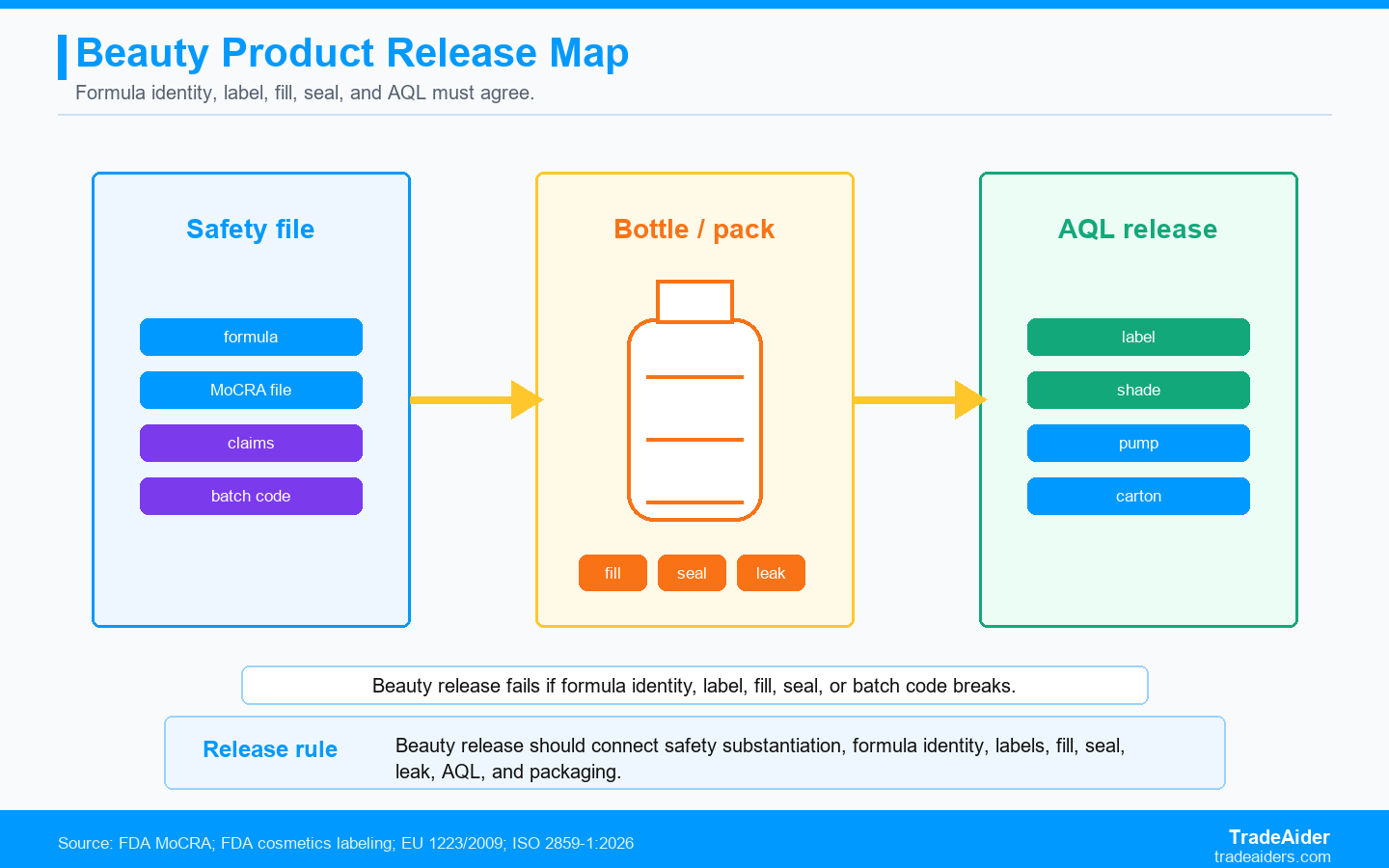
Beauty release should connect safety substantiation, formula identity, labels, fill, seal, leak, AQL, and packaging.
US cosmetic listing is not product approval
The FDA cosmetic facility registration and product listing page states that a responsible person must list each marketed cosmetic product with FDA and include product ingredients, while also noting that facility registration and product listing are not an approval program or promotional certificate. That distinction matters: inspection can verify that a batch matches the listed product identity, but it should not describe the product as FDA-approved.
For release, the inspection should compare product name, responsible-person label, ingredient list, net contents, batch code, and packaging artwork against the approved file. If the formula or label version changed, the lot should be held until the buyer confirms the evidence.
EU cosmetics need responsible-person and safety-file alignment
The European Commission cosmetics legislation page explains that EU cosmetics rules require strengthened safety requirements, a responsible person, and centralized notification. For an EU-bound shipment, inspection should verify that labels, product identity, claims, warnings, and batch information match the buyer's EU file and responsible-person setup.
The inspector does not create the safety assessment. The inspector checks whether the physical product still points to that assessment. A wrong shade name, missing responsible-person information, or outdated ingredient list can become a release issue even when the product appearance is acceptable.
Claims should not outrun the evidence file
Beauty claims such as anti-aging, whitening, acne, SPF, sensitive skin, hypoallergenic, natural, vegan, cruelty-free, or dermatologist tested can create evidence and regulatory questions. The inspection brief should identify which claims are allowed on the label and packaging. The inspector can verify claim presence or absence; the buyer must hold the claim substantiation.
A practical release rule is to inspect the artwork version, not just the physical carton. If a factory prints old claims, wrong shade names, or outdated ingredient order, the lot should be corrected before shipment.
Physical Inspection: Fill, Seal, Leak, and Contamination Clues
Personal care inspection is strongest when it checks what can be observed reliably before shipment. That includes fill level, weight where specified, seal integrity, leakage, pump or cap function, bottle scratches, tube crimp, label alignment, carton damage, and visible contamination clues.
Fill level and net contents should be checked by method
Fill checks need a defined method: visual fill line, weight check, sample count, tolerance, and whether the product settles or foams. The buyer should specify whether fill variation is judged by weight, volume, fill line, or net contents evidence. Without method, one side may call a bottle underfilled while the other calls it normal variation.
For transparent bottles, the report can show fill-line photos. For opaque packs, weight checks may be more useful if the buyer provides tolerances. The inspection should avoid making chemical or stability claims from a simple fill check.
Seal and leakage tests should mimic shipping stress carefully
Leakage risk is common in serums, lotions, shampoos, oils, gels, and pump bottles. Inspectors can check cap torque clues, induction seal presence, inner plug, pump lock, tube crimp, bottle closure, inverted rest, and basic leak observation. The buyer should define whether any compression, inversion, or short rest test is allowed.
Leakage findings should trigger packaging and assembly review. A small leak at the factory can become carton staining, barcode damage, customer complaints, and unusable inventory after international transit.
Visible contamination clues require escalation
Inspection can observe foreign matter, hair, dust, particles, discoloration, odor difference, mold-like appearance, broken seals, or dirty packaging. These are clues, not laboratory contamination results. If they appear, the release decision should move to hold, supplier investigation, or testing review.
The report should photograph the clue, identify affected SKU and batch code, and separate visible contamination suspicion from confirmed microbiological or chemical results. That precision protects the buyer from both underreaction and overclaiming.
Labels, Batch Codes, and Retail Packs
Beauty products are often sold through strict retail and marketplace channels. A physical defect can cause a return, but a label or batch-code defect can stop the product before sale. Inspection should treat identity marks as release evidence.
Batch code must connect bottle, carton, and outer shipper
Batch code control is central for traceability. The inspection should verify code presence, readability, location, format, and consistency across unit, carton, and master carton where required. If multiple batches ship together, the report should identify which batches were sampled.
Poor code control becomes painful during complaints or recalls. If the buyer cannot trace affected units, the commercial cost of a small defect can expand quickly.
Ingredient and claim labels should match the approved artwork
The inspector should compare printed artwork against approved files for ingredient list, claims, warnings, directions, net contents, responsible party, language, barcode, shade name, and product name. Artwork mismatch is not a minor printing issue when it affects compliance or customer expectation.
If the factory uses a revised label file, the buyer should approve it before release. A report photo of the label panel gives the buyer a chance to catch mistakes while cartons are still accessible.
Retail packaging should survive beauty-channel handling
Beauty retail boxes need clean finish, sharp print, consistent color, readable barcode, intact seals, and protection from leakage. Scratched caps, dented cartons, smeared labels, crooked stickers, and dusty bottles can damage brand perception even when formula quality is correct.
For kits and sets, the inspection should verify each component, insert, shade, scent, applicator, and gift box. A missing applicator or wrong shade card can create a return even when the main bottle is correct.
AQL Defects for Beauty Products
AQL under ISO 2859-1:2026 is useful for sampled appearance, packaging, fill, and workmanship defects, but beauty products also need hold triggers for formula identity, label version, batch code, contamination clues, and leakage. These should be defined before inspection.
Critical defects should trigger hold or testing review
Critical defects may include wrong formula identity, missing batch code, wrong ingredient list, visible contamination clue, broken seal, leakage pattern, wrong warning, or label mismatch that affects destination compliance. These should not be treated as ordinary minor defects.
The buyer should define who decides release when critical clues appear. Usually the next step is supplier investigation, document review, retesting, rework, or full hold.
Major defects should reflect customer and channel harm
Major defects may include underfill outside tolerance, pump failure, cap failure, leaking unit, damaged carton, unreadable barcode, wrong shade, missing insert, scratched visible component, or poor seal. These defects affect customer acceptance, retailer receiving, or marketplace reviews.
Minor defects should be limited to small cosmetic marks that do not affect hygiene perception, function, barcode, artwork, or sellability. Beauty buyers should be stricter with visible retail finish than with hidden shipping materials.
Reinspection should verify batch-specific correction
If the supplier relabels, reseals, repacks, or replaces affected units, reinspection should focus on the corrected batch or SKU. The report should show corrected code, label, seal, and packing evidence. A generic second AQL sample may not verify the specific problem.
Beauty rework can also introduce new issues such as scratched labels, dusty bottles, mixed batches, or poorly resealed cartons. The reinspection should look for those secondary defects.
Personal Care Release Evidence Table
| Release Layer | What To Check | Release Rule |
|---|---|---|
| Safety file | MoCRA/EU evidence, responsible person, formula and claim support | Do not release if physical lot no longer matches file |
| Batch identity | Batch code on unit, carton, master carton, sample records | Hold if traceability is missing or mixed |
| Label artwork | Ingredients, claims, warnings, net contents, barcode, language | Correct artwork mismatch before shipment |
| Fill and seal | Fill level, weight method, cap, pump, crimp, seal, leakage | Escalate repeat leakage or underfill |
| AQL defects | Critical, major, minor by beauty-specific defect class | Accept, reject, rework, or reinspect by class |
| Retail pack | Carton finish, inserts, kits, shade match, protection | Release only when product is channel-ready |
Where TradeAider Fits In Personal Care Products Inspection
TradeAider can help beauty importers with pre-shipment inspection for fill, seal, leakage, labels, batch code, packaging, kit completeness, AQL workmanship, and release photos. Buyers should provide artwork files, formula or batch identity requirements, defect classes, approved samples, and destination market before inspection.
The practical value is release evidence. TradeAider can show whether the physical lot matches the buyer's approved version and whether any leakage, seal, label, batch, or packaging issue needs hold or rework while the factory can still act.
SPAR Scenario: The Serum Shipment Failed on Seal and Lot Code
Situation: A beauty importer ordered serum bottles with a new carton and batch-code format for an online launch.
Problem: Sampled units looked clean, but several bottles leaked after inversion and one carton group used the previous batch-code format. The ingredient artwork was correct, but traceability was inconsistent.
Action: The buyer held the affected carton group, required resealing and code correction, and requested reinspection photos of unit codes, cartons, seals, and leakage checks.
Result: The shipment moved only after corrected evidence was documented, and the supplier added a batch-code verification step before final packing.
Personal Care Inspection Checklist
- Match formula, shade, scent, label, batch, and carton identity.
- Check fill level by agreed visual or weight method.
- Verify seal, cap, pump, crimp, and leakage clues.
- Treat contamination clues and missing batch codes as hold triggers.
- Compare labels and claims against approved artwork.
- Reinspect relabeled, resealed, or repacked units before release.
If your beauty shipment includes serums, lotions, cosmetics, personal care kits, pumps, tubes, or jars, send TradeAider the artwork, batch rules, approved samples, and defect classes so the inspection can verify release evidence before export.
Who Is TradeAider?
TradeAider is a quality inspection, testing, and certification service provider in China. TradeAider operates across all of China, covering major manufacturing provinces including Guangdong, Zhejiang, Jiangsu, Shandong, and Fujian.
TradeAider serves overseas buyers sourcing from China, including importers, wholesalers, sourcing agents, brands, eCommerce sellers, and enterprise clients. Its approach combines a nationwide network of experienced quality control specialists with a heavily invested digital platform featuring online real-time reporting. Clients can monitor inspections live, communicate directly with inspectors, and address issues during production rather than after shipment - a proactive model focused on problem-solving and prevention, not just defect identification.
Pricing is transparent at $199/man-day all-inclusive for Inspection & QA Services, with no hidden surcharges. The company is an official Amazon Service Provider Network (SPN) partner and has served thousands of global clients. Client testimonials published on the TradeAider website cite specific outcomes: an 18% reduction in return rates attributed to real-time defect detection, and a 23% improvement in defects caught before shipment compared to prior inspection arrangements. These are client-reported figures.
Frequently Asked Questions
Can inspection replace cosmetic safety substantiation?
No. Inspection cannot replace cosmetic safety substantiation, product listing, formula review, testing, or responsible-person obligations. It can verify that the physical lot matches the approved product identity, label, batch code, packaging, fill, seal, and visible quality requirements. If formula, label, or batch identity changes, the buyer should hold release for document review.
What are common personal care inspection defects?
Common defects include leakage, underfill, pump failure, cap failure, broken seal, scratched bottle, dirty packaging, wrong shade, missing insert, damaged carton, unreadable batch code, label shift, wrong artwork, barcode issues, and visible contamination clues. The most serious issues are usually traceability, label accuracy, seal integrity, and leakage.
Should labels be checked beyond AQL?
Yes. Labels should be treated as release evidence, not only sampled appearance. Ingredient list, claims, warnings, responsible-party information, net contents, batch code, barcode, shade name, and destination language should match the approved file. A label mismatch can create compliance, recall, or customer-trust risk even if normal AQL defects are within limits.
What should beauty importers send before inspection?
Send approved artwork, product specification, formula or batch identity rules, shade or scent standards, fill tolerance, packaging requirements, defect classifications, approved sample photos, destination market, and any safety or listing evidence relevant to release. This lets the inspection verify the physical lot against the actual evidence file.

Artigos Relacionados
Expanda seu negócio com o Serviço TradeAider
Clique no botão abaixo para entrar diretamente no Sistema de Serviço TradeAider. Os passos simples desde a reserva e pagamento até o recebimento de relatórios são fáceis de operar.

