
- Sobre Nós

- Nossos Serviços
- Sua Indústria
- Recursos
- Notícias e Blog
A product compliance checklist should start with the product category, not the marketplace name, because Amazon, Walmart, and Shopify can all expose the same underlying regulatory failure differently. Amazon may block or suppress a listing, Walmart may restrict assortment or seller offer, and Shopify may leave the merchant responsible for unlawful or policy-violating sales.
The importer should build one SKU evidence pack that connects regulator documents, label claims, barcode identity, origin marking, packaging, and inspection release evidence. Marketplaces are not substitutes for product compliance. They are enforcement and selling environments. A product that is weak on certificates, labels, barcode identity, or claims can fail before listing, during marketplace review, at import, or after customers receive the goods.
Three channels multiplied by five evidence groups creates 15 review points before the product is safe to list and ship. The evidence groups are regulator documents, label claims, barcode identity, origin marking, and release inspection evidence. The channel views are Amazon, Walmart, and Shopify.
- Amazon: Treat compliance as a listing and document-readiness gate.
- Walmart: Treat compliance as both marketplace-policy fit and product evidence fit.
- Shopify: Treat compliance as merchant responsibility, because the store platform does not remove the seller's legal duties.
- Inspection gate: Verify labels, packaging, marks, barcode, and document match before inventory moves.
The Direct Answer
For Amazon, Walmart, and Shopify, the safest compliance workflow is to build a SKU evidence pack first, then adapt it to each marketplace's listing and policy requirements.
TradeAider treats marketplace compliance as a SKU evidence-pack problem: Amazon, Walmart, and Shopify expose different failures, but the factory still has to pack the same product, label, barcode, manual, and claim evidence correctly.
The SKU evidence pack should include product category, market destination, applicable regulator, test report or certificate, model number, label artwork, claims, barcode, origin mark, packaging, approved sample, and inspection release criteria. The channel-specific layer then asks how that evidence is uploaded, displayed, reviewed, or requested by the marketplace. The order matters because a listing form cannot fix a noncompliant label, and a marketplace approval screen cannot prove the factory packed the correct product version.
According to GS1 barcode standards, barcodes support product identification across supply chains. According to CBP origin-marking guidance, imported products may require country-of-origin marking. These are not channel preferences. They are product-identity and import-readiness controls that should be checked before the product reaches a marketplace warehouse or customer.
Why Marketplace Compliance Is Not One Checklist
Marketplaces control selling access; regulators control product evidence. The buyer has to satisfy both layers before shipment.
According to Amazon seller product compliance guidance, sellers may need product compliance documents before a product can be listed or continue selling. According to Walmart Marketplace prohibited-products policy guidance, marketplace policy can restrict what may be sold through the channel. According to Shopify's Acceptable Use Policy, merchants must avoid using the service for prohibited or unlawful activity. The so what for importers is practical: channel access, legal compliance, and shipment release are connected, but they are not the same control.
Amazon compliance risk is often a document gate
Amazon sellers should assume that category risk can become a document request before or after listing. The product page may need model, brand, safety evidence, warning label, or certification evidence depending on category and claim. The buyer should connect the Amazon listing title, bullet claims, product images, model number, and packaging label to the same compliance file. If the listing says "kids," "wireless," "food contact," "cosmetic," or another regulated attribute, the compliance file should show why the claim is supportable. A factory sample that looks correct is not enough if the marketplace asks for a test report, certificate, or label photo.
Walmart compliance risk is both policy fit and product proof
Walmart sellers should read marketplace policy before ordering inventory, not after a listing is rejected. Some products may be restricted or prohibited by marketplace policy even when a factory is willing to produce them. The buyer should check category permission, product claims, safety documentation, label evidence, and packaging requirements before purchase order release. The risk is especially high when the product is regulated, consumable, child-facing, wireless, medical-adjacent, or claim-heavy. A product can be physically acceptable and still be commercially unusable if the marketplace will not allow the seller to offer it.
Shopify compliance risk remains with the merchant
Shopify gives merchants a storefront environment, but it does not make product compliance disappear. The seller still controls product claims, fulfillment promises, labels, customer disclosures, and where the product is sold. A Shopify brand selling cosmetics, supplements, electronics, children's goods, or imported consumer products should build evidence before running ads or sending inventory to a third-party warehouse. The risk is different from a marketplace suppression notice: the product may remain sellable until a payment, customer, regulator, or platform problem appears. That delay can make weak compliance feel invisible until the cost is larger.
Market-by-Market Compliance Checklist
The same product needs one shared evidence pack and three channel-specific review paths.
| Checklist Area | Amazon | Walmart | Shopify |
|---|---|---|---|
| Channel gate | Listing approval, compliance document request, suppression risk | Marketplace policy, category restriction, seller offer control | Merchant responsibility under store and legal rules |
| Product category | Match listing claims to category evidence | Confirm policy fit before order release | Confirm product can be lawfully advertised and sold |
| Regulator evidence | Prepare certificate or test report when category requires | Prepare evidence for restricted or sensitive categories | Keep evidence for claims, safety, and customer trust |
| Label and barcode | Match package, listing, model, barcode, and warning label | Match offer data, package identity, and marketplace data | Match storefront claim, package label, and fulfillment SKU |
| Factory release check | Verify version before FBA or channel fulfillment | Verify carton, mark, and product identity before shipment | Verify customer-visible claims and packaging before ads scale |
The comparison reveals why a single channel checklist is not enough. Amazon, Walmart, and Shopify expose different failure points, but the underlying product evidence often overlaps. The strongest workflow builds a SKU evidence pack once, then adapts it to the channel instead of recreating compliance after each marketplace asks a different question.
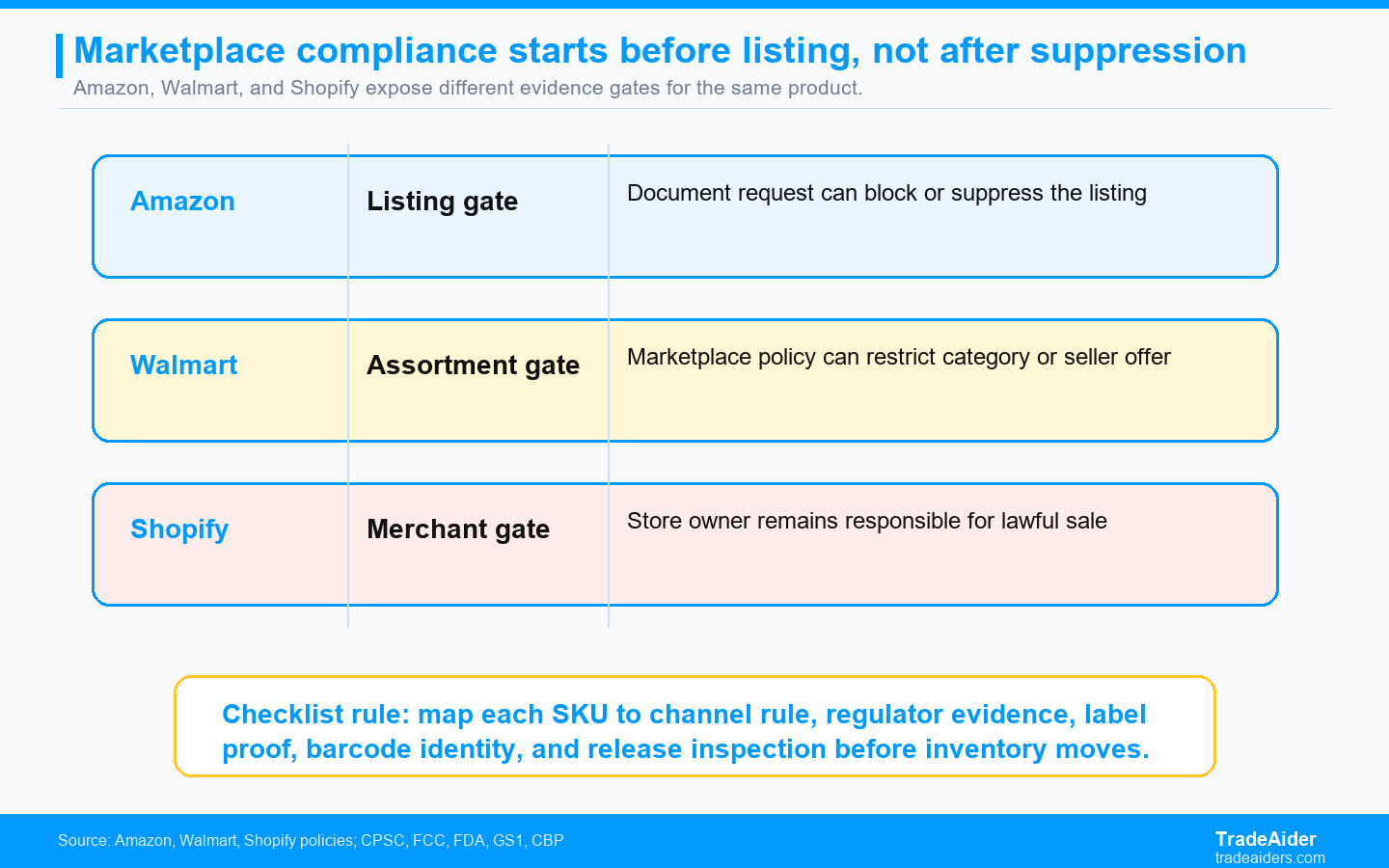
Marketplace compliance starts with SKU evidence that can survive channel review, import review, and shipment release.
Regulator Evidence to Check Before Listing
Marketplace rules decide whether the product can be sold through the channel; regulator evidence decides whether the product claim is defensible.
The buyer should not wait for Amazon, Walmart, or Shopify to identify every compliance issue. The product category itself should trigger evidence review. Children's products, electronics, cosmetics, food-contact goods, supplements, batteries, and claim-heavy products need earlier document discipline. The checklist below is not legal advice, but it shows why product category should drive sourcing control before the factory packs goods.
Children's products need certificate and label discipline
According to CPSC Children's Product Certificate guidance, children's products may need certification evidence tied to applicable rules. The buyer should make sure the certificate, product name, model, production date, factory identity, and label evidence match the same SKU being ordered. A common failure is treating a supplier's old certificate as proof for a new color, new material, new age grading, or new packaging claim. For marketplace selling, the certificate should be connected to listing claim, packaging warning, and inspection checklist, because customer-visible claims can trigger document review. The release check should also confirm age label, warning text, tracking label, and packaging version when those details apply to the product category.
Wireless and electronic products need model-level evidence
According to FCC equipment authorization guidance, many radiofrequency devices require authorization before marketing or import. The buyer should verify that the model number, component version, label, user manual, and packaging match the evidence. A factory may show a test report for a similar version while shipping a different antenna, chipset, enclosure, or charger. That mismatch can create marketplace, import, and customer risk. The inspection checklist should therefore include model label, rating label, plug type, manual, barcode, and visible compliance marks where applicable. If a supplier changes a wireless module during production, the issue is not only functional performance; it can invalidate the evidence package attached to the listing.
Cosmetics and claim-heavy products need label control before packing
According to FDA cosmetics labeling guidance, cosmetics labeling includes specific identity, ingredient, and warning considerations. A Shopify brand or marketplace seller should not treat label artwork as only a design file. Claims such as "organic," "hypoallergenic," "for kids," "antibacterial," or "FDA approved" can create risk if the evidence does not support them. The buyer should freeze label text, ingredient statement, net contents, responsible party, warnings, and batch code before packaging production. A beautiful product can still be unsellable if the label claim outruns the evidence file. The risk is greater when the same formula is sold under different channel-specific claims, because artwork control can split faster than factory batch control.
Where Inspection Fits in the Compliance Workflow
Inspection does not certify compliance, but it can verify that the product, label, package, and document version match the evidence the seller plans to rely on.
Product compliance starts before production, but release evidence still matters at the factory. The approved sample, artwork, test report, certificate, barcode, carton mark, and marketplace listing data should describe the same SKU. If the factory changes label text, uses an older barcode, mixes two model versions, or packs cartons with the wrong origin mark, the compliance file and physical shipment no longer match. That gap can appear even when the seller's documents were originally correct.
Use pre-production review when evidence is not frozen
Pre-production review is useful when label claims, test evidence, packaging artwork, or marketplace data are still changing. The buyer should freeze the SKU evidence pack before ordering mass packaging. If the artwork says one model and the certificate says another model, production should not start. If the barcode data does not match the SKU structure, carton labels should not be printed. The practical rule is to stop the defect before it becomes inventory. Compliance problems are much cheaper when they are still files, not packed cartons. This means buyers should review artwork, certificate, barcode, origin mark, and listing claim before the factory prints the first production carton.
Use PSI when the finished order must match the evidence pack
TradeAider's Pre-Shipment Inspection is useful when the buyer needs to verify the finished lot against the evidence pack. The inspector can check product version, model label, package artwork, barcode scan, carton mark, origin mark, warning label, accessory count, manual, and visible customer-facing claims. A PSI is conducted when 100% of the order quantity is completed and at least 80% is packed for export. That timing makes it a release gate, not a substitute for test reports or legal compliance review. It confirms whether the physical shipment matches the evidence the seller prepared. If the inspection finds two label versions in one lot, the buyer should hold release until the factory can sort by version and prove which units match the marketplace evidence file.
Use factory audit when supplier control is part of the risk
TradeAider's factory audit is useful when compliance depends on supplier process discipline, not only finished labels. If the factory handles children's products, wireless electronics, cosmetics, supplements, or multiple marketplace versions, the buyer may need to know whether the factory controls records, material traceability, document versions, subcontracting, and final QC release. The audit does not replace regulatory evidence, but it helps answer whether the supplier can keep evidence and production aligned across repeat orders. That matters when one supplier ships the same base product to three channels, because weak document control can create three different listing problems from one production mistake.
SPAR Scenario: One SKU, Three Channels, Fifteen Review Points
A marketplace checklist protects the listing; a SKU evidence pack protects the product decision.
Situation: A DTC brand plans to sell a rechargeable grooming device through Amazon, Walmart Marketplace, and its Shopify store. The first order is 3,000 units from a factory in Shenzhen. The product has a USB charging cable, wireless component, printed rating label, carton barcode, and online claims about safe home use.
Problem: The Amazon listing team asks for compliance documents, the Walmart team asks whether the product fits marketplace policy, and the Shopify team wants to launch ads quickly. The factory provides a test report for an older model and prints cartons with the current barcode but an older model label.
Action: The buyer builds a SKU evidence pack before shipment: model number, component version, FCC evidence, barcode, label artwork, manual, carton mark, origin mark, and approved sample. The buyer then maps that pack to Amazon document upload, Walmart listing review, and Shopify product page claims. PSI checks the finished order against the same pack.
Result: The shipment waits 6 days while the factory reprints labels and replaces 420 cartons. The cost is painful, but the alternative was worse: three channels could have exposed the same model mismatch in three different ways. The remaining limitation is that future artwork revisions need the same evidence-pack discipline before each reorder.
Product Compliance Checklist for Importers
Build one evidence pack per SKU, then map it to every marketplace and shipment release gate.
- Define product category, destination market, claims, age grading, electronics status, consumable status, and regulated attributes before quotation.
- Collect regulator evidence before artwork and packaging are frozen.
- Match model number, barcode, label, carton mark, origin mark, manual, and approved sample across all files.
- Map the same evidence pack to Amazon, Walmart, and Shopify channel requirements before listing.
- Use inspection to verify that the packed order matches the evidence pack before inventory moves.
If one SKU will launch across Amazon, Walmart, and Shopify, send TradeAider the channel list, product category, listing claims, test reports, certificates, label artwork, barcode data, PO, and packing status. The next step is to ask TradeAider to convert the marketplace evidence pack into PSI checkpoints before the factory ships a version that one channel can reject.
Frequently Asked Questions
Is product compliance the same for Amazon, Walmart, and Shopify?
No. The underlying product evidence may overlap, but each channel exposes the risk differently. Amazon may ask for documents, Walmart may restrict category or product offers, and Shopify leaves more responsibility with the merchant's own selling practices.
What should be in a product compliance checklist?
A practical checklist should include product category, destination market, applicable regulator, certificate or test report, label claims, barcode, origin mark, packaging, approved sample, marketplace listing data, and inspection release criteria.
Can inspection replace compliance testing?
No. Inspection cannot replace compliance testing or legal review. Inspection can verify that the physical product, label, packaging, barcode, and document version match the evidence the seller plans to rely on before shipment release.
Artigos Relacionados

Expanda seu negócio com o Serviço TradeAider
Clique no botão abaixo para entrar diretamente no Sistema de Serviço TradeAider. Os passos simples desde a reserva e pagamento até o recebimento de relatórios são fáceis de operar.

