
- Sobre Nós

- Nossos Serviços
- Sua Indústria
- Recursos
- Notícias e Blog
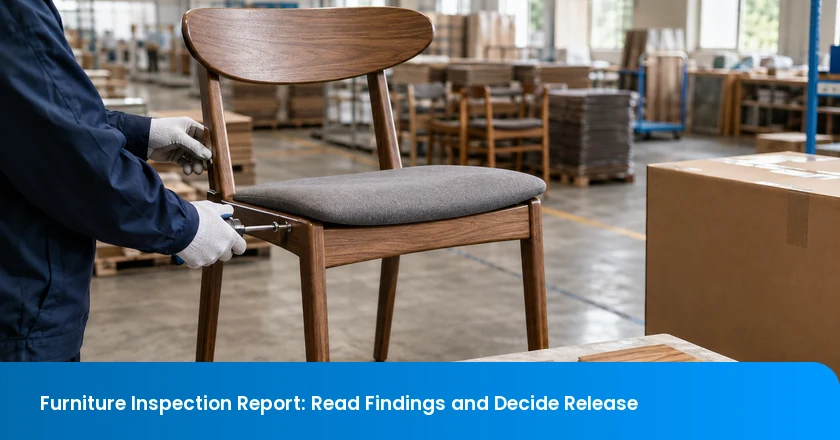
A furniture inspection report is not a pass certificate. It is a bounded record of which goods were available, how a sample was selected, what the inspector checked, and what was found. The summary result is useful only inside those limits. A buyer should therefore read identity and coverage before defect totals, then combine the observations with separate compliance, packaging, contract, and correction evidence.
That sequence prevents a green summary from clearing the wrong finish, an unfinished portion of the order, or a test the inspector never performed. It also produces a practical decision. The buyer can release an identified population, hold it, require rework, or request new inspection evidence without asking the report to prove more than it does.
Read the Report as a Decision Record, Not a Pass Certificate
A furniture inspection report is a bounded record of what was identified, sampled, checked, and observed in one declared lot, not an automatic release certificate. UKAS's ISO/IEC 17020:2026 transition guidance emphasizes inspection-body impartiality, independence, competence, and consistent operation. Those qualities strengthen inspection output; they do not transfer the buyer's contract, compliance, concession, or shipment authority to the report.
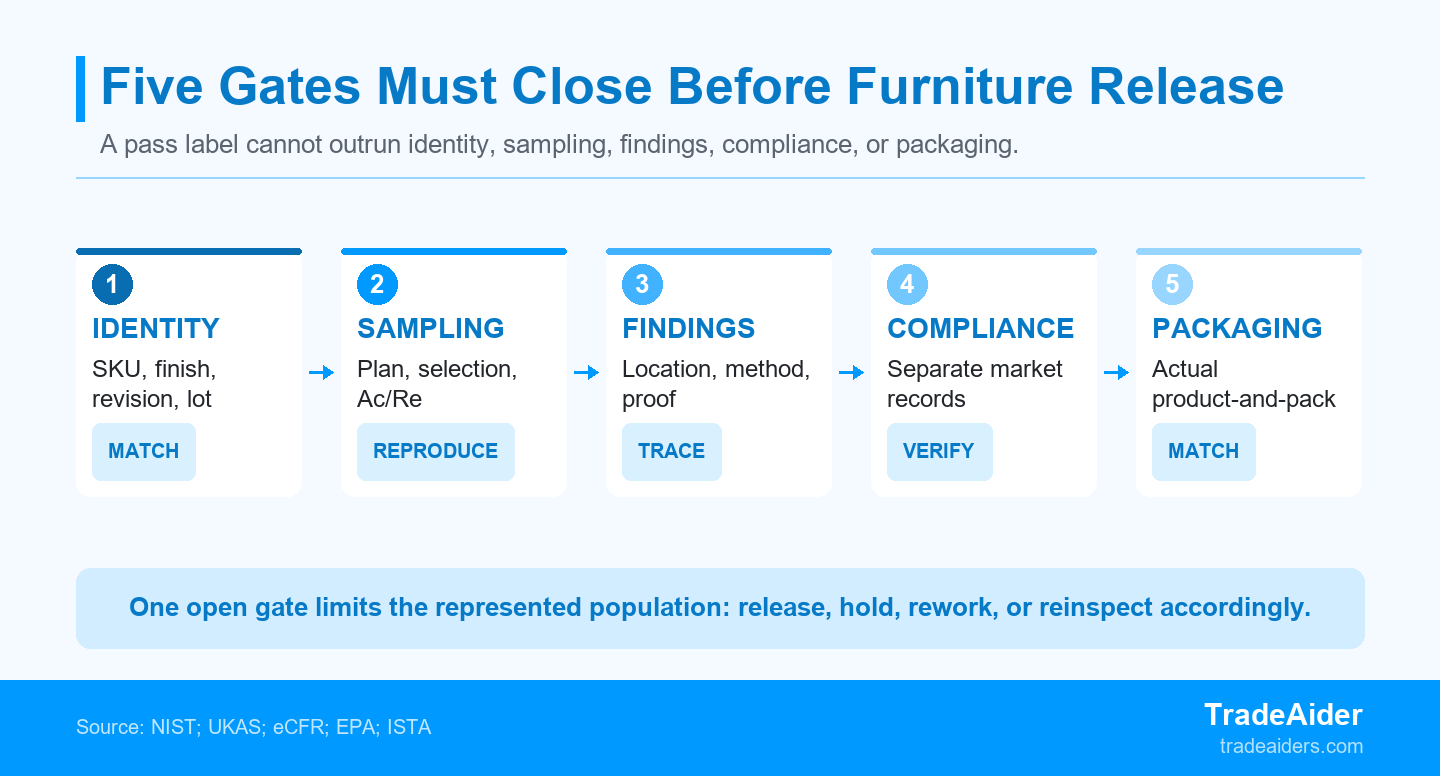
Furniture can move toward release only when every relevant evidence gate covers the same represented population.
- Read identity first: confirm the report covers the ordered model, finish, revision, factory, and identified goods.
- Rebuild the sample decision: connect lot size, selection, sample size, defect classes, and acceptance or rejection rules.
- Trace every material finding: connect it to a requirement, unit, location, method, photograph or measurement, and affected population.
- Choose a bounded action: release, hold, rework, or reinspect only the population supported by the combined evidence.
A report summary cannot outrun the narrowest unresolved boundary in product identity, sampling, findings, compliance, or packaging.
If any boundary remains open, the response should name that gap and the furniture it affects. This turns an unexplained verdict into a controlled buyer decision.
Verify Product, Lot, and Inspection Conditions First
Before reading defect totals, the buyer must confirm that the report identifies the ordered furniture, applicable revision, lot, readiness, location, date, and sample actually examined. That population must map to the goods being considered for release. When identity is vague, the observations may be real yet still fail to support the order.
Match the Product Reference to the Purchase Order
Model, dimensions, material, color or finish, hardware, label, drawing revision, approved sample, and packaging specification must point to the same ordered configuration. Also compare panel material, upholstery, fittings, fasteners, instructions, and revision dates. A report for the correct chair model with an obsolete joint drawing is not a clean match.
Record a conflict instead of choosing the convenient document after inspection. Ask which reference the inspector used, which one the factory built, and which one the buyer approved. The answer determines whether a finding is a production defect, a document-control failure, or a commercial change that still needs approval.
Reconcile Ordered, Finished, Packed, and Sampled Quantities
The report should distinguish the purchase quantity from the completed, packed, presented, and sampled quantities because each number answers a different coverage question. The purchase figure sets commercial scope; finished and packed totals show readiness; presented stock shows access; and the sample states what was observed.
| Report field | What it should identify | Buyer risk if missing |
|---|---|---|
| Ordered | PO quantity by SKU and finish | The inspection scope cannot be reconciled to the purchase |
| Finished | Units complete at inspection time | Unfinished goods may later enter the shipment without evidence |
| Packed and presented | Accessible cartons and their location | Selection may be restricted to convenient or visible stock |
| Sampled | Selected units or cartons by configuration | The result may hide thin coverage of one subgroup |
If 900 units were ordered but only 720 were finished, the report does not clear the future 180 units. The buyer should identify them as outside the inspected population and decide whether later evidence is required.
Rebuild the Sampling Decision Before Reading Defects
A sample result becomes interpretable only when the report records the defined lot, selection method, sampling scheme, inspection level, sample size, defect classes, and acceptance and rejection rules. NIST's acceptance-sampling handbook explains that a random sample helps decide what happens to a defined lot; its main purpose is not estimating exact lot quality. Ac/Re states the passing and failing count limits in the selected method. Defect counts have meaning only when those inputs were fixed before inspection.
For buyer and supplier alignment, an inspection standard resource can help connect product checks, defect classes, sample instructions, and acceptance rules. It should not substitute for a buyer-approved, product-specific inspection scope.
Trace Lot Size, Sample Size, and Ac/Re as One Chain
Lot size, inspection level or equivalent instruction, code and sample size, AQL or other acceptance parameter, and Ac/Re thresholds must form one reproducible chain fixed before results are known. Another reviewer should be able to trace that chain and reach the same accept-or-reject count.
| Sampling link | Question to answer | Stop condition |
|---|---|---|
| Defined lot | Which units share the same report result? | Mixed or unidentified populations |
| Selection method | How were cartons and units chosen? | Factory-selected convenient samples |
| Sample scheme | Which instruction produced the sample size? | Sample size shown without its basis |
| Defect decision | Which counts trigger Ac or Re by class? | Rules chosen after findings were seen |
Keep the Result Inside the Population the Sample Represents
The represented population is the identifiable furniture to which the sample result can reasonably apply; mixed finishes, production dates, factories, or unresolved rework can split that boundary. A different finish may use another coating line, while a revised cabinet may use changed hardware. Upholstery from another material batch can create a further split.
Check whether the sample included each material subgroup in a meaningful way and whether selection remained random. If the report cannot map a subgroup to sampled units and findings, keep that subgroup outside the broad result. This is a coverage decision, not an accusation that every unit is defective.
Translate Furniture Findings Into Buyer Risk
Defect labels are useful only when the report connects each finding to a location, quantity, requirement, photograph, measurement or functional observation, and the affected product population. A single loose chair-back joint may carry more decision weight than several small finish marks, depending on use, recurrence, and the approved classification.
When the order is sufficiently complete and identifiable, TradeAider's pre-shipment inspection can document finished-product and packing observations before shipment. The report should still distinguish sampled facts from buyer acceptance and separate compliance evidence.
Read Assembly and Function Results Against the Approved Method
Furniture assembly and function findings should state the configuration, sequence, load or operating condition, observed behavior, and affected component rather than merely saying stable or functional. The report should also name tools, fastener state, and repetitions where the approved method requires them.
For a chair, connect wobble or joint movement to the unit and joint location. For case goods, identify door alignment, drawer travel, anti-tip components, shelf fit, and hardware completeness. Record whether the condition appeared before or after assembly adjustment. The buyer can then separate isolated workmanship from a recurring assembly, machining, or component problem.
Require Measurements and Photos to Point to the Same Finding
Dimensions, moisture or other specified measurements, finish appearance, workmanship findings, and photographs should be traceable to the same SKU, sample unit, location, method, and limit. A close-up of a scratch proves little when it cannot be mapped to a table top, carton, finish code, or sample ID.
Use overview, location, and detail images together for material findings. Check that color or finish comparisons state lighting and reference conditions where the specification requires them. The photo sequence should retain the sample identifier across all three views. Decorative factory photos and isolated gauge screens should never carry a release decision by themselves.
Separate On-Site Findings From Compliance Evidence
An ordinary visual or functional inspection does not automatically prove market-specific stability, flammability, chemical, labeling, or composite-wood compliance that may require separate tests, certificates, declarations, or records. In the United States, 16 CFR part 1261 establishes a safety standard for clothing storage units within its defined scope, while 16 CFR part 1640 sets the federal flammability standard for upholstered furniture within that rule's scope. The EPA's TSCA Title VI program covers regulated composite panels and certain finished goods, including certification, labeling, testing, and recordkeeping provisions. These are separate evidence questions. A stability observation, workmanship check, or surface photo should not be treated as the complete compliance file for an in-scope product.
When laboratory or market-specific evidence is needed, TradeAider's product testing service provides a separate route for scope review. The importer should still determine which requirements apply and confirm that the sample, method, result, and product configuration match the shipment.
Read Packaging Evidence as a Product-and-Pack System
Furniture packaging evidence is decision-ready when it identifies the packed configuration, protection points, hardware and instruction placement, carton markings, sealing, observed damage, and any package-test record that applies to that exact system. For case goods, ISTA 2C is a partial-simulation procedure for an individual packaged furniture product. Its overview assigns the shipper responsibility for defining damage tolerance and acceptance criteria. That makes the actual product-and-pack combination part of the decision.
If the supplier changes foam density, corner protection, hardware location, carton grade, pack orientation, or item count, ask whether earlier test evidence still represents the shipment. Inspection photos can confirm the pack was assembled as specified. They cannot prove that an untested change performs like the tested system.
- Link carton IDs to the sampled furniture and finish.
- Confirm loose hardware and instructions are present and protected.
- Record carton condition, sealing, markings, dimensions, and gross weight where specified.
- Keep changed packaging outside prior evidence until equivalence or fresh testing is justified.
Illustrative Scenario: One Pass Result Hid a Finish-Level Cluster
A lot-level pass summary cannot clear a furniture subset when the report's sample barely covers that finish and all serious joint findings cluster inside it. The right response is to change the evidence boundary, not invent a defect rate.
Two Findings Changed the Boundary, Not the Lot Defect Rate
In an illustrative 720-chair order, 240 walnut chairs form one identifiable subset; only 8 of the 50 sampled chairs are walnut, and both serious loose-back findings occur in those 8 units. The other chairs are split equally between oak and black finishes. Finish and packing records link walnut production to one night-shift population.
Walnut chairs make up one third of the order, while they are 8 of 50 sampled units, or 16 percent of the sample. The report records 2 serious loose-back findings, both in that subgroup. Those figures do not prove a 25 percent defect rate in walnut chairs or any rate for the full lot.
Result: The buyer holds the 240 walnut chairs. The other 480 chairs are not automatically released; their references, sample coverage, findings, production records, and packing identity must remain separate and satisfactory. This scoped hold protects the challenged population without pretending that two findings prove every chair is defective.
The supplier isolates the walnut population, traces the joint process, corrects the cause, and preserves chair or carton identity through repacking. A buyer-approved expanded check or reinspection must identify selected IDs, finish, shift, joint method, result, correction record, and the 240-chair population before the hold can close. This illustrative example shows subgroup containment and inference limits; it does not prescribe an AQL, sample size, test method, legal requirement, or real client outcome.
Use a Scoped Hold and an Expanded Verification Gate
The supplier should isolate all 240 walnut chairs, confirm the night-shift production records, correct the joint process, and present the identified subset for a buyer-approved expanded check or reinspection. A during-production inspection may help verify the corrected process before the subset is fully repacked.
To close the scoped hold, the verification record should identify selected chair or carton IDs, finish, shift, method, observed result, correction record, and the represented subset. It should also name who may approve the final status and whether packing may resume. This prevents corrected and unchecked furniture from being mixed again.
Choose Release, Hold, Rework, or Reinspection
The buyer's disposition should join product identity, sampling result, defect significance and pattern, separate compliance status, packaging evidence, delivery timing, and verified correction scope. Disposition means the release, hold, rework, or reinspection action assigned to the identified furniture. An action without conditions or an owner simply moves uncertainty downstream.
| Action | Use when | Record before closing |
|---|---|---|
| Release | Required evidence supports the identified population and no blocking issue remains | Population, report revision, conditions, and approval owner |
| Hold | Identity, safety, compliance, coverage, or recurrence remains unresolved | Held SKU or cartons, reason, segregation method, and next evidence |
| Rework | The affected population and correctable cause are sufficiently defined | Method, population, owner, completion record, and preservation of identity |
| Reinspection | Fresh observation is needed to verify correction or cover an unrepresented population | Scope, selection, method, acceptance rule, and release authority |
A conditional release should state the condition and who verifies it. A concession should identify the accepted deviation and affected goods. Neither should be hidden inside an email saying “pass accepted.”
Send One Decision Packet Back to the Supplier
A usable decision packet links the report revision, affected SKU and population, finding references, disposition, corrective action, evidence requested, responsible owner, deadline, and reinspection trigger. Attach the controlled drawing, finish or material reference, and packaging revision when any of them affects the action.
Use one response revision and require the supplier and inspection partner to acknowledge it. State which furniture may move, which must remain segregated, and what closes the hold.
- Name the exact SKU, finish, production range, or carton IDs affected.
- Reference report pages, finding numbers, photographs, and measurements.
- Define correction evidence and the point at which fresh inspection becomes necessary.
- Keep shipment release with the buyer or another expressly authorized person.
For scope review, buyers can provide the report, controlled specification, lot map, finding references, and target verification date when they send the decision packet to TradeAider.
Frequently Asked Questions
Does a passed furniture inspection report guarantee the shipment is acceptable?
No, because a pass records defined checks on a defined sample and lot while the buyer still owns the final release decision. Review product identity, sample coverage, finding significance, applicable compliance evidence, packaging status, and contract terms. If one required stream remains unresolved, record a hold, condition, correction, or fresh verification instead of treating the report summary as a guarantee.
What should match between a furniture report and the purchase order?
The report should match the ordered model, material, dimensions, finish, hardware, drawing revision, labels, quantity, packaging configuration, and identifiable lot. Also compare the approved sample and any buyer concession. If the factory built one revision while the inspector used another, identify the conflict before classifying the observation as a defect or approving the goods.
Can photographs replace measurements in a furniture inspection report?
Photographs cannot replace measurements when the controlled specification sets a measurable requirement, limit, tolerance, load, or operating condition. Images should show the item, location, and visible context; the report should separately state the method, value, unit, and requirement. Use both forms of evidence when a buyer must understand not only appearance but also the size and significance of a deviation.
Should every defect in a furniture report be treated the same way?
Different findings require different decisions because safety, function, durability, appearance, saleability, recurrence, and contract classifications do not carry equal risk. Connect each observation to the affected part and population. A repeated weak joint may justify containment and process correction, while isolated cosmetic marks may support a different action under the buyer's agreed defect rules.
When is reinspection needed after furniture rework?
Reinspection is appropriate when records alone cannot prove that the defined correction reached every affected unit or that the recurring cause was controlled. Set the population, selection method, checks, acceptance rules, and required evidence before the return visit. If traceable records fully close a low-risk issue, the buyer may choose another verification route, but that decision should be explicit.

Artigos Relacionados

Expanda seu negócio com o Serviço TradeAider
Clique no botão abaixo para entrar diretamente no Sistema de Serviço TradeAider. Os passos simples desde a reserva e pagamento até o recebimento de relatórios são fáceis de operar.

