
- Sobre Nós

- Nossos Serviços
- Sua Indústria
- Recursos
- Notícias e Blog
CNY peak-season quality risk refers to the higher probability of defects, delays, rushed packing, substitute materials, incomplete rework, and weak restart control around the Chinese New Year production shutdown and recovery period.
China inspections around CNY peak season need to be planned earlier than normal because the risk is not only factory closure. The risk is the compression of decisions before shutdown, the labor and capacity changes during the final production weeks, the pressure to ship before freight cutoffs, and the unstable restart period after workers return. A normal inspection plan can fail if it is scheduled too close to the holiday window.
Importers often remember Chinese New Year as a logistics problem, but quality teams experience it as a decision-timing problem. If production finishes late, the buyer may have no time to rework, sort, relabel, or repack before the factory closes. If the buyer skips inspection to catch a vessel, the defect risk moves from the factory floor to the destination warehouse or Amazon FBA network.
TradeAider works with buyers during the exact weeks when factories are trying to finish production, pack cartons, and clear shipments before a long holiday. The inspection calendar should protect correction time without pretending every factory follows the same shutdown schedule.
Key Takeaways
- Timeline: Plan inspection windows 4 to 8 weeks before CNY, not during the final freight rush.
- Risk: The highest-risk periods are the last 2 production weeks before shutdown and the first 2 to 4 weeks after restart.
- Decision: Do not release a late shipment unless finished goods, packaging, labels, and rework capacity are all verified.
- How it works: Use PPI for material and setup risk, DPI for schedule compression, PSI for release, and restart checks after CNY.
- Bottom line: CNY quality planning is about preserving correction time before factories close.
The Direct Answer
Importers should manage CNY inspection risk by moving quality decisions earlier: confirm materials before production, inspect during production when the schedule compresses, and run pre-shipment inspection before cartons leave the factory. According to China Briefing 2026 holiday calendar, Spring Festival timing creates a concentrated shutdown window that buyers must plan around.
The reason is correction time. Eight weeks before CNY, a wrong packaging file can still be corrected calmly. Four weeks before CNY, the buyer may still have time to inspect work in progress and stop a defect pattern. One week before shutdown, the choice may be limited to sorting, relabeling, holding, or accepting a delay. The same defect has a different business cost depending on when it is found.
For the 2026 cycle, Chinese New Year fell on February 17, 2026, and many factories planned operations around the Spring Festival period. According to China official February 2026 manufacturing PMI release, the holiday period can coincide with softer manufacturing activity, which reinforces why buyers should avoid placing all inspection decisions in the final week.
The public holiday date is only the anchor. A plastics factory in Zhejiang, an electronics assembler in Guangdong, and a packaging subcontractor in Jiangsu may stop accepting corrections on different days. Some workers leave before the official holiday, some suppliers stop shipping components earlier than the assembly factory, and some carton or label vendors restart later than the main factory. The buyer's inspection calendar should be based on the factory's real last production day, last packing day, and first stable restart week.
According to Amazon FBA documentation, FBA inventory still flows into a system where customer service and returns are handled after the sale. That makes pre-shipment quality control especially important before a seasonal shutdown because a factory may not be available to correct issues after the shipment leaves.
Comparison Table
| Timing | Main Quality Risk | Best Inspection Type | Buyer Decision | Risk if Skipped |
|---|---|---|---|---|
| 8-6 weeks before CNY | Material or sample drift | PPI | Lock specs and packaging | Wrong input discovered too late |
| 5-3 weeks before CNY | Schedule compression | DPI | Find defects while line is active | No time for rework |
| 2-1 weeks before CNY | Rushed packing | PSI | Release, sort, or hold | Defects shipped blind |
| Holiday shutdown | No correction capacity | No normal inspection | Avoid release decisions | Factory unavailable |
| 1-4 weeks after restart | Labor and process instability | Restart check / DPI | Verify first stable output | Early lots drift from sample |
The table shows that CNY inspection planning is a calendar problem before it is a sampling problem. The buyer's leverage is highest when materials, labels, and packaging files are still changeable; it is lowest when cartons are packed, workers are leaving, and the next normal correction window is after the holiday.
That leverage matters most for Amazon inventory because a late defect can force a choice between missing seasonal sales and shipping a questionable lot. A realistic CNY plan names that trade-off before the final week, so the buyer is not negotiating quality under vessel, warehouse, and factory-closure pressure.
The 8-week planning gate protects material and packaging decisions
The first CNY risk appears before the holiday rush is visible. Materials, accessories, packaging, carton artwork, barcode files, and approved samples need to be frozen early. According to GS1 US product data guidance, product identity and barcode information can affect downstream operations, so late barcode or label changes should not be treated as minor artwork edits. The buyer should confirm specifications, approved samples, purchase order terms, and packaging drawings 8 to 6 weeks before CNY.
The decision at this stage is to lock what later becomes expensive to change: approved sample, component source, color standard, barcode file, carton artwork, manual version, and retail-box structure. A buyer who waits until the final PSI to discover a wrong barcode or carton design may technically find the defect, but has already lost the easy correction window.
The final 2 weeks require release discipline
The last 2 weeks before factory shutdown are the most emotionally difficult period for importers because the shipment feels close and the calendar creates pressure. According to ANSI/ASQ Z1.4 sampling guidance, lot inspection should follow a defined sampling approach, but CNY pressure tempts buyers to rely on supplier photos or partial packing. A PSI should be conducted when 100% of the order quantity is completed and at least 80% is packed for export.
The release rule in the final 2 weeks should be written before the inspection result arrives. If the defect affects safety, labeling, SKU identity, packaging protection, or a repeated customer-visible pattern, the buyer should hold or sort even if that means missing the earliest pickup. If the defect is minor and isolated, the buyer can release with documented acceptance. CNY pressure should not decide this rule on the spot.
Restart quality checks prevent post-holiday drift
Post-CNY production can be less stable than normal because worker return timing, subcontractor readiness, line setup, and material availability may change. According to ASQ cost of quality guidance, prevention and appraisal costs are part of avoiding internal and external failure. A restart check verifies that the first post-holiday lots still match the approved sample, materials, workmanship, packaging, and labeling.
The restart decision is different from the pre-shipment decision. Before the holiday, the buyer asks whether this packed lot can ship. After the holiday, the buyer asks whether the factory process has returned to the approved standard. That means checking first-off output, worker instructions, material identity, line setup, packaging revision, and any subcontracted steps that may have changed during the break.
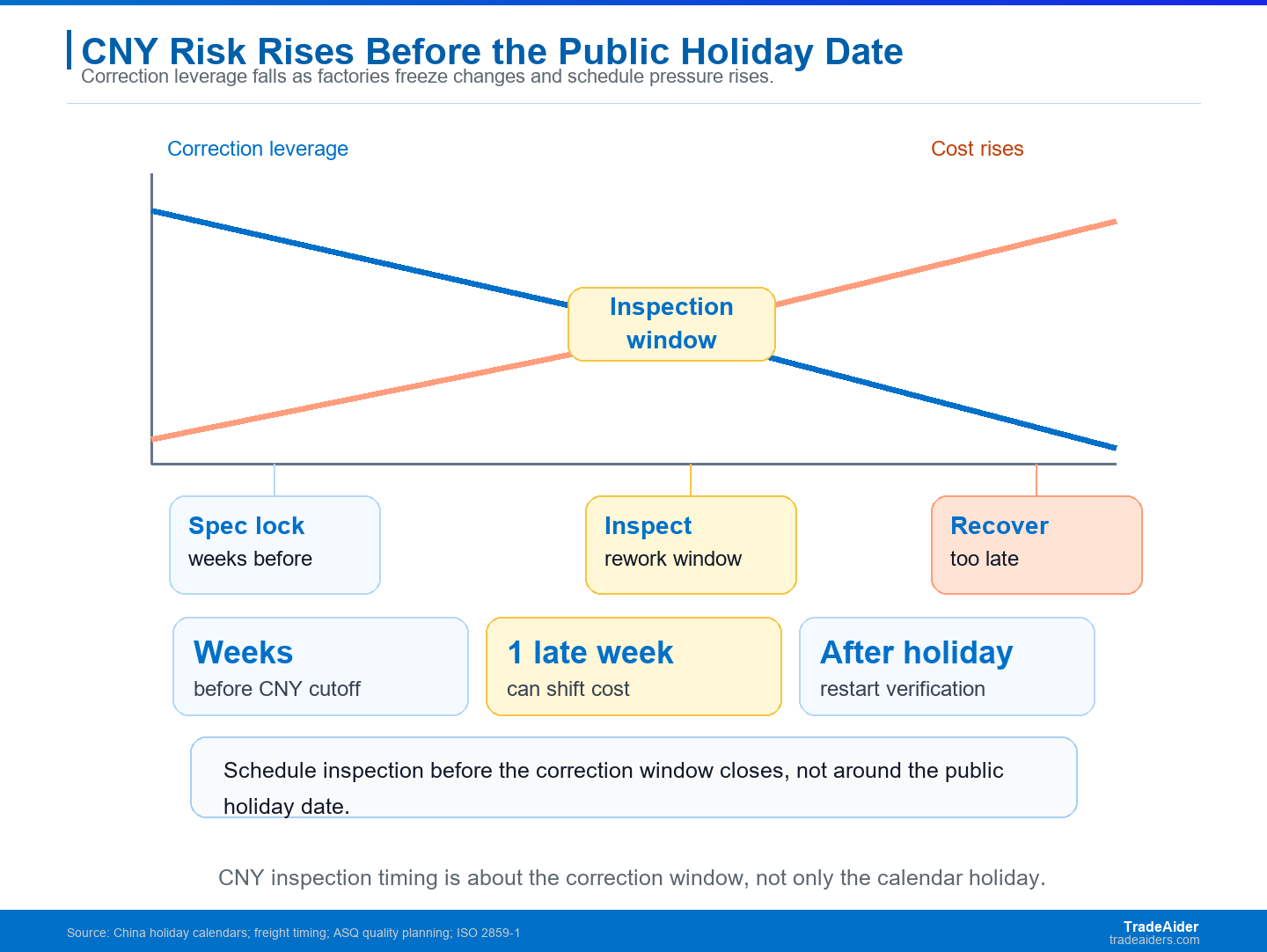
The CNY inspection timeline shows hich quality decision belongs before shutdown, during the final packing rush, and after factory restart.
How to Set the Inspection Calendar
The buyer should place each quality decision at the latest date when the factory still has enough people, materials, cartons, and time to correct the defect.
Eight to six weeks before CNY, the decision is whether the order is ready to start: sample, materials, labels, manuals, barcodes, carton marks, and purchase-order requirements should be locked. Five to three weeks before CNY, the decision is whether production is drifting under capacity pressure; DPI can catch wrong components, rushed workmanship, or packaging changes while correction is still possible. Two to one weeks before CNY, the decision is whether finished goods should be released, sorted, relabeled, or held.
Document and marking details deserve special attention during the rush. According to CPSC certificate guidance and CBP country-of-origin marking guidance, product compliance can depend on records and marks as much as visible workmanship. A late label or document mismatch should not be waved through just because the factory is about to close.
China-Sourced Order Scenario
Situation: an Amazon FBA seller orders 5,000 humidifiers from Zhejiang with a planned shipment 10 days before CNY. Problem: the supplier completes production late, and 80% of the cartons are packed, but the inspector finds a mixed manual version and weak inner protection in 9 sampled cartons. Action: the buyer holds release for 48 hours, asks the factory to replace manuals, reinforces inner packaging, and rechecks the corrected cartons before loading. Result: the shipment misses the earliest pickup but avoids sending a mixed-version lot into FBA before the factory closes. The trade-off is real: a later sailing is easier to explain than a post-holiday return pattern that the factory cannot fix until after restart.
Release Checks at Each CNY Window
Before production accelerates, release readiness means confirming material, component, label, manual, barcode, and packaging files. During production, it means checking whether the line is producing to the approved version before cartons pile up. At final PSI, it means inspecting finished goods when 100% of the order quantity is completed and at least 80% is packed for export, then deciding release, sorting, relabeling, rework, or hold.
After restart, release readiness shifts back to process stability. The first post-holiday order should confirm that workers, subcontractors, materials, carton suppliers, and test procedures have returned to the approved setup. A clean pre-holiday PSI does not prove the first post-holiday lot is clean.
Who Is TradeAider?
TradeAider is a quality inspection, testing, and certification service provider in China. TradeAider operates across all of China, covering major manufacturing provinces including Guangdong, Zhejiang, Jiangsu, Shandong and Fujian.
For CNY-season shipments, TradeAider can support the inspection windows that matter most: material and packaging checks before the rush, DPI when production starts compressing, PSI before final release, and restart checks after workers return. Real-time reporting is especially useful during this period because buyers often have only hours or days to decide whether to release, relabel, sort, or accept a later sailing.
Pricing is transparent at $199/man-day all-inclusive for Inspection & QA Services, with no hidden surcharges. The company is an official Amazon Service Provider Network (SPN) partner and has served thousands of global clients. Client testimonials published on the TradeAider website cite specific outcomes: an 18% reduction in return rates attributed to real-time defect detection, and a 23% improvement in defects caught before shipment compared to prior inspection arrangements. These are client-reported figures.
Next Steps: CNY Inspection Action Card
- Ask the factory for its real last production day, last packing day, and restart date instead of relying only on the public holiday calendar.
- Lock samples, materials, label files, manuals, barcodes, and carton artwork 8 to 6 weeks before the CNY shutdown window.
- Schedule DPI 5 to 3 weeks before CNY if the product is new, the supplier is new, or the order is at risk of schedule compression.
- Write the final release rule before PSI: which defects trigger release, sorting, relabeling, rework, hold, or a later sailing.
- Use TradeAider's during-production inspection when the shipment needs factory-side release evidence.
Frequently Asked Questions
When should I schedule inspection before Chinese New Year?
Schedule inspection at least several working days before the factory's real closure date, and earlier if the product is new or high risk. For tight orders, use during-production inspection 3 to 5 weeks before CNY and PSI before final shipment release.
Is it safe to ship without inspection before CNY?
Shipping without inspection before CNY is risky when the supplier is new, the product is new, packaging has changed, or there is no time for post-failure correction. The shutdown window makes factory-side fixes harder after the goods leave.
Do I need inspection after CNY if I inspected before the holiday?
Post-CNY inspection is recommended for the first restart lot when materials, workers, line setup, or subcontractors may have changed. A clean pre-holiday inspection does not automatically prove that the first post-holiday production run is stable.

Artigos Relacionados

Expanda seu negócio com o Serviço TradeAider
Clique no botão abaixo para entrar diretamente no Sistema de Serviço TradeAider. Os passos simples desde a reserva e pagamento até o recebimento de relatórios são fáceis de operar.

