
Achieving quality management compliance starts with identifying the requirements that apply to your organization, then building them into everyday work. Assess the gaps, assign objectives and responsibilities, put controls into operation, and use records, audits and review to check the results. A quality management system becomes useful when people can follow it and managers can see where action is needed. The steps below cover that complete implementation path, including the decision about certification.
Build a quality system that your team can operate and evaluate
- Identify the applicable requirements and the activities, sites and products within the system’s scope.
- Give each implementation gap an owner, an action and observable completion evidence.
- Connect documents and training with the way employees actually perform the work.
- Use audit results, operating data and effectiveness checks to decide the next improvements.
Define the requirements your quality system needs to meet
Quality management compliance means meeting the quality requirements applicable to your organization and its activities. A quality management system, or QMS, is the connected set of responsibilities, processes and information used to manage that work. Start by identifying the actual legal, customer, contractual and selected management-system requirements against which conformity will be assessed.
Write down the organizational boundary. Identify the covered sites, activities, product or service groups and outsourced processes. For each requirement, record its source, relevant edition or revision, applicability and responsible person. A buyer specification for a product, a destination-market obligation and a management-system requirement may lead to different controls and evidence. Keep those connections visible.
ISO 9001:2026 is the current edition of the quality management system requirements standard. Use the applicable requirements text when assessing your system, including the arrangements relevant to an existing certification. ISO’s current standard page.
Other management-system frameworks address different purposes. ISO 14001 concerns environmental management, while ISO/IEC 27001 concerns information security management. Select additional frameworks when those subject areas belong in your organization’s objectives or obligations. ISO’s management-system overview.
ISO 31000 provides principles and guidelines for risk management across an organization. It can inform how a team considers uncertainty when planning its quality work. Identify the actual quality-system requirements separately when using this broader guidance. ISO’s risk-management description.
Step 1. Assess current processes against the requirements
Use a gap analysis to compare what the requirements call for with what your processes and records currently demonstrate. Walk through real work, from receiving a customer requirement to delivering the product or service. Include purchasing, supplier coordination, production or service execution, checks, complaints and changes where they fall within your scope.
ISO’s ISO 9001:2026 implementation guidance starts with organizational context and objectives, active leadership, connected processes, risks and opportunities, evidence and continual improvement. These elements provide a useful basis for understanding how your current system operates. ISO’s implementation guidance.
For each process, ask the person doing the work to show the input, instruction, output and retained result. Compare that evidence with the relevant requirement. Record a specific gap, such as an obsolete drawing available at the inspection bench, together with the affected activity. “Documentation needs improvement” is too broad to assign or verify.
Distinguish a missing document from a process that is not being followed, a requirement whose applicability is unresolved and an outcome that has not been measured. Each needs a different action. Prioritize gaps using their consequences for customers, product requirements and continuity of work. Preserve practices that already work within the selected scope.
Step 2. Set objectives, owners and an implementation plan
The implementation plan should connect each priority gap with a responsible owner, resources, a due date and evidence that will show whether the action worked. Leadership resolves priorities and resource conflicts, while process owners implement the controls in their areas.
ISO’s current update guidance emphasizes leadership, quality culture and ethical behavior, and distinguishes risks from opportunities. It encourages organizations to review existing systems and strengthen the areas needing change. ISO’s explanation of the updated approach.
Define objectives using the problem you are trying to resolve. For repeated dimensional rejects, agree which products and defect categories are counted, the measurement period, the baseline and the intended result. For delayed complaint responses, define when the response clock starts and what counts as a response. Choose targets using actual obligations and operating needs.
Plan dependencies as well as deadlines. A revised check instruction may need a confirmed drawing, suitable measuring equipment and a competence demonstration before rollout. Give someone authority to resolve a blocked dependency. Encourage employees to report unclear instructions and inaccurate records so that implementation problems become visible while they can still be corrected.
Step 3. Put process and supplier controls into daily work
Translate agreed requirements into process controls that people can carry out. Identify the input, responsible role, instruction, acceptance criteria, output and escalation route. Include supplier controls for externally provided products and services that affect the intended result.
Start with a real transaction or production activity. Show how an approved requirement reaches purchasing, how the supplier receives the current specification, how incoming results are checked and how an unacceptable result is handled. Resolve gaps between departments, such as purchasing accepting a substitution before engineering has evaluated the change.
For suppliers, define the information needed for selection, ongoing evaluation and follow-up. The evidence may include performance records, relevant technical documents and observations of the production site. TradeAider’s factory audit service can provide agreed findings on areas such as production equipment, quality management and warehousing, recorded in a formal audit report. Use those findings in the supplier actions your own system assigns.
Pilot changed controls in the affected work before extending them. Ask employees to demonstrate the handoff and retain the resulting record. If the process only works when the implementation lead intervenes, identify what the normal role, instruction or resource is missing. This also helps address resistance by showing how the change fits the actual task.
Step 4. Control documents, records and changes
Control the information people use to do the work and the records showing what happened. Instructions, drawings and acceptance criteria guide an activity. Completed check sheets, approvals and results provide evidence of its execution.
ISO 10013 provides guidance on developing and maintaining documented information for an effective QMS, tailored to the organization’s specific needs. Use that principle when deciding how much detail and which format your team needs. ISO’s documented-information guidance.
Identify who approves information, how revisions are identified and where the current version is available. Decide how obsolete working copies are removed or clearly separated from current instructions. Set access, protection and retention arrangements using the actual requirement and the purpose of the record.
Manage a change through its effect on the work. A revised product specification may affect purchasing, supplier instructions, inspection criteria and training. Identify those affected uses before the revision takes effect, then check that each has been updated. Select software only after the information flow is understood, with permissions, version control and retrieval suited to that flow.
Step 5. Train employees and check competence
Define the competence needed for each task, provide appropriate instruction and check that the employee can perform the work using current information. A practical demonstration can show whether the person understands the acceptance criteria, records the result correctly and knows when to escalate.
For an incoming inspector, this might mean retrieving the approved drawing, selecting the agreed measurement method and completing a check record on a representative item. For purchasing, it might mean communicating a controlled specification change to the supplier. Choose a demonstration that reflects the person’s actual responsibility.
Record the competence decision and any remaining support needed. If an employee can explain the procedure but cannot access the current drawing, fix the access problem as well as the training. Repeat the relevant check after a meaningful process change or when results indicate a gap in performance. Keep the learning activity connected to its observable outcome.
Step 6. Audit the system and evaluate performance
Evaluate whether the implemented system meets the selected criteria and works in practice. An internal audit can trace a requirement through instructions, interviews, observations and records to identify where the process conforms and where evidence is missing or contradictory.
ISO 19011 provides guidelines for audit program management, conducting management system audits and auditor competence. It offers a reference for organizing this evaluation. ISO’s management-system auditing guidance.
Plan the audit scope, criteria, responsibilities and timing. Use applicable requirements, process importance, changes and previous results when setting the program. Arrange objective evaluation and suitable auditor competence. A fixed annual calendar by itself says little about whether the important processes and changed conditions have been examined.
Monitor measures that match the quality objective and the actual process. Keep the definition, denominator and review period clear. Examples include defect results for a defined product group, repeat complaints or completion of agreed corrective actions. When a result deteriorates, identify the affected activity and the action to investigate it.
Read audit findings and performance data together. A procedure can be followed while producing an unsuitable result, and an acceptable result can occur despite an uncontrolled process. Examine the relevant evidence before deciding which part of the system needs change.
Step 7. Correct problems and verify effectiveness
Address the immediate nonconformity, meaning a failure to meet a requirement, and investigate its cause. Choose a corrective action that addresses that cause, then define a follow-up check for effectiveness. The check needs to show whether the changed process controls the problem under the relevant conditions.
Record the affected activity, evidence and requirement so the responsible team can investigate a concrete finding. Consider whether similar work elsewhere is affected. Assign containment or correction where needed, then determine which process change will address recurrence. Training, equipment adjustment or a document revision should follow the identified cause.
Illustrative scenario. In this hypothetical drawing-control problem, an inspector uses an outdated PDF after the revision index has changed. The team corrects the immediate inspection record and evaluates any affected acceptance decisions. Investigation finds that the old drawing remains in a shared working folder. The owner removes the obsolete copy, changes distribution responsibilities and checks access to the approved revision. During the next check, a reviewer observes the inspector retrieving that revision and applying its criteria, then examines the completed record. This gives evidence about the revised distribution control at its point of use.
Use the agreed follow-up result to decide whether the action is effective, needs adjustment or requires more evidence. A successful observation covers the conditions actually checked. Continue monitoring where recurrence depends on other shifts, sites or product variants, and record the unresolved scope instead of closing it on the strength of an unrelated improvement.
Step 8. Review the system and decide the certification path
Management review brings performance, audit findings, customer feedback and relevant changes together so leaders can make decisions about priorities, resources and system improvements. Record the decisions, the people responsible and the follow-up needed to check implementation.
Plan review intervals using the applicable requirements and the way the organization operates. Also identify changes that justify earlier attention, such as a new product, significant supplier problem or revised market requirement. Examine unresolved actions and whether previous decisions produced the intended results. Use the review to update the implementation plan and resource commitments.
ISO’s ISO 9001:2026 implementation guide explains that certification is optional, although particular markets or contracts may call for it. Existing certified organizations can plan their transition with their certification body. Decide which certification conditions apply to your situation and include the relevant arrangements in the plan. ISO’s certification and transition guidance.
External certification bodies perform certification. ISO develops standards and does not issue certificates or perform certification itself. Accreditation provides independent recognition of a certification body’s competence. When selecting a body, agree the relevant scope, audit process, evidence expectations and continuing arrangements. ISO’s explanation of certification and accreditation.
Prepare using operating evidence from the covered processes. Ask the selected body to explain its readiness review, certification assessment, treatment of findings and subsequent surveillance. Plan around its actual process and your organization’s readiness. Continue the internal review and improvement cycle after any certification decision.
Keep one implementation record from gap to follow-up
Use a record that links each gap to its requirement source, action, owner, due date, completion evidence and next effectiveness check. The template below can be copied into the team’s working plan. Add the actual requirement reference and observed gap to each work item before assigning it. Keep an unclear requirement open until its applicability is resolved.
| Work item and action | Owner and due date | Completion evidence and next check |
|---|---|---|
| Scope and requirements — Action ____ | Owner ____ Due ____ | Source and applicability ____ Open question ____ |
| Current-state gap — Action ____ | Owner ____ Due ____ | Observed process or record ____ Gap ____ |
| Objective and plan — Action ____ | Owner ____ Due ____ | Measure, baseline and intended result ____ |
| Process or supplier control — Action ____ | Owner ____ Due ____ | Operational record ____ Handoff checked ____ |
| Documents and competence — Action ____ | Owner ____ Due ____ | Current instruction ____ Demonstration result ____ |
| Audit and performance — Action ____ | Owner ____ Due ____ | Criteria and findings ____ Result period ____ |
| Corrective action — Action ____ | Owner ____ Due ____ | Cause and change ____ Effectiveness check ____ |
| Review and certification decision — Action ____ | Owner ____ Due ____ | Decision and resources ____ Next review ____ |
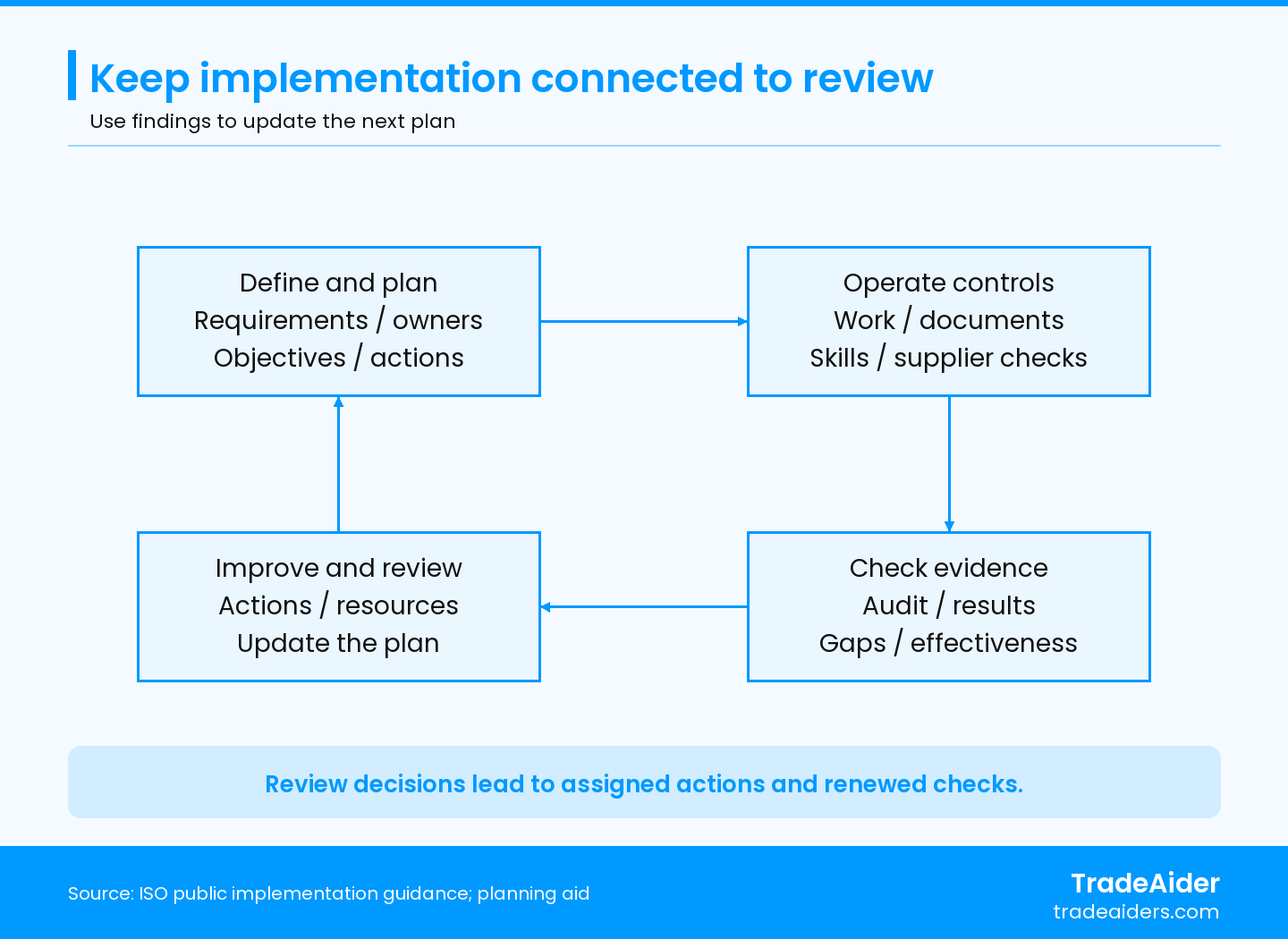
Implementation aid. Use actual process evidence and review decisions to update the next plan.
For the drawing example, the document-control owner would enter removal of the obsolete PDF and the changed distribution method as the action. Completion evidence would identify the controlled location and approved revision. The next check would record the observed retrieval and use of that revision. If access still fails, retain the open action and address that failure before claiming completion.
Use supplier evidence in your implementation plan
For a supplier audit inquiry, start with the available factory, product and sourcing information, known quality concerns and intended timing. Share the supplier requirements and records already available. TradeAider can discuss the supplier-site checks and report needed for that scope. Before execution, agree the audit references, covered activities, evidence to be collected and reporting arrangements.
Use the resulting factory audit report to assign supplier follow-up within your implementation plan. Contact our team to discuss an appropriate supplier audit.
Frequently Asked Questions
Can a small team implement this without dedicated QMS software?
Yes. A small team can use controlled documents and records in tools suited to its work, provided they meet the applicable requirements. Check that people can access the current information, protect completed records and retrieve evidence when needed. Dedicated software becomes useful when it solves a genuine coordination or control problem.
What should we do when a requirement’s applicability is unclear?
Keep it open and assign an appropriately qualified person to resolve its applicability before declaring conformity. Record the source, the uncertainty and the affected process or decision. Obtain clarification from the responsible customer, technical specialist or other appropriate authority. Once resolved, update the requirement record and the actions that depend on it.
How long does quality management implementation take?
There is no single implementation period that fits every organization. Scope, existing practices, the size of the gaps and available resources affect the work required. Plan milestones around completed controls and evidence of operation. If certification is part of the objective, coordinate its assessment schedule and readiness expectations with the selected certification body.
Artigos Relacionados
Expanda seu negócio com o Serviço TradeAider
Clique no botão abaixo para entrar diretamente no Sistema de Serviço TradeAider. Os passos simples desde a reserva e pagamento até o recebimento de relatórios são fáceis de operar.

