
- Sobre Nós

- Nossos Serviços
- Sua Indústria
- Recursos
- Notícias e Blog

The global home decor market reached nearly $960 billion in value in 2024, with China as the dominant manufacturing hub supplying everything from decorative mirrors and ceramic vases to metal wall art and woven baskets. For importers, the sheer volume and variety of home decor products sourced from China creates a quality control challenge that looks very different from electronics or apparel. Mirrors, in particular, require specialized inspection knowledge — defects in silvering, backing material, or frame construction are category-specific failures that a generalist inspector unfamiliar with glass products may miss entirely.
This guide explains how to evaluate and choose a product inspection company in China for home decor and mirrors, what the best providers actually do differently, and how to apply inspection effectively across different order types.
Key Takeaways
- Not all inspection companies have home decor category expertise — mirrors, glass, and decorative metalwork each require category-specific checklists that go beyond a generic hardgoods inspection.
- Mirror inspection in North America is governed by ASTM C1503-08, while European importers reference DIN EN 1036 and ISO 25537:2008. Your inspection provider should be familiar with the standard applicable to your target market.
- Same-day or 24-hour inspection reports are now an industry baseline for professional QC providers — if a company cannot deliver reports within 24 hours, your supply chain flexibility is compromised.
- Real-time visibility matters more than price per man-day when sourcing fragile home decor items where a large-batch defect discovered late costs far more than the inspection itself.
Why Home Decor and Mirrors Demand Specialist Inspection Knowledge
Home decor encompasses an unusually broad range of materials and production processes — glass, ceramic, resin, metal, wicker, fabric, and combinations of all of these in a single SKU. Each material has its own failure modes, its own inspection standards, and its own set of factory-side risks. A metal desk can be inspected with a largely consistent checklist across suppliers. A decorative mirror with a metal frame, a glass face, silver backing, and a velvet hanging cord involves four separate material categories, each requiring different evaluation criteria.
According to industry research on the home decor sector, a significant share of online purchases involve products misrepresented in terms of quality — which means both the brand damage from customer complaints and the logistical cost of returns fall squarely on the importer. Sourcing and quality control specialists estimate that 20–30% of ecommerce returns are attributable to defective or misrepresented goods. For home decor categories where aesthetics are the primary purchase driver, that number is even more consequential.
Mirror-Specific Quality Standards You Need to Know
Mirrors are one of the most technically demanding home decor categories to inspect correctly. The key defects — silvering inconsistencies, glass distortion, backing delamination, edge chips, and frame misalignment — require inspectors who understand the manufacturing process well enough to know where each failure originates.
Applicable Standards by Market
The relevant standard depends on where you're selling. Glass inspection authorities identify three primary mirror standards: ASTM C1503-08 (North America, covering silvered flat glass mirrors for indoor use), ISO 25537:2008 (international, restricted to tinted or annealed clear glass between 2mm and 6mm thickness), and DIN EN 1036 (Germany and EU, specifying requirements, test methods, and evaluation criteria for commercial indoor mirrors). When briefing an inspection company for a mirror order, specify which standard applies to your destination market — an inspection conducted against ASTM criteria produces different acceptance criteria than one conducted against DIN EN 1036.
| Standard | Market | Scope |
|---|---|---|
| ASTM C1503-08 | North America (US, CA) | Silvered flat glass mirrors, indoor use |
| ISO 25537:2008 | International | Tinted/annealed clear glass, 2–6mm |
| DIN EN 1036 | Germany / EU | Commercial indoor mirrors, two-part standard |
| JSA JIS R 3220:1999 | Japan / Asia | Mirrors manufactured and distributed across Asia |
The Most Common Mirror Defects Found at Inspection
Based on the categories covered by inspection standards and typical factory-side failures, the defects found most frequently in mirror inspections include silvering spots (small areas where the reflective coating is absent or inconsistent), edge chips (particularly at the corners of cut glass panels), backing delamination (the protective paint layer separating from the silver coating, visible as dark patches), glass distortion (visible when a straight object's reflection appears curved), and frame construction failures such as loose joints, uneven gap between frame and glass, or missing hanging hardware.
Bubbles, surface scratches, and smears are also commonly cited defects in glass product inspections. Inspectors examine each mirror sample under natural light at multiple angles — the same defect that appears minor under direct overhead lighting becomes immediately visible when light is raked across the glass surface at 30–45 degrees. An inspection provider who does not use directional lighting during glass inspection is missing defects that your end customer will notice immediately upon unboxing.
What to Actually Look for in a China Inspection Company for Home Decor
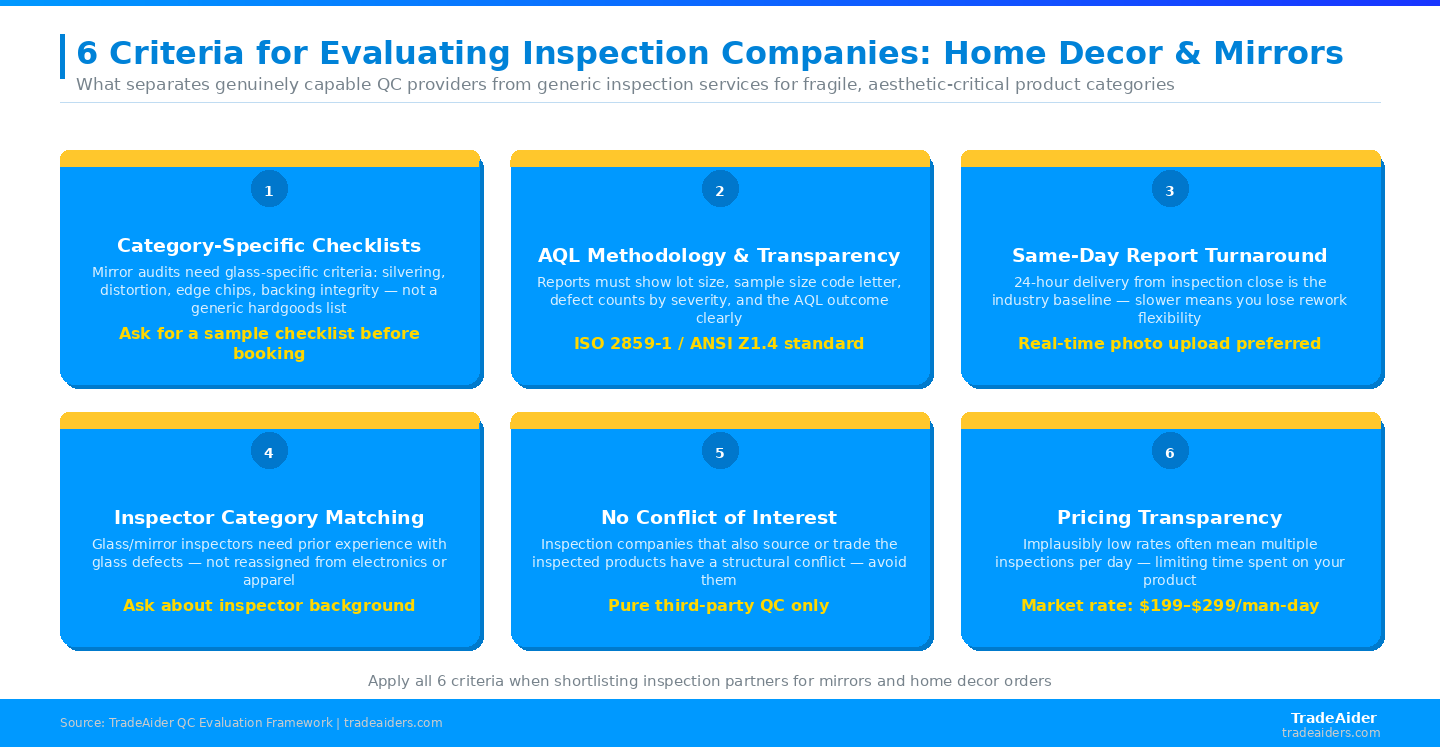 Request a sample mirror-specific checklist before booking — it's the fastest way to verify whether a provider has genuine category expertise
When evaluating inspection providers for home decor and mirrors, the critical differentiators are not company size or price — they are category expertise, reporting quality, and operational transparency. Here is how to evaluate each.
Category-Specific Inspection Checklists
The most reliable signal of genuine home decor expertise is whether the inspection company can provide you with a draft checklist before you book. A generic hardgoods checklist covers visual inspection, dimensions, packaging, and labeling — all necessary, but insufficient for mirrors. A category-specific mirror checklist will additionally include silvering quality assessment, glass distortion test, backing integrity check, edge safety evaluation, frame-to-glass gap measurement, and hanging hardware load test. Request a sample checklist during your evaluation process and assess whether it addresses the specific failure modes relevant to your product.
AQL Methodology and Sampling Transparency
Every reputable inspection company operates under the ISO 2859-1 / ANSI Z1.4 AQL framework for determining sample sizes and accept/reject thresholds. The standard industry setting for home decor is AQL 2.5 for major defects (functional or significant cosmetic failures) and AQL 4.0 for minor defects (small cosmetic issues that don't affect function). Your inspection report should show the lot size, sample size code letter, sample size inspected, number of defects found by category (critical/major/minor), and the pass/fail outcome for each AQL level. If an inspection report presents only a narrative description and a pass/fail result without showing the AQL table applied, you cannot verify whether the sampling was statistically adequate. The ANSI/ASQ Z1.4 framework exists precisely to ensure that sampling decisions are transparent and reproducible.
Report Turnaround and Real-Time Visibility
For home decor orders, where rework windows are typically narrow and factories have multiple concurrent production runs, inspection report turnaround directly determines your operational flexibility. The industry standard is now a same-day or 24-hour report from the time the inspection concludes. Any provider that cannot commit to this timeline significantly constrains your ability to make rework or hold decisions before the factory loads the container.
Real-time visibility goes beyond report delivery speed. The best inspection platforms provide live updates during the inspection — photo and video evidence uploaded in real time as the inspector works through the checklist. This means you can see product condition, packaging status, and defect photos on the same day as the inspection, even before the formal report is compiled. For fragile home decor categories like mirrors, where decisions about rework versus shipment acceptance need to happen quickly, this visibility is the difference between a managed quality issue and an expensive dispute after delivery. TradeAider's pre-shipment inspection service delivers inspection reports within 24 hours, with real-time status updates so you're never waiting on a closed-door process.
Inspector Qualifications and Category Matching
Inspection companies vary significantly in how they match inspectors to product categories. The best providers maintain inspector profiles with documented product experience, and they assign inspectors whose background aligns with the category being inspected. For mirrors and glass home decor, this means inspectors who have conducted glass-specific inspections and are familiar with the defect vocabulary — not inspectors reassigned from an electronics or apparel background. Ask any prospective inspection company how they match inspector expertise to product category, and whether the inspector assigned to your order will have prior experience with glass or home decor products.
How TradeAider Approaches Home Decor and Mirror Inspections
TradeAider's inspection model is built around real-time visibility — the principle that an importer should never be in the dark about what's happening at the factory on inspection day. For home decor and mirror orders, this means inspectors working through category-specific checklists with photo documentation captured at every defect finding, uploaded to the platform as the inspection progresses.
The inspection process for a mirror order typically proceeds as follows: the inspector arrives at the factory and confirms the production lot against the purchase order, then randomly selects the AQL-appropriate sample quantity. Each unit is examined under natural and directional lighting for glass defects, silvering quality, backing integrity, edge condition, and frame construction. Dimensions are measured and compared to the technical specification. Packaging is opened and inspected for adequacy of foam protection and carton specification. A load test may be performed on the hanging hardware if specified. All findings are photographed, categorized by severity, and compiled into a structured report that clearly shows the AQL outcome.
For importers managing multiple SKUs across a home decor range — for example, a collection that includes mirrors, ceramic accent pieces, and metal wall art — TradeAider can coordinate concurrent inspections across different factories on the same day, with consolidated reporting so you're reviewing one set of findings rather than chasing individual inspection companies for separate reports. Contact our team to discuss how we structure multi-SKU home decor inspections.
Red Flags to Watch for When Evaluating Inspection Companies
Several patterns consistently indicate a lower-quality inspection provider. The first is pricing that seems implausibly low — professional third-party inspection in China requires a full working day of inspector time, travel, reporting, and account management. Pricing significantly below the market range often means the inspector is conducting multiple inspections in a single day, which mathematically limits the time available for your product.
The second red flag is a lack of category-specific documentation. If you ask for a sample checklist for mirror inspection and receive a generic hardgoods checklist with no glass-specific criteria, the company does not have the expertise you need. Similarly, if the sample reports you review are narrative-only without structured AQL tables, you cannot verify whether the sampling methodology was applied correctly.
A third warning sign is inspection companies that also offer sourcing or trading services for the products they inspect. The conflict of interest in having the same company inspect goods they have a financial interest in selling is structural, not merely theoretical. Third-party inspection is only genuinely independent when the inspection provider has no commercial relationship with the factory or the product beyond the inspection itself.
When and How to Use Different Inspection Types for Home Decor
The right inspection type depends on your order value, your familiarity with the supplier, and the complexity of the product. For a first order with a new mirror supplier, a Pre-Shipment Inspection (PSI) is the minimum. For orders over 500 units or above $15,000 in value, a During Production Inspection (DPI) provides an earlier opportunity to catch defects while the production line is still running. For a new supplier relationship where you have no prior audit data, a factory audit before placing the first order gives you documented evidence of the manufacturer's QC infrastructure, production capacity, and quality system maturity.
For Amazon FBA sellers importing home decor, there's an additional consideration: Amazon's fulfillment requirements include specific carton labeling, product labeling, and packaging standards that must be verified before the shipment arrives at the fulfillment center. An inspection company familiar with Amazon FBA requirements will include these checks in the inspection checklist without needing to be reminded. TradeAider's Amazon FBA inspection solutions are designed specifically for this workflow, covering both product quality and fulfillment compliance in a single inspection visit.
Frequently Asked Questions
What is the most common defect found in mirror inspections from China?
Silvering spots and edge chips are the most frequently reported defects in mirror inspections. Silvering spots — areas where the reflective coating is missing or inconsistent — are typically a production-side failure in the coating application process. Edge chips occur during glass cutting and handling. Both are assessed under ASTM C1503-08 and ISO glass inspection standards for North American and international markets, respectively.
Do I need a separate inspection for the mirror frame and the glass?
Not necessarily — a single inspection visit with a category-specific checklist should cover both the glass panel (silvering, distortion, edge condition, backing integrity) and the frame (material quality, finish consistency, joint construction, hanging hardware). The key is that the inspector's checklist must explicitly address both components. Request a copy of the proposed checklist before confirming the booking to verify both elements are covered.
How many units should I inspect from a mirror order of 800 pieces?
For a lot of 800 units under General Inspection Level II (the standard for most consumer products), the ANSI Z1.4 code letter is J, requiring a sample size of 80 units. At AQL 2.5 for major defects, the batch passes if inspectors find 5 or fewer major defects and fails at 6 or more. Use TradeAider's AQL calculator to quickly verify the right sample size for your specific lot quantity and AQL settings.
Can one inspection cover multiple home decor SKUs in a single factory visit?
Yes, and this is common for importers managing a home decor range. When multiple SKUs are produced in the same factory, an inspector can cover them in a single man-day visit, applying AQL sampling to each SKU separately. However, if the lot sizes are large and the SKUs are diverse (for example, both mirrors and ceramic pieces requiring different testing approaches), you may need to book additional man-days to ensure adequate coverage of each category. Discuss multi-SKU inspection requirements with your inspection company when booking, not after the visit is scheduled.

Artigos Relacionados



Expanda seu negócio com o Serviço TradeAider
Clique no botão abaixo para entrar diretamente no Sistema de Serviço TradeAider. Os passos simples desde a reserva e pagamento até o recebimento de relatórios são fáceis de operar.

