
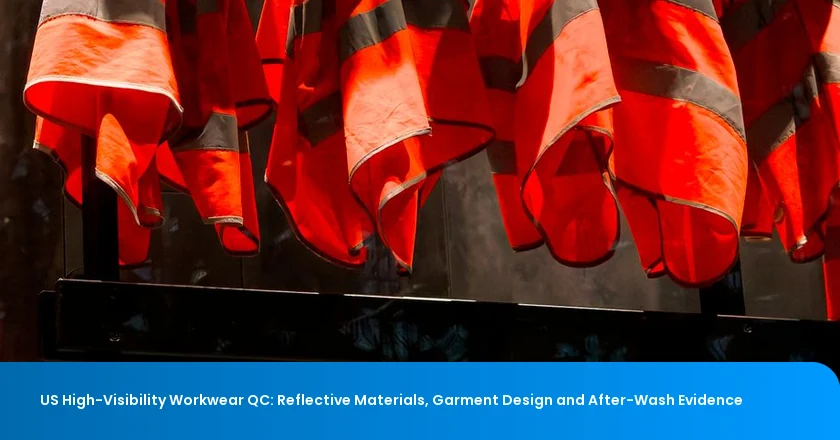
US high-visibility workwear quality control, or QC, starts with the intended work setting and the requirements adopted for that order. Match the stated garment type and performance class to the actual design, sizes, background fabric and reflective trim. Then check whether the test evidence represents that construction, including its claimed performance after cleaning. A bright vest or a passing tape report cannot establish all of these points. Use bulk inspection to record the agreed physical checks, while keeping unresolved performance questions with the technical reviewer.
What to establish before accepting high-visibility workwear
- The US application, adopted standard edition, garment type and performance class.
- The current design and size range, with identifiable fabric, trim and attachment.
- The relevant wash results, matching labels and limits of the bulk inspection.
Fix the US use, governing requirements and standard edition
The correct high-visibility specification depends on where and how the garment will be used. Ask the buyer or employer’s safety representative to identify the work environment, traffic exposure, day or night use, applicable jurisdiction and purchasing specification. Record the required standard edition and classification in the order. “For the US market” is not enough information to select a garment for every workplace hazard.
The International Safety Equipment Association, or ISEA, announced ANSI/ISEA 107-2026 in its October 26, 2026 update. ISEA also explains that previous-edition garments do not suddenly become obsolete and that products tested and labeled to both editions are expected during transition. Confirm the edition accepted for the actual application and contract. Publication of a newer standard does not alone establish a new legal requirement for every workwear order.
For a specific roadway example, MUTCD Section 6C.05 addresses workers within the right-of-way and the temporary traffic control, or TTC, zone. It specifies Performance Class 2 or 3 under ANSI/ISEA 107-2015 or equivalent revisions, with stated exceptions and class selection by an employer-designated safety person. Its nighttime flagger Class 3 paragraph is guidance using “should.” The section also specifies fluorescent orange-red, fluorescent yellow-green or their combination for background material. Do not extend these scoped provisions to every workplace or assume every generally listed ANSI background color is accepted in that roadway application.
Obtain the controlling specification before evaluating a supplier’s claim. If a tender names an earlier edition while a supplier offers the new one, ask the recipient to resolve acceptance and any required comparison. Keep that decision with the order rather than quietly replacing the edition in the purchase document or relabeling existing goods.
Define the physical lot check separately. TradeAider’s inspection reference guide is a starting point for discussing inspection scope and lot assessment; it is not the high-visibility garment performance standard. The technical requirements still need an identifiable source and an authorized owner.
Read garment type and performance class together
High-visibility garment type and performance class describe different aspects of the claim. Read both, together with the standard edition and the intended use. A supplier quoting only “Class 2 reflective clothing” has left out information needed to judge the actual application and design. Request the full designation, the style or model and the supporting conformity records.
ISEA’s high-visibility product overview describes Types O, R and P by work environment, and performance classes by the amount and placement of high-visibility materials. In ISEA’s garment-type explanation, O means off-road, R means roadway and temporary traffic control, and P means public safety activities. It identifies Class E as supplemental for items such as pants and bib overalls. The standard’s scope also includes material color, retroreflection, physical properties, visible area and garment design. A material grade or tape width therefore cannot be read as the complete garment classification.
Have the employer or appropriate safety representative confirm which type and class suit the actual work. Keep this decision distinct from the importer’s inspection instructions. The inspector can compare the label and construction with an agreed specification; that does not make the inspector the person selecting protective equipment for every worker, task or traffic condition.
Make the claim specific to the product offered. Record whether the order contains a vest, shirt, jacket, coverall or separate supplemental item. Identify the claimed size range, colors and any components sold together. If the claim depends on wearing an ensemble, ask for evidence identifying that combination and its conditions of use. Do not assume separate garments with familiar labels can be combined into any desired class.
Check that fit has been considered alongside the classification. A buyer should know which sizes are actually covered and how the garment is meant to be worn and fastened. An oversized sample with ample fabric does not answer whether the smaller ordered design has been evaluated. Keep the relevant size drawings and assessment scope available for the next stage.
Identify background fabric and retroreflective trim separately
High-visibility materials need traceable identities before their reports can be applied to an order. Record the background fabric specification, color and finish, together with the trim manufacturer, product code, construction and attachment method. Keep the supplier’s material references linked to the actual garment style and production records. “Same fluorescent fabric” or “equivalent silver tape” leaves the technical reviewer without a defined comparison.
Background color and retroreflection answer different visibility questions. The bright background and the reflective bands should not be judged by one general appearance score. Retroreflective material returns incident light toward its source; it does not produce its own light. A photograph can show where bands have been placed, but camera exposure and flash conditions do not supply the prescribed optical measurement or a finished-garment assessment.
Keep background fabric and retroreflective trim separately identifiable, then connect their evidence to the actual application. The practical reason is that a familiar surface or supplier name cannot show whether the current material, finish and attachment are represented by the available results. A genuine component report may be relevant while leaving a finished-design or after-wash question unanswered.
Ask how material and process changes are controlled. A revised substrate, heat-transfer process, coating or trim construction needs a documented review of the evidence it may affect. Obtain the actual change description and the first affected goods. The appropriate technical evaluator should decide whether existing evidence remains representative or whether additional assessment is needed; do not declare every substitution equivalent or automatically require every test again.
Retain an identifiable approved garment and material references where permitted. Record who holds them and which version controls the comparison. If the physical sample, drawing and component list conflict, resolve the conflict before issuing inspection instructions. This gives the factory and the reviewer the same product to discuss rather than several almost-matching examples.
For the physical lot, the AQL sampling calculator can support an agreed acceptance quality limit, or AQL, sampling plan for workmanship checks. Keep that sample count separate from the laboratory’s required specimens and conditioning. A workmanship sample cannot establish that every material or claimed performance has been tested.
Check the finished design across the ordered sizes
Finished-garment design needs its own evaluation, even when the fabric and trim have suitable material evidence. Compare the current style with the assessed drawing and construction. Check the relevant visible-material areas, band layout and dimensions against the adopted edition and approved specification. Use the actual criteria; a generic sketch of a vest cannot supply them.
ISEA’s public 2026 standard overview describes updated design and testing guidance for split-trim, segmented, non-continuous and heat-applied retroreflective materials. Confirm how the current construction has been assessed. A segmented strip’s overall footprint, for example, should not automatically be counted as a solid reflective area. The assessor needs the actual pattern and applicable method, not an assumption based on the roll’s outside width.
Use this procurement checklist to collect the controlling references. Fill in the actual value or document identifier and the owner of any gap. These are review fields, not a replacement for the standard’s design and performance requirements.
| Review item | Record for this order | Evidence or open-item owner |
|---|---|---|
| Use and claim | Application; adopted edition; type and class | Employer/recipient specification and decision |
| Style and sizes | Model, ordered size range and current drawings | Design assessment covering relevant variants |
| Background and trim | Fabric/color; trim code; attachment process | Material records and represented test scope |
| Finished layout | Countable areas, band geometry and construction | Applicable criteria and assessment record |
| Care and labeling | Claimed cleaning process; current label version | Wash reports, instructions and declaration |
Include features that can change the visible design: pockets, closures, logos, ventilation panels, hoods and layered components. Check their effect in the intended wearing configuration, not only on an unfastened sample laid flat. Identify the relevant ordered sizes in photographs and measurements. When the technical assessment excludes a size or variant, record the gap rather than extending the claim by resemblance.
Carry the agreed drawings and comparison points into TradeAider’s Pre-Shipment Inspection services. Pre-Shipment Inspection, or PSI, applies when the order quantity is 100% complete and at least 80% packed for export. The 80% threshold concerns packing. Agree which physical measurements and observations are feasible; the visit does not itself certify the garment’s protective performance.
Read the conditions behind after-wash performance
After-wash evidence is useful only when the tested construction and cleaning conditions are identifiable. Ask what was tested: loose trim, trim attached to a specified substrate, background fabric or the finished garment. Match that specimen to the current product and the intended cleaning process. A wash count without those connections leaves a central part of the claim unresolved.
ISEA’s 2026 overview of testing changes includes laundering, dimensional change, colorfastness and retroreflective performance. These are distinct outcomes. Read the actual report’s methods, conditioning, cleaning and drying process, cycle count, measured results and acceptance criteria. A statement that the specimen “looks fine after washing” does not establish all of these assessments or the claimed performance of a different application.
Use the following record when requesting or reviewing wash evidence. Keep the original report reference with the completed fields. If a field is absent, ask the laboratory or technical owner to clarify its effect on the claim instead of filling it from a general brochure.
| Evidence field | Record or compare | Question if incomplete |
|---|---|---|
| Specimen and application | Style/material code, substrate and attachment | Does it represent the current garment? |
| Cleaning and drying | Method/version, program and relevant conditions | Does it support the intended care process? |
| Exposure and conditioning | Cycle count and required pretreatment | Which durability claim was assessed? |
| Results and criteria | Relevant optical, color, dimensional or other outcomes | Which requirements passed, failed or were not assessed? |
| Claim and coverage | Label wording, variants and declared limitations | What review or testing remains, and who owns it? |
Do not treat home laundering, industrial laundering and dry cleaning as interchangeable evidence. Compare the actual washing and drying procedure with the intended care instructions. Different detergent, temperature, drying or attachment conditions can change what the reported result represents. Where the supplier relies on a material bulletin, obtain the relevant application evidence and a technical explanation of how it supports the finished product claim.
A claimed number of cleaning cycles is not an unconditional service-life guarantee. Keep the conditions and limitations visible to the user, and resolve inconsistencies between the care label and the report. Actual wear, contamination, damage and maintenance also matter when the employer assesses continued suitability. This review does not supply a universal wash temperature, cycle requirement or replacement interval; use the adopted requirements and current product instructions.
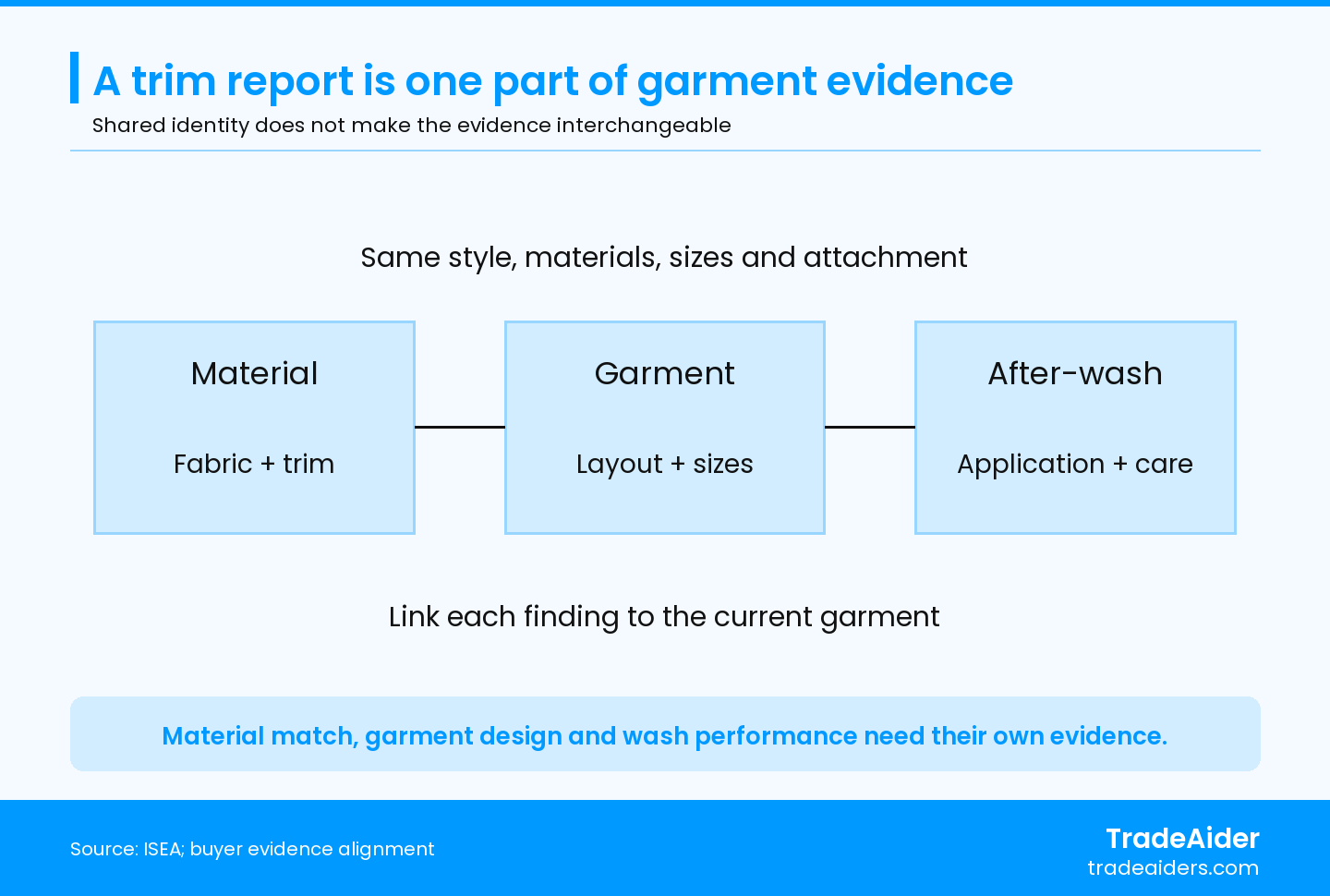
Evidence alignment schematic, not a garment pattern or certification sequence. Match material, finished design and wash results to the current construction and adopted requirements. Bulk inspection records agreed observations; it cannot fill missing laboratory performance evidence.
If the available report describes an earlier trim or attachment, preserve it as evidence for that identified configuration. Ask the technical reviewer what supports the current one. Record whether the answer is documented coverage, additional information needed or a defined further test. An unspecified promise to send a “new certificate later” does not close the question before the buyer relies on the durability claim.
Match markings and conformity documents to the garment
High-visibility markings should describe the garment actually supplied and the claim supported by its records. Compare the manufacturer or responsible entity, style identification, size, stated standard edition, type/class information and care instructions against the applicable marking requirements. Check the physical label for legibility and attachment. A correct-looking label on the wrong construction is still a mismatch.
ISEA’s 2026 update on documentation and markings calls for a Declaration of Conformity for each style or model upon request and markings that remain legible throughout the garment’s duration of use. Request the declaration for the actual style and check its claim against the reports and product references. A declaration is not the same document as a laboratory report, and neither should be presented as an ANSI-issued product approval.
Connect the label version and packaging identification to the order. Check that mixed sizes, colors or models have not received a common label unsupported for some variants. If the factory changes the print file, retain the authorized revision and inspect the affected goods against it. Do not relabel an earlier product to a newer edition merely because the standard has been updated.
Read care information as part of the performance claim. The garment instructions should be compatible with the supported cleaning process and product limitations. If the fabric, trim and attachment references recommend conflicting treatment, ask the manufacturer and technical reviewer to resolve the finished-garment instructions. Selecting the least demanding sentence from each document does not create an assessed care procedure.
Confirm who will use the records: the importer, employer, distributor or another specified recipient. Agree the report language, format and any actual acceptance requirements before the inspection. Keep the issuer’s original reports and declarations available through an authorized route. A summary for the buyer can explain the gaps, but it should preserve the original document’s scope and qualifications.
Carry the agreed checks into bulk inspection and closeout
Bulk inspection should connect the identified garment and lot with agreed physical observations, while preserving any unresolved wash or other performance evidence. Record the order, style, sizes, quantities and goods presented. Compare the current construction, workmanship, measurements, trim application, labels and packing with the controlling references. State exclusions and unperformed checks so the recipient knows what the report covers.
NIST’s explanation of acceptance sampling describes random sampling for lot acceptance rather than estimating the lot’s quality. Apply the agreed plan to the defined lot and record the results. A workmanship inspection of sampled garments does not mean every unit was examined, and its outcome cannot replace specialist optical or after-wash evidence for the current construction.
Illustrative scenario: A supplier replaces sewn reflective trim with heat-applied segmented trim on a vest. The new trim looks similar, but the available wash report describes the earlier application. The inspector records the current trim, attachment and agreed physical observations. The buyer asks the technical reviewer to determine whether evidence supports the changed construction and what additional assessment is needed. The factory identifies the affected production and retains the previous records. Any requested test or follow-up inspection is then linked to those goods. This hypothetical example does not prove that the new trim fails; it shows why a visual match cannot settle the coverage question. It is not a TradeAider client case.
For each discrepancy, identify the affected product or quantity, the controlling reference, the required action and its owner. A loose band may need a production correction and physical recheck; missing after-wash coverage needs a technical evidence decision. Retain the original finding and the record that closes it. Confirm that the designated recipient has enough information to make the shipment decision within their authority.
To discuss the physical assignment, contact the TradeAider team with the available product, order, factory location, US destination and expected timing. An initial inquiry can begin with this information. Before execution, agree the adopted requirements, current design and sizes, material and attachment references, available testing and care documents, known changes, feasible checks and reporting needs. Keep any missing performance evidence visible alongside the inspection findings.
Frequently asked questions
Can an EN ISO 20471 report replace the requested US evidence?
Not by itself; ask the technical reviewer to map it to the actual US requirements and identify the remaining evidence. The report may contain relevant measurements, but a different standard name or a familiar class number does not establish equivalence. Confirm the methods, tested construction and recipient’s acceptance basis before relying on it for the requested US garment claim.
Can Class E trousers be treated as a stand-alone Class 3 garment?
Do not treat a supplemental Class E item as stand-alone Class 3 evidence. If the supplier claims a classification for an ensemble, obtain the record identifying the specific combination and applicable wearing conditions. Keep those instructions with the order. The buyer needs the supported combination, rather than an assumption that any trousers and upper garment provide the desired class.
Does high-visibility performance also establish flame resistance?
No; visibility evidence does not by itself establish flame-resistant performance. Where flame or another hazard is relevant, have the safety representative specify the additional protection and obtain the appropriate product evidence and instructions. Check the complete garment and its components against that requirement. A high-visibility classification alone is insufficient support for adding a separate flame-resistance claim to the label or listing.
Artigos Relacionados

Expanda seu negócio com o Serviço TradeAider
Clique no botão abaixo para entrar diretamente no Sistema de Serviço TradeAider. Os passos simples desde a reserva e pagamento até o recebimento de relatórios são fáceis de operar.