
- Sobre Nós

- Nossos Serviços
- Sua Indústria
- Recursos
- Notícias e Blog
A quality inspection process is the structured path from buyer requirements to shipment decision: define the product file, map the lot, choose a sampling plan, inspect the sampled goods, classify defects, document evidence, and decide whether to release, hold, sort, rework, test, or reinspect. In 2026, importers should treat the process as a decision system, not as a factory visit with a checklist attached.
ISO 9001 frames quality around customer requirements, planned processes, documented information, performance evaluation, and improvement. For importers, the inspection process should therefore begin before the inspector arrives, when the buyer defines what the goods must prove.
ISO/IEC 17020:2026 covers the competence and consistent operation of inspection bodies. That matters because the process must make findings repeatable: the same product file, sample plan, defect rules, and report format should produce a consistent buyer decision.
When the process uses acceptance sampling, ISO 2859-1:2026 gives the lot-by-lot AQL framework. AQL is only one part of the process, but it prevents the inspection from becoming arbitrary carton picking.
- The process starts before inspection: product file, sample, tolerance, labels, packing, and defect classes must be ready.
- Sampling must represent the shipment: SKU, carton, production date, size, color, and subgroup spread matter.
- Findings need buyer meaning: defects should be critical, major, or minor based on safety, function, saleability, and buyer promise.
- The process ends with action: a report is useful only when it supports release, hold, sort, rework, test, or reinspection.
What Does a Quality Inspection Process Include?
A quality inspection process includes scope definition, product-file review, lot mapping, AQL or risk-based sampling, visual and functional checks, measurement and label verification, defect classification, photo and count evidence, report review, supplier corrective action, and a release decision.
The buyer should not define the inspection process as inspect the goods. That phrase does not say which goods, how many samples, which requirements, which tools, what severity rule, what evidence, or what action threshold. A useful process answers those questions before the visit.
Quality tools support the process when they turn observations into decisions. ASQ explains check sheets, Pareto charts, cause-and-effect diagrams, and control charts as tools that organize quality evidence. In import inspection, the equivalent is simple: record defects consistently, identify concentration, and decide whether the pattern changes shipment release.
NIST process-control guidance separates process monitoring from lot acceptance. That distinction matters because a final inspection process may confirm the shipment result, while a during-production process may still change the process that creates the result.
The Quality Inspection Process Has Five Decision Gates
Each gate should answer one buyer question before the process moves forward.
| Process Gate | Buyer Question | Evidence Needed | If It Fails |
|---|---|---|---|
| 1. Product file | What must the goods match? | PO, approved sample, drawings, tolerances, labels, packing | Clarify scope before booking |
| 2. Lot and sample plan | What does the sample represent? | Lot size, carton map, SKU spread, AQL level | Remap samples or delay inspection |
| 3. Inspection execution | Do sampled goods conform? | Measurements, tests, visual checks, label and packing proof | Classify and count defects |
| 4. Report evidence | Can the buyer verify the finding? | Photos, videos, defect counts, sample locations, comments | Request more proof while on site |
| 5. Release action | Can the shipment move? | Pass/fail result, severity, concentration, supplier correction | Release, hold, sort, rework, test, or reinspect |
The process is intentionally sequential. A buyer cannot make a reliable release decision if the product file is unclear, the lot map is false, the sample plan ignores a risky subgroup, or the report lacks clear defect evidence.
The process can be simple for low-risk repeat orders and more detailed for new suppliers, high-value launches, regulated categories, or products with known defect history. The structure stays the same; the depth changes with risk.
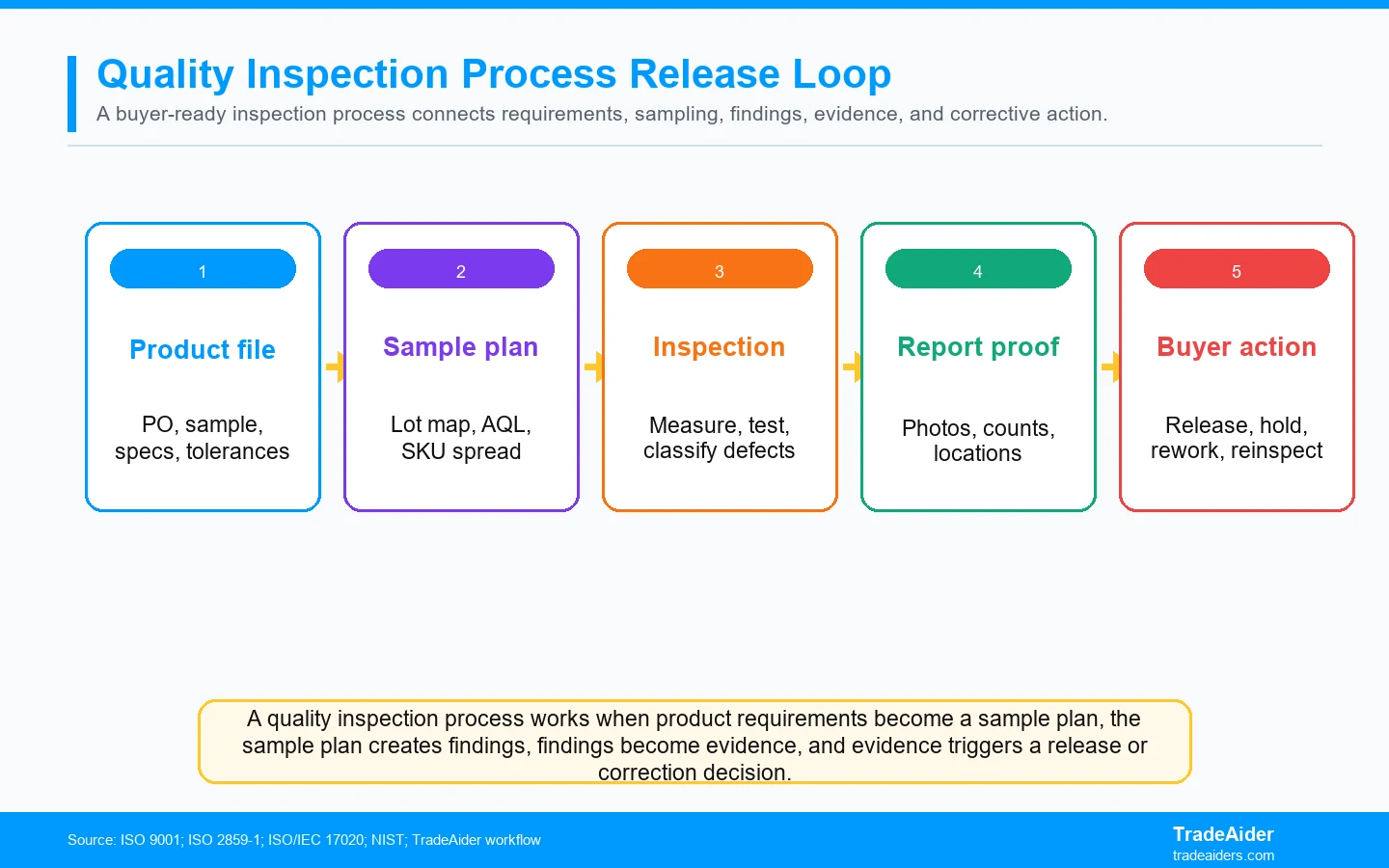
A quality inspection process works when product requirements become a sample plan, the sample plan creates findings, findings become evidence, and evidence triggers a release or correction decision.
The Process Begins With Inspection Scope, Not the Factory Visit
A quality inspection process fails early when the buyer sends the inspector to the factory without a decision-ready product file.
Scope converts buyer expectations into checkable points
The scope should include the purchase order, product specification, approved sample, drawings, tolerances, color references, materials, accessories, labels, retail packaging, master carton marks, and any required documents. If the buyer has a live marketplace listing or retailer requirement, the relevant claims should also enter the file.
A vague scope forces the inspector to use generic judgment. A clear scope lets the inspector verify the shipment against buyer requirements. The difference matters most when the supplier changes material, accessory set, packaging, label language, barcode, or carton configuration between sample approval and mass production.
Timing changes what the process can still fix
A pre-production process can catch setup mistakes before they multiply. A during-production process can catch drift while correction is still possible. A pre-shipment process can support release when goods are complete and at least 80% packed for export. A loading process protects the handover moment.
Importers should choose timing by consequence. If a defect mechanism can spread, earlier inspection is valuable. If the main risk is finished-lot acceptability, final sampling may be enough. If hidden safety or performance claims matter, testing must be planned separately.
Sampling Turns the Process From Observation Into Evidence
The inspection process becomes weak when the sample does not represent the shipment the buyer will receive.
AQL is useful only after the lot is defined
The lot definition should state total quantity, carton count, SKUs, colors, sizes, production dates, factory areas, packing versions, and any separated or high-risk subgroup. The sample plan should draw from those groups deliberately instead of from whichever cartons are easiest to open.
TradeAider buyers can use the AQL calculator to plan sample size, but sample size should not be confused with sample quality. A correctly sized sample from the wrong subgroup still creates weak evidence.
Defect concentration is part of the process
The report should identify whether defects are random or concentrated. Ten defects spread across the lot may lead to one decision; ten defects from one SKU, carton range, shift, material batch, or subcontracted step may lead to a different one.
This is why sample locations, carton numbers, production dates, defect photos, and defect counts matter. They let the buyer decide whether to release the clean goods, sort a subgroup, ask for rework, or expand inspection.
Execution Should Separate What Inspectors Can See From What Must Be Tested
A good process is honest about visual inspection, measurement, function checks, document review, and laboratory evidence.
Visual and functional checks need methods
The inspection process should state what the inspector will check and how: appearance, dimensions, assembly, operation, barcode readability, label content, accessory count, packing, carton strength indicators, or basic function. For each point, the report should show whether the check was sampled, measured, photographed, or counted.
A phrase like check function is too loose for many products. A better process says which function, how many samples, what tool, what pass/fail condition, and what photo or video evidence the buyer needs.
Testing is a separate evidence path
Some risks cannot be closed by inspection alone. Chemical composition, flammability, electrical safety, restricted substances, long-term durability, and detailed performance claims may require a laboratory method or document review.
When the unresolved claim is hidden, TradeAider can coordinate product testing services alongside the inspection process. The buyer should not ask a visual report to prove what only a suitable test can prove.
Reporting and Follow-Up Complete the Process
The quality inspection process does not end when the inspector leaves; it ends when the buyer acts on the evidence.
The report should make the decision easier
A useful report gives the buyer product identity, sample size, carton spread, defect photos, defect count, severity classification, measurement data, label and packing evidence, and an overall result. The buyer should not need to reconstruct the inspection from scattered comments.
Real-time evidence can also change the process while the inspector is still on site. If the buyer sees a critical defect photo during inspection, the buyer can request more sample spread, supplier clarification, or extra photos before the opportunity disappears.
Corrective action should be specific
A failed inspection should not produce only a supplier promise. The follow-up should define what will be sorted, repaired, replaced, relabeled, repacked, retested, or reinspected; which cartons are affected; and what evidence will prove correction.
The process improves over time when buyers keep defect history. Repeated findings should become future defect examples, sampling priorities, supplier questions, or process-control checks.
Scenario Estimate: A Late Process Decision Can Turn One Defect Into a Shipment Delay
The cost of a weak process usually appears after the buyer has fewer options.
Assume a 10,000-unit order has a wrong barcode on 3% of retail boxes. If the issue is found during PSI, about 300 units may need relabeling before release. If the same issue is found after arrival, the buyer may face warehouse hold, relabeling labor, inventory mismatch, and customer-service pressure.
If factory relabeling costs $0.20 per unit and warehouse relabeling costs $0.85 per unit after arrival, the same 300-unit subgroup changes from about $60 to about $255 before counting launch delay or receiving disruption. The defect did not change; the process timing did.
This estimate is illustrative. Its decision value is the timing rule: define identity, label, and barcode evidence inside the inspection process before shipment, not after receiving.
Where TradeAider Fits in the Quality Inspection Process
TradeAider helps importers turn a quality inspection process into real-time shipment evidence: product file review, AQL sampling, on-site photos and videos, defect classification, report delivery, and release-action support.
For setup risk, Pre-Production Inspection can verify samples, materials, packaging, and line readiness before mass production. For process drift, During Production Inspection can check early output while correction is still possible.
For shipment release, Pre-Shipment Inspection can verify 100% completed goods when at least 80% is packed for export, using AQL sampling, product checks, label and packing evidence, and defect reporting.
TradeAider's real-time visibility is useful when a buyer wants to act during inspection, not only after the final PDF arrives. If a finding needs supplier action, the buyer can review evidence while the inspector is still on site.
SPAR Scenario: The Process Found a Label Risk Before Release
The buyer used the inspection process to turn a vague label concern into a release decision.
Situation: A buyer ordered 12,000 consumer products with three SKU labels and two retail package versions.
Problem: The supplier packed old and new barcode labels in the same master cartons, but the buyer's checklist only said check packaging.
Action: TradeAider rebuilt the inspection process around SKU spread, carton mapping, label photos, defect severity, and subgroup sorting rules.
Result: The buyer held 520 mislabeled units for relabeling, released the clean subgroup, and accepted a one-day correction window instead of receiving mixed inventory.
Quality Inspection Process Checklist for Importers
Prepare the process before the inspector reaches the factory.
- Current PO, approved sample, drawings, tolerances, labels, packing rules, and change approvals.
- Lot size, carton count, SKU, color, size, production date, and subgroup map.
- Inspection timing: PPI, DPI, PSI, loading supervision, testing, or audit support.
- AQL level, sample size, sample spread, and defect severity examples.
- Required photos, videos, measurements, function checks, label checks, and document checks.
- Release, hold, sort, rework, retest, or reinspection rule.
The buyer should keep the report, supplier response, defect photos, and shipment decision. That record becomes the starting point for the next inspection process.
A quality inspection process is not paperwork. It is the operating system that turns buyer requirements into factory evidence and shipment control.
If your inspection process still depends on a generic checklist, send TradeAider the PO, approved sample, spec sheet, lot breakdown, top risks, and shipment deadline. The next step is to build a quality inspection process for your order before the factory visit.
Frequently Asked Questions
What is a quality inspection process?
A quality inspection process is a structured workflow that defines requirements, sampling, inspection checks, defect classification, evidence, reporting, and release action for a product or shipment.
When should the inspection process start?
It should start before booking the inspector, when the buyer prepares the product file, approved sample, lot map, defect rules, sampling plan, and release criteria.
Is AQL the same as the inspection process?
No. AQL is one sampling method inside the process. The full process also includes scope, lot mapping, defect classes, inspection execution, reporting, and follow-up action.
What happens after a failed inspection?
The buyer should decide whether to hold, sort, rework, retest, or reinspect the affected goods based on defect severity, concentration, supplier correction evidence, and shipment urgency.
Can visual inspection prove every quality requirement?
No. Visual inspection can verify many defects and visible evidence, but hidden safety, chemical, durability, or performance claims may require appropriate testing.
Artigos Relacionados
Expanda seu negócio com o Serviço TradeAider
Clique no botão abaixo para entrar diretamente no Sistema de Serviço TradeAider. Os passos simples desde a reserva e pagamento até o recebimento de relatórios são fáceis de operar.

