
- Sobre Nós

- Nossos Serviços
- Sua Indústria
- Recursos
- Notícias e Blog
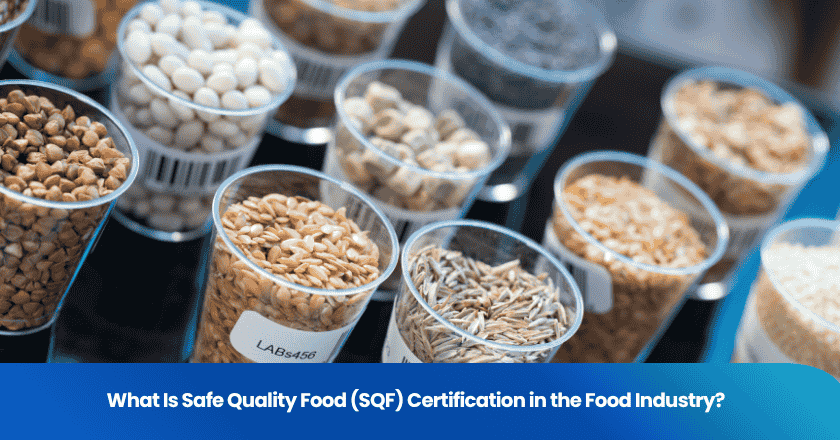
If you're selling food products to major retailers — Walmart, Costco, Whole Foods, Kroger — there's a good chance SQF certification is no longer optional. Over the past decade, Safe Quality Food (SQF) certification has moved from a competitive advantage to a baseline requirement for food manufacturers and suppliers who want access to the world's largest grocery chains. But what exactly is SQF, what does it take to get certified, and why does it matter if you're importing food-category products from overseas suppliers?
Key Takeaways
- SQF (Safe Quality Food) is a GFSI-recognized food safety and quality certification program administered by the SQF Institute, with over 14,000 certified sites across 40 countries.
- There are three certification levels — SQF Fundamentals, SQF Food Safety Code, and SQF Quality Code — each addressing progressively more rigorous food safety and quality management requirements.
- Major global retailers increasingly require GFSI-recognized certifications like SQF as a condition of supplier approval, making it effectively mandatory for food manufacturers targeting these channels.
What Is SQF Certification?
Safe Quality Food (SQF) certification is a rigorous, globally recognized food safety and quality management program administered by the SQF Institute (SQFI). It is recognized by the Global Food Safety Initiative (GFSI) — the industry benchmark that major retailers use to evaluate whether a supplier's food safety management system meets the standard they require.
In practical terms, SQF certification tells a retailer, food service company, or importer that a food facility has been independently audited against a comprehensive set of food safety and quality requirements — and has been found to meet them. The certification covers the systems, processes, and documentation that a facility uses to prevent food safety risks, from raw material inputs through processing, packaging, and storage.
As of 2026, the SQF program has over 14,000 certified sites in 40 countries, making it one of the most widely adopted food safety standards globally. The program covers every sector of the food supply chain — primary production, manufacturing, storage and distribution, food retail, and food packaging.
Why SQF Certification Matters for Importers and Food Brands
Retailer Requirements Have Raised the Bar
The most immediate business reason to care about SQF certification is retailer access. Major grocery retailers — particularly in the U.S., UK, and EU — have adopted GFSI-recognized certifications as a standard supplier qualification requirement. A food manufacturer without a GFSI-recognized certification (which SQF is) cannot sell to these retailers, full stop.
For importers sourcing food-category products from overseas factories — particularly from China — this creates a direct due diligence obligation: before a product can be placed in a major retail channel, the manufacturing facility needs to demonstrate GFSI compliance. SQF certification from the supplier factory is one of the most widely accepted forms of that proof.
SQF Goes Beyond Basic HACCP
Many food facilities operate under a Hazard Analysis Critical Control Points (HACCP) food safety plan — a foundational framework required by regulators in most markets. SQF builds on HACCP but goes significantly further. Where HACCP focuses on identifying and controlling biological, chemical, and physical hazards in a specific production process, SQF requires a documented quality management system that covers the entire operation: management commitment, supplier verification, traceability, recall procedures, employee training, environmental monitoring, and continuous improvement systems.
This distinction matters for importers: a supplier claiming HACCP compliance has cleared a basic regulatory threshold. An SQF-certified supplier has been independently audited against a much more comprehensive framework, by an accredited certification body such as NSF, and has met the requirements in a documentable, verifiable way. The certificate provides a level of assurance that a self-declaration of HACCP compliance does not.
The 3 Levels of SQF Certification Explained
SQF certification is not a single, monolithic standard — it has a tiered structure that allows food businesses at different stages of maturity to enter the program and progressively strengthen their food safety systems. Understanding the three levels is essential for both food manufacturers pursuing certification and importers evaluating their suppliers' credentials.
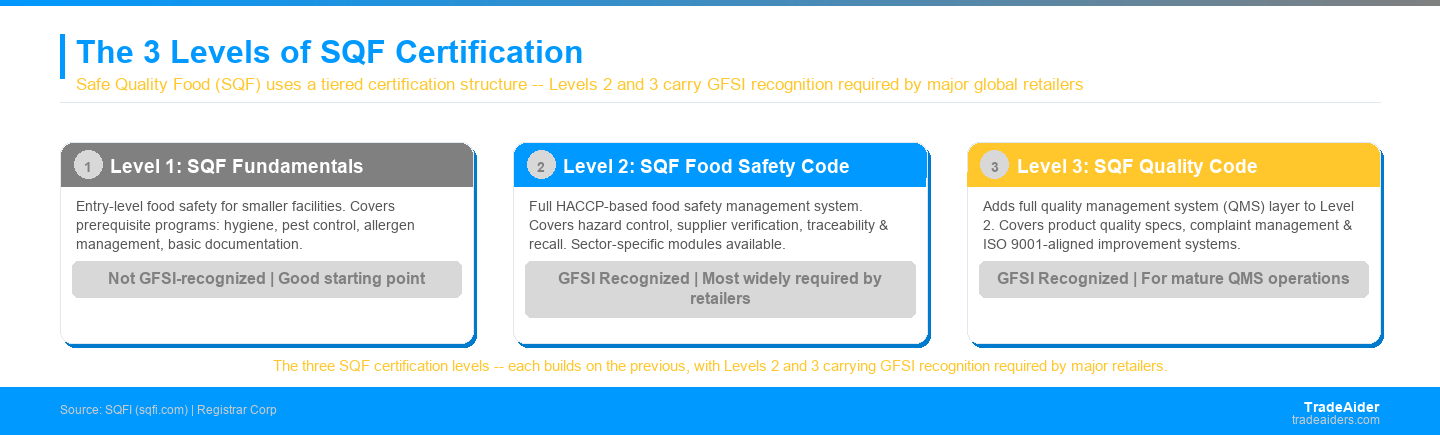 The three SQF certification levels represent a progression from foundational food safety practices to a fully integrated quality management system — each level building on the one before.
Level 1: SQF Fundamentals Program
The SQF Fundamentals Program is the entry-level tier, designed for food facilities that are newer to formal food safety management systems. It covers the basic prerequisite programs — the foundational hygiene, pest control, allergen management, and documentation practices that underpin any food safety system — without requiring the full HACCP-based plan mandated at higher levels.
SQF Fundamentals is suitable for: smaller food businesses, suppliers in primary agricultural production, and facilities working toward a full SQF Food Safety certification. It is not GFSI-recognized (only Levels 2 and 3 carry GFSI recognition), so it does not satisfy retailer requirements that specifically call for GFSI certification.
Level 2: SQF Food Safety Code (GFSI Recognized)
The SQF Food Safety Code is the most widely pursued level and the one that carries GFSI recognition. It requires a facility to have a fully documented and implemented HACCP-based food safety management system, covering hazard identification and control, prerequisite programs, corrective action procedures, supplier verification, traceability systems, and a documented management review process.
According to Registrar Corp's analysis of SQF certification levels, Level 2 is the standard that satisfies most major retailer and food service requirements. It's sector-specific — the SQF Code has separate modules for food manufacturing, food retail, storage and distribution, primary production, and food packaging, among others. A facility certifies to the module that matches its operations.
For importers evaluating food-category suppliers, SQF Level 2 certification is the meaningful credential to look for: it means the facility has been independently audited against a GFSI-recognized standard and has maintained the documentation and systems to pass that audit.
Level 3: SQF Quality Code (Full Quality Management)
The SQF Quality Code builds on Level 2 by adding a comprehensive quality management system (QMS) layer — covering not just food safety hazard control, but product quality specifications, customer complaint management, continuous improvement processes, and quality-specific management systems aligned with ISO 9001 principles.
Level 3 is typically pursued by larger manufacturers or those supplying private-label products where retailers or brand owners have imposed quality specification requirements beyond basic safety. It is also GFSI recognized and satisfies the same retailer access requirements as Level 2, with the additional signal that the facility has a mature, documented quality management infrastructure.
The SQF Certification Process: What to Expect
The path to SQF certification follows a structured sequence. The SQFI's official certification overview outlines the core steps.
| Step | What Happens | Typical Timeline |
|---|---|---|
| 1. Learn the Code | Review the SQF Code edition relevant to your sector; identify gaps in current systems | 2–4 weeks |
| 2. Register | Register on the SQFI database; designate a trained SQF Practitioner (mandatory) | 1–2 weeks |
| 3. Gap Assessment & Implementation | Conduct internal gap assessment; build and implement required food safety systems and documentation | 3–12 months |
| 4. Select Certification Body | Choose an SQFI-licensed certification body (e.g., NSF, SCS Global, Bureau Veritas); schedule audit | 2–4 weeks |
| 5. Initial Audit | On-site audit by licensed certification body; document review + facility walkthrough + employee interviews | 1–3 days on-site |
| 6. Corrective Actions | Address any non-conformances identified during audit; submit corrective action plans to certification body | Up to 30 days |
| 7. Certification Issued | Certification body issues SQF certificate, valid for 12 months; annual recertification required | 2–4 weeks post-audit |
The total timeline from starting the process to receiving certification typically ranges from 6 to 18 months, depending on how mature the facility's existing food safety systems are. A facility with a well-documented HACCP plan and active prerequisite programs already in place can move much faster than one starting from scratch.
SQF Certification Costs: What to Budget
SQF certification costs vary by facility size, sector, location, and certification body. Based on industry estimates, food manufacturers should budget in the following ranges:
- Annual certification body fees: $3,000–$8,000 USD for the audit itself (varies by facility size and CB pricing)
- SQFI database registration: Approximately $400–$800 USD annually
- Implementation costs (staff time, consultant fees, documentation, training): $5,000–$20,000+ for facilities building systems from scratch
- Ongoing annual maintenance: $5,000–$15,000 USD per year all-in, once systems are established
For overseas suppliers — particularly factories in China supplying to U.S. or EU markets — SQF certification is an investment that enables access to retail channels that would otherwise be closed. For importers evaluating supplier quotes, it's worth factoring in whether a supplier's pricing reflects the ongoing cost of maintaining certified food safety systems, or whether those systems simply don't exist.
SQF vs. Other Food Safety Certifications
SQF is one of several GFSI-recognized schemes. Others include BRCGS (British Retail Consortium Global Standard), FSSC 22000, IFS Food, and GlobalG.A.P. Each has its own structure, sector focus, and geographic prevalence.
| Certification | GFSI Recognized | Primary Market | Sector Focus |
|---|---|---|---|
| SQF | Yes (Levels 2 & 3) | North America, Global | All food sectors |
| BRCGS | Yes | UK, Europe | Manufacturing, packaging |
| FSSC 22000 | Yes | Global | Food manufacturing |
| IFS Food | Yes | Germany, France | Manufacturing, retail |
For importers sourcing food products to sell in North American retail channels, SQF is generally the most directly relevant certification to require from suppliers. For UK and EU markets, BRCGS tends to be the dominant requirement. In practice, many large food manufacturers pursue multiple GFSI-recognized certifications to satisfy different retail customers' requirements.
What SQF Certification Means for Importers Sourcing from China
For importers buying food-category products from Chinese manufacturers — whether packaged foods, ingredients, snacks, condiments, or food-contact packaging — SQF certification from the supplying factory is one of the strongest indicators of food safety system maturity available.
However, certification status alone is not sufficient due diligence. SQF certificates have a 12-month validity and must be renewed through annual re-audits. An importer receiving a certificate that is 10 months old should verify renewal status through the SQFI certificate database. Additionally, certification covers the scope listed on the certificate — a factory certified for one product category may not have the same controls in place for others.
Alongside verifying a supplier's SQF certification status, importers benefit from independent product testing to confirm that the goods actually manufactured meet specification — particularly for food-contact materials and finished food products destined for regulated markets. TradeAider's product testing service bridges this gap, providing laboratory testing against destination-market standards (FDA, EU food contact regulations, etc.) that confirm compliance independent of the factory's certification status.
Pre-shipment inspections also remain a critical verification layer. Even SQF-certified facilities can produce off-specification product, mislabeled packaging, or incorrect quantities. An independent pre-shipment inspection before goods leave the factory provides the final quality check that prevents problems from reaching your warehouse or your retail customer. If you're building your supplier verification process for food-category imports, contact our team to discuss how inspection and testing services can integrate with your SQF supplier qualification requirements.
Frequently Asked Questions
Is SQF the same as GFSI certification?
SQF is not the same as GFSI — but SQF is recognized by GFSI. The Global Food Safety Initiative (GFSI) is a benchmarking body that evaluates food safety standards and recognizes schemes that meet its requirements. SQF Levels 2 and 3 are GFSI-recognized, which means they satisfy retailer requirements that specify "GFSI certification." Think of GFSI as the accreditation body and SQF as one of the accredited schemes.
How long does SQF certification take?
The total timeline depends on your starting point. A food facility with mature food safety systems already in place can typically achieve SQF certification in 6–9 months from registration to certificate issuance. Facilities building their food safety systems from scratch should plan for 12–18 months. The gap assessment and implementation phase is usually the longest, as it involves documenting existing practices, closing identified gaps, training staff, and running the systems for a sufficient period before audit.
How much does SQF certification cost?
Total first-year costs for SQF certification typically range from $10,000 to $30,000 USD for a mid-sized food manufacturing facility, including registration, audit fees, implementation costs, and staff training. Annual renewal costs (once systems are established) generally run $5,000–$15,000, primarily comprising the annual recertification audit fee and ongoing database registration. Costs vary significantly by facility size, sector, location, and whether a consultant is engaged to support implementation.
Do food importers need SQF certification, or just the supplier?
Retailers typically require the manufacturing facility — the supplier — to hold SQF certification, not the importer per se. However, if you are importing food products under your own brand label and selling to major retail channels, those retailers may require you to demonstrate that your manufacturing partner holds a current GFSI-recognized certification. As the brand owner, you are responsible for ensuring your supply chain meets the standard — even if the certification sits at the factory level. This is why verifying supplier certification status and conducting independent quality checks are both essential parts of an importer's due diligence process.
What happens if an SQF-certified supplier fails their recertification audit?
If a facility fails its annual recertification audit, the certification is suspended or withdrawn, and the facility's status on the SQFI database is updated accordingly. As an importer, this is why relying solely on a certificate copy provided by a supplier is insufficient — always verify current status through the SQFI's public database. Importers whose retail contracts require GFSI-certified suppliers are contractually exposed if a supplier's certification lapses, which underscores the importance of active ongoing supplier monitoring rather than one-time credential verification.
Artigos Relacionados
Expanda seu negócio com o Serviço TradeAider
Clique no botão abaixo para entrar diretamente no Sistema de Serviço TradeAider. Os passos simples desde a reserva e pagamento até o recebimento de relatórios são fáceis de operar.

