
- About Us

- Our Services
- Your Industry
- Resources
- News & Blog
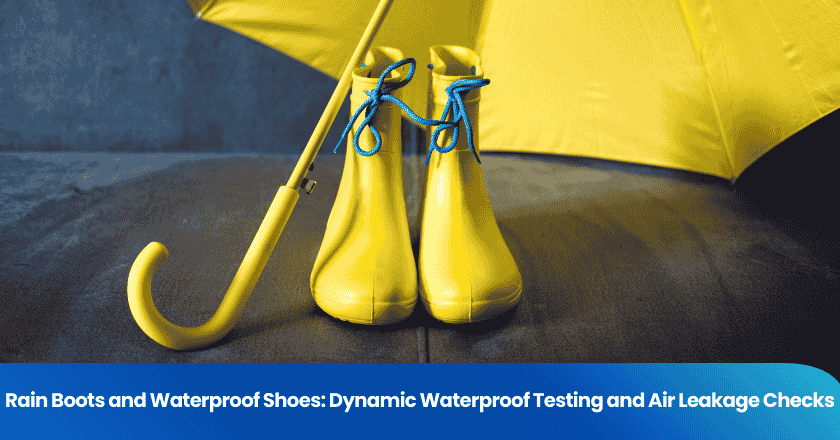
In the specialized sector of Softline Products, the reliability of aquatic footwear is determined by its resistance to hydrostatic pressure and its ability to maintain structural integrity under kinetic loads. Rain boots and high-performance outdoor shoes must achieve a near-perfect barrier against moisture ingress while maintaining biomechanical comfort. Engineering excellence in this domain is validated through two rigorous technical pillars: Dynamic Waterproof Testing, which simulates the repetitive stress of a human gait in saturated environments, and Pneumatic Air Leakage Checks, which detect microscopic voids in membranes and seals. Adhering to international standards such as ISO 20344 and SATRA TM230 is essential for manufacturers to mitigate the risk of assembly failure and ensure long-term functional fidelity.
Key Takeaways
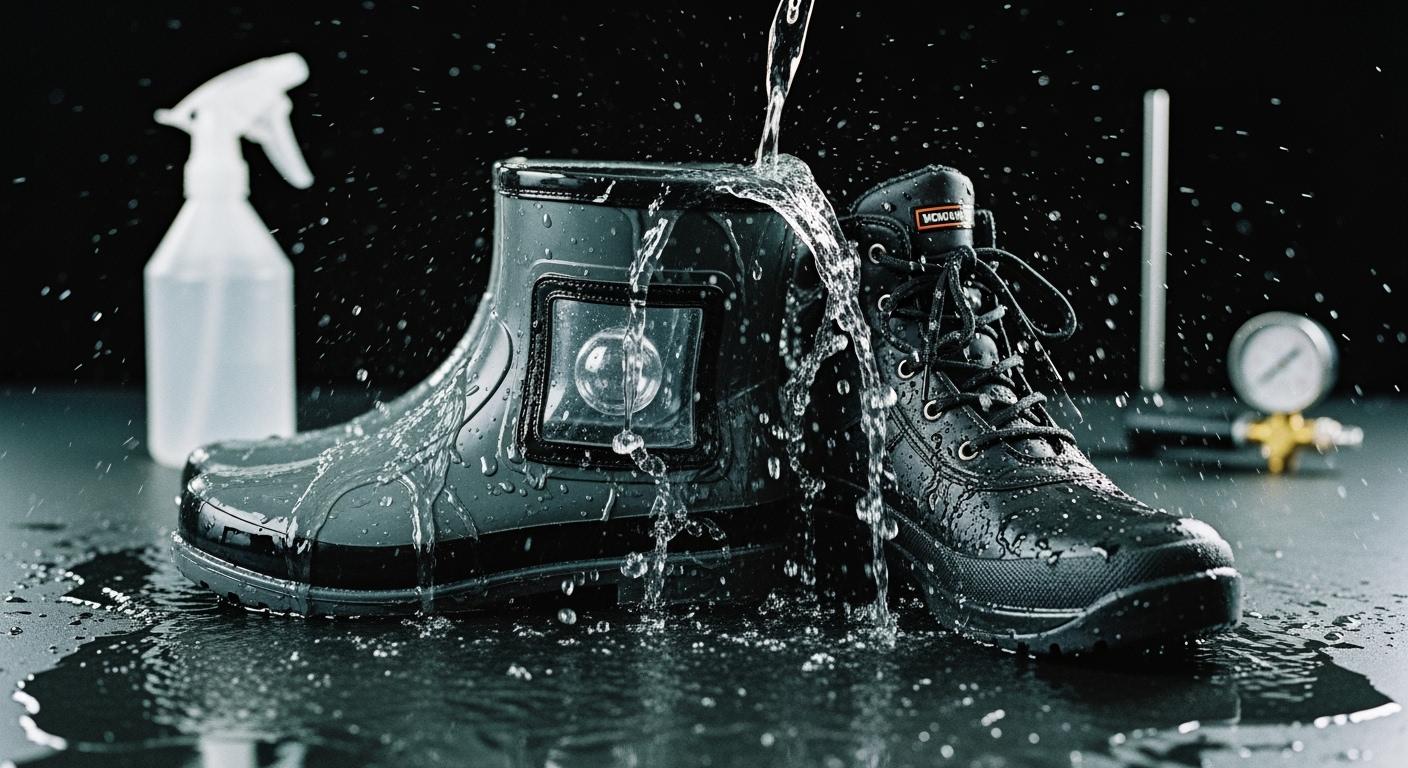
- Dynamic testing simulates thousands of flex cycles in water to identify latent weaknesses in tongue gussets and sole attachments.
- Pneumatic air leakage checks identify microscopic porosities in waterproof membranes that are invisible to the naked eye.
- ISO 20344 and SATRA TM230 are the definitive industrial benchmarks for certifying aquatic footwear performance.
- Seam tape integrity and "Bootie" construction are critical technical components that prevent capillary moisture transfer.
- Professional quality checks must include raw material verification of TPU and ePTFE laminates.
- Real-time inspection reporting allows for immediate corrective actions during mass production cycles.
The Physics of Waterproofing: Membrane Kinetics and Capillary Action
The technical efficacy of waterproof footwear is governed by the surface tension of water and the pore size of the material. Traditional rubber rain boots utilize a "Direct Injection" or "Vulcanization" process to create a monolithic, non-porous structure. However, high-performance waterproof shoes utilize complex multi-layer laminates, such as ePTFE (expanded Polytetrafluoroethylene) or PU membranes. These membranes are engineered with billions of microscopic pores that are 20,000 times smaller than a water droplet but 700 times larger than a water vapor molecule, allowing for the elusive balance of waterproofing and breathability.
Seam Engineering and Hydrostatic Resistance
The primary point of failure in any waterproof assembly is the seam. In the context of footwear manufacturing, every needle puncture creates a potential pathway for moisture. Professional quality control involves auditing the application of "Seam Tape"—a heat-activated thermoplastic film that seals the stitch lines. If the sealing temperature is inconsistent, the tape will delaminate under the dynamic stress of walking, leading to eventual ingress.
| Material Feature | Technical Objective | Performance Benchmark |
|---|---|---|
| Membrane Pore Size | Prevent liquid entry; permit vapor exit | ISO 11092 (Ret value < 6) |
| Seam Tape Bond | Seal mechanical stitch punctures | Peel strength > 15N/cm |
| Hydrostatic Head | Resist moisture under pressure | Minimum 10,000 mmH2O |
| Vulcanization Depth | Ensure monolithic sole attachment | Zero delamination after 100k flexes |
Quantitative Dynamic Waterproof Testing: ISO 20344 Analysis
Laboratory validation of waterproof claims requires a simulation of real-world gait cycles. Unlike static immersion, dynamic testing targets the "Bending Zone"—the area where the shoe creases during a step. This repeated compression and expansion tests the elastic limits of the waterproof membrane and the structural durability of the gusseted tongue.
Industrial Flexometer Protocols
Under the ISO 20344 protocol, the finished shoe is secured in a flexometer and partially immersed in water containing a fluorescent dye. The machine flexes the footwear at a rate of 60 cycles per minute. For high-end performance gear, a "Pass" requires zero water penetration after 4,800 cycles (approx. 80 minutes of continuous walking). Advanced testers like the Maeser machine can run for over 100,000 cycles to evaluate professional-grade expedition boots.
| Test Methodology | Standard Reference | Typical Parameters |
|---|---|---|
| Dynamic Flexing | ISO 20344 Section 5.15 | 4,800 to 50,000 cycles in 20mm water |
| Centrifugal Test | SATRA TM230 | High-speed rotation to force water through voids |
| Trough Walk Test | ASTM F1902 | Human subject simulation in controlled troughs |
| Pneumatic Pressure | In-house / Industrial | 1.5 to 3.0 psi internal air charge |
Pneumatic Air Leakage Checks: Detecting Micro-porosities
While dynamic flexing tests the overall construction, air leakage checks are the definitive tool for verifying the integrity of the individual components and sub-assemblies. This method is particularly vital for footwear utilizing "Bootie" construction, where a waterproof inner sock is inserted into the shoe. The bootie is pressurized with air and submerged in water; any stream of bubbles indicates a microscopic puncture or a failed seam seal.
On-Site Quality Monitoring and Rectification
Integrating these checks into the production management lifecycle is critical. During a "DUPRO" (During Production Inspection), inspectors utilize portable air pressure testers to verify batch-level consistency. If the air leakage rate exceeds a pre-defined threshold (often 0.5cc/min), the line is halted to recalibrate the seam-sealing machinery. This prevents the "Quality Fade" often seen when mass production speeds compromise technical precision.
Expert Insight: For premium waterproof golf shoes, the centrifugal SATRA TM230 test is often preferred. By spinning the shoe at high RPMs while filled with water, the centrifugal force mimics the internal pressure of a heavy step in wet grass, revealing failures that standard flexing might miss.
Global Standards for Industrial Waterproof Certification
For importers and global brands, navigating the landscape of technical certifications is a baseline for risk management. Markets in North America heavily rely on ASTM D1052 for material-level flexing, while the European market focuses on the harmonized EN ISO 20344 for whole-shoe performance. Achieving a certified footwear status requires documentation of both initial "Type Testing" and ongoing batch inspections.
Key technical benchmarks for certification include:
- Membrane Adhesion: Verifying the bond between the lining and the membrane using a 180-degree peel test to prevent "Bunching."
- Wicking Resistance: Ensuring the laces and outer fabrics do not "wick" water upward and into the interior via capillary action.
- Thermal Stability: Testing the waterproof seal after exposure to 70'C to simulate shipping in hot containers.
Integrated Quality Assurance: PPI, DPI, and PSI
Consistency in waterproofing is achieved through a multi-stage quality assurance strategy. A simple final audit is insufficient for technical footwear. Effective oversight requires:
- Pre-Production Inspection (PPI): Testing the "Hydrostatic Head" of the incoming fabric rolls to ensure the laminate meets the spec before cutting.
- During Production (DPI): Daily air-leakage checks on the "Closed Booties" before they are lasted into the shoe.
- Pre-Shipment Inspection (PSI): Final random sampling for dynamic flexing as per AQL 1.0 or 1.5 levels to verify assembly integrity.
By utilizing standardized inspection methods, buyers can ensure they are delivering products that safeguard the consumer's comfort and fulfill the high-performance promises of the brand.
Ready to secure your product quality before shipment?
As your third-party inspection, testing & certification partner in China, TradeAider supports brands and sourcing teams across the entire production process, helping you identify quality risks early, ensure compliance, and strengthen your team’s capabilities before shipment.
Book an Inspection or Testing Service with TradeAider today, or for tailored solutions and expert guidance, contact us at services@tradeaider.com.
Frequently Asked Questions (FAQ)
What is the difference between "Waterproof" and "Water-Resistant"?
Technically, water-resistant footwear utilizes a DWR (Durable Water Repellent) surface coating that causes water to bead up but will eventually saturate under pressure. Waterproof footwear utilizes an internal membrane (like ePTFE) and sealed seams to provide a complete barrier that can withstand total immersion.
Why do some waterproof boots feel "sweaty" inside?
This is often caused by a failure in "Breathability" rather than a leak. If the outer material is too thick or the membrane is low-quality, moisture vapor from the foot cannot escape. Technical product inspection should include a breathability test (ISO 11092) to ensure a comfortable internal climate.
Can I test my rain boots at home?
A basic "Static Soak" test can find large holes. Submerge the boot in a bucket of water up to the ankle for 15 minutes. If the interior is dry, the static barrier is intact. However, only a dynamic flex test can verify that the seams won't leak while you are actually moving.
How long should a waterproof membrane last?
In professional-grade footwear, a membrane should maintain its integrity for at least 500,000 flex cycles, which equates to roughly 400 miles of walking. Factors like salt, dirt, and improper drying can accelerate the degradation of the membrane pores.
What is "Gusseted" construction?
A gusset is a triangular piece of material that connects the tongue to the upper of the shoe. This design is technically essential for waterproofing as it prevents water from flowing into the shoe through the eyelet gaps when stepping into a puddle.
Related Articles


Grow your business with TradeAider Service
Click the button below to directly enter the TradeAider Service System. The simple steps from booking and payment to receiving reports are easy to operate.

