
- About Us

- Our Services
- Your Industry
- Resources
- News & Blog
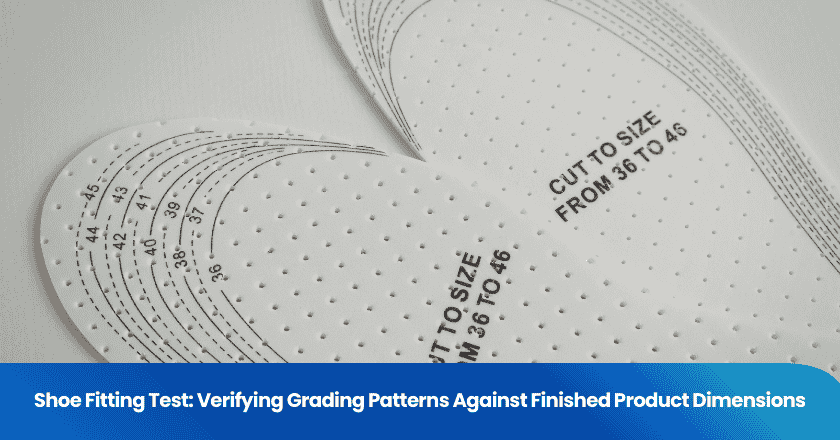
In the technical domain of footwear manufacturing, dimensional fidelity is the ultimate metric for comfort, stability, and marketability. A shoe fitting test is not merely a trial of wearability; it is a systematic metrological audit that verifies if the finished product spatial coordinates align with the approved CAD grading patterns. As production scales from a single sample size to a full commercial range, the risk of 'Grading Drift'—where the volumetric proportions of the shoe distort during scaling—becomes a significant threat to quality. By implementing rigorous verification protocols, supported by international standards such as ISO 9407 (Mondopoint), manufacturers can ensure that every SKU, regardless of size, delivers a consistent ergonomic experience and structural integrity.
Key Takeaways
- Dimensional fidelity is ensured by comparing the physical finished shoe against the digital master pattern (CAD).
- Pattern grading utilizes standardized 'Grade Rules' to scale length, width, and girth increments proportionally.
- The Mondopoint system (ISO 9407) provides the most accurate metrological framework for foot-to-shoe volume matching.
- A multi-stage quality check prevents sizing rejections by auditing lasts and patterns before mass production.
- Proportional vs. non-proportional grading allows for better fit in extreme sizes (very small or very large).
- Professional quality assurance utilizes digital reporting to track dimensional variance across production batches.
The Metrological Framework of Shoe Fitting
Footwear quality is categorized into grades—A, B, and C—based on their adherence to technical specifications. A-grade shoes represent the 'Gold Standard,' where the finished product matches the grading pattern within a +/- 2mm tolerance. Achieving this requires precise anthropometric data and a deep understanding of the 'Last'—the three-dimensional form upon which the shoe is constructed. The Last determines the internal volume, including the vital 'Toe Spring' height and 'Heel Pitch' angle.
Industrial Inspection Stages
Consistency is achieved by building quality checkpoints into the production lifecycle. A technical shoe quality control strategy includes:
- PPI (Pre-Production): Verification of the master pattern against the last measurements.
- DPI (During Production): Monitoring the 'Lasting' tension to ensure the upper material doesn't over-stretch, which alters the final size.
- PSI (Pre-Shipment): Statistical sampling to verify that the entire size curve matches the tech pack dimensions.
| Inspection Phase | Technical Objective | Critical Measurement Points |
|---|---|---|
| Pattern Audit | Validate CAD(Grading) accuracy | Length, Ball Girth, Instep Height |
| Lasting Check | Confirm structural symmetry | Back-height, Vamp length, Joint width |
| Post-Assembly | Measure finished external dimensions | Outsole length, Heel-to-Toe radius |
| Functional Fitting | Verify ergonomic comfort | Flex point alignment, Insole curvature |
The Mechanics of Shoe Pattern Grading
Pattern grading is the engineering process of transforming a sample size (usually US Men's 9 or Women's 7) into a full commercial run. This is governed by 'Grade Rules'—mathematical increments applied to each component of the shoe. While length increments are standardized (e.g., 8.46mm for a full US size), 'Girth Grading' is more complex. A failure to correctly scale the volume of the toe-box relative to the length results in shoes that are too narrow or too voluminous for the intended size.
Proportional vs. Non-Proportional Grading
In high-end industrial footwear, manufacturers utilize non-proportional grading. This means certain components, such as the eyelet stay or the heel counter, do not scale linearly with the length. This maintains the aesthetic 'Golden Ratio' of the design and ensures that the mechanical stability of the heel remains constant regardless of the shoe's size. Professional shoe quality audits must verify these non-linear adjustments in the CAD files.
Engineering Focus: The 'Mondopoint' system (ISO 9407:2019) is the only technical standard that defines sizes based on both foot length and foot width. This eliminates the ambiguity of traditional US/UK/EU systems and allows for a more precise verification of the shoe's internal cavity.
Geometric Fidelity Verification: Pattern vs. Product
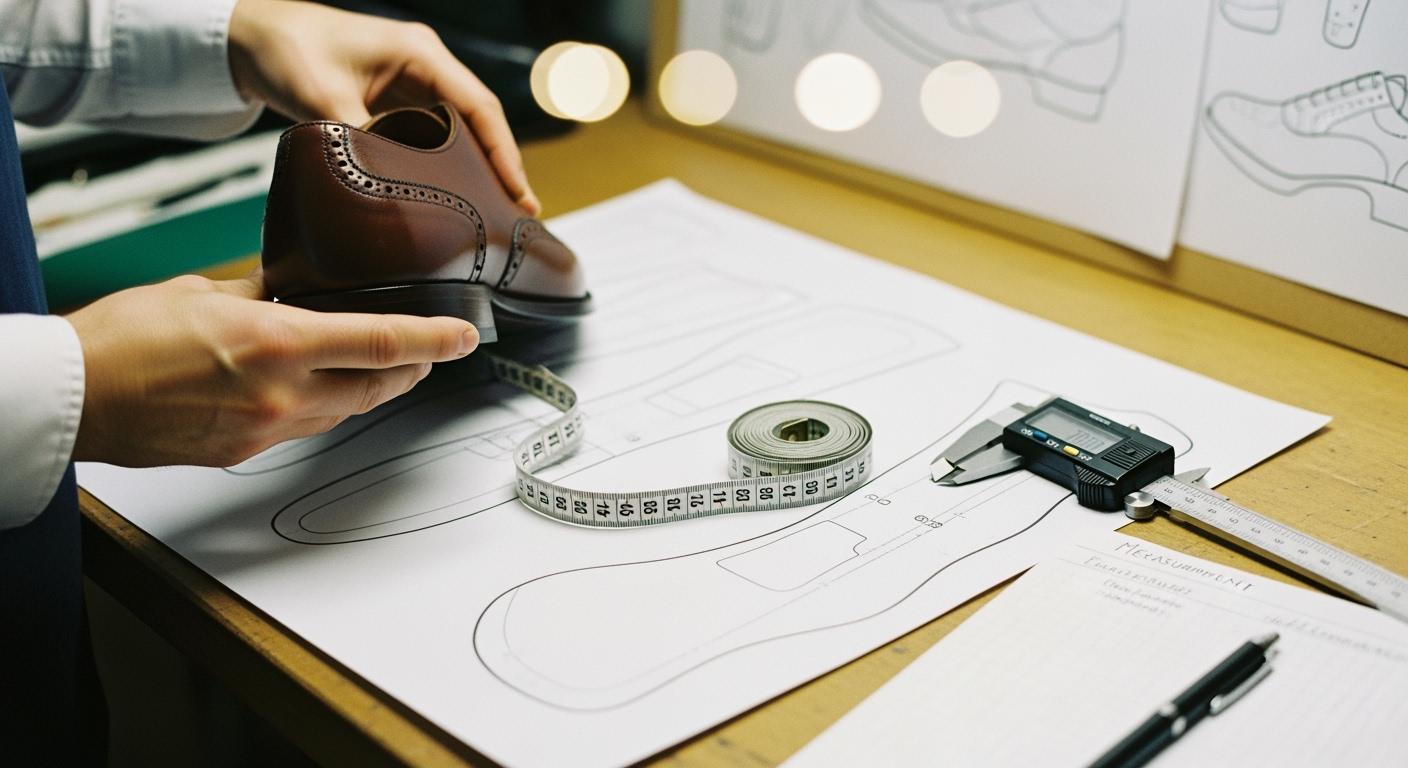
During a shoe manufacturing inspection, technicians perform a comparative analysis using specialized metrological tools. This involves a 'Pattern Overlay'—placing a 2D cutout of the grading pattern over the finished shoe to detect any distortions caused by the heat-setting or lasting processes.
Critical Dimensions in Fitting Analysis
- Heel-to-Ball Length: Ensuring the 'Flex Point' of the shoe aligns with the anatomical flex point of the foot. Misalignment here causes early material fatigue and wearer foot pain.
- Vamp Symmetry: Measuring the distance from the toe cap to the throat. A variance of more than 1.5mm between the left and right shoes is a Major defect.
- Quarter Height: Ensuring the ankle support is consistent. If the grading pattern for the quarter is incorrect, larger sizes may lack necessary lateral stability.
| Data Metric | Technical Objective | Tool Utilized |
|---|---|---|
| Girth Measurement | Validate internal volume | Digital Girth Tape |
| Hardness Verification | Check outsole/midsole density | Shore Durometer (ASTM D2240) |
| Toe spring Angle | Ensure gait cycle efficiency | Angular Protractor / 3D Scan |
| Heel Seat Alignment | Prevent pelvic misalignment | Laser Level / Precision Caliper |
Challenges in Dimensional Compliance: Material Shrinkage and Variance
One of the primary technical challenges in maintaining grading accuracy is 'Material Shrinkage.' Natural leathers and synthetic polymers react differently to the heat-molding process. For instance, a PU upper might shrink by 1% during steam-conditioning, while a canvas upper may expand. A robust shoe quality assurance process must include shrinkage testing (ISO 3759) to calibrate the CAD patterns accordingly.
Furthermore, 'Lasting Margin' errors often occur when the sewing technician does not follow the 'Stitch Margin' marks on the pattern. This causes the upper to be pulled too tight or left too loose on the last, effectively changing the shoe size despite using the correct components. Regular quality control training for line operators is the only way to mitigate these manual errors.
The Role of Digital Reporting and AI in Fitting Tests
Modern quality assurance has transitioned from paper logs to digital ecosystems. At TradeAider, inspectors now utilize mobile platforms (APP) to capture photos / videos and upload metrological data directly from the factory floor. This real-time report transparency allows buyers to identify 'Size-Curve Variations' instantly. For example, if the size 10s are consistently narrower than the size 9s, the buyer can pause production to audit the size 10 lasts for dimensional accuracy.
Ready to secure your product quality before shipment?
As your third-party inspection, testing & certification partner in China, TradeAider supports brands and sourcing teams across the entire production process, helping you identify quality risks early, ensure compliance, and strengthen your team’s capabilities before shipment.
Book an Inspection or Testing Service with TradeAider today, or for tailored solutions and expert guidance, contact us at services@tradeaider.com.
Technical Advancement: Advanced brands are now utilizing CT (Computed Tomography) scanning to check the internal layers of a shoe. This non-destructive test reveals the alignment of the steel shank and the thickness of the foam layers, ensuring that the internal fitting matches the engineering blueprint perfectly.
Conclusion: Establishing a Culture of Dimensional Precision
Shoe fitting tests and pattern grading verification are the bedrock of brand reputation. A shoe that is aesthetically perfect but dimensionally flawed is a failure of engineering. By integrating standardized shoe quality control with digital metrology and CAD-aligned audits, manufacturers can achieve the high level of consistency required by modern athletes and consumers. Transparency in these technical processes not only reduces the financial burden of returns but also fosters a reliable supply chain built on data and engineering excellence.
Frequently Asked Questions (FAQ)
What is 'Toe Spring' and why does it affect fit?
Toe spring is the curvature of the sole upward at the toe area. It is technically designed to facilitate the 'roll' of the foot during walking. If the toe spring doesn't match the grading pattern, the shoe will feel 'clunky' or may cause the wearer to trip.
Why do shoes of the same size from different brands fit differently?
This is because each brand develops its own unique 'Last Geometry.' While the length may be standardized under Mondopoint or US systems, the 'Girth' and 'Volume' are proprietary engineering choices that vary based on the target demographic's anthropometric data.
What is 'Grading Drift'?
Grading drift occurs when the errors in pattern scaling accumulate as you move further away from the sample size. For instance, a size 13 might have a completely different aesthetic proportion than a size 8 because the grading increments were not properly calibrated for larger volumes.
How often should a factory calibrate its measurement tools?
For industrial quality control, digital calipers and girth tapes should be verified daily and professionally calibrated every 6 to 12 months. Any tool showing a variance of more than 0.01mm should be removed from the product quality inspection line.
Can 3D scanning replace manual fitting tests?
3D scanning is an excellent tool for verifying 'Form' and 'External Geometry,' but it cannot fully replace functional fitting. Manual fitting tests are still required to assess 'Dynamics'—how the materials flex and how the pressure is distributed during movement.

Related Articles


Grow your business with TradeAider Service
Click the button below to directly enter the TradeAider Service System. The simple steps from booking and payment to receiving reports are easy to operate.

