
- About Us

- Our Services
- Your Industry
- Resources
- News & Blog
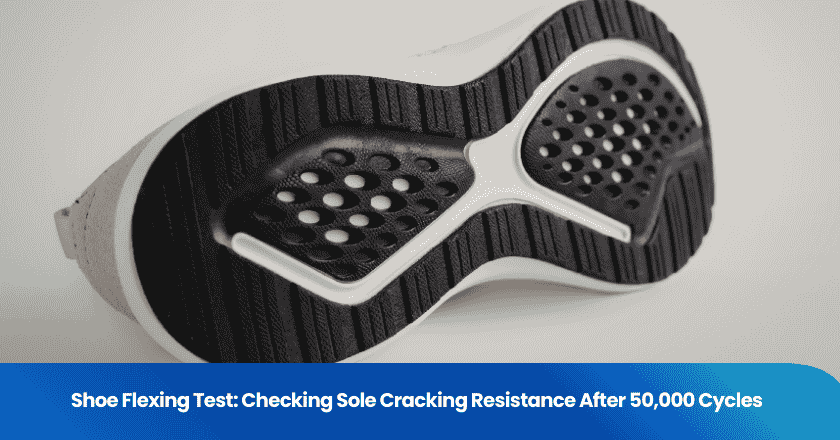
In the footwear manufacturing industry, the flexing resistance of a shoe sole is the primary determinant of a product's lifecycle and structural fidelity. Every step taken by a consumer subjects the footwear assembly to cyclic mechanical stress, potentially triggering material fatigue, crack propagation, or adhesive delamination. Metrological validation through standardized flexing tests—typically targeting 50,000 cycles—provides an objective forecast of long-term performance. For industrial manufacturers and global brands, adhering to international protocols such as ISO 20344 and SATRA TM92 is essential to mitigate the risk of 'Quality Fade.' This technical guide explores the physics of sole fatigue, the material science of elastomeric failure, and the rigorous quality control systems required to deliver reliable footwear to the global market.
Key Takeaways
- Cyclic fatigue validation simulates real-world kinetic stress to identify latent material defects in soles and uppers.
- ISO 24266 and SATRA TM92 are the definitive benchmarks for whole-shoe and component-level flexing durability.
- Crack propagation is quantified by measuring the growth of a pre-made incision after a fixed number of flexural cycles.
- Material composition, such as the ratio of PU to EVA, dictates the hysteresis loss and thermal buildup during bending.
- Professional quality assurance must include specimen conditioning in a controlled environment to ensure result repeatability.
- Digital real-time reporting enhances supply chain transparency, allowing buyers to verify batch-level stability before shipment.
The Physics of Flexural Fatigue and Material Degradation
When a shoe sole is bent, the outer surface undergoes tensile stress while the inner surface is compressed. This repeated transition generates internal friction at the molecular level, a phenomenon known as hysteresis. For thermoplastic materials like EVA (Ethylene Vinyl Acetate) or PU (Polyurethane), this energy is converted into heat, which can accelerate the aging process of the polymer chains. In shoe manufacturing quality control, the objective of the 50,000-cycle test is to reach the 'Fatigue Limit'—the point beyond which micro-cracks consolidate into visible structural failures.
Molecular Mechanisms of Sole Failure
The failure of an outsole typically begins at 'stress concentrators' such as tread patterns or sharp geometric transitions. If the rubber compound lacks sufficient 'Elongation at Break' or 'Tear Strength,' these micro-fissures propagate rapidly. Advanced footwear metrology involves analyzing the 'Fracture Toughness' of the compound, ensuring that the material can absorb kinetic energy without experiencing brittle fracture.
| Material Type | Flexural Modulus | Fatigue Resilience | Common Failure Mode |
|---|---|---|---|
| Vulcanized Rubber | High | Excellent | Surface ozone cracking |
| PU (Polyurethane) | Moderate | Very Good | Hydrolytic degradation |
| EVA Foam | Low | Moderate | Permanent compression set |
| TPU | Moderate | Superior | Interfacial delamination |
International Standards for Flexing Resistance
Reliability in footwear is verified through a tiered testing approach. Depending on the target market and the footwear category (athletic, casual, or safety), different standards apply. The most rigorous protocols require testing not just at room temperature, but also in 'Arctic' conditions (-20'C) to ensure the sole does not shatter in cold climates.
Ross Flex vs. De Mattia vs. SATRA TM92
The **Ross Flex Test (ASTM D1052)** is the industrial standard for sole materials. It involves piercing the specimen and measuring the growth of the cut. The **De Mattia Test (ISO 132)** focuses on the initiation of cracks on a smooth surface. However, for finished products, the **SATRA TM92 (Whole Shoe Flexing)** is the most comprehensive, as it evaluates the interaction between the upper, the midsole, and the outsole bond under a 90-degree flexural angle.
| Test Standard | Focal Component | Technical Goal |
|---|---|---|
| ISO 20344 | Safety Outsoles | Measure cut growth after 30,000 cycles |
| SATRA TM92 | Whole Shoe | Verify upper-to-sole bonding integrity |
| ASTM D1052 | Rubber/Polymers | Evaluate material-level fatigue limits |
| ISO 5423 | Boots/Heavy Duty | Cold-flex resistance at sub-zero temperatures |
Technical Workflow of an Industrial Flexing Test
To ensure valid data, the footwear quality assurance process must follow a precise technical sequence. Any deviation in sample preparation or machine calibration can result in 'Type II Errors'—accepting a batch that is technically non-compliant.
Specimen Conditioning (ISO 2419)
Prior to testing, all samples must be conditioned in a standard atmosphere (20'C +/- 2'C and 65% +/- 2% RH) for a minimum of 24 hours. This is critical because the moisture content of leather uppers and the crystallinity of polymer outsoles are sensitive to environmental variables. Failure to condition specimens often leads to inconsistent 'Stiffness' readings during the initial cycles.
Test Execution Parameters
- Incision Placement: For Ross Flex, a 2.0mm +/- 0.1mm incision must be made at the point of maximum stress using a calibrated chisel.
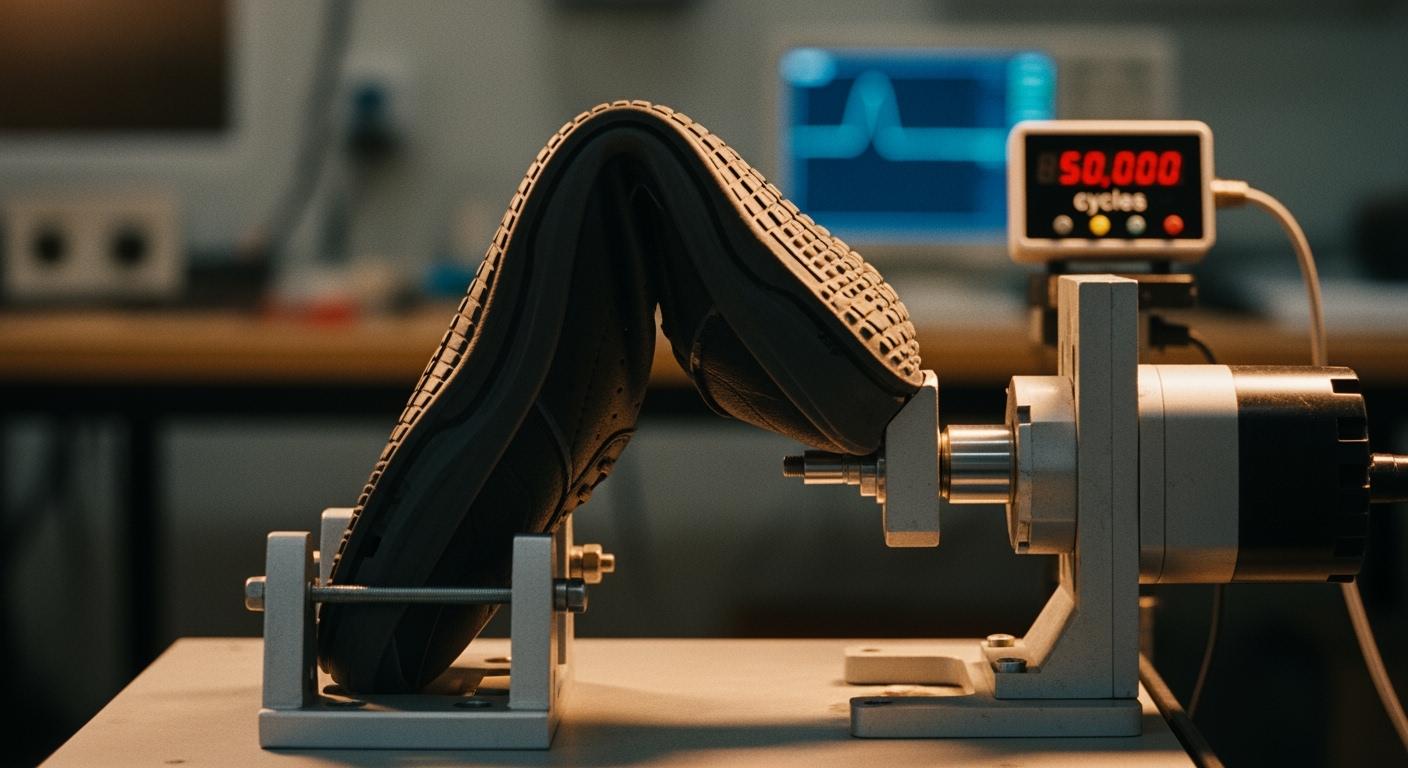
- Flexing Frequency: Standardized at 100 +/- 5 cycles per minute to prevent excessive thermal buildup that does not reflect natural walking speed.
- Angle Control: The bending angle must reach exactly 90 degrees (or as specified by SATRA) to simulate a full toe-off phase in a human gait cycle.
- Technical Standard Alert: According to ISO 24266, a 'Pass' result for a performance sneaker requires the cut growth to be less than 6.0mm after 50,000 cycles. Any growth exceeding this threshold indicates a structural risk of sole splitting in the field.
Integrating Flexing Tests into the Quality Management System
Consistency is achieved by building quality into the 'Pre-Production' and 'In-Line' phases. Relying solely on a final audit is a high-risk strategy for complex footwear. Professional shoe quality control should involve:
- PPI (Pre-Production): Validating the flex resistance of the raw material batch *before* it is cut into soles.
- DPI (During Production): Pulling random samples from the assembly line after sole pressing to check for adhesive-induced brittleness.
- PSI (Pre-Shipment): Final random sampling (AQL 1.5 or 2.5) for whole-shoe flexing durability to confirm assembly integrity.
Effective production monitoring utilizes digital sensors to track the pressing pressure and temperature on the assembly line, as these variables directly impact how the sole responds to future flexing cycles.
Digital Reporting and Risk Control Mitigation
Transparency is the enemy of 'Quality Fade.' By utilizing a digital reporting system, brands can oversee the testing process in real-time. Digital logs provide objective data that is resistant to human manipulation, ensuring that the '50,000 cycles' were actually completed under the correct parameters.
This data-driven approach allows for 'Predictive Quality Management.' If a batch shows a slightly higher rate of crack initiation at 10,000 cycles, even if it eventually passes at 50,000, managers can preemptively audit the chemical mixing ratios of the sole supplier to prevent future failures.
Practical Guide for Importers and Procurement Managers
When sourcing footwear, a technical checklist can mitigate the risk of procurement failure. Organizations should prioritize documentation over visual samples. A technical report from an ISO 17025 accredited laboratory should include:
- Cycle-by-Cycle Observation: Photos of the specimen at 0, 10k, 25k, and 50k cycles.
- Material Density Data: Ensuring the sole weight matches the approved 'Golden Sample.'
- Bonding Strength Metrics: Verification that flexing has not caused 'Grinning' (gaps) at the toe or arch.
- Certification Validity: Cross-referencing the factory's ISO 9001 and SATRA memberships.
By prioritizing products that have passed rigorous mechanical testing, buyers can ensure they are providing components that safeguard the wearer's anatomical comfort and enhance the brand's reputation for durability.
Ready to ensure the durability and performance of your sports shoes before shipment?
As your third-party inspection, testing & certification partner in China, TradeAider supports brands and sourcing teams across the entire production process, helping you identify quality risks early, ensure compliance, and strengthen your team's capabilities before shipment. Book an Inspection or Testing Service with TradeAider today, or for tailored solutions and expert guidance, contact us at services@tradeaider.com or submit the request form on the right.

Frequently Asked Questions (FAQ)
What is the difference between a 'Crack' and a 'Split'?
In technical terms, a crack is a surface-level fissure that does not penetrate the entire thickness of the sole. A split is a through-thickness failure that compromises the waterproof integrity and structural safety of the shoe. A failure in the flexing test is usually defined by a split or excessive crack growth.
Why is 50,000 cycles the magic number?
While a human takes millions of steps, 50,000 flex cycles at a 90-degree angle represent a 'High-Stress' simulation that effectively captures the material's fatigue limit. If a sole survives this concentration of stress, it is technically expected to last for the standard 6-12 month consumer lifecycle under normal conditions.
Does a 'Soft' sole mean it will pass the flexing test easily?
Not necessarily. While soft materials (low Shore A hardness) are flexible, they often have lower tear resistance. A 'Gummy' sole might flex easily but could experience rapid crack propagation once a micro-nick occurs. Technical excellence requires a balance of elasticity and tear strength.
Can I perform a flexing test at home?
You can perform a 'Manual Bend' to check for immediate delamination, but you cannot replicate the cyclic fatigue of a machine. A machine flexes the shoe at a consistent speed and force, which is the only way to induce 'Molecular Fatigue' and get a reliable durability forecast.
How does 'Hydrolysis' affect the flexing test results?
Hydrolysis is the chemical breakdown of PU soles in humid environments. If a shoe has been stored in a humid warehouse for too long, it may appear perfect but will 'shatter' during the first 500 cycles of a flexing test. This is why testing 'Aged Inventory' is a critical part of risk control for retailers.
Related Articles


Grow your business with TradeAider Service
Click the button below to directly enter the TradeAider Service System. The simple steps from booking and payment to receiving reports are easy to operate.

