
- About Us

- Our Services
- Your Industry
- Resources
- News & Blog
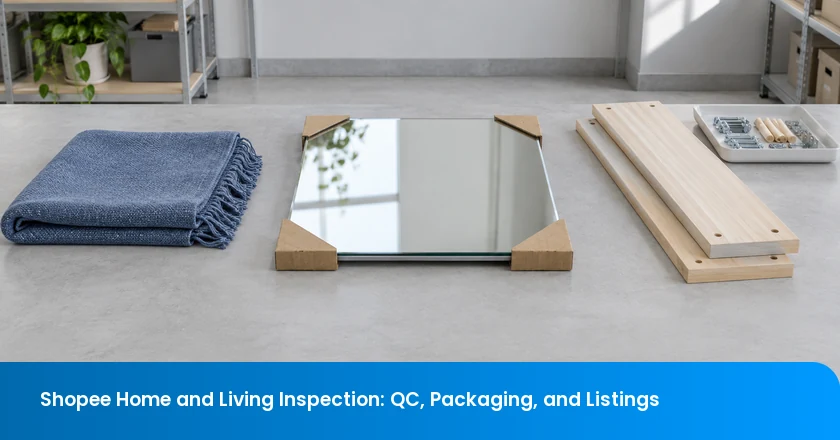
Shopee home and living inspection should compare the goods with the seller’s product specification, listing promises, and actual delivery packaging. For mirrors, furniture, and textiles, the checks differ because the failure risks differ. A factory report can document condition and agreed tests; it cannot by itself establish platform approval or destination-market safety compliance. Start by identifying the exact product and parcel you will sell, then assign each unanswered question to the party able to verify it.
Separate Seller Inspection, Listing Review, and Product Safety
Seller-commissioned inspection, Shopee listing review, and product-safety assessment serve different purposes. An inspector evaluates goods against an agreed brief. The platform decides how its listing rules apply, while the seller and relevant compliance specialists address applicable safety obligations. Calling all three “Shopee certification” obscures who must resolve a missing document, a misleading image, or a defective fitting.
Quality control (QC), the work of checking goods against agreed requirements, needs a clear handoff. Match the same model, variant, and revision across the listing, supplier specification, inspection request, and supporting documents. Otherwise, a report may describe a different finish or construction from the item offered to customers.
| Decision | Useful evidence | Owner of the next step |
|---|---|---|
| Does the shipment match the order? | Measurements, contents, photographs, and agreed inspection results | Seller and inspection provider |
| Does the listing meet applicable platform requirements? | Current market-specific seller rules and the submitted listing | Seller through the relevant Shopee process |
| Can this product lawfully be sold in its destination? | Applicable classification, test evidence, registration, and labeling | Responsible supplier/importer and compliance specialists |
This separation also changes timing. Resolve the destination and product classification before relying on finished-goods checks. Discovering that the wrong evidence was requested at the shipping deadline leaves little room to correct the product or its documentation.
Turn the Shopee Listing into a Checkable Product Brief
Shopee’s published Mall listing guide addresses images, product names, categories, descriptions, attributes, and variations. It is older Mall training material, so use it to understand listing quality rather than as a current rulebook for every market. Confirm today’s requirements in the Seller Centre for the country and account concerned.
For the factory visit, translate the listing into observable requirements. “Large storage basket” is vague; an approved drawing with external dimensions and tolerances gives the inspector something to measure. A photograph showing a lid and inner liner creates a different contents question from a listing offering only the basket.
- Identity: record the seller’s stock code, factory model, size, color, and approved revision.
- Contents: specify the number of pieces, accessories, assembly hardware, and instructions supplied.
- Appearance: provide the approved sample or controlled reference images and define acceptable variation.
- Claims: identify which statements need measurement, a functional check, or separate test documentation.
Resolve discrepancies before the visit. If the listing says “solid wood” but the purchasing specification describes a different construction, asking an inspector to “check quality” will not settle the commercial promise. The seller must first agree what should be supplied and advertised.
When appointing a provider, assess the organization behind the service and confirm the proposed product scope. For that background, review TradeAider’s company background.
Home and Living Inspection Checklist by Product Risk
Build the inspection checklist around construction, intended use, listing claims, and packaging. The Home and Living category alone cannot determine which checks matter. A folded textile, a wall-mounted mirror, and an assembled shelf need different observations even when they share a supplier.
| Product group | Checks to specify | Evidence needing separate attention |
|---|---|---|
| Mirrors and other fragile goods | Edges, surface condition, frame joints, supplied fittings, and corner protection | Mounting suitability and representative package-handling evaluation |
| Flat-pack shelves and small furniture | Panel dimensions, hole alignment, hardware count, assembly, and observed stability | Load, durability, or safety claims requiring defined methods |
| Bedding, towels, and curtains | Finished size, shade, seams, labels, fasteners, and set contents | Fiber composition, shrinkage, colorfastness, or other performance evidence |
For every requested check, provide the reference, method, acceptance criterion, and reporting detail. “Measure the finished curtain against the approved size and tolerance” is actionable. “Confirm premium quality” is not. Agree what happens when a required tool, reference sample, or document is unavailable, so an omitted check is visible rather than silently treated as satisfactory.
Fragile Goods and Assembly: Inspect More Than Appearance
A mirror can look acceptable while its mounting system presents a separate concern. Singapore’s Consumer Product Safety Office lists a recall for repair of IKEA LETTAN mirrors because wall fittings could break and mirrors could fall. That named recall does not establish a defect in other mirrors; it shows why a surface photograph cannot answer a fitting question.
Ask for clear identification of supplied brackets, hooks, screws, and mounting instructions. Compare the kit with the approved specification. Where mounting performance needs assessment, agree the installation conditions and suitable evaluation with the appropriate specialist. Merely counting screws does not establish their suitability for an intended wall or load.
For flat-pack furniture, assemble selected units using the supplied parts and instructions. Record misaligned holes, missing hardware, uneven contact with the floor, or doors that cannot close as intended. Distinguish an observed assembly problem from a durability claim: a short assembly check does not reproduce prolonged use.
Use the inspection-standard guidance when agreeing defect categories and evidence expectations. Define how potentially hazardous findings will be escalated before the visit; they should not disappear inside a general count of cosmetic blemishes.
Home Textiles: Compare Size, Shade, Seams, and Set Contents
Finished size, shade, seams, and supplied pieces can be inspected against agreed references. Claims about washing behavior or material performance require an appropriate method and supporting evidence. A towel that feels soft during a visit has not thereby demonstrated its advertised absorbency or fiber composition.
Set the measurement method before comparing results. State whether a curtain is measured flat, how hems are treated, and whether dimensions refer to a single panel or the complete set. For coordinated bedding, compare pieces together under consistent viewing conditions rather than judging isolated photographs taken in different light.
Inspect stitching and accessible seams, check fasteners where present, and count the pieces inside representative retail packs. A correct outer label does not prove that each bag contains the advertised pillowcases. Photograph any mismatch alongside the product and package identifiers so the factory can locate the affected variant.
If the listing promises wash resistance, request relevant test evidence matched to the material and finish being supplied. Agree how a material substitution will be reviewed. A previous report for another fabric blend should not be treated as proof for the current goods simply because the seller uses the same product name.
Check Safety Requirements in the Destination Market
Safety requirements depend on the destination and product classification. In Singapore, Controlled Goods under the Consumer Protection (Safety Requirements) Regulations must meet the applicable testing, registration, and SAFETY Mark requirements before sale. This is a defined regulatory route, not a certificate required for every item described as home goods.
Start with the actual model and intended use. A powered household item raises different questions from an unpowered storage organizer. Give the person checking classification the product description, electrical ratings where relevant, construction, intended user, and destination. Do not decide the route from a supplier’s broad catalog category alone.
The evidence review should then connect any required report or registration to the model being sold. Compare identifiers and relevant product details; resolve substitutions that may affect the basis of the evidence. An inspector may record markings or document availability within an agreed scope, but those observations are not a substitute for a qualified compliance assessment.
For another Shopee market, establish that market’s requirements separately. Do not transfer Singapore’s terminology or mark to a different country. If classification remains unresolved, settle it before assuming that a passed workmanship inspection is sufficient to proceed with sale.
Singapore Furniture and Bedding Follow a Different Route
General home products still have safety obligations. Singapore’s Consumer Protection (Consumer Goods Safety Requirements) Regulations overview includes furniture, mattresses, and bedding among covered consumer goods. The regulator requires applicable safety standards and additional safety requirements; absence from the Controlled Goods route does not mean absence of safety duties.
Use that distinction when requesting evidence from a furniture supplier. Ask which requirements apply to the specific product and intended use, then obtain relevant supporting information. A document for a different design or use case may leave the buyer’s question unanswered even if the document itself is authentic.
Keep the factory checklist and the safety review connected through model identity. Observations about sharp accessible edges, loose fittings, or unstable assembly can identify concerns to investigate. They do not establish that all relevant requirements have been evaluated. Where a concern needs a defined safety test, arrange the correct method and competent assessment rather than improvising an unsupported pass criterion at the inspection table.
Inspect the Parcel That Will Actually Reach the Customer
TradeAider’s pre-shipment inspection scope applies when 100% of the order is complete and at least 80% is packed for export. Pre-shipment inspection (PSI) can address finished goods, packaging, and agreed on-site checks. Confirm that the packing available includes the configuration relevant to your customer delivery.
Shopee’s published seller fulfillment training advises additional cushioning and labeling for fragile goods and clear, secured shipping labels outside the package. This is useful packing guidance from older training, not evidence of current penalty thresholds or a universal package-test protocol.
The practical distinction is between an export master carton and an individual parcel. If a warehouse removes the mirror from its export carton and dispatches it separately, the outer carton’s condition tells you little about protection in that later configuration. Identify who adds the final cushioning, closes the box, and attaches the shipping label.
Compare representative dispatch packs with the approved specification: corner pieces, separation from hard fittings, void space, closure, and labels. Where handling performance matters, agree the method, sample selection, and acceptance criteria before testing. An improvised drop demonstration cannot support an unspecified transport claim. Record the actual packing configuration with the result so a later material change can be recognized.
Read Inspection Findings Without Overstating the Result
A sampling result applies to the identified lot and agreed criteria. It does not establish platform approval or validate claims that were never tested. Read the report’s scope, inspected quantities, observations, and limitations alongside its overall result.
Keep three outcomes distinct: a check that met the criterion, a check that failed, and a check that could not be performed. If a required reference was missing, obtain it and resolve the open comparison. Do not translate “not checked” into “no defect found.”
For workmanship sampling, define the lot and defect categories before using an acceptance quality limit (AQL). The AQL calculator helps with sampling-plan selection; it does not determine whether a mirror’s mounting design or a textile claim is safe and substantiated. Keep those separate questions visible in the seller’s release decision.
Illustrative Example: A Mirror Changes at the Packing Bench
Consider an illustrative order of 600 mirrors awaiting dispatch: 120 retail parcels use thinner corner protection than the approved packing sample. Those changed parcels need packing verification before dispatch. The seller intends to ship each mirror individually. Master-carton appearance remains acceptable, but no matching handling result covers the changed retail packaging. The inspector photographs the substituted pieces and records which parcels contain them.
The issue is an unverified packing change, not proof that all 120 mirrors will break. Once the warehouse separates the mirrors from the master cartons, protection depends on the individual pack. Keep the identified changed parcels out of dispatch while the seller evaluates the evidence for the remaining goods separately. An acceptable exterior on the master carton does not close this gap.
Ask the factory to restore the approved corner protection or propose an alternative for evaluation. Record the chosen specification and identify the parcels rebuilt to match it. A photograph of one corrected box is insufficient to show which of the affected parcels were corrected; the packing records and checks must address that population.
Before the seller decides dispatch, verify rebuilt parcels against the selected specification and obtain the agreed representative handling evaluation for that configuration. Report what was examined, which packing was used, and any remaining limitation. This illustrative example explains a decision; its quantities are not a recommended sample size or a predicted breakage rate. If the changed parcels cannot actually be distinguished, expand the investigation before relying on the stated boundary.
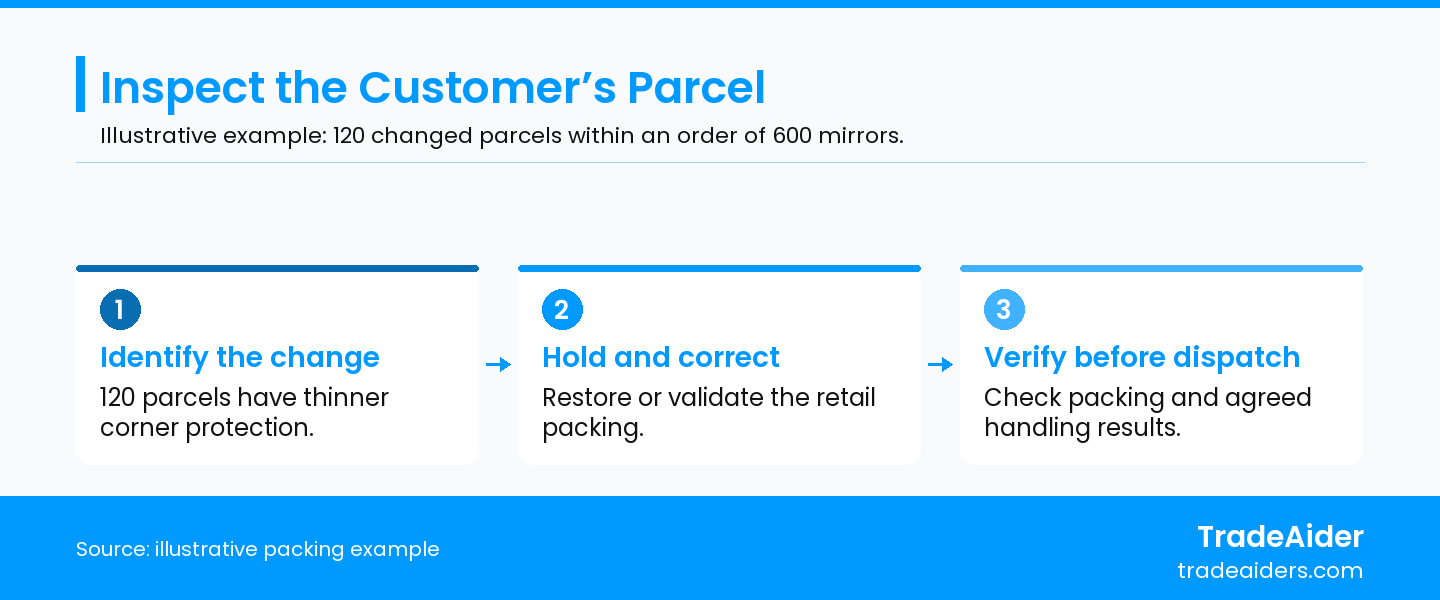
Illustrative example: the changed retail parcels require their own packing verification; an export-carton observation does not answer that question.
Prepare a Home-Goods Inspection Request
- For listing mismatches, agree the product promise and specification before booking.
- For safety questions, identify the destination route and required evidence before relying on factory checks.
- For changed retail packing, arrange verification of the configuration customers will receive.
Send the product and variant list, approved samples, packing specification, destination, listing claims, and known risks when requesting an inspection. Include the criteria you expect the goods to meet and explain whether customers receive factory-packed units or parcels rebuilt by a warehouse.
The team can confirm the feasible inspection scope and reporting needs, with any separate testing identified for further arrangement. The inspection report should document checked quantities, product findings, and packing observations. To agree those checks before dispatch, contact TradeAider to plan your home-goods inspection.
Frequently Asked Questions
Can a seller use a supplier’s inspection report?
A supplier’s report can support your review if you check who produced it, what was inspected, and which shipment it covers. Ask for the inspected model, date, quantities, criteria, and underlying observations. If you need independent verification, a factory’s own check does not provide that independence merely because its report uses a formal layout.
Should spare fittings be counted as part of the set?
Count spare fittings when the approved contents or listing include them, while distinguishing extras from the parts required for assembly. A bag containing the right total number of pieces may still contain the wrong mix. Compare part types and quantities with the instructions, and record whether the missing piece prevents assembly or reduces the promised spare supply.
What if only one color receives repeated damage complaints?
Investigate the affected color as a distinct variant first, comparing its supply and packing records before extending the conclusion to other versions. The color may coincide with a different production batch, material, or packing configuration. Preserve photographs and identifiers from complaints, then use the pattern to specify targeted checks rather than assuming color itself caused the damage.
Does a QC report settle a Shopee return dispute?
A QC report can support a return dispute with relevant observations, but it does not guarantee how Shopee will decide the case. Check the applicable market’s dispute process and requested evidence. Connect the report to the sold item and shipment, and retain customer photographs and dispatch information; factory observations may not describe what happened later in delivery.

Related Articles
Grow your business with TradeAider Service
Click the button below to directly enter the TradeAider Service System. The simple steps from booking and payment to receiving reports are easy to operate.

