
- About Us

- Our Services
- Your Industry
- Resources
- News & Blog

A silicone baby feeding set inspection is a lot-specific check that links the finished bowls, spoons, bibs, and cartons to the material, cure, intended-use evidence, functional method, and cleanliness records that actually apply to them. A soft smell, a clean-looking surface, or one bowl that grips a table can be useful information, but none should clear an unrelated colorway or an unidentified packed population.
The practical answer is the Silicone Set Evidence-to-Use Framework. It treats the product as two connected decisions: first, establish what material system and production run the finished set represents; then, inspect what that identified set does and shows under a buyer-defined brief. The result is a release record that stays useful when a pigment, cure run, carton group, or product signal changes.
The Feeding-Set Release Decision in One View
A feeding-set release should cover only the population whose material records, finished checks, and cartons identify the same lot. Here, lot-specific release means a decision limited to the production population, records, and carton boundary that can be connected without assumptions.
- Definition: Keep the silicone grade, pigment batch, cure record, intended use, and finished colorway together before interpreting a generic material certificate.
- Risk: Treat odor, tackiness, pigment transfer, residue, or moisture as screening signals that may require record review; they do not by themselves prove migration or microbiological status.
- How it works: Record suction, spoon and bib dimensions, sharp flash, cleanliness, and pack-out under defined buyer methods and sample identities.
- Decision: If one traceable color or cure batch is unresolved, hold that population, correct it under controlled records, and recheck it instead of issuing a vague whole-order result.
The rule is intentionally narrow. It prevents a good-looking sample or a passed suction demonstration from lending approval to a colorway whose records, cure conditions, or cartons cannot be reconciled.
Use the Silicone Set Evidence-to-Use Framework Before Sampling
The Silicone Set Evidence-to-Use Framework uses an input-and-scope gate plus a finished-use-and-pack gate to decide release, hold, or recheck. Gate 1 answers what material system, colorway, cure run, and intended-use evidence the set represents. Gate 2 answers what that identified finished set showed under the agreed sensory, cleanliness, functional, and pack-out checks.
Start with a controlled packet rather than a loose “food-grade silicone” statement. The packet should name the product SKU, component list, approved silicone grade, pigment or colorant identification, finished colorway, applicable food-contact evidence, intended food-contact use, cure record, cleaning specification, approved sample, carton marking, and the buyer's defect and acceptance rules. A cure record is the production document that links the specified silicone mix and curing run to a lot. It is useful only if the production and carton identifiers allow the buyer to find the finished sets it covers.
The framework also avoids all-or-nothing reactions. A changed or unresolved input should not automatically condemn separately documented cartons, but neither should one passing sample clear an undefined population. The decision unit is the linked material-and-carton group. If that link is missing, the hold boundary should expand until the population can be identified.
Gate 1: Trace Silicone, Pigment, Cure, and Food-Contact Scope
FDA explains that the regulatory status of a food-contact material is dictated by the status of its individual component substances. For factory QA, that is a practical reason to capture the silicone grade, the colorant or pigment batch, and any relevant process input as part of the finished-set identity. It is not a reason to treat an inspection report as a US regulatory determination.
Before the line starts, ask the supplier to map each bowl, spoon, and bib component to the approved material and color packet. Confirm the colorway, the mold or cavity convention where it helps traceability, the cure run reference, and the clean-down rule used between colors or material batches. If the buyer has an approved odor limit, require the sample preparation, enclosure time, temperature, panel or observer rule, and result format. Do not ask an inspector to decide what “no smell” means after the fact.
Also define the escalation path for tackiness, pigment rub-off, visible residues, flash, or foreign material. These observations may reveal a process or cleanliness question, but they do not identify the chemical cause on their own. Buyers who want this early checkpoint written into the production plan can set a Pre-Production Inspection before silicone and pigment inputs are released.
Gate 2: Screen the Finished Set Under the Intended Use Brief
Finished-set sensory, workmanship, cleanliness, and functional observations are usable only when the buyer defines their method, sample identity, and acceptance rule. A result such as “odor passed” or “suction good” should therefore carry the colorway, sample quantity, preparation, surface condition, result, and exception rule that give it a real boundary.
For bowls, observe the suction base for warpage, contamination, torn lips, trapped flash, and any surface condition that could change the agreed test. For spoons, check the dimensions, handle shape, edge finish, color consistency, and molded parting-line flash against the approved sample or drawing. For bibs, inspect the neck closure, pocket geometry, strap pull requirement where defined, dimensions, and sharp or rough molding points. The check sheet should call out when a component is not intended to suction or when a buyer requirement applies only to one SKU.
Cleanliness needs the same discipline. Look for visible residue, oil, dust, trapped debris, moisture, mold-release residue, or packing damage under the agreed inspection conditions. Record what is observed and where. Do not label a lot “mold-free” from a visual check; visual inspection can identify visible failures but cannot establish the absence of non-visible microbiological contamination.
Keep Migration Evidence Separate From Factory Sensory Checks
The European Commission notes that food-contact material constituents that transfer into food may affect chemical safety, health, taste, smell, and appearance. That is why a buyer should keep food-contact migration evidence separate from a factory odor, tackiness, or appearance check. The factory result can flag a mismatch worth investigating; it does not replace the evidence required for the finished material system and intended use.
Food-contact migration evidence is a report or record showing what material and intended use a food-contact assessment covers. It should help a buyer identify the applicable finished material system, relevant component or colorant information, intended food-contact conditions, and any stated limitations. It is not simply a logo, a generic supplier declaration, or a report that cannot be tied to the product actually being packed.
FDA describes food-contact substances broadly enough to include food preparation surfaces and cookware, and explains that intended-use assessment considers migration testing data and toxicological information. Review that boundary in the FDA food-contact substances overview before treating a material label as a finished-product conclusion. When a buyer needs formal evidence alongside an inspection, TradeAider can combine formal food-contact testing with the lot-specific brief so that the test request and factory record use the same material, colorway, and product identifiers.
Match Migration, Cure, and Cleanliness Records to the Finished Colorway
FDA reference tables organize food-contact substance notifications by food type and conditions of use. The practical buyer lesson is not that every feeding set needs the same report or test condition; it is that evidence must be read against the actual intended use and the material system in scope.
Use a simple evidence map for each finished colorway: silicone grade and supplier reference; pigment identification; component and SKU; cure-run reference; cleaning or mold-release control; report or declaration reference; intended food-contact conditions; production date or lot; and carton range. The map does not create a compliance conclusion. It makes a missing connection visible before a generic document is extended to a changed colorant, revised component, or unclear production run.
For EU-bound material, the general framework requires that food-contact materials not release constituents at harmful levels or change food composition, taste, or odor in an unacceptable way; the European Commission's legislation summary is a useful starting point for the applicable scope. Keep that market review with the responsible evidence owner. The factory team can still verify whether the current colorway, records, cleanliness controls, and cartons match the approved packet.
Build a Feeding-Set Check Sheet That Produces Usable Release Evidence
A feeding-set check sheet should keep sensory, workmanship, function, cleanliness, traceability, and pack-out observations distinct. This stops a clean-looking bowl from being logged as a pass for suction, dimensions, food-contact evidence, and carton identity at the same time.
| Control area | Record before sampling | Factory observation | Release boundary |
|---|---|---|---|
| Material and cure | Silicone grade, pigment, cure and colorway | Record match, odor or tackiness signal | Traceable input-to-lot group |
| Food-contact scope | Report, use conditions, component reference | Current SKU and colorway match | Evidence owner confirms scope |
| Function and dimensions | Surface, dwell time, drawing, acceptance rule | Suction, spoon, bib, edge checks | Recorded method and sample |
| Cleanliness and pack-out | Cleaning rule, carton map, packing standard | Residue, moisture, count, lot mark | Named cartons or controlled hold |
Based on this comparison, each release line has a different owner and limit. An inspector can record the current physical condition and whether it matches the agreed method. The buyer or appropriate evidence owner decides whether a food-contact report applies. Put the result, exception owner, hold instruction, and recheck requirement beside each control. “Not evaluated under this brief” is safer and more useful than turning an observation into a broad approval.
Record the Suction Surface, Spoon and Bib Dimensions, and Finished Edges
Suction, spoon and bib dimensions, and finished-edge checks need buyer-defined conditions and acceptance rules. A suction result should state the test surface, its cleanliness and dryness, the bowl orientation, dwell time, load or pull condition if any, sample identity, and the observed release behavior.
Measure spoon length, bowl width, bib neck opening, pocket depth, strap length, and any other claimed dimension against the approved drawing or sample. Check the parting line and rim by touch and sight under the agreed light condition, then record flash, rough edges, incomplete molding, deformation, inconsistent color, or distortion by component and sample. The point is repeatability: another inspector should understand what was tested and why a unit passed, failed, or needed review.
Set the sample plan and defect rules before the visit. Teams that need a shared baseline can use an inspection-standard baseline for the finished-set checks, then add the feeding-set-specific surface, dimensions, sensory, cleanliness, and carton requirements. Do not borrow a suction threshold from a different bowl design or a different table surface.
Contain Odor or Tacky-Silicone Signals Before They Become a Whole-Order Claim
A traceable odor or tackiness signal should create a defined hold and evidence review, not a guess about every carton. The right response depends on whether the buyer can identify the affected colorway, cure run, and carton group without borrowing evidence from another population.
A conditional hold is not a weaker quality decision. It protects the documented unaffected population while keeping an unresolved signal from disappearing into a general pass result. The following composite example is illustrative, not a TradeAider client case.
Illustrative Scenario: One Color Batch Shows Cure and Cleanliness Signals
When odor and tackiness are limited to a traceable color batch, holding only that batch preserves a controlled evidence path for separately identified cartons.
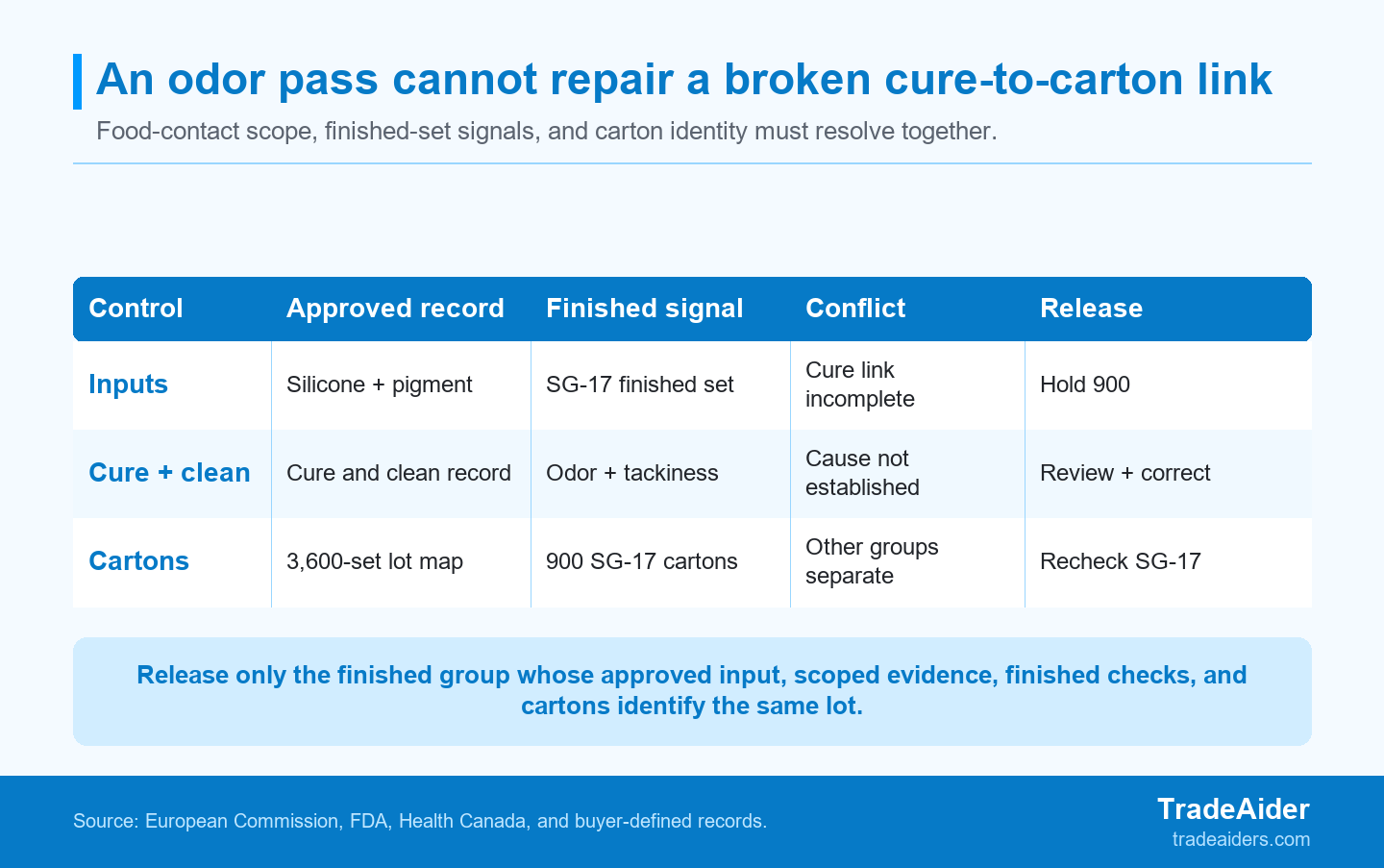
A sensory signal is not a food-contact conclusion. It is a controlled reason to stop the linked color batch until records, finished checks, and cartons resolve to the same population.
An importer QA manager is preparing a 3,600-set order for several online retail channels. The order contains suction bowls, spoons, and bibs in four colorways, and the buyer needs a release record that distinguishes each finished color group rather than a general statement that the silicone sets look acceptable. Nine hundred sage-green sets are identified as color batch SG-17. The other 2,700 sets are packed under separately identified colorway and carton groups, creating a practical boundary if the supplier records can be reconciled. The goods are complete and packed by colorway, but release has not been authorized. The buyer's brief requires the input-to-lot record, a defined sensory screen, cleanliness observations, suction and dimension checks, and carton identification before any group moves.
During unpacking, sampled SG-17 sets show a persistent enclosed-pack odor and isolated tackiness. The observation is recorded against the set SKU, colorway, sample, preparation, and carton group rather than reported as a generic failure for the full order. The cure record supplied for SG-17 does not clearly connect to the finished-set pack record. The other colorways have their own carton labels, but the affected color batch has an incomplete bridge between pigment, cure, cleaning, and packed-product records. These signals do not prove a migration result or a contamination result. They do show that the evidence chain for SG-17 is incomplete, so a whole-order release would ask the buyer to assume that an unresolved material-and-process signal applies nowhere or everywhere.
Place a conditional hold on the 900 SG-17 sets and keep the other colorway populations segregated. Review the other 2,700 sets against their own records; do not release them because the held batch is being corrected, and do not hold them merely because their colors are different. The supplier reviews the identified cure run and cleaning controls, reconciles the silicone and pigment records with the carton list, and prepares a controlled SG-17 recheck population. Any formal food-contact or microbiological question follows the applicable evidence scope rather than the inspector's sensory observation.
Recheck the identified SG-17 population for the buyer's defined sensory, cleanliness, suction, dimensions, edge, traceability, and pack-out rules. If a buyer needs help turning that evidence boundary into a field-ready scope, they can request a baby-feeding-set inspection brief review. This illustrative scenario is not a verified client result and does not establish food-contact, chemical, or microbiological compliance. It shows how a traceable process signal can lead to a controlled hold, correction, and recheck decision.
Turn the Two Gates Into a Lot-Specific Feeding-Set Inspection Brief
A reusable inspection brief identifies the material and colorway, intended use, cure and cleanliness records, check conditions, acceptance rules, and carton boundary. Send these items before the visit so that an observation can be tied to a finished product population instead of a loosely described sample.
Include the approved component and colorway list; silicone, pigment, cure, and cleaning references; the food-contact evidence reference and intended-use notes; the approved sample or drawings; sensory, suction, dimensional, workmanship, and cleanliness methods; sample plan; defect rules; evidence owner; packaging artwork; component count; and carton or lot map. For a Pre-Shipment Inspection, specify that it takes place when 100% of the order quantity is completed and at least 80% is packed for export. That timing makes the final carton boundary meaningful.
Use the Silicone Set Evidence-to-Use Framework one last time before release: Gate 1 confirms that the material and scope records identify the intended finished population; Gate 2 confirms that the recorded finished-set checks and cartons identify the same population. Buyers can use a baby-feeding-set Pre-Shipment Inspection to verify the packed lot against that controlled brief.
Who Is TradeAider?
TradeAider is a quality inspection and testing service provider in China, covering major manufacturing provinces including Guangdong, Zhejiang, Jiangsu, Shandong, and Fujian. Pricing is transparent at $199/man-day all-inclusive for Inspection & QA Services. Client-reported figures published by TradeAider cite an 18% defect reduction and 23% delivery timeliness improvement; these are client-reported outcomes, not universal results. TradeAider also provides testing services, covering Hardline Products, Softline Products, Electrical & Electronic Products, and Industrial Products, enabling buyers to manage quality control and testing needs within a single service framework. It is an Amazon Service Provider Network (SPN) partner.
Frequently Asked Questions
Can an odor check prove food-contact compliance?
No. An odor check can screen a specified sensory condition, but it cannot by itself prove that a silicone feeding set meets the food-contact requirements for its intended use. Record the method, colorway, sample, and result so the signal can be investigated. Then compare the actual material and intended-use packet with the applicable evidence. An odor result may support a hold or recheck decision, but it should not be presented as a migration result, a regulatory conclusion, or proof that every carton is acceptable.
What migration evidence should a buyer request for a silicone set?
A buyer should request evidence that identifies the finished material system, relevant colorants, intended food-contact use, and the conditions covered by the report. Ask whether the document can be connected to the current component, colorway, and supplier records, then have the appropriate evidence owner assess destination-market scope. The factory inspection brief should carry the reference number and variant identifiers so that a physical observation and a document review use the same product language. Do not assume that a generic silicone declaration covers every pigment or use condition.
How should a suction bowl be tested during inspection?
A suction bowl should be tested against a buyer-defined surface, preparation method, dwell time, and release condition rather than an assumed universal threshold. State whether the test surface is smooth, clean, and dry; how the bowl is placed; whether a load or pull condition applies; how long the result is observed; and what counts as an unacceptable release. Record the sample and colorway. That record lets a buyer compare production checks with a later recheck without pretending that one surface represents every use environment.
Can a visual inspection rule out mold contamination?
No. Visual inspection can identify visible residue, moisture, or cleanliness failures, but it cannot establish the absence of non-visible microbiological contamination. Use the factory check to identify and contain what can be observed, including mold-release residue, damp cartons, debris, or surface growth. If the buyer's risk assessment requires a microbiological conclusion, define the appropriate method, sampling scope, and evidence owner separately. Keep the physical finding, corrective action, and affected carton boundary in the inspection record.
Related Articles



Grow your business with TradeAider Service
Click the button below to directly enter the TradeAider Service System. The simple steps from booking and payment to receiving reports are easy to operate.

