
- About Us

- Our Services
- Your Industry
- Resources
- News & Blog
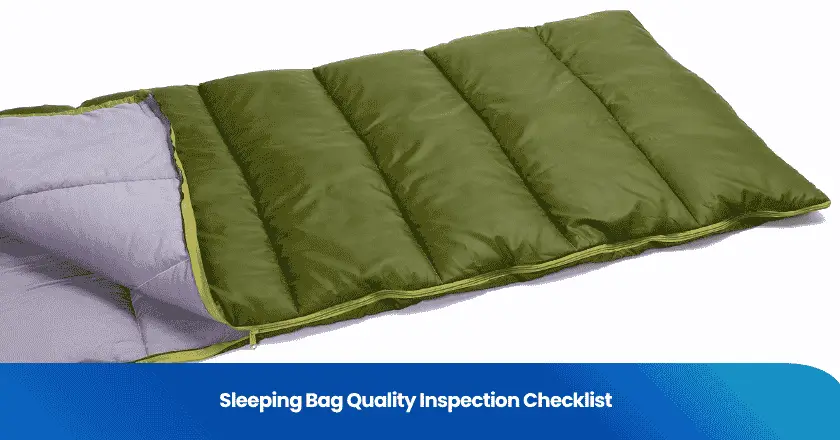
A sleeping bag inspection checklist is a set of release checks that decide whether a packed order can ship, not a general look at stitching and zippers. The checks that matter most are the ones a factory self-check tends to skip: how the fill is distributed and how much of it stays where it should, whether the zipper still works after repeated cycling, whether the seams and shell hold under load, and whether the compressed bag recovers. Warmth, closure, seams and compression fail in different ways, so each one needs its own check, its own method and its own record.
What This Sleeping Bag Checklist Decides
Fill distribution and fill weight are separate checks; a correct total weight can still leave a chamber short.The zipper is checked by cycling and by its hardware, not by one open and close.Seam and shell strength need a force or tensile method, not only a straight stitch line.Compression packing is a performance check: compare the recovered loft with the pre-compression loft.
What a Sleeping Bag Inspection Must Establish
A sleeping bag pre-shipment inspection has to establish four release conditions before a packed order ships: the fill matches the specified type, weight and distribution; the zipper cycles and locks; the seams and shell hold; and the compressed pack recovers. A pre-shipment inspection is a final check of a completed, packed order before it leaves the factory, so it can confirm workmanship, measurements and function on site, but it can only confirm a material or performance claim when a measurement or a test report backs it. That difference decides which checks run during the visit and which need a laboratory or a supplier record.
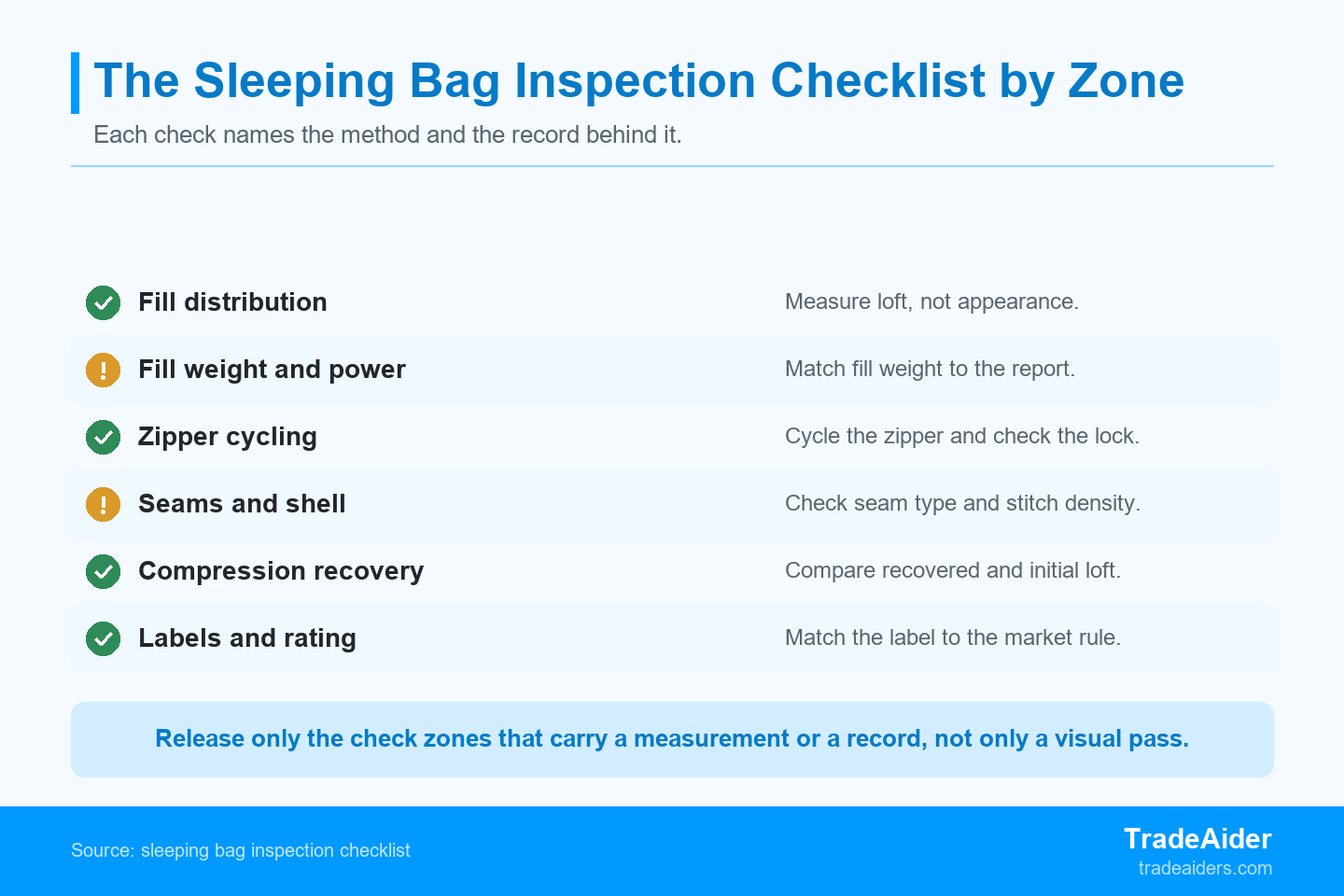
Each sleeping bag check zone carries its own method and record, from fill loft to the sampling plan.
The scope also has a boundary worth setting before the visit. ISO 23537-1:2022 sets the requirements, test methods and labelling provisions for adult sleeping bags used at a limit temperature of -20 °C and higher, and it does not cover sleeping bags for children or babies or bags built for military and extreme-climate expedition use. A buyer should match the checklist to the product family and keep the product specification separate from the method used to check it, which is the split described in the inspection-standard guidance.
Fill Distribution and Fill Weight
Fill distribution and fill weight decide warmth, and they are two different checks. A sleeping bag can carry the specified total fill weight and still develop cold spots where the fill has migrated, where a chamber is under-filled, or where the construction lets heat escape along the stitch lines. That is why the checklist checks the fill twice: once for where it sits, and once for how much of it the label promises.
ISO 23537-2:2023 treats the fabric and material properties of an adult sleeping bag as a separate requirement from the thermal and dimensional values in Part 1, which is the reason a complete inspection keeps a material layer and a performance layer rather than one pass.
Checking Fill Distribution and Baffles
Down stays where it is put only if the baffles hold it. A baffle is a fabric wall inside the bag that holds fill in a chamber and lets it loft, where loft is the thickness of the fill and the measure of how much still air the bag traps. The down industry separates two construction types: baffle box construction, where the fill lofts between stitch lines, and sewn-through construction, where the shell and lining are stitched directly together so the stitch lines conduct heat away. The check follows the construction. Confirm the baffle type on the technical pack, measure the chamber dimensions, feel for clumping and migration, and inspect the stitch holes for down leakage, because a short chamber or a leaking seam shows up as a thin patch rather than a wrong label. The two construction types are the distinction the down and feather terminology draws.
Fill Weight, Loft and Fill Power
The fill weight on the label is a specification value, so the inspection verifies it by measurement rather than by feel. Fill power is the loft of down measured as cubic inches per ounce, and EN 12130:2018 specifies one procedure for determining it as the fill’s massic volume, so the sampled bag’s loft can be compared with the fill power report and the labelled fill weight. A bag that meets the total weight but reads low at the marked points is short in distribution, not in total fill. Cleanliness is checked the same way: down terminology reports an oxygen number, where the cleanest samples measure 1.6 to 3.2 and the highest number allowed is 10, and a turbidity result of at least 300 mm. When the fill checks are sampled rather than run on every bag, the sample size and the accept and reject numbers come from the AQL sampling calculator, which sizes a random sample from the acceptable quality limit.
Zipper Cycling and Hardware
The zipper is the most-cycled mechanical part of a sleeping bag, so a single open and close proves very little. A pre-shipment check cycles the zipper and watches three things: whether the slider snags on the draft tube or the shell, whether the slider lock holds when the bag is pulled, and whether the top and bottom stops keep the slider in place. A two-way zipper is checked in both directions and for alignment where the two sliders meet. The check is repeated enough times to catch the failure that appears after use, and the buyer sets the cycle count and the acceptance value in the specification.
Zipper Cycling, Snagging and Slider Function
The cycle check can be tied to published methods rather than a factory’s word. ASTM D2062 covers the opening and closing of zippers, the functioning of separators and the sticking of zippers at stops, while ASTM D2061 covers the strengths of zipper and zipper parts, including chain and element strength, stop holding strength, slider deflection and recovery, and the holding strength of the slider lock. Naming those methods in the brief turns a snag, a weak stop or a slider that will not lock into a documented defect instead of an opinion.
Seam and Stitch Integrity
Seams hold the fill and the shell together, so a straight stitch line is not enough. The check looks at seam type, stitch density, seam allowance, thread tension and needle damage, then at whether the shell and lining are compatible enough to move together under load. Loose threads, skipped stitches, needle holes that let down escape and a seam that slips when it is tugged are the findings that matter, because they decide whether the bag keeps its fill and its shape through use.
Seam Strength, Stitch Density and Shell Fabric
Seam and fabric strength are measured separately. ISO 13935-1:2014 determines the maximum force to seam rupture by the strip test, and it applies to straight seams, which is why a curved seam or a baffle corner needs its own agreed method. ISO 13934-1:2013 determines the shell fabric’s maximum force and elongation by a strip method. On site, the inspector can check seam type and stitch density and can tug the seam by hand, but a pass or fail force value comes from the laboratory method named in the specification, so the brief should say which one applies.
Compression Packaging and Loft Recovery
Compression packing protects the bag in transit but flattens the fill if the compression is too high or the recovery is not checked. The check covers the compression sack and its straps and seams, the stuff sack dimensions against the specification, the pack volume, and the carton or bale compression used for the shipment. Then it checks the bag itself: after the agreed recovery time, the loft at the marked points is measured again and compared with the pre-compression loft. This is the stage where the pre-shipment inspection checks the packed bag, not only the loose sample.
Compression Sacks, Pack Volume and Loft Recovery
The recovery check compares two loft readings, and the compression sack itself is checked first because a strap or seam that fails in transit releases the load and lets the fill shift. Because the fill power measured under EN 12130:2018 is a loft value, the inspector can measure the bag before compression, compress it for the agreed time and load, then measure the same marked points after recovery and compare the two. A recovered loft that stays below the pre-compression reading, or below the value the fill power result predicts, is a finding even when the bag looks full. The comparison is the evidence; the number alone is not.
Labels, Measurements and Temperature Rating
The label is both a legal document and a performance record. Fiber content, fill composition, temperature rating, size and care must match the tested sample and the destination rule, so the inspection checks the label against the sample rather than trusting the artwork.
In the United States, 16 CFR Part 303 requires the fiber content of fillings incorporated for warmth to be set forth separately and distinctly, allows a 3 percent tolerance on stated percentages, and requires a fiber present at less than 5 percent to be shown as "other fiber." A US-bound sleeping bag with a down or synthetic fill therefore needs its fill disclosed on its own line.
In the European Union, Regulation (EU) No 1007/2011 requires a textile product to be labelled with the name and percentage by weight of all constituent fibres in descending order, and to carry the phrase "Contains non-textile parts of animal origin" where such parts are present. A down or feather fill is exactly that case, so the phrase and the descending-order fibre list are both checked.
The fill composition has its own rule. EN 12934 sets provisions for labelling the composition of the plumage and the fowl species as waterfowl or landfowl, and it does not apply to fillings containing more than 2 percent foreign matter. That gives the buyer a specific check: the species claim and the composition must match the fill lot, and a foreign-matter figure above 2 percent falls outside the standard’s scope.
The temperature rating is the last label item, and it has a limit. Because ISO 23537-1:2022 places the thermal value on the label through its own controlled test method, an inspection verifies that the label matches the tested sample and the destination rule, but it cannot re-rate the bag on site. Older stock may still carry an EN 13537 rating, which was withdrawn in 2017 and superseded by ISO 23537-1, so the buyer should confirm which edition the sample was rated under.
Illustrative Example: A Short Fill and a Snagging Zipper
An illustrative order shows how the gap between a passing sample and a failing bulk run appears in practice, and why the release decision follows the measured loft and the cycle record rather than the total fill weight. Review who runs the checks in TradeAider's company background.
What the Buyer Changes After the Findings
An importer orders 8,000 mummy sleeping bags across two runs of 4,000, with a specified fill type, fill weight and a full-length two-way zipper, for the US and EU markets. The factory meets the total fill weight on the label, but the baffle fill is uneven and the zipper snags on the draft tube when it is cycled. The sample bag passed a visual check, so the buyer expects the bulk order to behave the same way and does not ask for a loft or cycle record.
The total fill weight matches the label, but the foot and shoulder chambers feel thin and the measured loft at two marked points is below the pre-compression loft. The zipper snags on the draft tube within the first 200 cycles, and the slider lock does not hold when the bag is pulled.
A correct total fill weight hid an uneven distribution and a snagging zipper, so the failure only appeared when the loft was measured at marked points and the zipper was cycled rather than opened once. Hold the batch, escalate from sorting to a fill-distribution and zipper correction, and require a loft measurement and a cycle record before re-inspection, covering the 2,600 units built with the uneven fill and the snagging slider.
The factory re-distributes the fill to the specified chambers, replaces the snagging slider and draft-tube setting, and submits a fill power report and a cycle record for the corrected bag. Re-measure the loft at the marked points and re-run the zipper cycle check on the corrected sample, and keep the fill power report and cycle record in one file. An illustrative inspection example, not measured client data, a supplier rating, or a compliance result.
Turning the Checklist Into an Inspection Brief
The checklist becomes usable when it is written into an inspection brief. The brief names the product and the destinations, the fill and loft specification, the zipper cycle count, the seam and fabric methods, the compression specification, the label requirements and the sampling plan. The buyer sets the acceptance values; the inspector records the findings against them.
| Check zone | Method or evidence | Who holds the record |
|---|---|---|
| Fill distribution | Loft at marked points and fill per chamber | Inspector |
| Fill weight and power | Labelled weight and fill power report | Supplier and laboratory |
| Zipper | Cycle count, slider lock and stop checks | Inspector |
| Seams and shell | Seam type and stitch density, then seam force | Inspector and laboratory |
| Compression | Compression sack check and loft recovery | Inspector |
| Labels and rating | Label against tested sample and market rule | Buyer and supplier |
The table is the brief in miniature: each row is a check, the method that makes it measurable, and the party that keeps the record, so a release decision can point at a document rather than a memory. Set the sample size and the accept and reject numbers for the order first, then confirm which checks run on site and which go to a laboratory. To scope the work for a specific bag, contact TradeAider to scope your sleeping bag inspection.
Frequently Asked Questions
Can a visual inspection confirm the fill weight?
No, because fill weight is a measured value, and a visual check cannot show whether the labelled fill is present in every chamber. The inspection weighs the sampled bag or checks a fill weight record, then compares the loft at marked points with the specification, and it treats a bag that meets the total weight but reads low at those points as a distribution problem. A visual pass can confirm workmanship, but it cannot prove that the labelled fill weight is present in every chamber.
How many zipper cycles should a pre-shipment check run?
The buyer sets the cycle count, because no single number fits every sleeping bag, slider and shell combination. A practical approach is to cycle the zipper several hundred times while watching for snagging on the draft tube, a slider lock that does not hold, and stops that let the slider travel past them, and to record the findings against the operability and strength methods. The count and the acceptance value belong in the specification, so the result is comparable across runs and suppliers.
Do sleeping bags need a laboratory test, or is on-site inspection enough?
The answer depends on the claim being checked, because some sleeping bag checks are laboratory measurements while others are on-site observations. Fill power, fill composition and seam or fabric strength are laboratory measurements, while fill distribution, hardware function and packing can be checked on site during a pre-shipment inspection. A complete plan usually combines both: the inspector confirms workmanship and function and draws the samples, and the laboratory report proves the material claims that the label depends on.
Can an inspection verify the temperature rating on the label?
An inspection verifies that the label matches the tested sample and the destination rule, but it cannot re-rate the bag on site. The temperature rating is established by the standard’s controlled test, so the check compares the labelled value with the sample’s test report and confirms the correct edition, which matters because older stock may still carry the withdrawn EN 13537 rating rather than ISO 23537-1.
Related Articles
Grow your business with TradeAider Service
Click the button below to directly enter the TradeAider Service System. The simple steps from booking and payment to receiving reports are easy to operate.

