
- About Us

- Our Services
- Your Industry
- Resources
- News & Blog
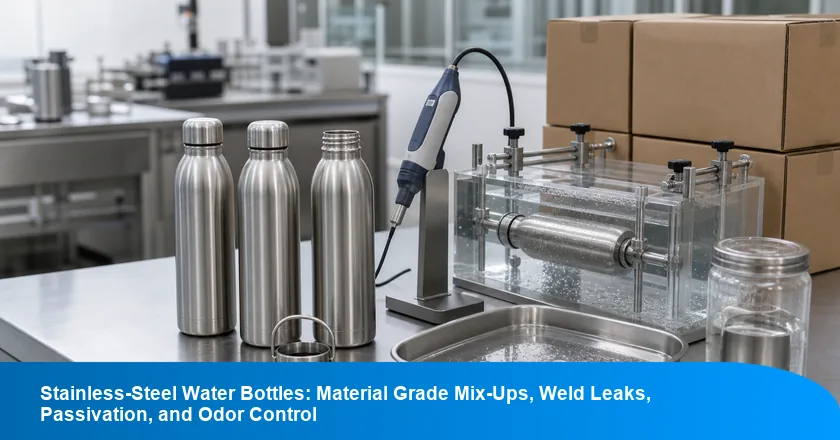
A stainless steel water bottle quality inspection becomes unreliable when one good result is extended to a bottle population it cannot identify. A clean-looking interior, a passed leak check, or a mill certificate may each be useful. None can independently clear a lot if the material, finished configuration, and cartons no longer point to the same units.
Stainless steel water bottle quality inspection is a lot-specific verification of the contracted material, finished body and closure, surface-process records, sensory observations, and export cartons against buyer-approved requirements. It documents the current production population; it does not replace food-contact compliance assessment or a defined laboratory method.
The practical question is therefore not simply, “Did the factory test it?” Ask instead: which heat or component record, cap and gasket configuration, process record, and carton IDs does this result cover? That question gives an importer a faster way to close recurring defects without adding inspection points that cannot support a release decision.
The Bottle Release Decision in One View
A bottle pass only clears the material, finished configuration, and packed lot that the record can identify. Use that rule to decide what can move, what needs a focused hold, and what must be rechecked after a material or process change.
- Material identity: Tie the buyer's contracted grade and material form to a certificate or defined XRF plan, then map that evidence to the formed body or component lot.
- Finished configuration: Treat the welded body, cap, gasket, coating, and any internal treatment as the product that a leak or fit observation actually covers.
- Surface and odor: Record the process, visual finding, and sensory finding separately; do not turn a clean appearance or a neutral odor into a food-contact conclusion.
- Lot boundary: Use carton and packing records to hold the smallest affected group only when the remainder has its own documented evidence chain.
Build the Bottle Evidence-to-Lot Control Framework
The Bottle Evidence-to-Lot Control Framework says a release decision is limited by the first material, process, or carton link that cannot identify the current bottle population. It has four layers: material identity, food-contact scope, process and finished-bottle checks, and packed-lot identity.
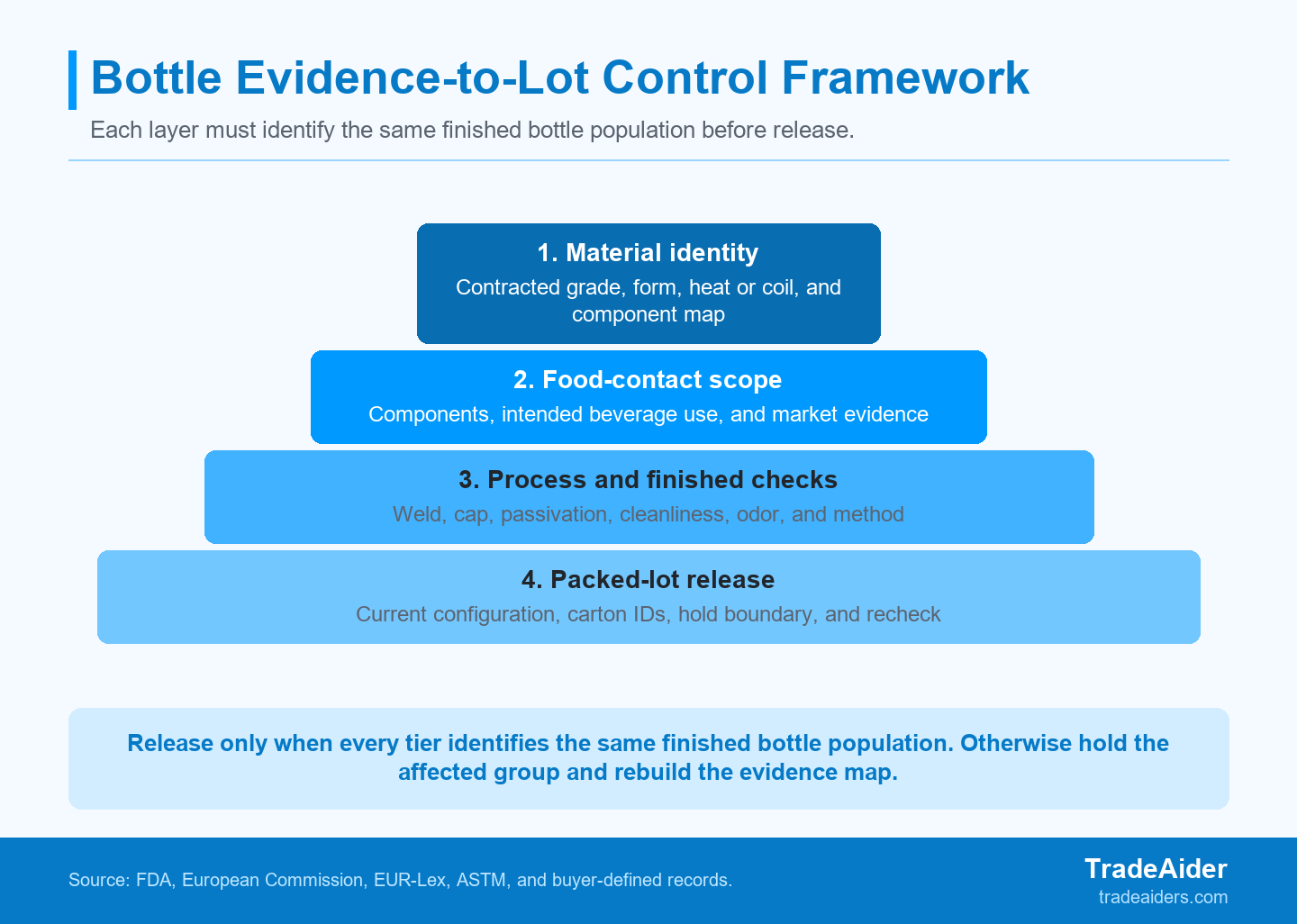
Use the framework to keep a material certificate, surface-process record, closure result, and carton list tied to the same finished bottle population; formal food-contact conclusions remain separately scoped.
Use the framework in that order. First establish what component was supplied. Then confirm what the product evidence is intended to cover. Next record what happened to the actual body-and-cap configuration. Last, verify where that configuration was packed. A result becomes weaker at every missing handoff: a certificate without a component map, a valid process record without a batch reference, or a pass sample with no carton boundary.
Lock Material Grade, Heat, and Component Identity
ASTM A240/A240M covers specified stainless steel plate, sheet, and strip forms. That is useful context for a sourcing specification, but it does not prove that a particular finished bottle body came from the contracted material or that another component uses the same material.
Ask for a material crosswalk before inspection: buyer material requirement; supplier and mill record; heat or coil identifier where available; material form; body, base, neck, or straw component it feeds; production date or line; and the finished SKU or color variant. If the buyer uses XRF as a verification tool, define the units, locations, sampling logic, comparison basis, and escalation path in advance. XRF can help sort a suspected substitution; it should not be described as a universal replacement for the buyer's approved material evidence.
Do not let a certificate for an original coil quietly become evidence for an emergency replacement sheet. The right question is not whether the paperwork looks familiar. It is whether the paperwork identifies the physical components and finished variant in the current lot.
Treat Food-Contact Evidence as a Scope Record
FDA states that the regulatory status of a food-contact material is dictated by the status of each individual substance comprising the article. Food-contact evidence means records showing how the components and intended use are evaluated for contact with food or beverages. A grade label is therefore one input, not a complete conclusion about the finished bottle, coating, printing, gasket, straw, or adhesive.
FDA food-contact tables distinguish food types and conditions of use, including beverage categories. For a real buying decision, the evidence packet should name the component, intended beverage use, temperature or other relevant conditions, destination market, document owner, and the exact product configuration it covers. Do not assume that a document describing a bare body also covers a new coating, lid liner, or accessory.
EU Regulation 1935/2004 Article 3 sets safety and organoleptic boundaries for food-contact material transfer. The inspection brief should therefore identify the evidence to compare, not ask an inspector to infer EU or US compliance from an odor check, a steel grade, or a copied report title.
Verify the Production Gates That Alter Release Risk
A useful bottle control plan gives weld, closure, surface, and sensory risks separate methods and escalation paths. That keeps a recurring defect from being buried in one broad “appearance and function” result.
TradeAider can apply a buyer-approved sampling baseline, then add product-specific checkpoints for each current SKU and cap configuration. Where the buyer needs a formal method or food-contact evaluation beyond factory observations, scope product testing alongside the bottle inspection brief. The method sheet should state who owns the requirement and what result triggers a hold, rework, retest, or formal review.
| Control gate | What it can support | What it cannot replace | Record with the result |
|---|---|---|---|
| Material review | Contract-to-component identity | Finished closure performance | Heat or coil, component, SKU, lot |
| Leak and fit check | Current body-and-closure function | Steel grade or food-contact status | Method, cap, gasket, sample, lot |
| Surface-process review | Process and visible-condition control | Every residue or compliance conclusion | Process batch, method, acceptance rule |
| Odor observation | A sensory escalation signal | A formal root-cause or compliance decision | Configuration, finding, carton boundary |
Weld and Leak Checks: Test the Finished Closure System
A leak result applies only to the finished body-and-closure configuration and sampled population that the method identifies. The weld seam, formed body, threads or mouth, cap, gasket, straw or spout, and any venting feature are part of that configuration.
Write the method into the brief rather than relying on “no leakage” as a vague request. State the medium or pressure approach approved by the buyer, dwell time, orientation, fill condition, cap position, sample population, pass rule, and failure documentation. Inspectors should also record the defect location: longitudinal seam, base joint, neck area, mouth interface, cap interface, or an accessory path. This makes recurring failures comparable across lots and factories.
A pass is valuable, but its scope is narrow. It shows the sampled completed configuration met the buyer's defined leak check. It does not confirm the contracted steel grade, prove surface treatment, or settle food-contact status. If an observed leak is tied to one cap revision or gasket lot, contain that configuration rather than reporting a generic bottle failure.
Passivation and Internal Cleanliness: Verify the Process Record, Then Inspect
ASTM A967/A967M covers chemical passivation and does not prescribe one application-specific acceptance rule. Passivation is a controlled surface-treatment process used to remove contamination and improve the stainless surface condition. In a bottle brief, name the buyer-approved process record, material and component scope, process-batch reference, any required verification method, and the criterion that triggers a hold or escalation.
ASTM A380/A380M notes that visual examination may not reveal thin oil or chemical films. Use visual inspection for what it can show: gross discoloration, obvious residue, weld tint, scratches, loose debris, or inconsistent finish. Pair it with the process record and a defined response for findings that are not resolved by appearance alone.
For internal cleanliness, specify how units are opened, illuminated, handled, and protected from recontamination during inspection. Record whether the body was assembled before the observation, whether the cap and gasket were present, and whether an internal coating or print variant changes the scope. Do not invent a universal corrosion, residue, or passivation limit; the approved requirement and the actual market route set the escalation boundary.
For the sampling structure that supports those checks, review the inspection-standard framework.
Odor, Cap Fit, and Coating: Separate Sensory Findings From Formal Compliance
European Commission states that food-contact materials include containers and transferred constituents may affect taste or smell. An odor finding is therefore worth documenting, but it is not a stand-alone determination of cause or compliance.
Make the sensory check repeatable enough to be useful: identify the bottle configuration, cap and gasket material, internal coating or print, cleaning stage, sample condition, and carton or line group. Log a neutral observation, a detectable odor, or a buyer-defined category; retain a sample only if the approved escalation process calls for it. At the same time, verify cap engagement, gasket seating, spout operation, coating coverage, and obvious transfer or abrasion risks against the approved configuration.
TradeAider can record those factory observations against a buyer-approved brief. When odor, coating, or component questions require a formal determination, route them to the responsible compliance owner and the appropriately scoped evidence or testing program rather than declaring the issue closed at the inspection table.
Contain Material or Process Drift to Its Traceable Bottle Population
A partial hold is defensible only when the separately releasable bottle population has its own material, configuration, and carton evidence chain. If that separation cannot be shown, the hold must expand to the wider untraceable population.
In the illustrative order, passed leak checks do not make the substituted steel sheet traceable to the 1,500 affected bottles. A functional result answers a different question from the missing material-to-carton link.
Illustrative Scenario: An Unmapped Steel Sheet Substitution
Hold the 1,500 navy-cap bottles until their material record, body and cap configuration, process record, inspection result, and carton IDs all agree.
Situation: An Importer QA Manager is preparing a 6,000-bottle order in two cap colors for US and EU e-commerce channels. The 6,000 completed bottles use two cap colors, with 1,500 navy-cap units associated with a late material substitution. The goods are complete and awaiting final export-packing confirmation. Sampled navy bottles pass the buyer's defined leak check, but that observation identifies the finished body-and-cap sample rather than the missing material record.
Problem: The factory used a replacement steel sheet for 1,500 navy-cap bottle bodies after an urgent substitution. The available certificate names the original sheet heat, and the carton list names the cap color but does not connect cartons to the replacement sheet. The buyer also finds that the original body record, replacement-sheet record, and carton list cannot yet be reconciled for the affected group. The separately documented 4,500 bottles should be reviewed on their own evidence chain, not presumed to share the uncertainty. The leak result supports the sampled finished configuration, but it cannot establish the missing material-to-component and component-to-carton links for the substituted population. To turn the changed-group records into a defined factory check, use the available documents to request a bottle inspection brief review.
Action: Place a hold on the identified 1,500 navy-cap bottles; segregate their cartons; reconcile the replacement material document with the actual body lot; rebuild the body-to-carton map; and repeat the specified finished-bottle checks for that configuration. Result: The hold can be lifted only when the replacement material, body and cap configuration, process record, inspection result, and carton IDs all point to the same 1,500 bottles. Until then, the passed leak sample does not authorize use of the original certificate for the changed group. This is a full hold for the affected, identified group; the documented 4,500-piece remainder needs its own complete evidence chain and buyer approval.
The reinspection gate is a reconciled record set plus the buyer-defined recheck of the affected finished configuration. Before that recheck, compare the replacement-sheet document with the agreed material requirement, finished body identifiers, cap revision, process-batch reference, and segregated carton list. If any one of those links remains absent, keep the group on hold and record the missing owner, document, or physical check rather than converting the uncertainty into a generic shipment comment. This is an illustrative control scenario, not a verified client result, a stainless-steel grade determination, or a food-contact compliance conclusion. When the wider order is ready for a final check, use a bottle Pre-Shipment Inspection to verify the packed lot.
Turn Evidence Into a Lot-Specific Bottle Inspection Brief
A release-ready inspection brief names the current bottle configuration, evidence map, finished-goods method, acceptance rule, and lot-specific escalation path. This gives the factory, buyer, and inspector the same decision boundary before sampling begins.
Send the approved bill of materials; material certificates or the agreed XRF plan; current component and cap revision list; weld, leak, fit, odor, surface, and coating requirements; passivation or cleaning process record; food-contact evidence references; approved sample; packing list; carton-to-SKU breakdown; and a named escalation contact. Mark any open item as a hold condition instead of leaving it to a verbal factory explanation on inspection day.
A Pre-Shipment Inspection is a finished-order factory check conducted before export release.
A PSI is conducted when 100% of the order quantity is completed and at least 80% is packed for export. If the product is still changing, postpone the release conclusion or scope a separate affected-group recheck.
For a recurring defect, the deliverable should name what was verified, what evidence it was connected to, which population is affected, and what must happen next. It should also identify the decision owner for any open document or product mismatch so that the final report is not mistaken for a compliance determination.
Who Is TradeAider?
TradeAider is a quality inspection, testing, and certification service provider in China. TradeAider operates across all of China, covering Guangdong, Zhejiang, Jiangsu, Shandong and Fujian. $199/man-day all-inclusive for Inspection & QA Services. Client testimonials report results such as an 18% reduction in defects and a 23% faster issue-resolution cycle; these are client-reported figures, not universal outcomes. TradeAider is an Amazon Service Provider Network (SPN) partner.
Frequently Asked Questions
Is 304 steel automatically safe for every water bottle?
No, a grade label alone does not establish the food-contact status of every finished water bottle or its components. The body, internal coating, print, cap, gasket, straw, adhesive, intended beverage use, and destination market can all affect the evidence required. Keep the buyer's contracted grade requirement separate from the food-contact documentation and compliance review that apply to the actual finished configuration.
Can a leak test prove a bottle has the contracted steel grade?
No, a leak test can support the finished bottle-and-closure result but cannot prove the steel grade or heat identity. It is still useful because it reveals whether the sampled body, weld, cap, gasket, and method worked together under the buyer's defined conditions. Pair that result with the material-to-component record; do not let either document stand in for the other.
Does passivation testing replace food-contact compliance evidence?
No, passivation process evidence addresses surface condition and cannot replace the applicable food-contact compliance evidence for the finished article. A passivation record may help show how a stainless component was treated and verified within an agreed process. It does not itself settle the status of every food-contact component, intended use, coating, or market route, so those records should be reviewed separately.
When should a water bottle pre-shipment inspection happen?
A water bottle pre-shipment inspection should happen when the order is complete, at least 80% is packed for export, and the relevant records identify the current configuration. At that point, an inspector can compare the finished bottle, cap, gasket, pack, carton IDs, and current document set. If a late material or component change remains unmapped, identify the hold population and reinspection gate before release.

Related Articles



Grow your business with TradeAider Service
Click the button below to directly enter the TradeAider Service System. The simple steps from booking and payment to receiving reports are easy to operate.

