
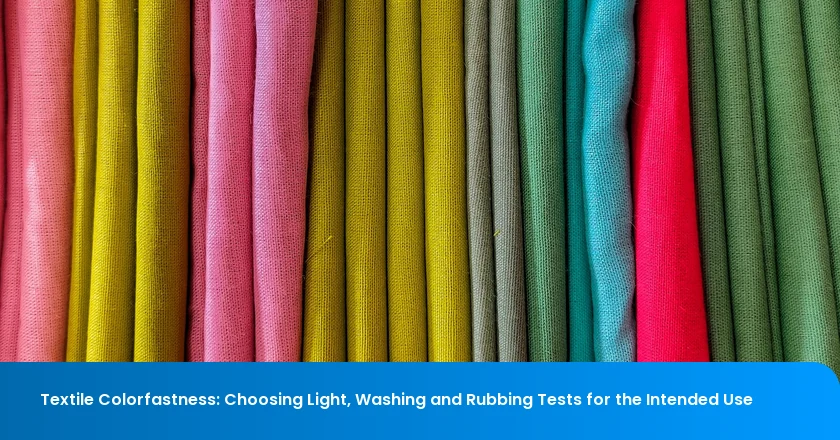
Choose textile colorfastness tests by the exposure the product will face: light for fading, washing for changes during laundering, and rubbing for color transferred by friction. Then specify the method conditions, the colors and finished materials to sample, and a separate acceptance criterion for each outcome. Apparel, curtains and outdoor cushions can need overlapping tests, but one general “colorfastness pass” does not answer every use. Start with the intended use and care instructions, then ask the laboratory to turn those risks into a defined test request.
Three decisions before commissioning colorfastness tests
- Match each expected exposure to a named method and its conditions.
- Identify the actual color, surface, finish and construction represented by each specimen.
- Keep color change, staining, and dry/wet rubbing outcomes separate when comparing results with agreed criteria.
Choose colorfastness tests from the product’s actual use
The useful starting point is the failure you want to prevent. Light, washing and rubbing reproduce different exposures, so select them from the product’s expected use and the consequence of color loss or transfer. A satisfactory result under one condition leaves the other conditions unanswered.
Colorfastness means resistance to a change in color or transfer of colorant under a stated exposure. For a washable shirt, an important question is whether laundering changes its appearance or stains another textile. For a curtain, light falling on the exposed face can be central even if cleaning is infrequent. A cushion cover can raise all three questions: sunlight, cleaning and contact with clothing.
| Intended use | Failure to investigate | Method family to discuss | Specimen/color focus |
|---|---|---|---|
| Frequently washed apparel | Fading or staining during washing; transfer during wear | Washing plus dry/wet rubbing; light where exposure warrants it | Each selected body color; contrasting panels, prints and trims |
| Curtains and indoor upholstery | Fading on the exposed face; transfer to clothing | Light and rubbing; cleaning method consistent with care | Face material, colorway, coating/finish and relevant reverse face |
| Washable bedding, towels and throws | Appearance change and transfer to adjacent textiles | Washing; rubbing where contact transfer matters | Body colors and contrasting borders, pile or decorative areas |
| Outdoor cushions, awnings or covers | Fading, wet-contact transfer and exposure to weather | Light/rubbing as relevant; separately define weathering needs | Exposed face, selected colors and the actual outdoor finish |
These are selection prompts, not compulsory bundles. Decide which rows describe the product, then add or remove tests with the laboratory and final report user. A dry-clean-only upholstery fabric needs a cleaning question that matches its care route; a domestic-wash result should not be stretched to cover solvent cleaning. Likewise, perspiration, pool water and other exposures need separate consideration when they are part of use.
Write those product references before requesting a price. TradeAider’s inspection reference points can help organize agreed appearance and workmanship checks; they do not supply a universal laboratory pass grade for every textile.
Specify light exposure before comparing fading results
A lightfastness report needs an identified exposure, not just a favorable grade. The public scope of AATCC TM16.3 describes xenon-arc options and leaves the relationship to actual exposure in use for the contractual parties to establish and agree. The separate AATCC TM169 weathering method includes controlled wetting or no wetting and evaluation of colorfastness and/or strength. Choose the question before treating the reports as comparable.
Ask for the method edition, selected option, exposure endpoint, relevant chamber settings and evaluation procedure. An exposure endpoint tells the laboratory when to stop or assess the specimen; it is part of the test definition. A report missing that information gives you too little basis to compare two suppliers, even when both use a xenon lamp. The equipment name alone does not identify the complete procedure.
For indoor curtains, explain whether the concern is the outward-facing panel or another exposed surface, and identify the actual fabric and finish. For outdoor material, describe expected sunlight, wetting and cleaning. If the concern includes weather-driven loss of strength, ask for that property to be included in the test plan rather than assuming a color grade answers it. A material can retain an acceptable appearance while a different performance property remains unassessed.
Related ISO method families include ISO 105-B02 for artificial-light colorfastness. A specification naming an ISO method should retain its own conditions and evaluation basis; do not substitute an AATCC method simply because both use xenon light. If the buyer permits an alternative, document the permitted method and acceptance basis before testing. The same caution applies when comparing exposure hours, fading units and reference-based grades: keep their labels and conditions attached.
For a service-life claim, ask what evidence connects the laboratory exposure to the proposed use. Location, shade, wetting and the material system can change that relationship. Without an agreed basis, report the laboratory result as a laboratory result and leave the claimed number of outdoor seasons unresolved.
Read wash color change and staining as separate outcomes
For washable goods, define the wash conditions and request distinct appearance and transfer outcomes. AATCC TM61 is an accelerated laundering method using selected temperature, detergent, bleaching and abrasive conditions. The evaluation has another layer: AATCC EP1 addresses overall color change, while AATCC EP2 addresses colorant staining on a control material. A short “wash pass” can hide which observation was actually evaluated.
Color change concerns the original textile after exposure. Staining concerns color received by another material tested with it. A navy panel may remain close to its original appearance while enough color transfers to make a pale adjacent textile unacceptable. Request the individual staining outcomes required by the selected procedure, including the relevant adjacent-fabric components, rather than accepting one unexplained combined number.
Match the selected procedure to the intended care and buyer protocol. Record the full test designation or option, temperature, detergent and bleach condition, treatment count and evaluation method. ISO 105-C06 is another laundering family, but its specific test designation still matters. “ISO wash tested” is not a complete request. The laboratory should confirm the appropriate procedure from the current method rather than infer it from a garment category.
An accelerated test is a controlled representation of stated washing effects, not proof of every consumer detergent, cycle or bleach combination. Keep colorfastness separate from other after-wash properties too. A color result does not establish shrinkage, seam appearance or print adhesion; request those outcomes if they matter to the product instead of treating them as automatically included.
Also distinguish a laboratory specimen plan from shipment acceptance sampling. An AQL sampling resource helps discuss how an agreed lot is sampled for inspection. It does not decide which dye colors, finishes or material combinations a colorfastness test should represent. Those decisions need the product and test risks described here.
Keep dry rubbing, wet rubbing and pretreatment distinct
Rubbing, also called crocking, asks how much color moves from the surface to a receiving cloth. AATCC TM8 provides dry and wet white-cloth procedures and permits testing before, after, or before and after treatments that may affect transfer. Its public scope also cautions against carpets and print areas too small to isolate with that method. Confirm suitability for the actual surface and area.
Specify dry and wet results separately. A dry-cloth result does not establish wet-contact behavior, and a good wet result does not remove the need for a dry result when both are specified. Explain how the product is handled: contact with pale clothing, damp use or friction against another textile can make the receiving surface as important as the product’s own appearance.
Identify the tested face and treatment state. A printed face, coated face and reverse fabric can present different contact surfaces. For a finished washed garment, clarify whether the specimen represents that supplied finish. Where use after laundering is relevant, agree any pretreatment and the subsequent rubbing assessment with the laboratory. Do not compare an untreated swatch from one supplier with a prewashed specimen from another as though the difference were only supplier quality.
ISO 105-X12 is a related rubbing method family. Preserve the specified method’s conditioning, cloth preparation, rubbing conditions and evaluation requirements; the names “dry” and “wet” alone do not establish that two laboratories used equivalent setups. Ask for the actual method and option in the report, not a generic hand-rub photograph.
Small motifs and mixed-color prints deserve a specific sampling discussion. If the standard contact area cannot isolate a particular color, ask which suitable method or documented sample preparation will address it and how that choice affects interpretation. A pass obtained mostly on an unprinted background is weak evidence for a small dark motif that the consumer actually touches.
Match each test to the actual colors and finished construction
Build the specimen selection around the actual colors, materials, prints, finishes and contact surfaces. Record which purchased variants each tested sample represents, and the reason for any grouping. The visually darkest swatch is a candidate to investigate; it is not automatically the worst case for every light, wash and rubbing mechanism.
Begin with the product’s colorway list. For each one, identify the fiber blend, fabric construction, dye or print route if known, finish, component and relevant supplier reference. Note contrasting combinations such as a dark body against a white trim. Then agree the separately tested specimens and any representative selection with the laboratory and report recipient. If the basis is unknown, leave the coverage question open rather than silently grouping colors.
A fabric specimen and a finished-product specimen can answer different questions. A flat base fabric may not include the garment wash, coating, print or contrasting trim present on the order. Ask whether the selected preparation can assess the intended combination, and whether separate component testing is also needed. The point is to preserve the construction relevant to the claim, not to assume a complete garment is always the correct specimen for every apparatus.
Keep traceable sample identifiers on the request, photographs and report. Useful fields include style, color code, material/component reference, finish revision, sample source and date, plus the production or dye-lot reference where available. If a supplier changes a finish after an early swatch passes, ask the laboratory which previous findings remain relevant and what needs reassessment. Request a reasoned coverage decision rather than assuming that every change invalidates everything or that no change matters.
When a buying agent commissions the testing, agree the colorways, specimens and methods with the laboratory and confirm how the buyer needs the results reported.
Compare results only against their own agreed criteria
Read the grade with its observation and scale. AATCC’s gray-scale descriptions use matching chips for grade 5 and increasing contrast for lower grades. Color change describes the tested textile; staining describes the receiving material. A grade without the method, exposure, evaluation scale and agreed acceptance criterion is incomplete decision information.
Keep separate report lines for the relevant outcomes. A color-change grade and a staining grade are not two readings of the same property, so averaging them can conceal a failure. Lightfastness results can also use a different reference or reporting basis from a wash or rubbing result. Ask the laboratory to explain the reported scale; do not rank an unexplained light grade against a gray-scale rubbing grade.
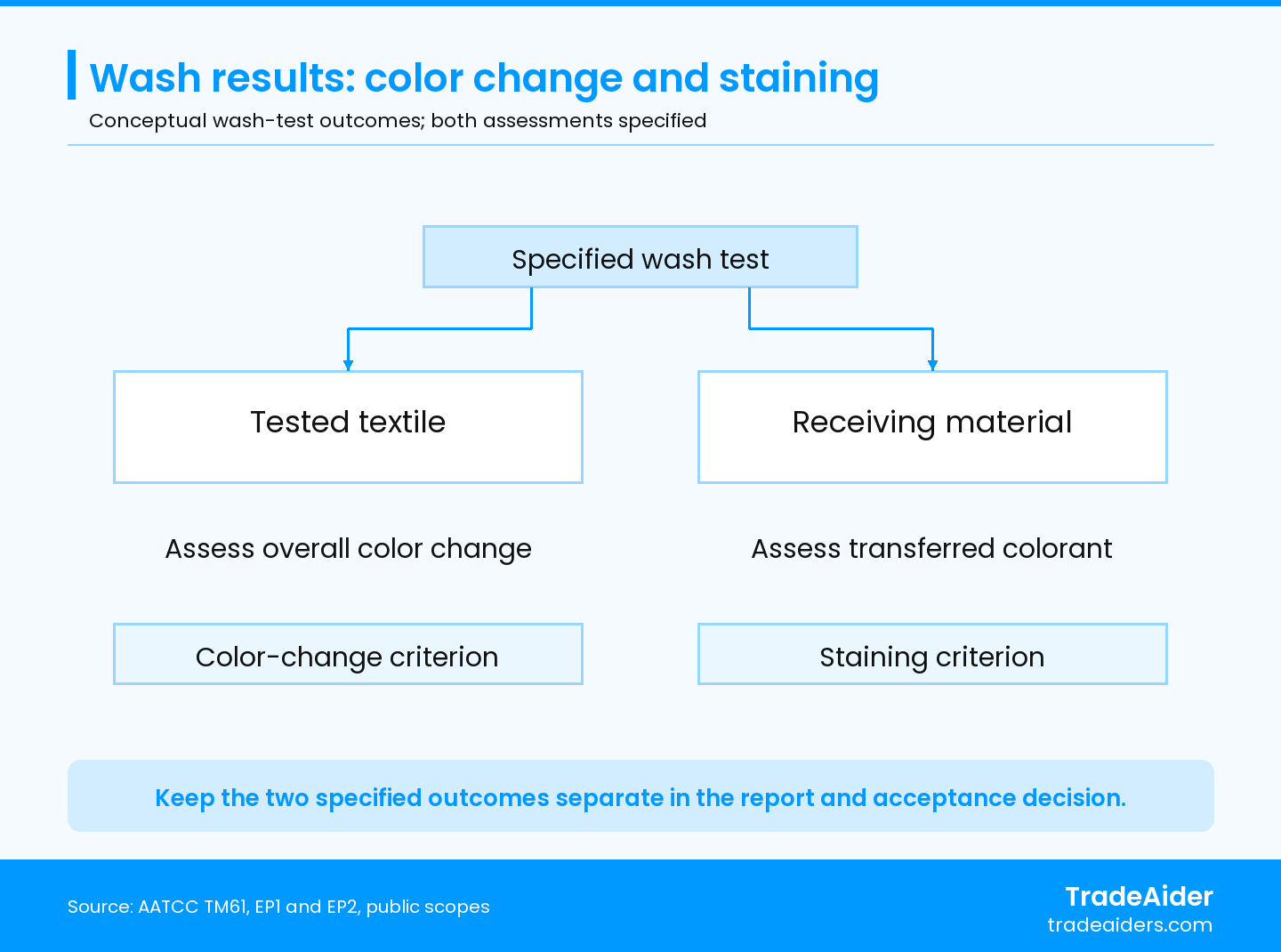
For a wash test that specifies both outcomes, color change describes the tested textile and staining describes transferred colorant on a receiving material. Compare each result with its own agreed criterion. Conceptual diagram; no measured result or calibrated color scale is shown.
Illustrative example: A buyer’s agreed wash specification requires at least grade 4 for color change and grade 3 for staining on the specified cotton adjacent fabric. A hypothetical report gives color change 4 and cotton staining 2.5. The appearance criterion is met, but the stated staining criterion is not. These are invented criteria and results for explanation, not industry-wide limits or TradeAider client data.
Ask the supplier and laboratory to confirm the sample identity and selected conditions, then address the staining result with the responsible technical team. If the finish or process changes, identify the revised sample and agree the affected retesting before reconsidering acceptance. Preserve the original and revised results so that a corrected submission can be compared under the same conditions. If the report omitted the required cotton staining outcome entirely, the next action would instead be to obtain that missing evidence.
Order checks can then use the approved references and available reports. For pre-shipment inspection, the order quantity is 100% complete and at least 80% packed for export. Agree which visible shade, component, label and packing observations are required; a shipment inspection does not recreate controlled light exposure or laundering in a laboratory.
Write a test request the supplier and report user can follow
Send the supplier and laboratory a request that keeps use, specimens, methods and outcomes together. Carry the agreed references into order inspection where relevant, while preserving the difference between laboratory exposure results and on-site observations. A report should answer the requested questions or identify exactly what remains untested or unresolved.
| Request field | Copy and complete | Purpose |
|---|---|---|
| Use and care | Product/use: ___; exposed face/contact: ___; care route: ___ | Choose the relevant stress and cleaning conditions |
| Specimen coverage | Style/color/component/finish IDs: ___; separately tested: ___; grouping basis: ___ | Show what each result represents |
| Method and conditions | Method/edition/option: ___; exposure endpoint or wash condition: ___; pretreatment: ___ | Make the test reproducible and comparable |
| Separate outcomes | Light evaluation: ___; wash change/staining: ___; rubbing dry/wet: ___ | Avoid an unexplained overall pass |
| Acceptance and user | Criterion for each result: ___; specification owner/recipient: ___; required format: ___ | Establish who accepts which finding |
| Open items and changes | Missing information: ___; responsible person: ___; revised sample/report references: ___ | Keep unanswered questions visible until resolved |
Use one line per relevant method and specimen group. For example, a washable cushion with a dark printed face and pale reverse needs a request that names those surfaces and the intended contact or wash concern. Discuss whether the exposure and preparation assess the combined construction or require separate samples. If outdoor use is claimed, add the weathering question rather than leaving it hidden inside a generic lightfastness line.
Have the final report user confirm the criteria before testing begins. A retailer’s requirement, a brand’s internal protocol and an applicable product rule can have different scopes. Record the actual document and version that governs this order. Do not turn a threshold quoted in a general guide into a mandatory rule for every market, platform or textile category.
For inspection planning, make the approved appearance samples, component references and report identifiers available to the inspection provider. State what can be observed at the factory, what equipment or references are agreed and which questions remain with the laboratory or buyer. If a sampled item has a different finish or color code from the approved reference, record that discrepancy for the buyer’s decision rather than extending the old laboratory result by assumption.
You can begin a scope discussion with available information. To arrange agreed order checks, contact the TradeAider team with the product and order details, factory, destination, timing, available color/finish references and existing test reports. Identify open method or coverage questions and the intended report recipient. Confirm technical requirements before inspection; the resulting inspection record should state the agreed checks, observed findings and limitations.
FAQ
Can a quick hand-rub check replace laboratory rubbing evidence?
No. Treat a quick hand-rub check as a screening observation, because it does not establish that the specified laboratory procedure was followed. If transfer appears, record the sample identity, treatment state, receiving material and photographs, then ask whether laboratory confirmation is needed. Keep the observation in its own record; do not label it an AATCC or ISO pass or assign a formal grade from that check.
Does a gray-scale grade of 2–3 mean a range?
In AATCC half-step notation, 2–3 denotes the intermediate grade 2.5 rather than an uncertain interval between two results. The public AATCC M11 glossary accepts decimal and dashed half-step forms. Confirm that this is the report’s notation, preserve the original entry, and compare the confirmed grade directly with the criterion. Do not round a half-step upward to obtain a pass.
What if the report lists dry rubbing but omits wet rubbing?
If wet rubbing was specified, a missing wet result remains an evidence gap even when the dry result passes. Ask the laboratory whether wet testing was performed and documented. If it was, obtain the authorized missing result or corrected report; if it was not, agree the needed test on the identified specimen. Do not enter a blank field as zero or infer a wet pass from the dry grade.
Related Articles


Grow your business with TradeAider Service
Click the button below to directly enter the TradeAider Service System. The simple steps from booking and payment to receiving reports are easy to operate.