
- About Us

- Our Services
- Your Industry
- Resources
- News & Blog
Toy quality control in Asia is not one standard but a map of them. ASTM F963 governs the United States. EN 71 governs the European Union. ISO 8124 is the international reference. China's GB 6675, India's BIS certification and Japan's ST Mark add their own national rules. A toy built for one market still has to meet the rule and mark of every destination it enters. The sections below set out the standards, the hazard classes behind them, the quality control practices that carry them, and where third-party testing and inspection fit.
Why Toy Safety Standards Matter in Asia
Toy safety standards matter in Asia because the region, led by China, makes most of the world's toys. A single unsafe batch can therefore reach consumers in many markets and trigger recalls, legal action and lasting brand damage. The scale raises the stakes, and the rules a toy must meet are a condition of market access rather than a formality.
The concentration of production explains the pressure. The European Commission's toy sector facts state that China is the world's largest exporter of toys, with more than 86% of world toy exports. One design or material decision can therefore reach children in dozens of markets. A defect that escapes inspection can become a recall before the cause is found, and regulators respond by tightening the rules a toy must satisfy.
A buyer usually cannot watch every stage of production, so the checks and the records matter as much as the units. When a brand shares a specification, a bill of materials and test records with an outside provider, the engagement should make clear who performs each check and who keeps the evidence, because clear ownership of each record is what makes the rest of the plan work. For information about the organization handling that work, review TradeAider's company background.
The Main International Toy Safety Standards
A toy safety standard is a published set of safety requirements and test methods that a toy has to meet. The main international toy safety standards are ASTM F963, EN 71 and ISO 8124. They belong to different systems, but they address the same hazard classes. A manufacturer can therefore read them as a shared safety vocabulary.
A hazard class is a family of risks such as mechanical and physical, flammability, chemical migration or electrical. Each standard groups its requirements by those classes. That is why two standards written in different regions often look similar once they are compared by the risk they control rather than by their numbering. The shared classes also explain why a single test method can be recognised across markets. A missing test is easy to spot by asking which hazard class a requirement belongs to.
The classes also travel across product types. A plush toy, a plastic figure and a ride-on all raise mechanical, flammability or chemical questions, even though the tests differ. When a buyer reads a test report from an unfamiliar laboratory, the fastest check is to ask which hazard class each test addresses and whether the toy's age grade brings additional requirements. That reading habit turns a list of test names into a decision about whether the toy is actually covered.
Where the standards diverge is in enforcement. A destination turns the hazard classes into its own mandatory rule and its own mark. The buyer's first decision is therefore not which standard is best, but which rule applies to the market being shipped to. Keep the safety requirement separate from the method used to check it, because a clear requirement can still be measured in more than one way. That separation matters most when a factory measures a requirement its own way, because agreeing the method up front keeps a later result from being disputed. The inspection-standard guidance explains how the two are kept apart.
ASTM F963: The United States Toy Safety Standard
In the United States, ASTM F963 is a mandatory consumer product safety standard for children's toys. 16 C.F.R. part 1250 requires each toy to comply with all applicable provisions of ASTM F963-23.
The standard addresses hazards a toy can present in normal use or after reasonably foreseeable abuse. It contains requirements and test methods for toys intended for children under 14 years of age. Not every section applies to every toy. The manufacturer identifies the sections that match the toy's age grade and features rather than treating the standard as a single checklist.
One recurring class is small parts: components that can detach and fit inside a small-parts cylinder, which is a choking hazard for young children. That class is why a tension or torque test can matter more than a visual check. It is also why the US route pairs the standard with certification work. A toy sold without the applicable provisions met is not compliant, however good it looks on the shelf.
EN 71: The European Toy Safety Standard
In the European Union, the Toy Safety Directive 2009/48/EC sets the legal safety requirements for toys. Harmonised European standards, the EN 71 series, give a presumption of conformity when a toy meets them.
That route rests on conformity assessment, the process that shows a product meets the applicable requirements. A toy that follows the harmonised standard is presumed to satisfy the directive's safety requirements. The standard series, not the directive's text alone, is therefore the practical reference for design and testing. The legal base is also moving. Regulation (EU) 2025/2509 repeals the directive and applies from 1 August 2030, so a manufacturer with a long product cycle should track the transition.
ISO 8124: The International Toy Safety Standard
ISO 8124 is the international toy safety standard. China's GB 6675 requirements are largely based on the ISO 8124 series, so it is the common reference behind many regional rules. It is not itself a market-access rule.
That is why several national standards read alike: they cover the same hazard classes and often borrow the same test logic. A manufacturer can use ISO 8124 to compare rules and to see where a national rule adds or tightens a requirement. The international standard does not replace the destination's mandatory rule and mark. Treat it as the shared baseline that makes the other standards easier to read.
National and Regional Requirements in Asia
Each Asian market enforces its own national toy safety rule and mark. A manufacturer selling into China, India or Japan has to meet that market's requirement rather than relying on one international standard. The table below maps the destinations most often named by Asian manufacturers to the rule, the mark and the evidence a buyer should hold.
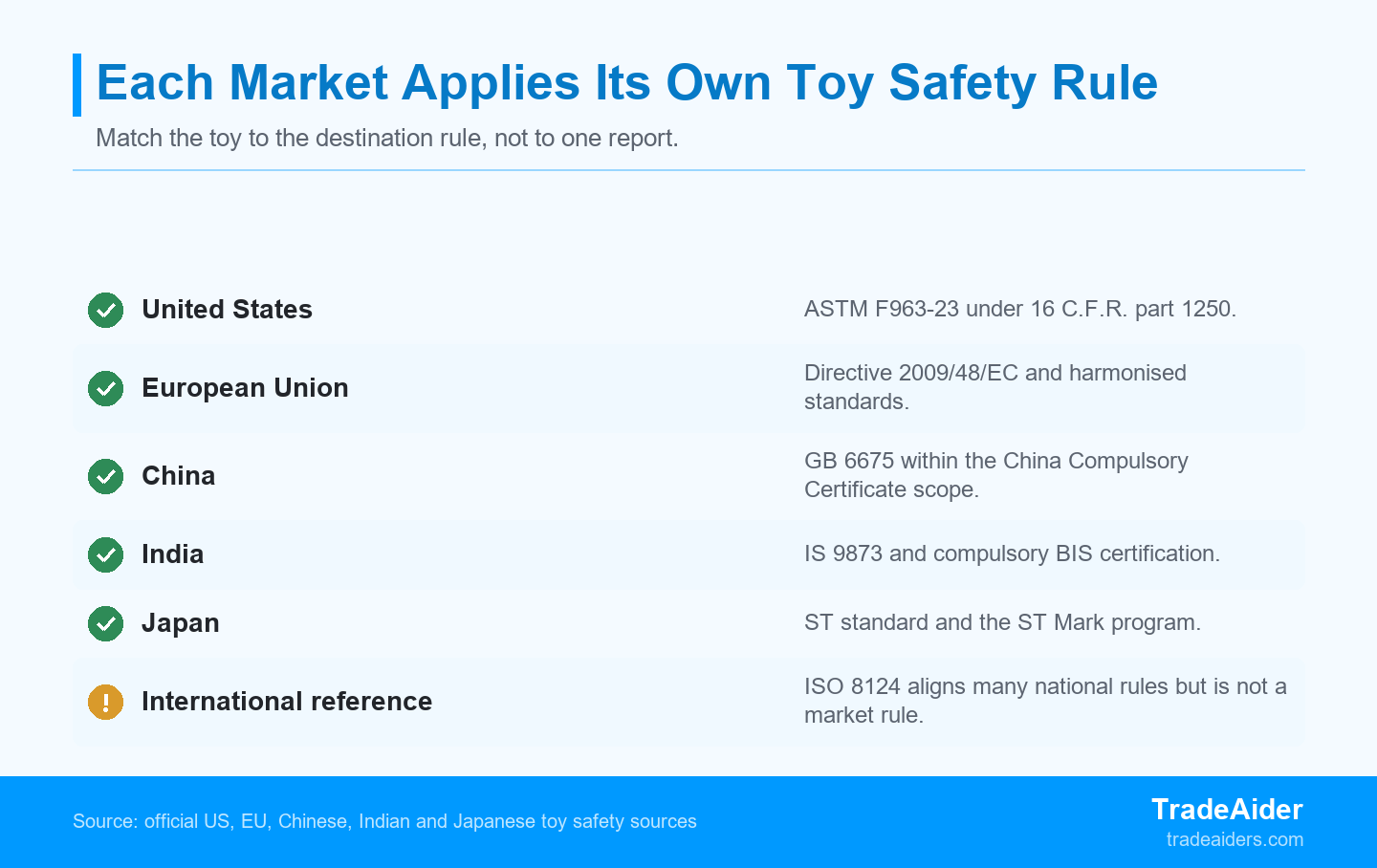
Each destination enforces its own toy safety rule and mark, so the same toy has to be matched to each market it enters.
| Market | Mandatory rule | Mark | Evidence the buyer should hold |
|---|---|---|---|
| United States | ASTM F963-23 under 16 C.F.R. part 1250 | Certification to the standard | Test report and certification record |
| European Union | Toy Safety Directive 2009/48/EC with harmonised standards | CE marking | Declaration of conformity and technical file |
| China | GB 6675 series | China Compulsory Certificate (CCC) where it applies | GB 6675 test report and CCC |
| India | IS 9873 series | BIS mark | BIS certification |
| Japan | ST standard | ST Mark | ST conformity test report |
The table is a starting map, not a substitute for the current text of each rule. Editions change, and a market may exempt or add categories. Read it as a decision tool: it names the rule and the mark to confirm before production, and it shows who owns the evidence for each destination.
China: GB 6675 and CCC
In China, the GB 6675 series is the mandatory toy safety standard within the scope of the China Compulsory Certificate. It is largely based on ISO 8124, and the updated series takes effect on 1 November 2026.
The standard and the certification mark work together. A toy that meets the standard still needs the CCC where its category falls inside the scheme's scope. Because the update replaces the 2014 editions and is mandatory, a manufacturer with an existing Chinese line should confirm which edition its test reports reference. Plan retesting before the implementation date rather than after. For a buyer, the practical check is to ask for the GB 6675 report and the CCC certificate together, and to confirm the report cites the edition in force.
India: IS 9873 and BIS Certification
In India, safety of toys was brought under compulsory BIS certification with effect from 1 September 2020 under the Toys (Quality Control) Order, 2020. Toys therefore need the BIS mark based on the IS 9873 series before they can be sold.
The requirement was issued by DPIIT, and it applies to toys placed on the Indian market whether they are made locally or imported. Because certification is compulsory rather than voluntary, the BIS route has to be started before the shipment. The factory or importer needs the test evidence that supports the licence. Confirm which parts of the IS 9873 series apply to the toy's category before booking testing, because the wrong standard produces a report that does not support the mark.
Japan: The ST Mark and JIS
In Japan, the ST Mark program is run on the ST standard by the Japan Toy Association. It licenses the mark after a third-party conformity test, so the mark is the reference Japanese retailers expect.
The program is built on the ST standard, and the mark is licensed only after an ST Standard Conformity Test conducted by third-party testing bodies. The manufacturer therefore plans the test and the label together rather than treating the international standard as enough. A buyer selling into Japan should confirm the ST Mark route and the JIS references behind the test before production, and keep the conformity test report with the order file.
Common Toy Quality Control Practices in Asian Manufacturing
The common quality control practices in Asian toy manufacturing are appearance inspection, material and component testing, and durability and safety testing. Each one is the way a written standard is turned into a check on a real toy. They are not interchangeable, because each answers a different hazard class.
Appearance inspection is the first gate. It relies on trained inspectors who look for surface defects, sharp edges, loose parts and assembly errors. It is fast and cheap because it does not load or test the toy. Its limit is that it cannot see inside a material or predict how a part behaves under force. It is a screen rather than a proof.
Material and component testing moves the check from the surface to the substance. Samples are tested for restricted substances such as heavy metals and certain plasticisers. Components are checked against the specification, so a hazard that is invisible to the eye is caught at the material level. This is the practice that most directly supports the chemical-migration class in the standards.
Durability and safety testing simulates use. Drop tests, tension and torque tests on small parts, and compression or bite tests load the toy the way a child might. That is the only way to show whether a part holds. Because the standards express these as test methods, the practice is not decoration: it is the evidence the standard requires, and it is where a visual pass and a safe toy can diverge.
Illustrative Example: A Small Part That Detaches
An illustrative case shows how a visual pass can hide a mechanical hazard. A toy brand places an order of 18,000 plush-and-plastic pull toys, across two runs of 9,000, with a factory in China for the US and EU markets. The factory uses the same approved sample as an earlier run but changes the adhesive that holds a small plastic eye on the plush body. The first run passed its appearance inspection, so the buyer assumes the second run will behave the same way and does not ask about the adhesive change.
Appearance inspection passes, but in abuse testing one plastic eye detaches and fits inside the small-parts cylinder. The factory cannot show a material record or a test report for the substituted adhesive, and no first-article check was run for the new part. The incoming material record lists the new adhesive only as a generic part number.
The visual pass hid a mechanical hazard because appearance inspection does not load the part. A small-parts failure therefore appears only under abuse testing, and a passing visual check looks the same as a safe toy. The buyer holds the run, escalates from sorting to a design and material correction, and requires a first-article check on the substituted adhesive against the applicable standard before the run continues.
The factory restores the approved adhesive or submits the substitute with a material record and a first-article report, then rebuilds the 2,000 affected units. The buyer re-runs the abuse test on the corrected first article and the next production sample against the same small-parts limit, and keeps both runs' records in one file. This is an illustrative toy-safety example, not measured client defect data, a supplier rating, or a compliance result.
The Role of Third-Party Inspection and Testing
Third-party inspection and testing give an impartial check against the standard. That check runs from laboratory testing of materials and components to an inspection of the packed order, so a manufacturer can show evidence rather than assert compliance. The two answer different questions, and a buyer who keeps them separate avoids the common mistake of treating a passing lab report as a statement about the whole order.
Testing establishes whether a sample meets a method. Inspection confirms the state of a lot or a packed shipment. A lab report does not tell you whether the right parts were used in the run, and an inspection does not prove that a material is compliant. A toy programme usually needs both, and it should place each where it can still change a decision.
That is where a testing partner earns its place. TradeAider's product testing in accredited laboratories verifies product quality and safety through testing in accredited laboratories in China, covering toys among the hardline categories. The process runs from needs alignment and sample management to testing, result determination and report issuance. Match each hazard class to a test, and record which laboratory, method and edition produced the result. That record is what lets the evidence be read against the destination rule later.
Compliance Challenges Manufacturers Face
Manufacturers face two recurring compliance challenges. The first is regional rules that keep changing. The second is communication and language gaps between the factory, the buyer and the regulator. Together they make compliance a moving target rather than a one-time task, and both are managed rather than solved. Each one has a clear owner once it is named.
A rule change such as a new standard edition can invalidate a test report that was valid last season. A requirement that is clear to a regulator can become ambiguous when it reaches a production line through a translated specification. Assign an owner who tracks the rules for each destination, and keep the buyer's requirements in one controlled document. Confirm the meaning of a requirement with the test body before the run rather than after a failed inspection. The cost of clarifying a requirement early is small next to the cost of rebuilding a shipment that met the wrong edition.
How to Reach the Highest Toy Quality Standard
To reach the highest toy quality standard, a manufacturer works with a reliable quality control provider and runs an internal system of standard operating procedures and regular audits. The packed order is then confirmed with an independent pre-shipment check. The internal system is what holds quality between orders: written procedures, defined records and periodic audits turn the standard into routine work rather than a one-off test. Start from the audit-standard guidance to see how a factory's quality system is scoped, and require the records that show it is followed.
The independent check closes the loop at the shipment. A pre-shipment inspection is normally conducted when 100% of the order is complete and at least 80% is packed, and it inspects randomly selected samples against the buyer's specification. It confirms the packed order rather than the design, so it works best after the standard and the testing are already set. It also gives the buyer a documented last decision before the goods leave the factory.
Turn the Standards Into a Testing and Inspection Plan
Send the toy, the destination rule and the production schedule with the request so the testing and inspection scope can be reviewed together. A first toy brief is short, and it states the decisions that drive every later check.
- Name the destination markets and confirm each one's rule and mark.
- Match the toy's age grade and materials to the applicable standard.
- Map each hazard class to a test and each stage to a check.
- Keep the material, test and inspection records with the order file.
A review needs four inputs: the toy and model identity, the destination market and its safety rule, the material, age grade and hazard classes involved, and the production schedule and shipment date. TradeAider can review those inputs, agree which standards and tests apply, and return a scoped testing and pre-shipment inspection proposal with an agreed standard list, test list and reporting deliverable. Keep the request short but complete, because a clear brief lets the provider confirm the destination rule, the age grade and the hazard classes before quoting. That avoids a test list that misses a requirement or repeats one the destination does not enforce. If several markets are involved, list them all so the scope can be planned together rather than market by market. To scope that work, contact TradeAider about your toy testing and inspection plan.
Frequently Asked Questions
Does one toy test report cover every market?
No, because each destination enforces its own national rule and mark, so a report written for one market does not clear a toy for another. A passing ASTM F963 report supports the United States route, while the EU, China, India and Japan each turn the shared hazard classes into their own mandatory rule and mark. If the toy is sold in several markets, list them first and confirm the rule and evidence each one requires, rather than assuming the strongest single report covers all of them.
Which standard applies to toys sold in the United States?
ASTM F963 applies, because a United States regulation requires each toy to comply with all applicable provisions of ASTM F963-23. The standard addresses hazards in normal use and reasonably foreseeable abuse, and it contains test methods for toys intended for children under 14. Because not every section applies to every toy, identify the sections that match the toy's age grade and features, then keep the test report and the certification record with the order file.
Is ISO 8124 enough on its own to sell a toy?
No, because ISO 8124 is an international reference, while market access turns on the destination's own mandatory rule and mark. Several national systems, including China's GB 6675, are largely based on the ISO 8124 series, which is why the rules look similar. Each destination still enforces its own requirement and its own mark. Use ISO 8124 to compare markets and to read the hazard classes, then confirm the mandatory rule for each destination before production.
When should you test versus inspect a toy shipment?
Test materials and components against the standard during development, and inspect the packed order at pre-shipment, because the two answer different questions. Testing establishes whether a sample meets a method, while inspection confirms the state of a lot or a packed shipment. A lab report does not tell you whether the right parts were used in the run, and an inspection does not prove a material is compliant. A toy programme usually needs both, so place each check where it can still change a decision.
Related Articles
Grow your business with TradeAider Service
Click the button below to directly enter the TradeAider Service System. The simple steps from booking and payment to receiving reports are easy to operate.

