
- About Us

- Our Services
- Your Industry
- Resources
- News & Blog
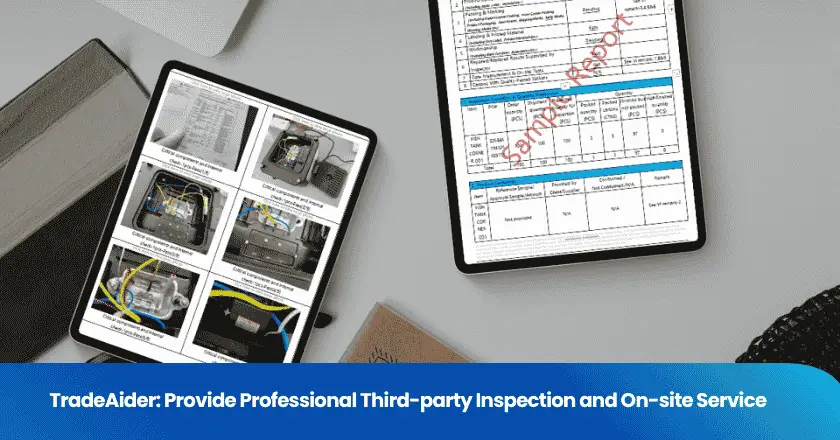
Third-party inspection is an independent quality check, commissioned by the buyer but performed by a neutral outside party, that verifies a product against agreed specifications before it ships. It exists because a factory checking its own work has no incentive to report problems that could delay a shipment or cost it the order.
What Is a Third-Party Inspection Service?
A third-party inspection service is an independent check on product quality, carried out by a company with no financial stake in either the buyer's purchase decision or the supplier's sale. The inspector works from the buyer's own reference points — the purchase contract, the agreed sample, the relevant national or international standard (such as an AQL sampling plan under ISO 2859-1) — and reports findings back to the buyer, not the factory.
This independence is the entire point. A factory's own internal QC team is judged, in part, on how many shipments go out the door on time. That creates a built-in incentive to under-report defects. A buyer's own staff, if not physically present in the country of manufacture, usually can't verify a shipment before it's already loaded. Third-party inspection sits outside both of those pressures: the inspector is paid to report accurately, not to keep the shipment moving.
Third-party inspection activity concentrates most heavily in industrial manufacturing and consumer goods manufacturing, where a single production run can span thousands of units and defects that go undetected at the factory become expensive returns, chargebacks, or safety incidents once the product reaches the end customer.
Why Buyers Actually Use Third-Party Inspection
Exporters and manufacturers. Every shipment ties up capital before it generates revenue. If goods reach the destination country and fail to meet the importing country's standards — a common outcome when a factory hasn't kept up with a market's current labeling, safety, or testing requirements — the exporter absorbs the cost of the shipment, the return freight, and often the customer relationship. An inspection against the destination market's actual requirements, done before the goods leave the factory, catches this while it's still cheap to fix.
Retailers and e-commerce sellers. For a retailer, the cost of a defect discovered on the shelf or in a customer's hands is far higher than the same defect caught at the factory — it shows up as returns, negative reviews, and chargebacks rather than a line item on an inspection report. Buyers selling on marketplaces with strict return-rate thresholds have an additional reason to inspect before shipment: a bad batch can affect account standing, not just one order.
Brand owners. For a company building a brand, a defective batch doesn't just cost the price of the goods — it costs the trust that took years of marketing spend to build. Buyers with an ongoing brand to protect tend to treat inspection as a standing part of every production run, not a one-off check used only when something already feels wrong.
Factories running assembly-line production. Inspection isn't only useful to the buyer. A factory running continuous production benefits from checks at defined points in the line — catching a problem when 10% of a run is done costs far less to fix than catching it after 100% is finished and packed.
Where Third-Party Inspection Fits in the Production Timeline
Rather than a single inspection at the end, third-party inspection is normally staged across the production cycle, with each stage designed to catch a different category of risk:
| Stage | What it checks | Why timing matters |
|---|---|---|
| Pre-Production Inspection (PPI) | Raw materials, components, and trims match the approved spec before mass production starts | Wrong material caught here costs nothing to fix; caught after production, it means reworking or scrapping the entire batch |
| During Production Inspection (DPI/DUPRO) | A sample from an in-progress run, typically once 20–30% of units are complete | Catches process drift — sizing, stitching, assembly errors — early enough to correct the remaining production |
| Pre-Shipment Inspection (PSI/FRI) | Finished goods, sampled against an AQL standard, before the shipment leaves the factory | The last checkpoint before the buyer's money and the goods change hands — this is the report most buyers rely on to release payment |
| Factory Audit | The factory's capability, equipment, and compliance standing, independent of any single order | Confirms a new or unfamiliar factory can actually deliver at the volume and quality level the buyer needs, before committing to a production run |
| Container Loading Supervision (CLS) | Correct SKUs, quantities, and packing method as the container is loaded | Confirms what was inspected is actually what ships — mismatches at loading are common and otherwise go unnoticed until arrival |
What Changes With Third-Party Inspection vs. No Independent Check
| No inspection | Factory's own QC only | Third-party inspection | |
|---|---|---|---|
| Who reports the findings | No one — buyer sees only what arrives | The factory, to itself | An independent party, to the buyer |
| Incentive to flag defects | N/A | Low — delays the factory's own shipment | High — inspector's reputation depends on accuracy |
| When problems are usually discovered | After arrival, on the shelf, or from customers | Rarely surfaced before shipment | Before the goods leave the factory |
| Documentation for disputes | None | Factory's own record, often unavailable to buyer | Independent report with photos and sampling data — see inspection reports as dispute evidence |
Who TradeAider Is and How TradeAider Runs On-Site Inspection
Everything above describes third-party inspection as a category. This section is about what TradeAider specifically does with it.
On-site inspectors, not remote reviewers. TradeAider's inspection reports are built on physical, on-site checks — an inspector present at the factory, not a review of photos the factory itself has selected and sent. This distinction matters more than it sounds: a factory choosing which units to photograph for a remote review has an obvious incentive to show its best work, which is exactly the incentive problem third-party inspection exists to remove in the first place.
Coverage across the full production lifecycle, not just one checkpoint. TradeAider runs Pre-Production Inspection, During Production Inspection, Pre-Shipment Inspection, Factory Audits, and Container Loading Supervision as a connected service line, so a buyer can book a single checkpoint or run all five as a standing program tied to a factory relationship — rather than piecing together different vendors for different stages.
Product testing alongside visual inspection. Some defects — fabric composition, colorfastness, mechanical or electrical safety, material toxicity — aren't visible to an inspector's eye and need lab-based testing. TradeAider runs this alongside on-site inspection across four category lines: hardline products (toys, furniture, sports and outdoor goods), softline products (apparel, textiles, luggage), electrical and electronic products, and industrial products.
A dedicated line for marketplace sellers. Buyers selling through Amazon and similar marketplaces face a specific version of the inspection problem — return-rate thresholds and account-health metrics that a single bad batch can put at risk. TradeAider's Amazon FBA Inspection Solutions are built around that use case specifically, rather than treating marketplace sellers the same as traditional wholesale importers.
Reporting a buyer can actually verify while it's happening. Standard inspections produce a dated official report with photo evidence and sampling data once the check is complete. For buyers who want visibility during the inspection itself, TradeAider also offers online real-time reports that update as the inspector works the floor — useful when a buyer wants to make a shipment decision the same day the inspection happens, rather than waiting for a finished document.
Standards a buyer can check in advance, not after booking. TradeAider publishes its own Quality Inspection Standard and Factory Audit Standard, and offers a free AQL Calculator and inspection charge calculator — so a buyer can work out sampling levels and expected cost against an order quantity before committing to a booking, rather than requesting a quote and waiting.
Booking runs through TradeAider's own service system. Rather than coordinating inspections by email back-and-forth, buyers book, pay, and receive reports through TradeAider's web app — the same platform covers scheduling an inspector, tracking a booking's status, and downloading the finished report once the check is done.
Total quality control for buyers who want less to manage themselves. For buyers who'd rather hand off the whole quality-management relationship with a factory instead of booking each checkpoint individually, TradeAider's WeGuarantee Total Quality Control service (TQC/TQM) bundles ongoing inspection and factory oversight into a single managed relationship. TradeAider also runs training and certification services for buyers who want their own internal QC staff brought up to the same standard TradeAider's inspectors work to.
Frequently Asked Questions
Does third-party inspection replace the factory's own quality control?
No — it works alongside it. The factory's QC team catches obvious defects during production; third-party inspection provides an independent check the buyer can actually trust, since the inspector has no stake in the factory's output.
At what stage should a first-time buyer start using inspection?
Most buyers new to a factory relationship start with a factory audit to confirm the supplier's capability, then add a pre-shipment inspection on the first few orders. Buyers with tighter tolerances or higher-risk products (electronics, apparel with sizing requirements, anything with a safety component) typically add a during-production inspection as well.
How is the sampling level for a pre-shipment inspection decided?
Sampling is normally based on an AQL (Acceptable Quality Limit) standard under ISO 2859-1, which sets the sample size and defect tolerance based on the total order quantity. TradeAider's AQL calculator can be used to check the sample size and defect thresholds for a given order before booking an inspection.
What happens if a shipment fails inspection?
The buyer receives a report detailing the specific defects found, categorized by severity (critical, major, minor), with photo evidence. This becomes the basis for negotiating a fix, a partial rework, a price adjustment, or a rejection of the shipment — decisions the buyer makes, not the inspector.
Does TradeAider only inspect one type of product?
No. TradeAider covers four category lines — hardline, softline, electrical and electronic, and industrial products — with inspection checklists and testing standards specific to each, rather than applying one generic checklist across unrelated product types.
Can I see what a TradeAider report actually looks like before booking?
Yes — TradeAider publishes sample official reports and sample real-time online reports so buyers can review the report format and level of detail before scheduling an inspection.
Do I need a different provider for lab testing versus on-site inspection?
No. TradeAider runs both under one relationship — on-site visual and functional inspection, plus lab-based product testing for materials, safety, and compliance requirements that a visual check alone can't confirm.
Working With TradeAider
TradeAider provides on-site third-party inspection — pre-production, during-production, pre-shipment inspection, factory audits, and container loading supervision — across hardline, softline, electrical, and industrial product categories, backed by lab-based product testing where visual inspection alone isn't enough.
Two ways to start:
- Use the inspection service charge calculator or AQL calculator to check sampling levels and expected cost against your order before booking.
- Contact TradeAider's team or book directly through TradeAider's service system to schedule an inspector for your next production run.
Related Articles
Grow your business with TradeAider Service
Click the button below to directly enter the TradeAider Service System. The simple steps from booking and payment to receiving reports are easy to operate.

