
A trampoline order should be reviewed as a complete assembled kit. A passing frame result does not clear the padding or enclosure, and a report for the base product does not automatically cover an added tent, hoop or changed suspension. Buyers need to know that the actual components work together and that the evidence matches the configuration being sold.
Trampoline quality inspection should cover frame assembly, mat response, spring coverage, enclosure gaps, accessory straps and warnings. For home-use products, many important findings occur at interfaces: a pad moves away from a spring, the lower net attachment opens, or a strap is used in the wrong location. The checks below connect those observations with inspection scope and supplier correction, without treating a brief assembly check as complete structural or safety qualification.
Establish What the Complete Retail Kit Includes
Define one complete retail kit from the approved parts list and every carton needed to assemble it. Include the frame, mat, suspension, padding, net, poles, entrance closure, tools and listed accessories. An assembled display unit cannot establish whether the delivered cartons contain that same compatible set.
Keep components from different sizes or versions separate. Similar-looking springs, frame tubes and nets are not necessarily interchangeable. Record the actual part references and assembly sequence, including any adjustments the instructions permit. If the supplier replaces a component during assembly, identify the original mismatch before continuing with the corrected kit.
NEN's current EN 71-14:2025 scope covers toy trampolines for domestic use, their access devices and enclosures, for one person at a time. It excludes several categories, including trampolines with additional features such as tents or a basketball hoop. An accessory-equipped package therefore needs an applicability review; a standard number on the base model is not enough to establish coverage of the complete package.
Identify whether the product is a domestic recreational trampoline, a fitness model or equipment for another setting. Confirm the relevant destination requirements and report scope with the technical reviewer. The inspection plan should describe the actual construction, not simply repeat whichever standard appears on a supplier's older report.
Six Results to Require for the Assembled Trampoline
Use the six checks to agree scope for the complete version. The drawings, instructions and applicable test plan must define sample quantities, methods and criteria. Identify checks requiring more space, equipment or time than the visit can provide, so a useful visual finding is not mistaken for an unperformed performance result.
CheckInspection actionJudgment referenceFrame assemblyAssemble the retail kit; inspect joints, legs, supports and fasteners.Correct parts, engagement, geometry and specified structural performance.Mat tensionCheck attachment positions and measure the specified response under controlled loading.Approved mat and suspension specification, deformation and damage limits.Spring coverageInspect pad position and retention through the required test sequence.Specified coverage of springs, hooks and frame; no unacceptable displacement.Enclosure gapsCheck mesh, seams, lower attachments, poles and the closed entrance.Applicable opening, attachment and performance requirements.Accessory strapsConfirm purpose, routing, attachment and free ends for each strap.The approved configuration and relevant retention or entanglement assessment.WarningsCompare product marks, instructions and packaging with the supplied model.Destination requirements, approved use restrictions and readable production identification.
Keep a record of any check that cannot be performed with the available equipment or space. A visual assessment is still useful, but its result should not be described as a completed load, impact or enclosure test. Arrange the missing assessment with a suitably equipped facility rather than improvising a passing result.
Check the Supplied Frame Before Accepting the Finished Assembly
The frame finding should describe joint engagement, orientation, legs, braces, welds and fasteners before padding or sleeves hide them. Look for evidence tied to the actual production assembly, with any technician's correction recorded separately. A finished-looking trampoline does not resolve a connection that required undocumented rework.
Assemble on the support surface required by the method. Check that the legs contact it as intended and that rocking is not caused by an uneven floor. Compare the frame's shape and dimensions with the drawing. A distorted ring can affect spring spacing and pad fit even when each individual tube looks acceptable.
Where the plan requires structural loading, record the configuration, supports, loading position and sequence. Inspect joints and welds afterward, including locations previously hidden by coverings. Do not retighten a loose connection before recording its condition. An approved assembly adjustment and a repair after testing are different events and should remain distinguishable.
ASTM's public description of ASTM F381-24 addresses consumer-trampoline components, assembly, use and labeling. Its scope is limited by bed size, height and intended use, including home use by a single user; it does not apply to institutional trampolines or those intended for use on water. Check those limits against the ordered model before relying on a report. A frame inspection alone does not establish completion of the standard's other assessments.
Confirm Mat and Suspension Compatibility Before Judging Tension
Mat tension depends first on the correct mat, suspension parts and installed arrangement. The jumping surface must match the frame and the specified attachments; a similar diameter alone does not establish compatibility. Once the construction is confirmed, interpret measured response under the prescribed loading conditions rather than a subjective bounce impression.
Missing attachment positions, twisted suspension parts or unequal installation can change local loading. The report should identify such assembly differences before interpreting a tension or deflection result. Preserve the supplier's correction separately from the original packed-product finding.
For a mat-response result, require the reference points, load application area and position, duration and conditioning. Deflection means movement under load. A light center push cannot establish behavior near an edge or under a different load; compare the result with the actual method's criterion.
Examine the mat and its attachments again after the prescribed sequence. Look for torn stitching, elongated attachment points, released hooks, local distortion and contact with parts underneath. A mat that returns close to its original height can still have a damaged seam or attachment. Record those findings separately from the dimensional reading.
Do not use children as inspection test jumpers or rely on an adult's subjective opinion that the bounce feels right. Use the required apparatus and controlled procedure. A short functional observation cannot establish fatigue life, and the inspection report should distinguish a measured result from an informal movement check.
Padding Must Stay in Its Protective Position
A protective pad needs the specified coverage in its installed position and after the required movement or loading. Initial width alone does not establish that it remains over springs, hooks and frame areas. Identify the displaced location and attachment condition before the pad is put back, so the supplier can address the actual retention problem.
Confirm the specified attachment points and orientation. Look for reversed sections, missing ties, weak stitching, loose fasteners and parts that pull the pad away from the intended position. Do not add improvised ties to hide a fit problem. Inspect the underside where accessible; an apparently tidy top surface may conceal a missed attachment.
Spring padding and the enclosure's lower attachment need separate checks. On a design with the net attached at the mat edge, a pad can cover the spring region while the net-to-mat connection remains open. Conversely, a securely attached net does not establish that the pad stays over the springs. Identify both connections, then assess each under the actual product's required test conditions.
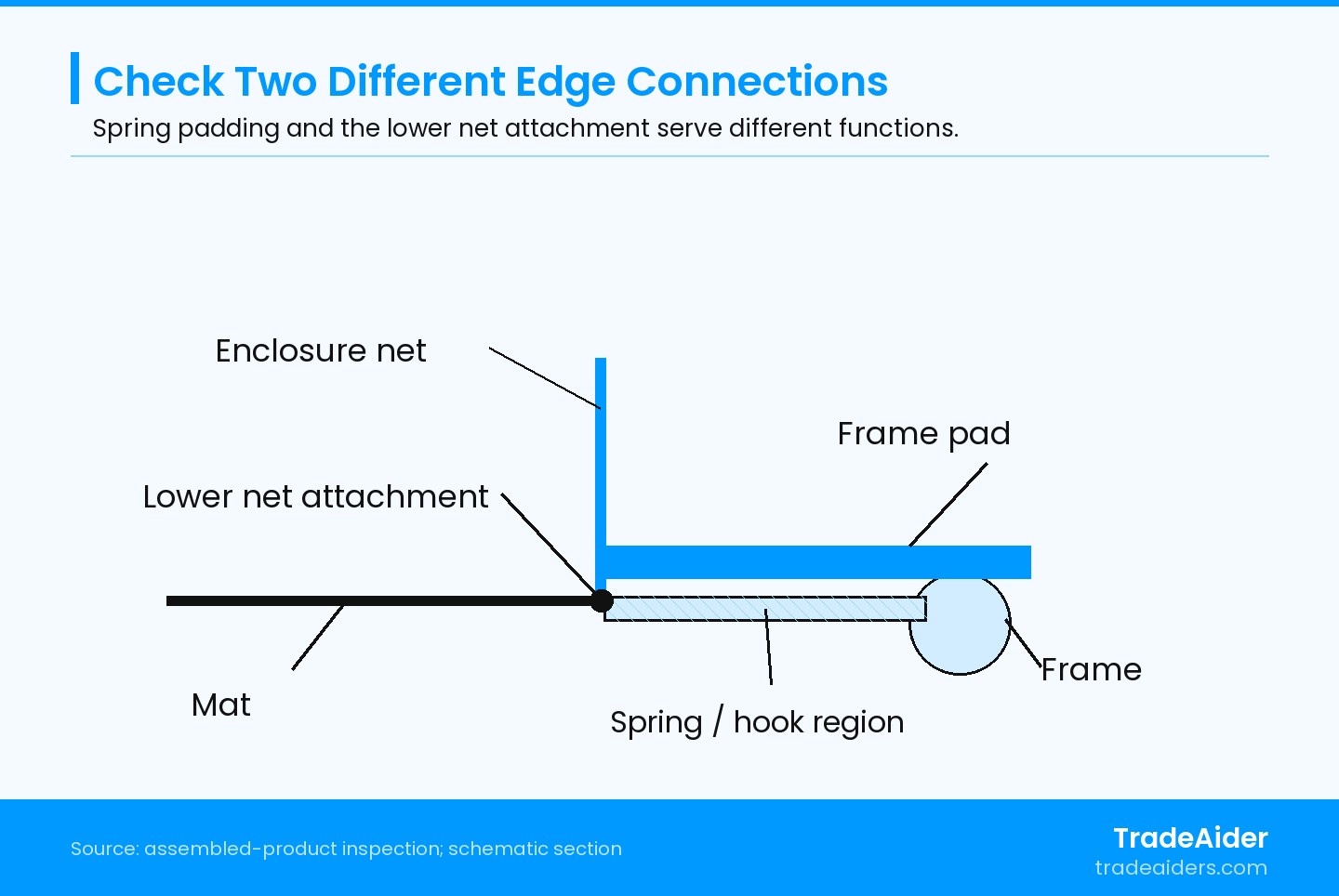
Schematic section of one spring trampoline with an inner net attached at the mat edge. The spring region is simplified; construction varies. Check pad coverage and the lower net attachment separately using the actual model and prescribed methods. No gap or load limit is shown.
Repeat the coverage check after the specified loading and movement sequence. Record exposed areas and the pad's displaced position before restoring it. Photographs taken only after the inspector pulls the pad back into place can miss the condition that caused the concern.
Keep physical coverage separate from cushioning performance and outdoor durability. Confirm the pad construction and relevant reports against the supplied materials. A thick-looking foam section is not a measured impact result, and an intact new cover does not demonstrate resistance to prolonged sunlight or weather exposure.
Assess the Entrance and Lower Attachment as Part of the Enclosure
Review the enclosure as a complete installed system: entrance, mesh, seams, poles, connectors and lower attachment. A closed entrance is only one result. The lower edge may still have missed attachments or gaps, and a visually neat net does not establish its required retention or impact performance.
Follow the full attachment path around the mat or other specified mounting feature. Look for missed positions, loose lacing, damaged clips, open seams and gaps concealed by a pad overlap. Use the appropriate probes and procedure where opening or entrapment assessments apply. Do not invent a universal gap limit or substitute an inspector's hand for a prescribed probe.
Operate the entrance using the supplied closure system. Check the complete zipper travel or other closing action, secondary fasteners where fitted, and the nearby seams. Repeat relevant checks after the required test sequence. A closure that works before loading may be affected by net tension, misalignment or damage afterward.
ASTM F2225-24 addresses consumer-trampoline enclosures, including their components, assembly, use, labeling and performance. Its scope also limits the trampoline configurations to which it applies. The standard explicitly cautions that an enclosure alone does not necessarily prevent all injuries. Treat enclosure evidence as part of the product assessment, rather than a reason to ignore mat, padding or frame findings.
Retention and impact results should identify the required fixture, loading position and specimen sequence, with the attachment and entrance conditions before and after. A hand pull cannot establish a numerical requirement. Where proper testing is unavailable, keep that evaluation outstanding rather than clear the enclosure on appearance.
Different Straps Do Not Provide Interchangeable Protection
A pad tie, enclosure connector, accessory fixing and ground-anchor strap serve different purposes. Match each to its approved location and role before accepting it. Supplying one type does not establish the function of another, and an included anchor kit is not by itself evidence of wind resistance.
Install straps in the approved configuration and inspect them from the user side as well as underneath. Look for unexpected loops, long loose ends, buckles within reach, routing across moving parts and contact with sharp edges. Assess potential entanglement or entrapment using the applicable requirements; cutting off a free end during inspection changes the supplied product.
The failed part in a strap assembly matters: webbing, buckle, seam, mounting hole and adjoining fabric can fail differently. Request the material, loading direction and observed failure location. An intact strap does not clear a torn pad eyelet or damaged connection around it.
Inspect the complete configuration when a tent, hoop or another accessory is included. Check whether it obstructs the entrance, affects enclosure tension, creates reachable loops or changes the assembly sequence. Request the appropriate technical assessment for that package. The accessory's presence is not resolved simply by adding it to the carton count.
Warnings and Identification: Match the Supplied Configuration
Warnings, user limits, age guidance and assembly information should describe the version in the cartons. Check whether the illustrated entrance closure, accessory and attachment arrangement match the product. Legible labels are necessary information, but cannot correct missing hardware or unsupported performance claims.
Health Canada's backyard-trampoline guidance advises active adult supervision, one jumper at a time and no use by children under six years of age. It also recommends complete shock-absorbing coverage of springs, hooks and frame on spring trampolines. These are consumer safety recommendations in that guidance, not a substitute for the product's destination-specific marking requirements or prescribed tests.
For U.S. children's products, 15 U.S.C. 2063(a)(5)(A) requires permanent distinguishing marks on the product and packaging, to the extent practicable. The required information enables specified production and source identification, including production location and date and batch or other cohort information. Check that the marks are legible and traceable to the production records. A retail size description alone does not identify the manufacturing batch.
Verify the actual language and placement against approved artwork and applicable requirements. Check that labels remain readable in the assembled configuration rather than hidden under padding or a sleeve. A warning does not correct an exposed spring, a released attachment or a net gap that fails the relevant assessment.
Hypothetical Example: Padding Moves During the Load Sequence
Suppose a production trampoline looks complete after assembly: the frame joints are seated, the net entrance closes and the pad covers the springs. During the agreed loading sequence, one pad section shifts away from the edge. The inspector records an exposed hook before repositioning anything and finds that its retaining strap was routed through a neighboring feature rather than the attachment shown in the instructions.
In this hypothetical example, correct the routing or the production instruction that allowed the mismatch, then repeat the relevant retention and coverage checks under the same prescribed conditions. Check adjacent attachments and the net's lower edge as well. A photograph of the restored pad proves only its restored position; it does not establish that the correction will keep it there during the required sequence.
Prepare the Inspection Around the Assembled Product
- Supply one consistent product definition: drawings, parts list, approved sample, instructions, artwork and relevant reports should describe the same size and accessory configuration.
- Agree the tests before the visit: identify equipment, loading conditions, specimen allocation and acceptance criteria, including observations required after testing.
- Preserve the actual finding: record a displaced pad, released strap or open attachment before adjustment, then verify the correction with the relevant method.
TradeAider's inspection standard explains sampling and customer-specific checks. Use that discussion to define the assembled-trampoline observations and report requirements for the visit.
For pre-shipment inspection, the order quantity is 100% complete and at least 80% packed for export. Provide the complete kit information and test plan so finished goods can be compared with the approved configuration.
Agree the available assembly space, equipment and reporting before the visit. Request findings tied to identifiable units and test stages, with specialist performance or material assessments arranged separately where required. Contact TradeAider to agree the inspection scope.
Frequently Asked Questions
How should a spring-free trampoline be inspected?
Use the suspension and edge-protection method appropriate to that construction. Spring-specific hardware checks do not apply automatically to flexible rods, bands or another system. Inspect the actual attachments, protective components and required performance instead. A change in suspension type also affects whether an existing report covers the supplied model; the absence of coil springs is not evidence that every edge hazard has been eliminated.
Can a replacement mat be accepted by diameter alone?
No. Check attachment count, spacing, construction and compatibility with the frame and suspension parts as well as dimensions. A similar diameter does not establish the assembled tension or required performance. Assess the complete replacement configuration under the relevant method, rather than extending an original report solely because the replacement fits inside the frame.
Does a supplied ground-anchor kit prove wind resistance?
No. Its presence confirms only that the listed parts were supplied. Check compatibility, installation instructions and any claimed performance separately. Ground conditions, installation and the assembled configuration can affect an anchoring result. Do not treat a pad tie or enclosure strap as a ground anchor, or extend a result to unassessed wind and installation conditions.
Do new pads and netting demonstrate outdoor service life?
No. Initial appearance does not establish performance after prolonged sunlight, moisture or temperature exposure. Check the supplied material version against the relevant durability evidence and maintenance instructions. If a material or supplier changes, have the technical reviewer assess the report's continued applicability. Keep a short factory inspection distinct from a demonstrated outdoor-life claim.
Related Articles

Grow your business with TradeAider Service
Click the button below to directly enter the TradeAider Service System. The simple steps from booking and payment to receiving reports are easy to operate.

