
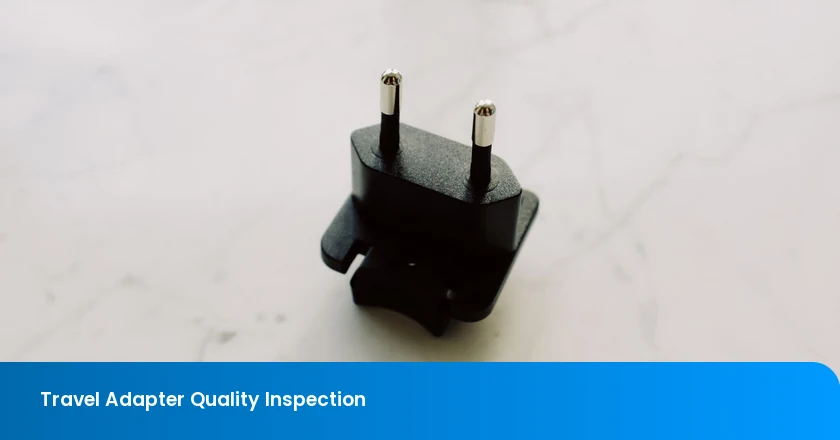
A travel adapter order should be inspected against its advertised combinations: the appliance plugs it accepts, the destination sockets it fits and the USB outputs it promises. Those claims are not interchangeable. A phone can charge while a mains interface fits poorly, and the presence of a three-pin opening does not establish an effective earth connection.
Travel adapter quality inspection therefore needs results by configuration, alongside product-matched safety evidence and the actual retail contents. The checks below help buyers specify plug fit, shutters, grounding, USB performance, markings and accessories. Agree specialist electrical evaluations separately; routine finished-goods inspection cannot substantiate every safety or charging-protocol claim.
Specify the Configurations the Order Actually Promises
Create the inspection scope from the exact model, pin mechanism, USB version and retail head assortment. Supply the compatibility list, approved construction, packing list and procedures. Ask for findings by sample and configuration so one faulty head or socket opening is not hidden by a general functional pass.
- Plug fit: Check both the destination-side pins and appliance-side socket using matching reference fittings or gauges. Include the pin selectors, locks and detachable heads supplied with that model.
- Safety shutters: Check correct opening and closure, then arrange the specified access-probe assessment. A visible plastic flap does not establish protection.
- Grounding path: For configurations intended for earthed appliances, measure the required protective connection through the complete assembled adapter.
- USB output: Measure the promised outputs with suitable loads, cables and protocol tools. Include the specified simultaneous-use combinations.
- Markings: Match AC ratings, USB ratings, restrictions, model identity and instructions to the supplied construction and destination market.
- Accessory count: Count each head, spare part and included item against the approved packing list, checking identity as well as quantity.
Disconnect the adapter from mains power and all appliances before mechanical, shutter or continuity work. Energized USB and load tests require qualified personnel, a guarded setup and suitable equipment. Agree numerical criteria and any destructive sample allocation before the visit; routine inspection is not an invitation to improvise mains-voltage safety tests.
Define Compatibility Before Selecting a Test
Build a configuration list with the accepted appliance plug, the selected destination plug and any restrictions for that pairing. Country names alone are insufficient where different socket systems or appliance requirements are involved. For a sliding-pin adapter, identify every permitted selector position; for a modular kit, identify every detachable head and its mating base.
The public scope of IEC 60884-2-5:2017 includes travel adapters in Annex AA, within its stated voltage and current scope. It excludes travel adapters allowing simultaneous connection of two or more plugs. This is an important applicability boundary: a report naming that edition does not automatically cover every multi-socket travel product. Confirm the actual product category, adopted edition and national requirements with the responsible safety specialist.
Keep AC compatibility and USB compatibility in separate columns of the product specification. A broad mains input range for an internal USB charger does not establish suitability of every connected appliance. Likewise, a plug head included in the box does not prove that the completed adapter supports every appliance plug advertised on the carton.
Verify Both Plug Interfaces and Their Retention
Require evidence for both destination-side seating and appliance-side acceptance using the prescribed reference fittings or gauges. The report should distinguish incomplete seating, loose retention and a locking defect. Mechanical examinations use disconnected samples; a successful fit at only one interface does not establish the claimed combination.
A 2023 UK product safety report on an international travel adapter identified pins too close to the plug edge and the possibility of inserting a single current-carrying pin while leaving the other accessible. The import was rejected at the border. This product-specific finding shows why a normal insertion demonstration cannot replace the relevant dimensional and accessibility assessments.
For sliding-pin designs, require results for every permitted selector position and the relevant lock. A retracted pin, missed latch or unintended combination needs its own finding. The agreed cycle method is needed for a durability result; a few hand operations only demonstrate those operations.
For detachable heads, check alignment, engagement and retention on the actual base. A head that looks correct can have a different latch or contact arrangement. Where insertion or withdrawal force is specified, record the measured result, fixture and configuration. Keep a separate record for each claimed interface instead of treating the easiest-fitting plug as representative of the entire range.
A Working Flap Is Not Proof of Contact Protection
Safety shutters are barriers intended to restrict access to socket contacts without a mating plug. Ask for normal operation and closure findings, followed by the applicable probe and accessibility assessment where required. A photograph of a flap or its movement cannot establish that hazardous contacts are inaccessible.
The UK recall notice for a black UK-to-EU travel adapter identifies inadequate shutters and a poor earth connection as electric-shock hazards. It concerns that particular product, not a finding that all adapters of this shape are unsafe. The inspection lesson is to assess these protections independently of ordinary power delivery.
For a multi-pattern socket, confirm that the assessment covers each claimed plug opening and its condition after the specified mating sequence. Where probe testing is required, qualified personnel must use the specified probes and forces on disconnected samples. Paperclips or energized demonstrations are neither safe nor valid substitutes.
If the design uses a pin to operate its shutter, assess that mechanism against the approved construction. Do not infer an electrical earth connection from the presence of a shutter-operating pin. Its mechanical function and the product's protective connection are separate questions.
Does Each Claimed Earthed Configuration Provide the Required Path?
Protective earth is the required path intended to carry fault current in an earthed design. For each claimed earthed configuration, require the specified resistance result through the complete appliance-side contact, body and selected head to the destination contact. A three-pin appearance or a test on a loose head alone does not demonstrate that assembled path.
Electrical Safety First's travel-adapter guidance explains that some adapters are unsuitable for appliances requiring an earth connection and should only be used with double-insulated equipment. Double-insulated equipment is also called Class II and carries a symbol showing one square inside another. Check the adapter's supported application and restrictions, not just whether an appliance plug can enter its socket.
Check that the report covers each grounded head on its actual base, including their junction, and any required before-and-after mechanical sequence. An intermittent result after stress needs investigation even if the untouched assembly initially passed.
Record the configuration, contact points, measured resistance and applicable method. A continuity buzzer indicates only that its own threshold was met; it does not establish compliance with a different protective-connection test. Keep neutral separate from earth in the approved circuit assessment. For a product restricted to non-earthed applications, assess its compatibility and warnings rather than inventing a missing earth conductor as the defect.
Read USB Ratings as Single-Port and Combined Claims
USB inspection should establish the output available at each port and under the promised simultaneous-use conditions. Identify whether the model has USB-A, USB-C or both, its voltage and current ratings, supported charging functions and any shared output limit. A phone charging icon does not show the actual voltage, current or negotiated capability.
In an ordinary travel adapter with an integrated USB charger, the AC socket connection and USB power supply perform different jobs. The socket path adapts the physical connection without converting the mains voltage, while the USB supply converts AC power to its specified DC outputs. A working USB port therefore does not establish that the AC socket is suitable for an appliance's input voltage. Check both functions against their own ratings and safety evaluations.
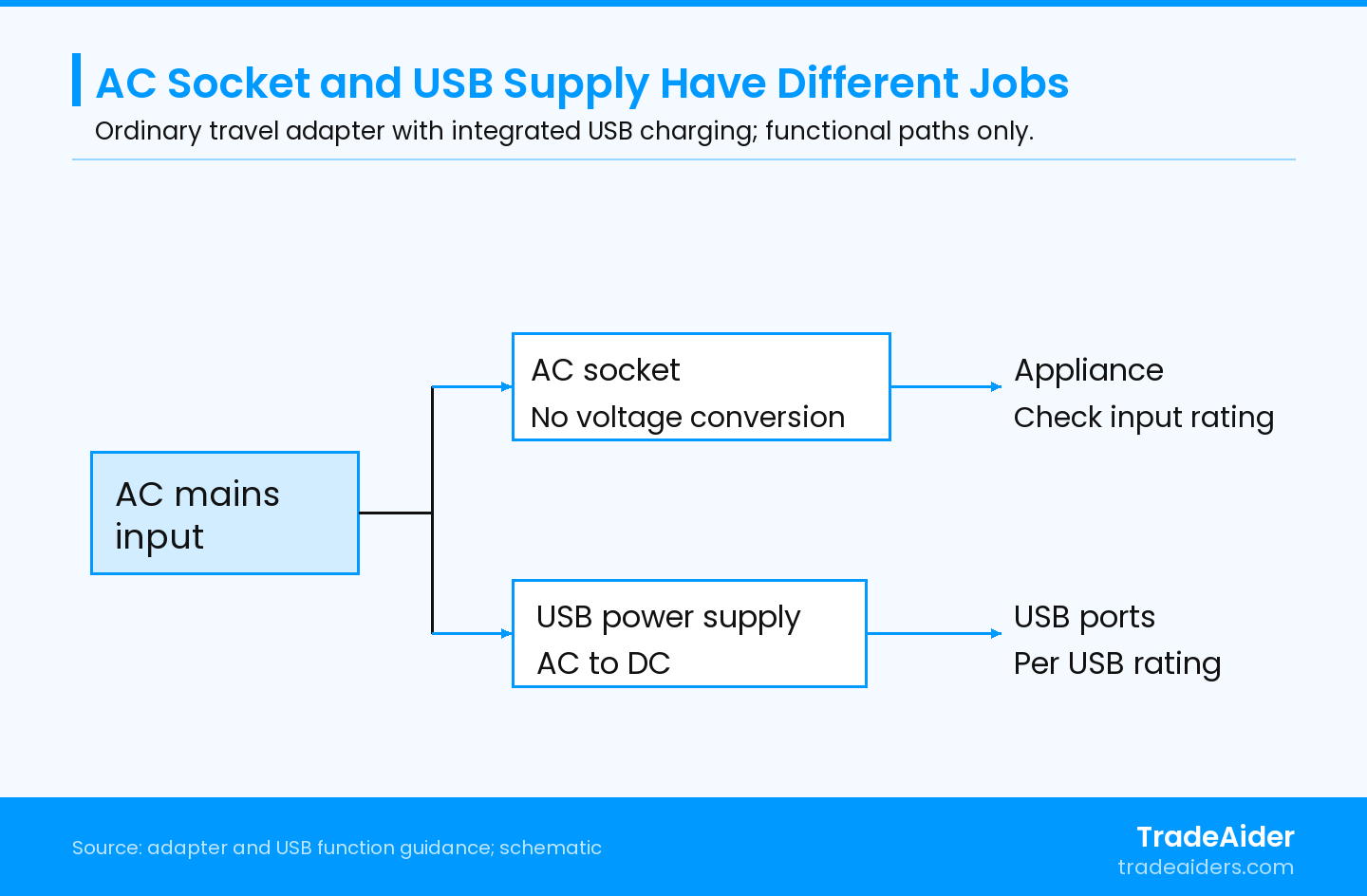
Functional schematic for an ordinary travel adapter with USB charging, not a wiring diagram. The AC socket does not convert mains voltage; the USB supply provides its specified DC output. Grounding and safety barriers are not depicted or verified by this drawing.
For example, the manufacturer datasheet for the SKROSS Europe to USA USB adapter lists two USB-A outputs at 5.0 V DC with a maximum 2.4 A shared. That is a combined limit for those ports, not a promise of 2.4 A at each port simultaneously. These figures describe this model only.
Compare Results at the Promised Load Combinations
For USB output evidence, require the input supply, active port combination, load, cables, measurement location and duration. Cable losses can change a load-end reading, so preserve the measurement convention when comparing reports. Simultaneous AC and USB operation belongs in the plan only where the model supports and specifies it.
For shared outputs, test the required load splits rather than assuming every port can deliver its individual maximum at once. Observe what happens when another device is connected or removed, including any interruption or redistribution permitted by the specification. Compare the measured behavior with the product's actual claims; an allowed redistribution is different from a voltage falling outside its required range.
Keep Protocol Checks Separate from Basic Output Measurements
USB Power Delivery, or USB PD, lets compatible equipment negotiate supported power delivery. The USB-IF testing resources distinguish protocol and power-supply compliance testing and provide shared-capacity testing resources. A USB-C connector's shape alone does not establish USB PD support. Use a suitable protocol analyzer or trigger and load for the advertised profiles; a basic meter cannot prove full protocol compliance.
Inspect damaged ports, unstable connections, unexpected resets and abnormal heating during the agreed functional tests. Treat insulation, temperature-rise, overload and other electrical safety evaluations as separate specialist work under the applicable methods. Do not short contacts or bypass protection to create an informal pass/fail demonstration on the inspection table.
Markings: Separate Mains Ratings from Charging Ratings
Read the product label, packaging and instructions together. Check the model number, voltage and current ratings, relevant AC load limits, USB outputs, compatibility restrictions and required market markings. Look for conflicts between the actual pin arrangement and the country or plug diagrams printed on the box. A generic leaflet for another version can misstate both compatibility and output.
The same travel-adapter safety guidance explains that adapters do not convert voltage or frequency. Keep that distinction clear in claims for the AC socket. An integrated USB charger providing regulated DC does not make the mains socket a voltage converter. Confirm that warnings and supported appliance types agree with the supplied design.
If certified USB logos are claimed, check their authorization rather than accepting the printed symbol as proof. USB-IF's USB Charger information describes compliance testing, inclusion on its Integrators List and the trademark licensing requirement for certified USB logos. This is distinct from the adapter's mains electrical safety assessment; one claim cannot stand in for the other.
Check label legibility and durability using the agreed method, and match any safety report to the model and construction revision. Pay attention to changed plug heads, internal contacts, protective components or USB boards. A similar-looking housing does not establish that a report covers those substitutions. Refer uncertain applicability to the responsible specialist instead of changing the printed rating to match a convenient document.
Accessory Count: Verify Identity as Well as Quantity
Count the specific heads, cables, pouch, instructions and any required spares against the retail version. The total number of heads can be correct while a duplicate replaces the destination head ordered. Keep item identity with the quantity so the buyer can distinguish a pack correction from an incompatible component.
Verify that each supplied head belongs to the actual base and that included cables support the bundle's charging claim. Where a replaceable fuse and spare are specified, match type and rating as well as fit. A model without that feature should not acquire a spare-fuse requirement from a generic checklist.
Check that the instruction language, compatibility chart and storage arrangement match the retail version. At carton level, verify unit quantities, variants and item codes against the order. Keep the contents result separate from functional testing: a complete set can contain a defective head, while a functioning sample may still be packed with the wrong accessories.
Hypothetical Example: Single-Port Results Miss a Shared-Output Fault
Suppose an adapter's approved specification gives its USB outputs a shared limit, and the agreed plan includes a simultaneous-load condition within that limit. Each port meets the required voltage range when tested alone. Under the agreed combined load, however, one port's measured voltage falls below the specified minimum.
This hypothetical result fails that combined-load requirement even though both single-port tests passed. First confirm the loads, cables and measurement points, then preserve the result by port combination for supplier investigation. It does not identify the faulty component by itself. After correction, repeat the affected single-port and combined-load conditions rather than demonstrating a charging icon on a phone.
Turn the Results into a Clear Supplier Request
The finished report should make it clear which configuration failed, which claim lacks support and which check remains unperformed. Use the finding to define the next action:
- Fit, shutter or earth-path defect: Identify the exact interface, head and condition. Preserve the affected sample and agree the correction and relevant mechanical or electrical rechecks.
- USB discrepancy: Record the ports, input supply, load combination, cable and measured result. Compare it with the applicable single-port or shared-output requirement.
- Label or contents mismatch: Correct the actual version or packing error and verify the revised goods. Obtain a justified applicability assessment where supporting safety documentation does not match construction.
TradeAider's inspection standard describes sampling and customer-specific checks. Use that sampling approach to select units, with the adapter's agreed procedures providing the actual functional and safety-related criteria.
For pre-shipment inspection, the order quantity is 100% complete and at least 80% packed for export. Confirm the available personnel, fixtures and procedures before scheduling the electrical checks; identify specialist evaluations separately.
To agree the inspection scope, send TradeAider the adapter specifications and configuration list, approved sample, packing list, test methods and existing safety reports. Confirm the supported factory checks and reporting needs, including how each tested configuration will be identified.
Frequently Asked Questions
How should a failed sample affect other plug variants in the order?
Investigate the parts shared by those variants before deciding the recheck scope. A fault in a common base or USB board may concern several plug-head versions; a defect confined to one head may call for a narrower examination. Compare the part numbers, revisions and production records, then agree the affected variants and tests. Neither one failed configuration nor one passing alternative establishes the status of every version.
Can the wall adapter's safety report cover a separately supplied USB cable?
Only where the report's scope and bundle identification actually cover that cable and its intended use. Otherwise, verify the cable separately against the order's requirements. Its connector type alone does not establish its current capability or suitability for the promised charging mode. Keep the included cable's part identity and specification tied to the retail bundle, and use the defined cable during relevant performance checks.
Should every sample be opened to inspect internal contacts?
No. Agree construction-examination samples and any destructive checks in advance, using qualified personnel and the applicable method. External inspection and functional testing serve different purposes from opening an assembly. Identify altered samples and keep them separate from saleable stock unless an authorized process restores and verifies their condition. Preserve useful components and photographs when a defect requires investigation.
Can a fuse check replace overload and temperature testing?
No. Verifying the specified fuse and rating establishes only that aspect of the construction. It does not establish the thermal behavior of the complete adapter or its response under every required abnormal condition. Obtain the applicable finished-product evaluation and confirm its relevance to the supplied version. A protective component's presence cannot replace the test method needed to assess the assembly.
Related Articles

Grow your business with TradeAider Service
Click the button below to directly enter the TradeAider Service System. The simple steps from booking and payment to receiving reports are easy to operate.