
For a Great Britain-bound toy shipment, the useful China-side control is a route-to-lot handoff. It connects the chosen conformity route, declaration reference, approved warning artwork, toy identity, importer information, and carton range to selected finished goods. It does not perform the safety assessment, validate a laboratory method, certify conformity, or decide whether a toy may be placed on the market.
This distinction matters because a correct-looking mark on one retail pack cannot show that every carton carries the same approved warning, importer detail, or toy version. The buyer needs a record that makes the physical match—or a missing link—visible before export, while keeping the technical and regulatory decisions with their accountable owners.
Choose the GB Conformity Route Before You Freeze Toy Artwork
For toys supplied in Great Britain, businesses can use CE or UKCA marking under the applicable conformity conditions, and the route should be fixed before the importer freezes final artwork and packing. GOV.UK guidance on the Toys (Safety) Regulations 2011 in Great Britain explains the marking options and conditions.
Great Britain here means England, Scotland, and Wales. It is not the Northern Ireland route. CE marking is the European conformity marking that Great Britain continues to recognise for toys under the stated conditions. UKCA means UK Conformity Assessed, the UK marking route available for the GB market. Which one belongs on a particular pack depends on the actual product, conformity work, and intended market—not on a printer’s preference.
- Confirm that the product is within the toy scope and that the target is GB, not NI or the EU.
- Name the chosen CE or UKCA route on the controlled product record.
- Freeze the declaration reference, marking location, warning artwork, and importer information together.
- Record any later toy, pack, or route change before final packing mixes versions.
The UK’s July 2026 toy-safety call for evidence concerns possible future reforms and emerging risks. It is not a new conformity route for a current shipment. The OPSS call for evidence is useful context, but a release brief should be based on the rules and evidence that apply to the product now.
Build a Safety Assessment and Technical-File Index for the Shipped Toy
Before a toy is placed on the GB market, the manufacturer must ensure it meets essential safety requirements, carry out a safety assessment, follow the applicable conformity procedure, prepare the relevant declaration and technical documentation, and use the relevant marking. The current GOV.UK CE and UKCA guidance sets out that documentation and marking sequence.
For a buyer-controlled handoff, turn those materials into a version index rather than a loose folder of PDFs. One evidence line should name the toy model, SKU, age-grade or intended-use reference, chosen route, declaration reference, safety-assessment owner, technical-file reference, relevant standards reference where supplied, warning-artwork revision, marking location, manufacturer details, importer details, retail-pack version, supplier batch, and carton range. An index identifies what should be connected; it does not prove that any document is technically adequate.
A later pack revision can turn one toy into a different release question. If an age warning, language panel, importer address, marking placement, accessory, or product version changes, create a new controlled reference. Before production spreads an unresolved sample or artwork change, a Pre-Production Inspection service can record selected physical facts against the buyer’s approved references.
Match the Declaration to the Chosen CE or UKCA Route
For GB toys, the manufacturer draws up a UK declaration of conformity when using UKCA marking or an EU declaration of conformity when using CE marking; the declaration must correspond to the toy and chosen route. The GB toy guidance specifies that declaration distinction.
At the factory, do not ask an inspector to validate the declaration. Ask for the controlled reference, date, issuer, toy identity, and route stated in the buyer’s record. Then compare it with the selected toy and retail pack. If a pack displays a route that the buyer’s controlled file does not support, report a document-to-product mismatch and send it to the responsible technical or regulatory owner.
Record the Applicable Designated-Standards Reference, Not a Generic Test Claim
The UK maintains a current toy-safety designated-standards list in support of the Toys (Safety) Regulations 2011; the relevant reference must be determined for the actual toy and conformity route. The designated-standards list for toy safety was updated in February 2026.
A standard reference is not a generic “tested” badge. The technical owner needs to decide the applicable standard, version, product scope, and evidence. The final inspection brief can record the reference the buyer supplied and compare the physical toy, pack, or version cue with that record. When the decision needs a test method and result rather than a physical comparison, use appropriate product testing services and keep the issued report reference in the technical-file index.
Make Toy Identity, Importer Details, Warnings, and Carton Ranges Retrievable
GB toy traceability depends on identification information for the toy and economic operators, together with records that let the importer retrieve the relevant product or batch evidence. The Toys (Safety) Regulations 2011 provide the underlying legal framework.
Build the final check around retrieval, not visual resemblance. Give the inspector the model code, approved retail artwork, expected CE or UKCA marking location, manufacturer and importer details, age warning and instruction reference, supplier batch or production run, carton label, and carton-range plan. TradeAider can scope a physical comparison of those selected facts and report what was present, missing, or inconsistent. Safety assessment, standards scope, and legal market-placement decisions remain with their accountable owners.
| Evidence lane | Factory comparison | What it cannot determine | Accountable owner |
|---|---|---|---|
| GB route and declaration | Controlled route, declaration reference, model, and marking location | Whether the route or conformity procedure is correct | Manufacturer or regulatory owner |
| Technical evidence | Supplied standards or report reference matched to the index | Test method, scope, or safety-assessment conclusion | Technical owner and laboratory |
| Retail pack | Warning artwork, instructions, importer details, and pack revision | Whether consumer information is legally sufficient | Pack and regulatory owner |
| Shipment record | Carton label, carton range, supplier lot, packing state, and photos | GB market-release approval | Buyer release owner |
The comparison shows why the final report should use precise language. A selected pack may match the controlled file and still leave a separate technical or legal question. A missing route-to-carton link should become a hold for the named owner, not a passing conformity statement.
Check Warnings and Instructions Against the Final Retail Pack
Warnings and safety information for GB toys should be visible, legible, understandable, accurate, and in English where required; a final-pack check should preserve the exact approved artwork and warning version. GOV.UK product-safety advice for manufacturers and importers also highlights clear consumer risk information and traceability details.
Compare the actual warning panel, placement, language, age statement, instruction insert, manufacturer and importer details, and pack revision with the approved artwork. Photograph the selected version and connect it to a carton label or packing record. A translation, wording, age-grade, or importer-address question should go to the responsible owner; a factory check records what is on the pack, not whether that content completes the legal analysis.
Define What a Toy Pre-Shipment Inspection Can—and Cannot—Verify
A pre-shipment inspection can record selected toy, marking, warning, packaging, carton, and batch facts against a buyer-controlled pack, but it cannot carry out a safety assessment, validate a test method, or certify GB conformity. A PSI, or pre-shipment inspection, is a finished-goods check before export.
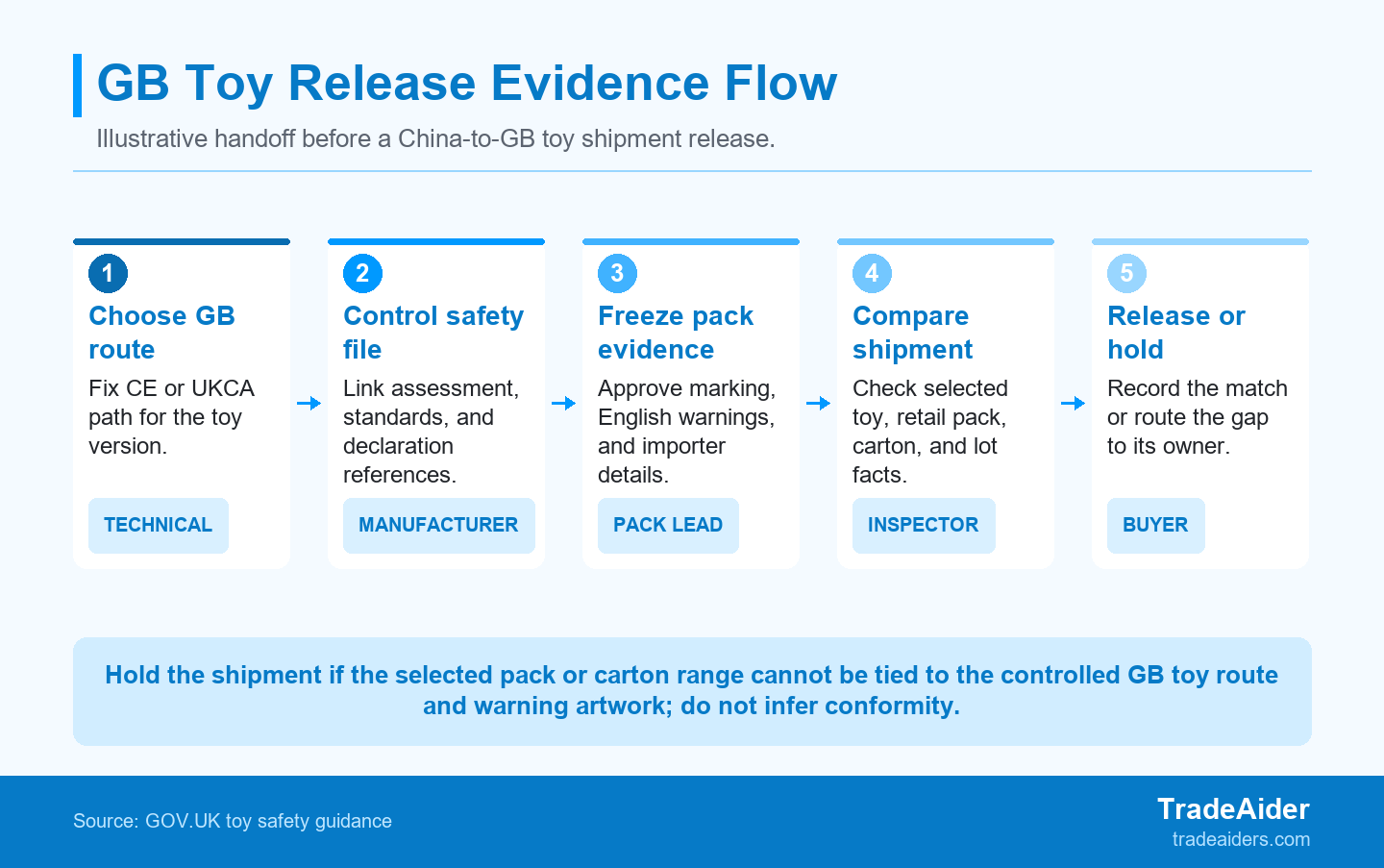
Use the flow to order GB toy evidence before a final shipment check; it is not a safety assessment or conformity decision.
TradeAider scopes a PSI when 100% of the order quantity is completed and at least 80% is packed for export. For GB toys, attach the route card, declaration reference, model or SKU list, marking and warning artwork, manufacturer and importer details, pack insert, sample basis, carton plan, supplier lot record, required photos, and escalation contact. The inspector should record the selected comparison and the affected range, not issue a safety or legal verdict.
Set the hold rule before sampling begins. Hold the identifiable carton range when a toy model, marking location, warning artwork, importer detail, instruction, or carton record does not match the controlled pack. If the factory cannot separate the affected version from the remaining cartons, expand the hold to the unseparated shipment. TradeAider’s Pre-Shipment Inspection service can document those selected physical findings against the agreed scope.
Illustrative Scenario: Mixed Warning Artwork Across an Export Lot
When two warning-artwork versions cannot be separated by carton range, a buyer should treat the mixed lot as a release hold rather than infer that one visible pack represents the entire shipment.
This composite uses a GB-bound activity toy. It shows a pack-to-carton evidence gap and a recheck path; it is not a client case, safety assessment, test result, conformity conclusion, or market-approval outcome.
Situation, Problem, Action, and Result
The illustrative scenario preserves a mixed-artwork evidence gap and recheck path without making a GB toy safety, conformity, or market-placement conclusion.
Situation. A private-label importer is preparing activity toys for Great Britain distribution.
Order context. One toy model is packed in two retail artwork variants across 240 export cartons, with one approved English warning panel and a controlled carton plan.
Readiness state. Finished goods are complete and export-packed for the buyer’s shipment-release decision.
Observation one. The inspector finds the approved warning panel on selected units from one carton range and retrieves the carton plan for that range.
Observation two. A second sample uses an earlier artwork panel with a different age-warning layout, while the factory cannot separate the mixed cartons by retail-pack version.
Problem. The inspector can preserve the selected pack, warning text, carton labels, and missing separation evidence. The inspector cannot decide whether the toy completed the required safety assessment or conforms with GB law.
Action. The buyer holds the full 240-carton shipment because the factory cannot establish a clean carton boundary for the earlier artwork variant.
The manufacturer supplies a controlled artwork decision, reworks or segregates the affected packs, and updates the carton plan before a targeted recheck.
Result. The recheck compares toy model, approved warning artwork, marking location, manufacturer and importer details, carton label, carton range, and supplier packing record. It produces a bounded physical evidence record only.
Illustrative only. This is not a client case, safety assessment, test result, CE or UKCA conformity conclusion, regulatory report, or market-approval outcome.
Brief a Toy-Focused Pre-Shipment Inspection
A useful UK toy inspection scope names the controlled toy version, marking route, pack artwork, warnings, identifiers, sample basis, carton plan, and hold conditions before the visit.
Attach the route card; declaration and technical-file references; model and SKU list; marking location; approved warning and instruction artwork; manufacturer and importer details; sample basis; supplier batch and carton plan; required photos; and the hold-and-escalation contact. Use inspection standard guidance to state observable acceptance points. For a China-side toy pack-to-carton comparison, request a UK toy pre-shipment inspection quote.
Who Is TradeAider?
TradeAider is a quality inspection, testing, and certification service provider in China, with coverage across Guangdong, Zhejiang, Jiangsu, Shandong, and Fujian. Its nationwide network of quality control specialists provides real-time reporting for scoped quality-control work.
Inspection & QA Services are offered at an all-inclusive rate of $199/man-day. TradeAider is an Amazon Service Provider Network (SPN) partner.
Frequently Asked Questions
The FAQ keeps GB marking, technical-file, warning, importer, and physical inspection decisions in separate accountable lanes.
Can I Use CE Marking for Toys Sold in Great Britain?
Yes, Great Britain continues to recognise CE-marked toys under the applicable conformity conditions, while UKCA marking also remains available for relevant GB toys. The correct choice depends on the product, conformity route, and intended market. Do not treat CE and UKCA as interchangeable print assets. Northern Ireland and EU supply have their own rules, so confirm the market before freezing the declaration, marking location, and retail artwork.
Does a Pre-Shipment Inspection Prove a Toy Is GB Compliant?
No, a pre-shipment inspection can document selected toy, pack, warning, carton, and batch facts but cannot certify GB conformity or complete a safety assessment. A robust scope compares the buyer-controlled route, declaration reference, model, warning artwork, and carton plan with selected finished goods. It reports a match, missing reference, or mismatch for owner review. Testing, safety assessment, conformity, and legal decisions remain outside the inspection result.
What Details Should a GB Toy Importer Retain?
A GB toy importer should retain the applicable declaration, access to technical documentation, toy and economic-operator identifiers, and a retrievable product or batch record. The importer should also be able to identify the relevant supply-chain actors and connect the controlled pack to the shipment. For a China shipment, make the supplier lot, retail-pack version, carton range, and evidence references retrievable before final release rather than trying to reconstruct them after arrival.
What Should a Toy PSI Compare Before Export?
A toy PSI should compare selected toy identity, marking location, warning artwork, instructions, importer details, retail pack, carton label, and batch records with the approved pack. It should also state the sample basis, required photos, carton-range plan, and hold trigger. The resulting report can show whether selected physical goods correspond to the buyer’s evidence pack; it cannot replace laboratory testing, a safety assessment, conformity assessment, or a GB market-release decision.
Related Articles

Grow your business with TradeAider Service
Click the button below to directly enter the TradeAider Service System. The simple steps from booking and payment to receiving reports are easy to operate.

