
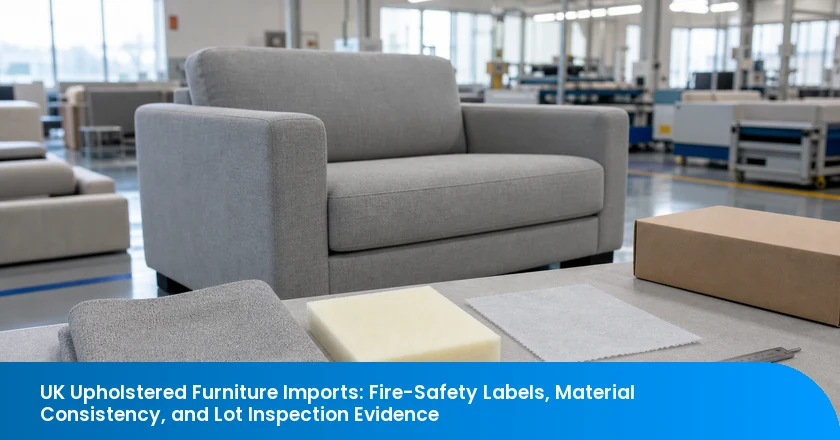
A sofa can look correct on the factory floor and still be a poor release candidate when its cover, filling, permanent label, and batch record do not point to the same controlled build. For UK upholstered furniture, the useful question is therefore not “Did the inspector see a fire label?” It is whether the material-to-lot release chain can be reconstructed for the actual goods being offered for shipment. That chain keeps legal and technical decisions with their accountable owners while giving a third-party inspection a clear, evidence-based job.
For an importer sourcing upholstered furniture from China for the United Kingdom, the practical handoff is an approved specification, applicable evidence, item-label artwork, and a named shipment population that can be compared at the factory. Legal interpretation, test selection, and conformity decisions remain with the responsible technical and compliance owners.
Four Records That Make a Furniture Release Defensible
Release readiness depends on four connected records: the approved build, applicable evidence, permanent-label data, and the defined lot presented for inspection.
Here, a permanent label is a durable label attached to the furniture for traceability, and a lot is the defined shipment population to which the release decision applies.
A “pass” on appearance is weaker than a record that tells the buyer exactly what was seen, which version it represents, and what remains outside the inspection scope. The most reliable release conversation is built around four questions:
- Approved build: Does the current bill of materials name the cover, filling, interliner, frame, hardware, and label artwork for this version?
- Applicable evidence: Can the technical owner identify the report, statement, or decision that applies to that named construction?
- Permanent-label data: Does the durable item label carry the controlled information and a retrievable identity?
- Defined lot: Can selected furniture, retail packs, cartons, and any rework be tied to a bounded shipment population?
When one answer is missing, the right outcome is usually an evidence hold on the affected scope, not an unsupported declaration that the whole shipment is compliant or non-compliant. That distinction protects the buyer from both over-release and unnecessary disruption.
Start With Scope and the 2025 Label Change
From 30 October 2025, the UK amendment removed the display-label requirement for new products, while the permanent-label obligation remains. GOV.UK’s 2025 amendment guidance confirms both parts of that change.
That update matters because older buying checklists often still ask the factory to prove a current “swing label” requirement. A display label may still appear on existing stock where it remains an accurate representation, but it is no longer the control that should govern a new-product booking. A permanent label is the durable, attached label that carries specified compliance and traceability information. It remains a useful physical interface between the finished furniture and the buyer’s controlled record.
The Furniture and Furnishings (Fire) (Safety) Regulations 1988 set flammability requirements for domestic upholstered furniture supplied in the United Kingdom. The product definition and the applicable market route still need confirmation for the specific item. Do not assume that “upholstered” alone resolves every scope question, especially for mattresses, covers, children’s products, outdoor furniture, or products supplied through different UK routes. Great Britain and Northern Ireland can have different product-safety application paths, so assign the route decision to the responsible compliance owner before the supplier receives final artwork or release instructions.
For a China sourcing team, the practical change is simple: replace a generic “fire label checked” line with a controlled requirement that names the current permanent-label artwork, its location, the record it must match, and the person who decides whether the product is in scope. That is specific enough for a factory and inspector to follow, but it does not ask either party to make a legal interpretation.
Build a Material-to-Document Traceability Pack
Current Trading Standards guidance groups filling ignition requirements, cigarette-resistant upholstery composites, match-resistant covers or an interliner, and permanent labels among the basic requirements for upholstered furniture. Business Companion’s updated fire-safety guide also emphasizes testing and record traceability.
Use those requirements to organize a short evidence pack, not a stack of unconnected PDFs. The pack should identify one approved furniture version and show where each physical fact can be checked. A BOM, or bill of materials, is the controlled list of materials and components for the approved furniture build. It is the simplest bridge between a report reference and what the factory actually makes.
| Evidence lane | Control before bulk work | Observable final check | What it does not establish |
|---|---|---|---|
| Approved build | Model, BOM revision, cover, filling, interliner, artwork | Selected visible materials and approved version cues | Material performance or test equivalence |
| Applicable evidence | Record owner, report reference, configuration and date | Reference availability and version correspondence | A technical or legal conclusion |
| Permanent label | Approved artwork, placement, lot or ID reference | Presence, attachment, legibility, stated identifier | Underlying material compliance |
| Defined lot | Production window, color, carton range, rework rule | Selected items and cartons mapped to the stated lot | That unselected goods share the same condition |
The table’s conclusion is intentionally narrow: the more clearly the four lanes connect, the more useful a final observation becomes. TradeAider can coordinate product testing services when the unresolved question is about a material’s performance, a test method, or whether changed construction remains supported; a visual inspection should not be asked to bridge that gap.
A Report Is Useful Only When It Names the Actual Build
A report is useful for release only when the buyer can map its named material and configuration to the actual build in the defined lot.
Start the crosswalk with fields that can survive an ordinary supplier change: model or SKU; BOM revision; cover material reference and color; filling and foam reference; interliner status where applicable; finished-item configuration; report or certificate reference; evidence owner; permanent-label artwork revision; and the production or carton range that uses the construction. Do not rely on broad labels such as “velvet,” “foam,” or “fabric sofa.” They may describe an appearance without identifying the component or construction used in the record.
A useful crosswalk also records the decision status of each variation. Mark a row as approved, pending technical review, or excluded from the intended lot. That makes a late supplier message operational: if the factory proposes a different foam density, cover backing, interliner, or fabric supplier, the buyer can immediately see which field changed, which report reference may be affected, and who has to decide the next step. The inspector’s role is then to compare selected goods to the approved visible references and document a mismatch, not to decide whether two materials are technically interchangeable.
Ask for this control before bulk work, not after cartons are closed. Add the material revision, label-artwork revision, and stated carton logic to the supplier handoff before requesting a focused Pre-Production Inspection service. That early comparison of samples and agreed physical references gives the buyer time to resolve a version issue. It cannot replace testing or the technical decision about whether the evidence applies.
The Permanent Label Needs a Retrievable Lot Identity
Schedule 7 permanent-label content includes a batch or identification number, interliner information, and a summary of compliance measures, with the label required to be durable and securely attached. The official Schedule 7 text sets out those permanent-labelling requirements.
Treat the label as an evidence locator. During an inspection, capture a clear photo of its placement and legibility, then record the exact batch or identification value, the model or color reference where available, the artwork revision, and the selected carton or lot reference. The useful question is not simply “Is a label present?” It is “Can this label be traced back to the record that governs this product version and forward to the defined lot being released?”
That distinction helps with a common supplier error: the correct-looking label is applied to a changed cover or a mixed carton range. Label presence does not make the underlying report applicable, and a report reference does not prove that the finished unit carries the controlled label. Reconcile both. If the furniture is sold as multiple pieces, the scope should also say which individual pieces require a photographed label check and how the record identifies the collection.
Use Substitution Controls Before the Final Lot
GOV.UK traceability guidance says the product or packaging should carry manufacturer and importer details and a product or batch reference that can identify the place and time of manufacture. The manufacturer and importer guidance frames those details as part of good traceability.
Build a change rule around that identity. Whenever a cover, filling, interliner, material supplier, label artwork, or pack configuration changes, require the supplier to name the old reference, the proposed reference, the affected production window, the lot or carton range, and the date the change begins. The buyer’s technical or compliance owner then decides whether the existing evidence remains applicable, whether a new document is needed, or whether the changed range must be held. Record that decision beside the BOM revision rather than leaving it in a chat thread.
This is not bureaucratic padding. It determines whether an apparently isolated mismatch can be contained. If a changed fabric was used only in cartons 41–72, a defined subset can be held and rechecked. If the factory cannot identify when the change began, the uncertainty may extend to the broader production population. The inspection brief should use the same boundary: state the intended lot, the cartons available, any excluded or reworked range, and the evidence version against which selected items will be compared.
For buyers who expect substitutions during development, make the rule part of the purchase-order and factory handoff: no substantive material or artwork change becomes release-ready until the change owner records its affected scope and evidence status. That practice is more valuable than increasing sample size after the fact, because sampling cannot reconstruct an unknown production history.
Design a PSI Around Observable Corroboration, Not a Compliance Verdict
UK product-safety guidance says manufacturers and importers must demonstrate relevant safety compliance and that product-specific provisions can apply differently in Great Britain and Northern Ireland. GOV.UK’s product-safety guidance for businesses describes those responsibilities.
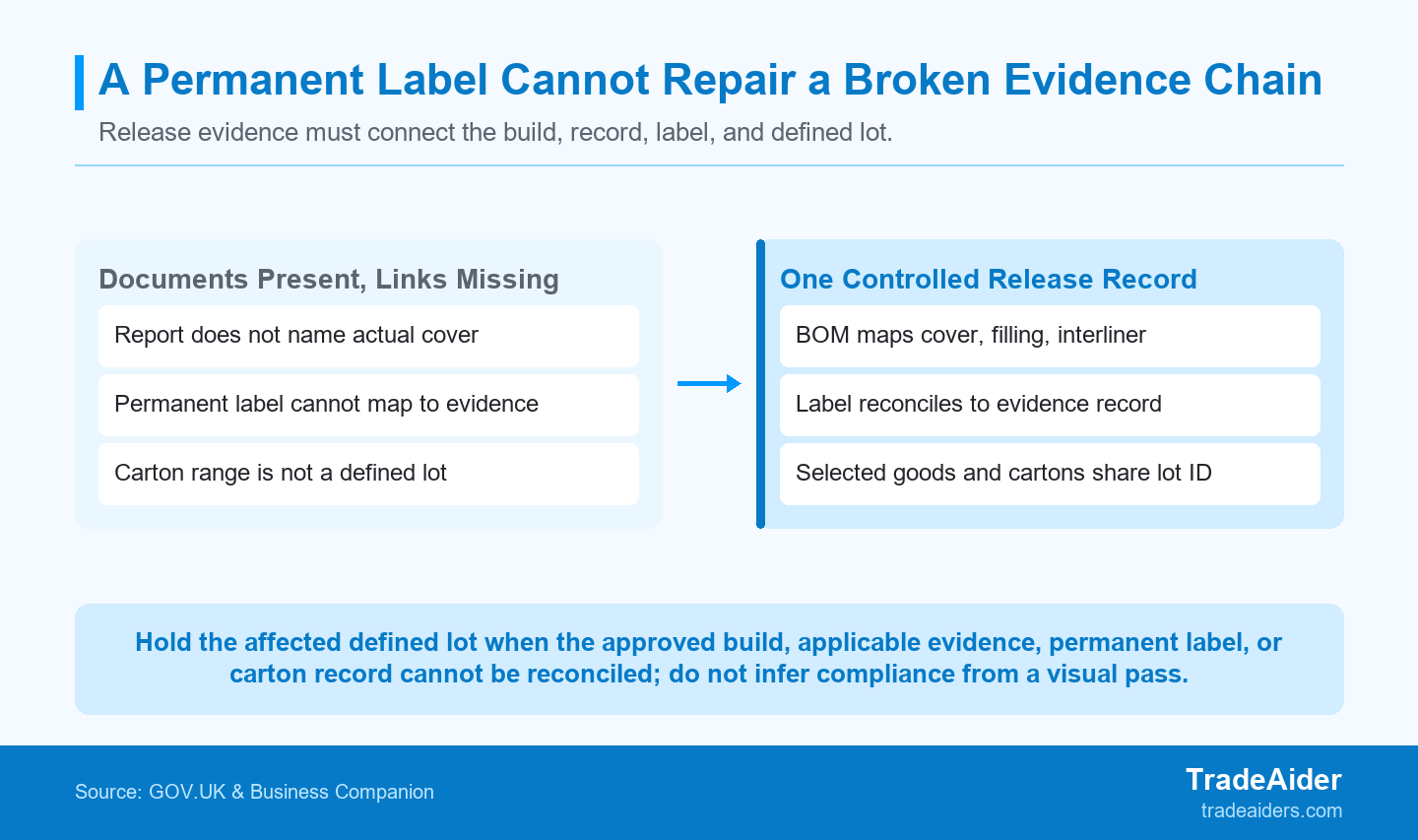
A permanent label helps a buyer trace the furniture only when the material, evidence, label, and defined lot can be reconciled; the model does not decide legal compliance.
That is why a PSI is a pre-shipment inspection of finished goods before export, not a request to certify UK compliance. Give the inspector a controlled evidence index and ask for observable comparisons: selected model and color; visible cover and construction cues; permanent-label presence, attachment, and stated ID; retail-pack and carton references; carton count or range; packing condition; and photographs of any specified component, warning, or label location. Ask the report to say match, mismatch, unavailable, or not inspected against each agreed point.
The four-record model is the practical boundary. A selected chair or sofa can corroborate that the visible material, label, packaging, and carton reference align with the controlled record. It cannot prove material performance, decide whether a report applies to a substituted construction, interpret a regulation, or issue a conformity decision. A scoped Pre-Shipment Inspection service is most useful when the buyer has already supplied those controlled references and knows who will resolve an exception.
Illustrative Hold: One Changed Cover Fabric, Three Evidence Questions
In the illustrative scenario, a 400-piece affected color lot is held until the substituted fabric, label revision, and lot record can be reconciled.
A UK private-label importer sources upholstered chairs from China and has agreed a controlled material and label pack before bulk production.
The order covers 1,200 chairs in three colors. Each color has its own carton range, but the supplier used one permanent-label artwork set across the order.
At 90% packed for export, a final review finds that one color used an alternate cover fabric because the approved fabric became unavailable.
The change is visible in selected units, but the current evidence index does not name the alternate fabric. The label artwork still carries the original batch reference, and the factory can identify the cartons containing the affected color.
The other two colors retain the approved cover and can be separated by their stated carton ranges. No one asks the inspector to decide whether the alternate fabric is technically acceptable.
The buyer has a traceable subset, not proof of a whole-order failure. The right question is whether the supplier can map the alternate roll, affected cutting window, label revision, and carton range to a technical decision. The physical report supports that question with photos and defined references; it does not answer it alone.
Hold the 400-chair color lot and continue the release review for the separately traceable colors. The hold notice names the affected cartons, missing evidence link, decision owner, and evidence needed for recheck.
The factory provides the substituted material reference, the production window, corrected label artwork if required, and the mapped carton range. The accountable owner determines whether the applicable evidence must be updated before the lot can proceed.
A recheck confirms the corrected label and lot identifiers on the held range only after the buyer-controlled record names that range.
This is an illustrative operational scenario, not a legal conclusion, laboratory result, or TradeAider client case.
Set a Release Hold When One Link Fails
An OPSS product-safety report for an upholstered sofa recorded insufficient test information and required labelling, followed by border rejection and destruction. The published OPSS report is a specific enforcement example, not a forecast for every shipment.
A good hold is controlled, reversible, and documented. It does not say “fail everything” when the issue is traceable to one color or carton range. It does say exactly what must happen before a release decision can resume:
- Name the affected model, color, production window, carton range, and quantity.
- Name the failed link: approved build, applicable evidence, permanent label, or defined lot.
- Assign an accountable owner for the correction and the decision about evidence applicability.
- Specify the correction artifact and the physical recheck needed before release.
Use written inspection standard guidance to turn those four points into observable acceptance rules rather than a vague request to “check compliance.” The booking brief should name the revision that controls the shipment, the physical checkpoints to photograph, the sample or selection basis, and the way the report identifies exceptions. It should also say what the inspector must not decide: material test applicability, legal scope, or conformity.
Before the booking, reconcile the supplier's final packing list with the lot definition. List the model, color, quantity, carton range, completed packing status, label artwork revision, BOM revision, evidence reference, and any rework record. If multiple configurations share cartons, either define the population more narrowly or state how selected units will be linked back to a configuration. If goods are not yet in final packing, describe that limitation rather than allowing a final report to imply that the whole shipment was available.
When a mismatch appears, ask four bounded questions: Which goods are affected? Which document or physical reference conflicts? Who can authorize the correction? What recheck will close the hold? A clear answer to those questions is more useful than a broad rejection because it preserves evidence for the affected range while keeping unrelated goods out of an unnecessary decision. It also gives the supplier a controlled way to present a corrected label, carton mark, or record for verification.
If you already have the approved BOM, applicable reports, permanent-label artwork, defined lot range, and packing status, request a furniture PSI scope review.
Who Is TradeAider?
TradeAider is a quality inspection, testing, and certification service provider in China, with coverage across Guangdong, Zhejiang, Jiangsu, Shandong, and Fujian.
Its nationwide network of quality control specialists provides real-time reporting for scoped quality-control work.
Inspection & QA Services are offered at an all-inclusive rate of $199/man-day. TradeAider is an Amazon Service Provider Network (SPN) partner.
Frequently Asked Questions
The correct next step is to route the missing link to the owner who can resolve it, not to ask an inspection report to decide a technical or legal question.
Do UK Upholstered-Furniture Imports Still Need a Swing Label?
No, for relevant new products the 2025 amendment removed the display-label requirement, but permanent-label requirements remain in place. Existing stock may still carry a display label when that label accurately represents compliance, so buyers should distinguish an old-stock presentation issue from the current control for new products. Confirm the item’s scope and market route before finalizing label artwork.
Can One Fire-Test Report Cover Every Upholstery Variation?
Not safely by assumption; the importer should confirm that the report and technical decision apply to the actual filling, cover, interliner, and configuration being supplied. A common product name or color family is not enough when the material reference or construction changes. Record the affected lot and route the applicability decision to the appropriate technical owner.
What Can a Furniture PSI Verify Before Export?
A furniture PSI can compare selected finished goods, permanent labels, packaging, cartons, and lot identifiers with the buyer-approved scope and record visible mismatches. It can also provide photos and define the inspected population. It cannot certify UK compliance, decide test applicability, or replace the importer's and manufacturer's responsibility for the technical and legal route.
When Should an Importer Hold an Upholstered-Furniture Lot?
Hold the defined lot when a material, applicable evidence, permanent label, or lot record cannot be reconciled to the finished furniture presented for release. The hold should identify the affected quantity or carton range, the missing link, the evidence owner, and the recheck needed. That creates a repairable release decision instead of an undocumented assumption.

Related Articles


Grow your business with TradeAider Service
Click the button below to directly enter the TradeAider Service System. The simple steps from booking and payment to receiving reports are easy to operate.

