
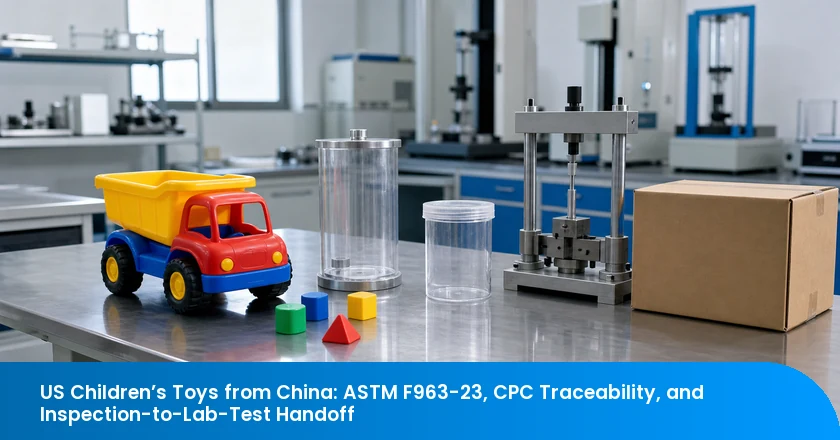
ASTM F963-23 toy inspection in China is the on-site reconciliation of a production lot to the approved toy evidence pack; it is not a substitute for laboratory testing or the importer's certification decision. Operational evidence-chain model, not legal advice. The practical release question is whether the current toy, its marking, and its defined carton range still trace to the evidence that covers that version.
The Toy Evidence Chain at a Glance
For a US children's toy, a passed report is only one link in the release decision. The stronger control is the Toy Evidence-to-Lot Handoff Matrix: lock the intended age grade and product features, identify the applicable testing scope, connect the report and Children's Product Certificate (CPC) inputs to an approved version, then ask whether the physical lot still matches. That sequence prevents a familiar mistake—treating a report for a sample as a blanket approval for every later component, label, carton, or production run.
- Scope first: classify the toy and its intended age before selecting a test plan.
- Evidence second: bind the report, CPC inputs, artwork, and tracking information to a named version.
- Observation third: use factory inspection to corroborate visible correspondence, not to make a laboratory finding.
- Release last: hold the defined carton range when a relevant reference cannot be reconciled.
Set the Product Scope and Age Grade Before Testing
Applicable test scope depends on the intended toy and product features; a generic ASTM label does not determine the applicable sections. The federal toy rule says each toy must comply with all applicable provisions of ASTM F963-23, so a sourcing file needs more than a product name and a supplier’s “ASTM compliant” statement. It needs a product description that a laboratory, importer, and factory can identify the same way: intended age, play pattern, materials, moving or accessible parts, sound or electrical features, batteries, cords, magnets, liquids, and the exact packaging configuration. See the current federal toy safety rule for the incorporation of ASTM F963-23.
Age grading is not a decorative box on the package. It frames the intended user and changes the questions that need to travel through development. For example, an activity toy marketed for ages 3+ can create a different review path from a visually similar item presented for children under three. The factory handoff should therefore carry the approved age grade and warning artwork as controlled references, alongside the bill of materials and model number. If marketing, packaging, and the tested sample describe different audiences, stop and reconcile the product scope before asking an inspector to compare the lot.
Build a short feature register before test samples leave China. Give each row a version ID and mark whether the feature is present, absent, or not applicable. The register is not a legal determination; it is the buyer’s way to make sure the laboratory receives the product actually intended for sale and the factory later has a stable reference. It also gives the importer a clear reason to ask about a revised component instead of discovering it only after final packing.
Map the Lab Evidence Before the Factory Builds the Lot
A CPC identifies the covered product and the applicable rules, certifier, record contact, manufacture details, testing details, and CPSC-accepted laboratory. A Children's Product Certificate (CPC) is the written certificate in which the responsible firm identifies the product and the applicable children’s-product safety rules. In operational terms, those fields should point back to the same approved toy version rather than becoming a paperwork exercise after production. The certificate-content rule requires a product identifier and description, each applicable rule, the certifier and records contact, manufacture details, test date and place, and the certifier’s attestation. For imported finished products, the importer is generally the finished-product certifier under the current rule; review 16 CFR Part 1110 for the detailed certificate requirements.
Use a one-page evidence map to make those fields usable at the factory. The left side can list the approved model, color or variant, artwork revision, age grade, and component references. The right side can list report numbers, the applicable rules stated by the certifier, the proposed CPC identifiers, production place and month, tracking-code format, and the carton range expected for the inspection. That map does not transfer certification responsibility to the factory or inspection team. It creates a shared lookup sheet so a visible mismatch can be isolated before the shipment leaves.
Where a buyer needs help aligning product features to the evidence pack before bulk production, TradeAider can help them coordinate the product testing evidence pack while the approved sample, documents, and factory contacts are still available. The useful output is a version-controlled handoff, not a generic “test passed” note.
The Lab-to-Inspection Handoff Is a Version-Control Task
The lab-to-inspection handoff should control the tested version and observable lot evidence without treating inspection as laboratory testing. A CPSC-accepted laboratory assesses the required test scope for the submitted product; a factory inspection can compare visible version signals—components, labels, instructions, tracking marks, artwork, packaging, and carton allocation—with the approved pack. The two functions meet at the product-version reference. The federal requirements for third-party conformity assessment bodies make clear that accepted scope is rule-specific, and the listed ASTM F963-23 provisions are feature-specific rather than a universal lab label; see 16 CFR Part 1112.
That boundary produces a clean escalation rule. An inspector may report that a battery-door screw is different, a magnet housing has changed, or the printed age grade no longer matches the approved artwork. The inspector should not declare that the alteration passes or fails an ASTM test. The responsible importer or manufacturer decides the compliance path, and the laboratory determines the testing implications within its scope. Keeping that handoff explicit protects both the evidence record and the factory team from being asked to make a decision outside their role.
Turn the Evidence Pack Into Observable Factory Checks
Permanent tracking information on the product and packaging should identify production and source details where practicable. The CPSA’s tracking-label provision calls for permanent marks, to the extent practicable, that make the manufacturer or private labeler, location and date of production, cohort or batch, and other source information ascertainable. That makes the tracking code more than a label-artwork detail: it is the bridge between a toy on the inspection table and a defined shipment range. The statutory text is available in 15 U.S.C. 2063.
Translate the evidence map into checks an inspector can actually observe. Ask for the approved product and packaging artwork, a sample of the tracking-code format, the factory’s carton numbering logic, and a packing list that connects cartons to the production batch. Then specify the checks: compare the model identifier and colorway; read the age grade and warning panel; observe accessible fasteners, battery access, detachable elements, and instruction inserts where applicable; photograph the tracking information; and record the first and last carton in each inspected range. Each observation should say what was seen and which reference it was compared with.
This is especially valuable while corrections are still practical. Buyers can check the production version during manufacturing when a component, printing plate, or packaging run first becomes available, rather than relying only on a final carton check. A change can still need laboratory or certifier review, but earlier observation narrows the affected range and keeps the evidence conversation concrete.
Compare What the Lab Proves With What Inspection Can Corroborate
Laboratory testing and factory inspection answer different questions and should be joined by a version-controlled evidence pack. The accepted toy-testing scope is not a checklist that an inspector can self-certify: the rule lists particular ASTM F963-23 provisions, including feature-specific areas such as small objects, accessible edges, wires, fasteners, folding mechanisms, cords, battery-operated toys, and magnets. Use 16 CFR 1112.15 to confirm the current accepted testing scope for the applicable rule.
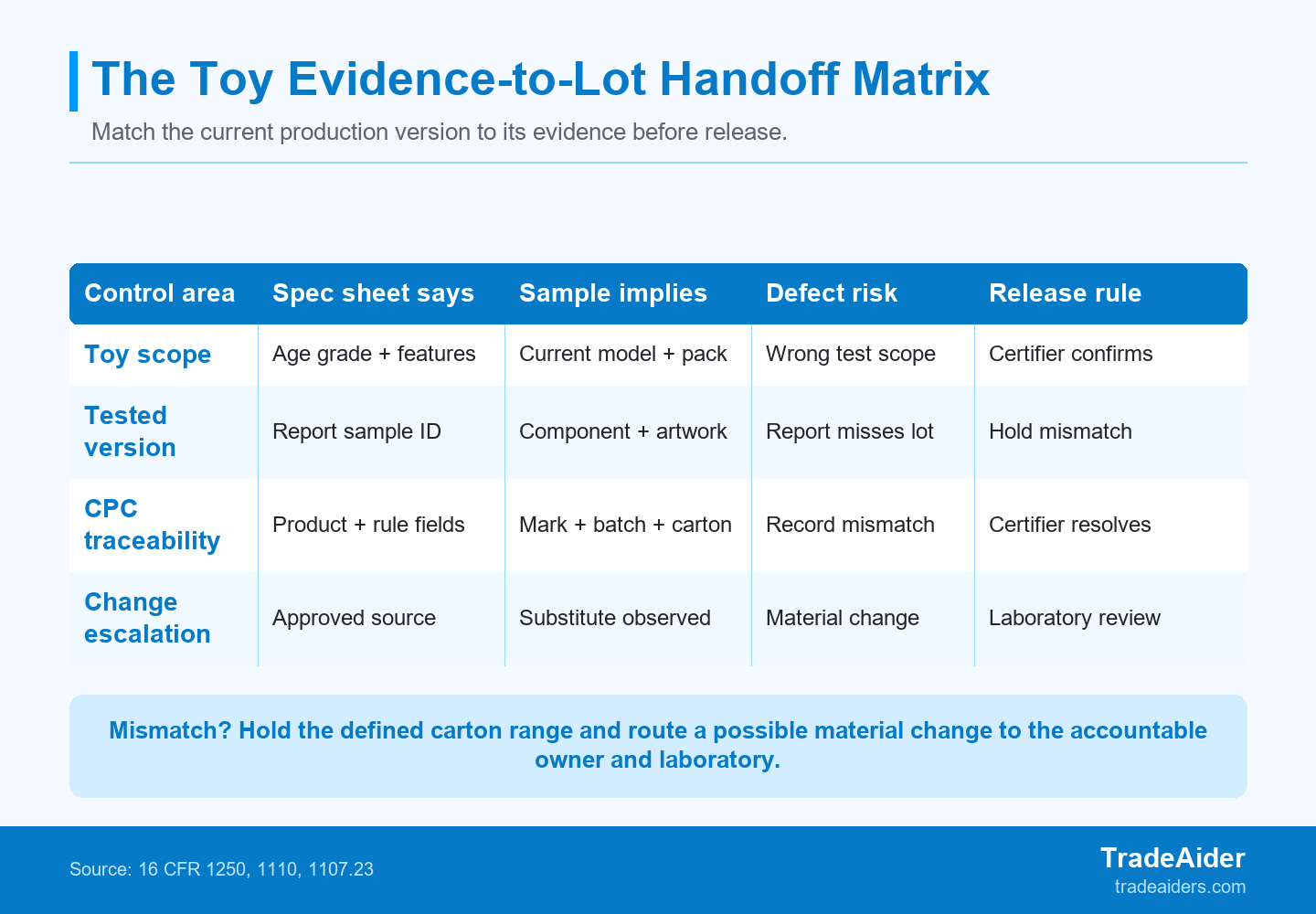
A factory inspection corroborates observable version and lot correspondence; it does not replace laboratory testing or CPC responsibility.
| Decision question | Laboratory evidence | Inspection corroboration | Reference that must match | Owner of the next decision |
|---|---|---|---|---|
| Which requirements apply? | Applicable test plan and report scope | Feature and age-grade observations | Approved scope and version register | Certifier / laboratory |
| Does this lot look like the tested version? | Tested-sample identity and limitations | Visible components, model, artwork, instructions | Model and component references | Importer / product owner |
| Can the certificate describe this product? | CPC fields and supporting records | Identifiers and production information presented | Product ID, place, month, test reference | Finished-product certifier |
| Which cartons are affected by a mismatch? | No laboratory conclusion from carton data alone | Tracking mark, carton labels, packing-list range | Defined batch and carton allocation | Importer / factory owner |
Based on this comparison, inspection is most valuable when it makes the evidence-to-lot link observable. It can identify that a production version or carton range needs to be held; it cannot convert an unresolved component difference into a passing laboratory result. Buyers should document the inspection acceptance standard so the report records the comparison reference, the observed difference, the defined affected range, and the required escalation rather than a vague “fail” note.
The Toy Evidence-to-Lot Handoff Matrix is a practical way to keep that comparison disciplined. It asks five linked questions: What scope applies? Which version was tested? Which CPC fields describe that product? What tracking information appears on the product and package? Which cartons belong to that version? A “no” or “unknown” at any link is a release-control signal, not an invitation to fill the gap with assumption.
Illustrative Hold: A Tested Sample and a Different Production Component
This illustrative example is a composite scenario; it is not a TradeAider client case and does not determine a legal outcome. A US private-label importer is preparing a 3+ activity toy made in China. The approved evidence map identifies model TY-7A, a blue-and-yellow elastomer component set, an approved age-grade panel, a tracking-code format, and the report references used to support the product’s certificate work.
The factory presents 96 export cartons after the evidence pack was assembled. The buyer asks for an observable final check of the approved component colors, model marking, age-grade artwork, tracking information, instructions, and the carton allocation shown on the packing list. The assignment does not ask the inspector to repeat laboratory tests or certify the toy.
The finished cartons are packed and ready for a release decision. The factory can provide the packing list and examples of the tracking mark, but the line supervisor notes that an elastomer subcomponent was substituted during production because the original material was unavailable. No revised evidence reference has been added to the handoff packet.
During the check, 12 cartons contain a red elastomer component where the approved evidence pack shows blue and yellow. The difference is visible and repeatable in the sampled cartons. The inspector records photographs, the model marking, the carton labels, and the first and last carton numbers associated with the affected pallet position.
The carton batch code for those 12 cartons also cannot be reconciled to the tested-version reference in the evidence map. The other cartons may appear consistent, but their position alone does not answer whether the changed component is isolated or whether an earlier manufacturing run used the same substituted material.
The inspection team can establish a version and traceability conflict, not its compliance effect. A change in product design, manufacturing process, or component sourcing that could affect compliance is treated as a material-change question under 16 CFR 1107.23. The responsible manufacturer or importer must decide whether the change could affect applicable rules and obtain the appropriate laboratory path; the changed product cannot simply inherit an earlier certificate without that review.
The illustrative changed-component lot is held for owner and laboratory review rather than released using an earlier report. The immediate decision is limited and operational: identify the 12 cartons, preserve their component and tracking evidence, prevent them from being mixed with a cleared range, and ask the accountable certifier and laboratory for direction.
Corrective action could mean restoring the approved component, establishing that the substitute is materially identical through the responsible review, or testing the affected component or product as directed. The inspection report should not predict which outcome will apply. Its value is that it leaves a factual chain—what differed, where it appeared, and which carton range was held.
The defined carton range can move only when its current version, tracking information, artwork, and evidence reference reconcile. A release note should name the cleared range and the still-held range separately, so a later packing-list revision cannot silently turn a localized mismatch into a shipment-wide assumption.
This illustrative example shows a control path; it does not say every color change is a material change or that every affected toy is unsafe. A visible change is a reason to reconcile the evidence and engage the responsible decision-makers, not a substitute for their technical or legal judgment.
Release Only a Lot That Reconciles to Its Evidence Pack
Hold the defined carton range when product identity, applicable evidence, tracking data, or artwork cannot be reconciled. That rule focuses the release decision on what is known, limits the scope of a hold, and avoids a false choice between releasing everything and stopping the entire order. Where a toy is intended for children under three, the small-parts rule is also age- and intended-use-specific; it considers the manufacturer’s stated intent, marketing, and common recognition of use. Review 16 CFR Part 1501 for the current scope and method.
A Pre-Shipment Inspection (PSI) is a final-stage check of finished goods, packaging, labels, and shipment presentation against an agreed scope. A PSI is conducted when 100% of the order quantity is completed and at least 80% is packed for export. For this toy handoff, define the scope before the visit: the version references to compare, the observable features to photograph, the tracking information to record, the packing-list data needed to identify carton ranges, and the escalation contacts. Buyers can scope a pre-shipment inspection around the approved toy lot when they need that China-side comparison recorded before export.
Use three outcomes in the report: reconciled for the defined range that matches its evidence pack; hold for clarification where a mismatch or missing reference has been contained; and not observed where the requested evidence was unavailable or the inspection scope could not see it. None of those labels is a laboratory conclusion. They give the importer enough precision to issue a controlled next instruction.
Prepare a Handoff Packet Before the Final Factory Check
A handoff packet makes the testing-to-inspection boundary observable and actionable. The Toy Evidence-to-Lot Handoff Matrix works when it is supported by a small packet the factory, inspector, and product owner can read without interpreting a laboratory report from scratch.
- Approved identity: model, SKU, color or variant, product photos, bill-of-material revision, and age grade.
- Evidence references: report identifiers, applicable-rule list as determined by the responsible certifier, and the version each record covers.
- Certificate inputs: proposed CPC product identifiers, certifier and records-contact details, manufacture date and place, and test-reference fields.
- Observable artwork: approved packaging, warning and instruction files, product marking, and tracking-code format.
- Lot map: factory batch logic, packing list, carton numbering, and the rule for separating cleared from held cartons.
- Escalation route: named importer or product owner, laboratory contact path, and the evidence to preserve when a mismatch appears.
Send the packet before production completion, not on the morning of the inspection. If the factory cannot connect a carton range to the version record, the missing information is already a result worth resolving. With the model list, report references, proposed inspection date, factory location, and specific version or lot questions in hand, request a US toy inspection handoff review.
Who Is TradeAider?
TradeAider is a quality inspection, testing, and certification service provider in China, with coverage across Guangdong, Zhejiang, Jiangsu, Shandong, and Fujian. TradeAider is an Amazon Service Provider Network (SPN) partner. Inspection & QA Services are offered at an all-inclusive rate of $199/man-day. TradeAider reports client-reported outcomes including an 18% reduction in return rates and a 23% improvement in defects caught before shipment.
Frequently Asked Questions
Residual questions should preserve the distinction between certifier responsibility, laboratory evidence, and inspection observations. The answers below explain how to keep those roles clear in a US toy release workflow.
Who must issue the CPC for an imported children’s toy?
For a finished product manufactured outside the United States, the importer generally acts as the finished-product certifier and issues the certificate. The CPC is the certifier’s document, even when the factory supplies production details and a laboratory supplies test results. The importer should therefore control the final product identifier, applicable-rule list, manufacture information, test references, and record-access process. A factory inspection report can support the evidence file by recording observable version and lot facts, but it does not issue or replace the CPC.
Does a factory inspection replace ASTM F963-23 laboratory testing?
A factory inspection does not replace ASTM F963-23 laboratory testing or other applicable testing requirements for a US children’s toy. It can corroborate what is visible in the presented lot—such as a model marking, artwork revision, tracking code, component appearance, carton label, or instruction insert—but it does not perform or replace applicable laboratory testing. The practical value of inspection is to detect a mismatch between the production version and the evidence pack early enough to hold the affected range. When a technical change may affect compliance, the certifier and laboratory need to determine the next step.
What should a toy tracking mark help an importer identify?
A tracking mark should help make the relevant production and source information ascertainable for importers to the extent practicable. In a release workflow, that means the buyer should be able to connect the product and package marking to the manufacturer or private labeler, production location and date, batch or run information, and the shipment records that define the carton range. The specific format can vary, but the mark is most useful when the packing list and inspection record use the same batch logic.
When should an importer hold a toy carton range after a production change?
Hold the defined carton range when a product, component, process, source, label, or tracking reference cannot be reconciled to the evidence that supports the current CPC. First preserve the observed item, photos, carton numbers, and version records; then separate the affected range from cartons that can be independently reconciled. The hold does not decide that the toy fails a requirement. It prevents an unresolved change from being released on the assumption that an older sample or report still covers it.
Related Articles


Grow your business with TradeAider Service
Click the button below to directly enter the TradeAider Service System. The simple steps from booking and payment to receiving reports are easy to operate.

