
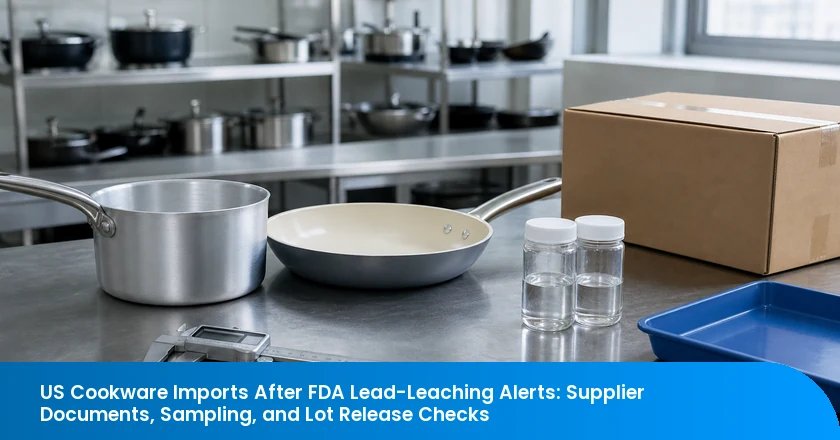
US cookware lead-leaching inspection is a controlled comparison between the materials and finishes that touch food, the records that describe them, the laboratory work the responsible owner requires, and the identifiable cartons being considered for release. It is not a chemical test, a conformity assessment, or legal advice. For an importer, the practical question is narrower: does this finished lot still match the records and review scope that the release decision relies on?
FDA alerts should change the buyer’s control process, not encourage an unsupported verdict about every pan. A visually acceptable shipment can still have an unresolved material, finish, report-scope, or lot-mapping question. Conversely, an alert does not prove that an unrelated SKU fails. The useful response is to assemble the necessary current records, keep laboratory sampling separate from inspection sampling, and hold only the carton range that cannot yet be reconciled.
The Release Decision Starts With the Evidence Packet
A cookware lot should move toward release only when its current food-contact construction, supporting evidence, laboratory scope, and defined carton range can be reconciled. Here, food-contact construction means the materials and finishes of the product surfaces intended to touch food. An evidence packet is the current records used to identify a product and support the next decision. Leach testing is a laboratory process that measures whether a substance can migrate from a food-contact surface under specified test conditions. That rule prevents a factory appearance check from being mistaken for a chemical conclusion.
FDA warns that certain imported cookware made from aluminum, brass, and specified aluminum alloys may leach lead into food when used for cooking or food storage. The warning is limited to certain products and potential lead leaching; it does not label all imported cookware unsafe. For a buyer, it is a reason to review the current product and supplier file rather than rely on a broad material claim. FDA’s August 2025 safety communication is the relevant risk context.
- Identify: name the current SKU, food-contact surfaces, component or finish codes, supplier, and carton range.
- Reconcile: compare those facts with the material certificate, change log, report scope, and laboratory instructions.
- Contain: if a link is missing, segregate the smallest identifiable range and assign the next decision owner.
- Release: retain the evidence-to-carton record with the buyer’s approved release decision.
Build a Cookware Evidence Packet Before Sampling
FDA describes its Toxic Elements in Food and Foodware compliance program as one route used to test for environmental contaminants. That context matters because a foodware document should identify the tested product and scope, not merely reassure the buyer that a supplier has a PDF. FDA’s lead-in-food-and-foodwares overview provides the foodware-specific context.
A generic report title is not enough to show which current food-contact construction and carton range it covers. Start the packet with the purchase-order SKU and approved specification, then add the current bill of materials or material declaration, food-contact component list, supplier and factory identity, laboratory report and its sample description, test conditions or scope, change log, production date or lot reference, carton allocation, and the person authorized to decide a discrepancy. A report can be genuine and still be irrelevant if it covers a different finish, supplier source, product family, or sample construction.
Use the packet to ask a simple, testable question: “Can this document be connected to the cookware on the line and to the cartons on the release list?” If the answer is no, record what is missing instead of trying to close the gap with a visual statement. TradeAider can capture the agreed product, document, and lot facts in China so the importer can route a bounded review. When testing support is needed before a release decision, it helps to align product testing evidence with the current cookware build before samples or finished cartons are selected.
Treat Material or Finish Changes as Test Triggers
FDA’s December 2024 letter told retailers and distributors that certain imported cookware products had demonstrated the potential to leach lead into food. The point for an importer is not that every alloy or finish change is a failure. It is that a change can make an old report or certificate a poor description of current goods. FDA’s retailer and distributor letter explains the focused nature of that response.
A relevant alloy, coating, finish, component source, or food-contact construction change should trigger a scope review because it can sever the connection between prior evidence and current goods. Ask the factory to identify the effective date, affected material lots, affected production window, old and new part or finish codes, and any finished cartons already packed. The change record should tell the buyer whether the original laboratory sample still represents the product now being released. It should not be treated as proof of contamination or as a substitute for the responsible technical review.
The earlier this check happens, the smaller the containment problem usually is. A buyer can inspect material changes during production to capture the change before identical-looking cartons are mixed in a finished order. If the factory cannot connect the change to an identifiable output range, the practical hold boundary may need to grow rather than shrink.
Separate Inspection Sampling From Laboratory Sampling
FDA EAM Section 4.6 describes lead and cadmium extraction from specified food-contact surfaces under defined analytical conditions. That is why a laboratory specimen must be selected and handled under the applicable analytical plan, with its construction and chain of custody preserved. FDA’s EAM Section 4.6 sets out the stated method scope and conditions.
FDA’s ceramicware cadmium CPG uses category-specific criteria based on examination of six units. That does not give every cookware importer a universal sample size; it illustrates why product category, method, and analytical purpose must be specified rather than borrowed from a generic inspection table. FDA’s ceramicware cadmium CPG states that limited scope.
FDA’s lead-contamination CPG is explicitly scoped to pottery and ceramics and includes import-detention release context. Keep that boundary visible: ceramic guidance can inform a buyer’s questions about method and scope, but it should not be silently treated as a complete rulebook for metal cookware. FDA’s lead-contamination CPG identifies its own pottery-and-ceramics scope.
| Control | Laboratory specimen | Inspection sample | Keep with the record |
|---|---|---|---|
| Primary purpose | Answer the defined analytical question under the applicable method | Show whether an agreed observable condition appears in the production population | The decision owner and the question each sample is meant to answer |
| Selection basis | Laboratory or qualified compliance instruction tied to construction and scope | The agreed inspection plan and identifiable lot | SKU, food-contact construction, finish or component code, lot, and carton range |
| What it cannot prove | It does not by itself show every packed carton is the same product | It does not by itself determine a chemical-leaching result | Any boundary or limitation stated by the responsible owner |
The two plans should share a common identity trail, not be collapsed into one plan. Photograph or record the selected product, finish or material code, sample label, lot, carton range, date, and handoff recipient. Then the lab result, inspection observations, and release decision can be compared without claiming that one has done the other’s job.
Use a Hold Rule When Records and Product Conflict
FDA Import Alert 99-45 includes entries that identify lead as the problem for specified foodware, cookware, and tableware categories. An import-alert record is not a universal test requirement, but it reinforces the value of recording exactly which product, hazard context, and evidence question are at issue. FDA Import Alert 99-45 provides that limited enforcement context.
When an observation, report, material certificate, or carton allocation cannot be reconciled, hold the smallest identifiable range and record the responsible next decision. A useful finding is not “certificate issue” or “material concern.” It names the current product identity, observed code or construction, document reference and version, affected production or carton range, missing link, required owner, and condition for recheck. This gives the supplier a bounded correction request and prevents the buyer from releasing cartons that the evidence does not actually describe.
| Finding state | Typical evidence | Immediate action | Release condition |
|---|---|---|---|
| Reconciled | Current construction, report scope, review status, and carton range agree | Retain the release record | Apply the buyer’s approved release rule |
| Document gap | Report or certificate exists but does not identify the current product or lot | Hold the defined range and request the missing mapping | Current scope and carton link are verified |
| Product conflict | Observed material, finish, or code differs from the controlled file | Segregate the affected range and route review | Responsible owner closes the difference and a recheck matches the range |
| Untraceable population | The supplier cannot identify which cartons share the condition | Expand the hold boundary | The population is reconstructed or the buyer chooses another controlled path |
Before the visit, buyers should document the inspection standard for the lot: which records are checked, which observation creates a hold, who receives the escalation, and what counts as a recheck. The report then becomes a decision handoff instead of a list of disconnected defects.
Illustrative Saucepan Scenario: Contain a Mixed-Material Risk
A defined carton range lets a buyer contain a certificate-to-product conflict without claiming that a factory inspection has resolved a chemical-compliance question. This illustrative composite shows the release-control sequence; it is not a TradeAider client case and it does not state a laboratory or regulatory result. The point is to keep the evidence gap connected to a visible population until the responsible review closes.
Situation, Problem, Action, and Result
A buyer can preserve options by tying the hold, document request, specimen decision, and recheck to one visible carton range. The sequence remains operational: it creates a clear factory record without making an unsupported claim about whether the saucepans meet a chemical requirement.
Situation: A US private-label importer is preparing a current cookware shipment for retail distribution and needs the finished China lot to match the evidence packet.
Order context: The order contains 4,800 aluminum saucepans in 240 numbered cartons. The buyer has requested a final review before release.
Readiness: Finished goods are packed in numbered cartons, and product codes, supplier records, and a proposed carton allocation are available for the review.
Problem: Cartons 181–240 show a different interior-finish code from cartons 1–180.
Two certificate sets are in the supplier file, but neither identifies which finished carton range used the changed finish or material input.
Analysis: The difference does not prove lead leaching. It means the current test-report and material-certificate scope cannot yet be reconciled to 1,200 finished units, so a broad “passed” statement would exceed the evidence.
Action: Release no carton from the unresolved range; segregate cartons 181–240 and route the material, finish, and specimen question to the responsible laboratory or compliance owner. The buyer requests a controlled change record and keeps cartons 1–180 separately identified.
The supplier maps the affected material and finish to the output range, supplies the requested records, and does not merge the held cartons back into the release population during the review.
Result: A recheck confirms that the corrected evidence packet and carton IDs describe the same defined range before it can move. The trade-off is a defined, temporary shipment delay for cartons 181–240 rather than an unsupported release decision across all 240 cartons.
Illustrative composite only; it is not a TradeAider client case and it does not state a regulatory result. It does not say that every finish change requires the same test or that an inspection replaces laboratory analysis.
Release Only Lots That Reconcile
The FDA-China ceramicware MOU distinguishes audit samples from private laboratory analysis and refers to quality-control plans for each production lot. Its ceramicware scope does not create a complete release procedure for every cookware material, but the distinction is useful: audit observations, laboratory work, and lot identity are connected controls with different purposes. The FDA-China ceramicware MOU sets out that limited lot-control context.
The release unit is the smallest carton range whose food-contact construction, evidence packet, required review, and physical identification point to the same current configuration. A report without a current construction match is incomplete. A matching-looking saucepan without an identifiable carton population is incomplete. A completed review that cannot be tied to cartons is incomplete. When those four links align, the range is a release candidate under the buyer’s rule; when one is open, hold that range and make the owner and next check visible.
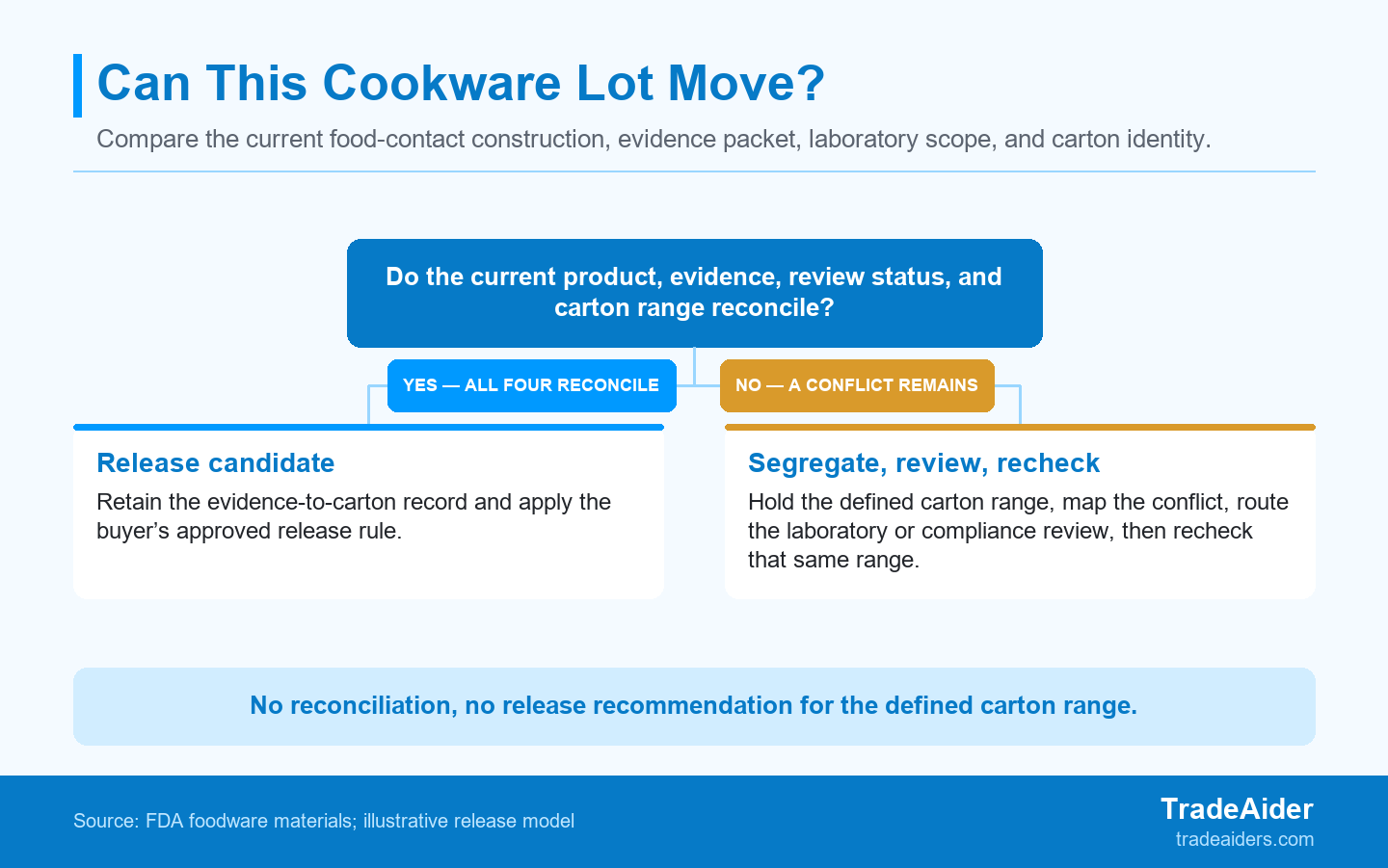
The release decision follows the evidence-to-lot match: reconcile and retain the record, or hold the defined carton range for the responsible review and recheck.
A PSI is conducted when 100% of the order quantity is completed and at least 80% is packed for export. At that stage, an inspection can record the observable product and carton facts needed for a bounded decision. The importer can set a pre-shipment inspection scope for the identified lot that names the current evidence, the sample instructions, the affected-carton rule, and the person who may release or hold the goods.
Prepare a China-Side Cookware Lot-Release Check
A focused China-side visit begins with the buyer’s current product file, laboratory instructions, change log, and carton-to-lot allocation—not a generic request to inspect cookware. The most useful scope says which food-contact surfaces and codes are checked, what documents are compared, how laboratory specimens are identified, which observations require photos, and which carton range is held if reconciliation fails. It also names the laboratory or compliance owner who receives the record.
- Send the current SKU specification and food-contact component list.
- Provide material, finish, and supplier change records.
- State laboratory specimen instructions and chain-of-custody requirements.
- Map the intended inspection population to numbered cartons or lots.
- Define the hold, escalation, and recheck owner before the visit.
That preparation lets the inspector capture facts that are usable to the importer without promising a chemical or legal conclusion. If the records and carton allocation are available, attach the evidence packet and request a cookware lot-release review.
Who Is TradeAider?
TradeAider is a quality inspection, testing, and certification service provider in China. Its Inspection & QA Services cover Guangdong, Zhejiang, Jiangsu, Shandong and Fujian, with $199/man-day all-inclusive for Inspection & QA Services. TradeAider can support a buyer’s agreed observation, document comparison, lot identification, and reporting process; the importer and its qualified advisers retain the laboratory, compliance, and release decisions.
For buyers that need China-side evidence collection before a defined lot decision, TradeAider can compare the agreed packet with the observable production range and report the differences for responsible review. Client-reported results include an 18% reduction in return rates and a 23% improvement in defects caught before shipment; these are client-reported outcomes, not a general guarantee. Learn more about TradeAider as an Amazon Service Provider Network (SPN) partner.
Frequently Asked Questions
Laboratory applicability, inspection observations, and the importer’s release decision are separate responsibilities. The questions below clarify how to keep those responsibilities connected without treating a document or a visual check as a stand-alone compliance conclusion.
Does an FDA cookware alert mean every imported pan needs the same laboratory test?
No, an FDA alert is a risk trigger, while the appropriate laboratory scope depends on the product’s food-contact construction, intended use, evidence, and the responsible owner’s assessment. Start by identifying the current materials and finishes, then ask whether the available report and method scope actually describe them. A universal sample size or test request copied from another product category can create a false sense of control.
Can a pre-shipment inspection prove cookware will not leach lead?
No, a pre-shipment inspection can verify agreed observable facts and lot records, but laboratory testing under an applicable method is needed to determine a chemical result. The inspection can capture the selected product, finish code, document revision, carton range, and sample handoff. Those facts make later laboratory or compliance review more reliable; they do not replace it.
What makes a supplier test report relevant to a current cookware shipment?
A report becomes useful release evidence only when its tested construction, sample identity, scope, date, and supplier details can be reconciled to the cookware and lot being shipped. Check whether the report describes the same food-contact surface, material source, coating or finish, SKU, and intended use. If a change occurred, preserve the change record and ask the responsible owner whether the original evidence still applies.
What should be held when a finish code and material certificate do not match?
Hold the smallest clearly identifiable carton range connected to the unresolved finish or certificate record, then keep it segregated until the responsible review and recheck are complete. Record why the range was selected and what evidence is still missing. If the supplier cannot distinguish the affected cartons from the rest of the order, the hold boundary needs to expand until the product population is controlled again.
Who decides whether additional testing or a release is appropriate?
The importer and its qualified laboratory or compliance owner decide the applicable testing and release conditions; an inspector documents the agreed facts and scope at the factory. The factory supplies records and supports segregation or correction. Assigning those roles before the visit keeps a material or finish difference from turning into a vague, late-shipment dispute.
Related Articles

Grow your business with TradeAider Service
Click the button below to directly enter the TradeAider Service System. The simple steps from booking and payment to receiving reports are easy to operate.

