
- About Us

- Our Services
- Your Industry
- Resources
- News & Blog
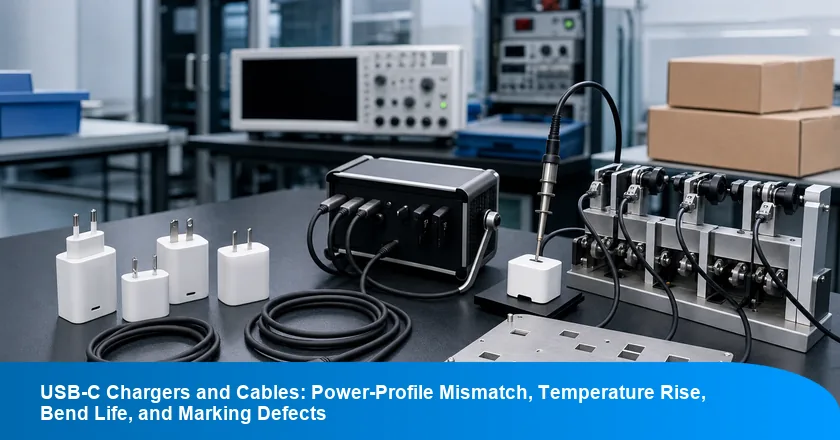
A USB-C charger can show a reassuring wattage on a meter and still be the wrong shipment to release. The missing link is usually not another headline number; it is whether the charger, cable, receiving device, requested power profile, test condition, markings, and cartons all describe the same sellable kit. A useful inspection therefore tests one defined charger-and-cable configuration, then limits the release decision to the lot that the record can actually identify.
What a USB-C Charging-Kit Release Actually Clears
A USB-C charging-kit release should clear only the configuration and packed population that its profile, cable, condition, marking, and lot records identify. This boundary prevents a short power-on check for one cable and one device from becoming a blanket approval for every charger, cable, carton, or destination-market claim. It also gives the buyer a practical question for any report: which exact kit, condition, and packed population does this result represent?
- Freeze the claimed kit: record the charger model and revision, cable identity, receiving device, requested PD profile, and declared load.
- Separate observations: negotiated power, temperature rise, mechanical bend performance, and markings answer different questions.
- Keep the evidence joined: attach the test record, approved artwork, cable BOM, and carton range to the same release file.
- Hold only what the record cannot clear: a traceable rework subset can be rechecked without treating the rest of the order as proven defective.
Use the USB-C Operating-Envelope Framework Before You Sample
The USB-C Operating-Envelope Framework treats the charger, cable, sink, profile, load condition, physical checks, markings, and lot record as one scoped release decision. Here, an operating envelope means the specific configuration under a stated test condition; it defines the result scope for that named kit. It is not a universal safety score, and it does not replace the conformity route required for a particular market. It is the buyer's way to prevent evidence from one configuration being borrowed by another.
Start by writing the product claim as a testable sentence: named charger revision + named cable revision or lot + named sink + requested profile + duration and load + buyer-approved acceptance rule. Then decide what could change that sentence after testing: a substituted cable, a revised board, a different plug, a new carton claim, or a mixed production lot. Those change points are where the inspection plan needs an identity check rather than a generic pass box.
Read the Advertised Profile as a Test Contract
USB-IF says that the USB Power Delivery Specification enables flexible power delivery along with data over a single cable. USB Power Delivery (USB PD) is the protocol context for this inspection discussion. USB-IF describes PD Revision 3.1 as enabling up to 240W for a full-featured USB Type-C cable and connector. That flexibility is exactly why a listing wattage alone is not a release criterion. A buyer should state the profile being checked, the receiving device used to request it, and the evidence expected from the observation. For a new program, set a Pre-Production Inspection for the approved charger-and-cable configuration before labels, cable lots, and packing details multiply.
A TradeAider inspection brief can carry these named configuration fields into fieldwork, so the buyer receives a report tied to a specific product file rather than a generic charging-speed check.
Ask the factory to identify the charger SKU and hardware revision, the advertised power claim, the specified sink, and the test instrument or observation method. A higher theoretical capability does not prove that the requested profile was reached in the configured kit. Conversely, a lower observed value is not automatically a defect until the buyer confirms that the source, sink, cable, input condition, and requested profile match the approved test contract.
Verify the Cable as Part of the Power Path
USB-IF says that its USB Type-C cable compliance program uses documents that depend on cable capability and directs cables with e-markers to the USB Power Delivery Compliance Plan. Its program also states that USB-C-to-USB-C cable categories carry a 60W or 240W power marking before compliance testing. Treat that as a reason to preserve cable identity in the record, not as proof that an unexamined private-label cable supports every advertised charger claim. Check the cable construction or BOM reference, connector and overmold appearance, claimed power marking where applicable, plug fit, and the lot or reel traceability available to the buyer.
The most common paperwork gap is a charger report paired with a generic cable description. If heat, profile stability, or plug retention later changes, the team cannot tell whether the charger, cable, or pairing shifted. During production, preserve the cable-lot and charger-revision identifiers while they are still separable.
Test the Combined Kit Under a Declared Load
The combined kit should be tested under a declared load because a profile observation, thermal observation, and bend result are interpretable only for their stated configuration and method. The sequence matters: first confirm the configuration and requested profile; next observe heat under the approved condition; then assess the defined mechanical stress boundary. A unit that powers on after a brief connection is not necessarily evidence that the advertised kit has completed all three checks.
The table below turns a vague request to “test the charger” into records a buyer can compare across production lots. It intentionally does not prescribe a universal temperature limit, duration, bend-cycle count, or sample size. Those acceptance rules must come from the approved product specification, risk assessment, applicable market requirement, and buyer decision.
| Observation | Record before release | What it can support | What it cannot support alone |
|---|---|---|---|
| PD profile | Source, sink, cable, requested profile, input condition | Whether the named kit reached the requested state | Thermal or mechanical durability |
| Temperature rise | Load, duration, points measured, ambient condition, rule | A conditioned heat observation | A market-wide compliance conclusion |
| Bend life | Fixture, bend point, cycles, direction, post-bend check | Performance under the stated mechanical stress | All electrical or safety evidence |
| Marking review | Approved artwork, product, cable, pack, instructions, carton range | Whether the shipped claim matches the release file | A substitute for functional evidence |
The comparison reveals a release rule: each record is useful only when it describes the same charger-and-cable configuration and packed scope. A report with an unstated cable or load should trigger clarification before it is used to clear cartons.
Observe the Requested Profile Before Reading Watts
The first functional record should show the requested profile for the named charger, sink, and cable before a wattage reading is interpreted. Record the starting state, requested state, observed state, and any instability or reset that appears during the declared interval. This makes an unexpected reading actionable: the buyer can investigate the correct pairing or condition instead of asking the factory to repeat an undefined “65W test.”
Keep the sampling rule separate from the functional logic. The technical brief still needs to name which profile record must be collected for each selected kit. Sampling tells the team how many units to examine; it does not create the missing configuration fields.
Make Temperature Rise a Conditioned Observation
A charger temperature observation is comparable only when the input condition, profile, cable, sink, load duration, measurement points, and acceptance rule are recorded together. A number without those fields can still be a useful troubleshooting clue, but it cannot fairly distinguish a changed board from a changed cable, a different receiving device, or a shorter run time.
Plan the measurement locations before the test: for example, the case area, connector or cable-entry region, and any buyer-identified hot spot. Record when the run starts, how long the declared state is maintained, and whether the observation is a spot measurement or another approved method. The buyer should set the acceptance rule with the product file; a factory inspection team should not invent a universal limit from a one-off reading. Where a repeatable heat or profile finding appears, use During Production Inspection to contain a repeatable heat or profile finding while the affected production window is still traceable.
Use Bend Life to Test the Strain-Relief Boundary
A buyer-defined bend method should state the fixture, cycles, bend point, and post-stress functional check rather than promise a universal service life. The strain relief is the reinforced cable area at the plug junction that carries repeated mechanical stress. The method should name the cable end under stress and the functional evidence required after the sequence, such as continuity or the same profile observation used for the configured kit.
USB-IF’s cable-and-connector compliance document describes mechanical, environmental, and electrical performance criteria for connectors and passive cable assemblies. That wider scope is the boundary: a bend result is relevant mechanical evidence, not a shortcut to a broad safety or conformity claim. Photograph strain relief, connector shells, and any cracking or looseness before and after the defined stress so reinspection has a visible comparison point. For the sample plan and defect language, use an inspection-standard baseline for buyer-defined sampling and defects.
Keep Claims, Markings, and Lot Records in One Release File
The European Commission says that new ecodesign requirements apply from 14 December 2028 to external power supplies, selected chargers, wireless chargers, and USB Type-C cables. This is a dated EU example, not a global rule. It shows why a buyer should compare the destination-market file, product claim, cable marking, packaging, and instruction artwork before treating a factory check as release evidence.
A GOV.UK report on a USB-C 20W power adapter described high electric-shock risk and called for improvements to labeling, instructions, and marking. It is a product-specific enforcement example, not a defect-rate statistic. Its practical lesson is that marking and instruction checks belong beside construction and electrical evidence; they are not cosmetic checks performed after the technical decision.
DOE says that covered external power supplies manufactured and distributed in U.S. commerce must meet standards specified at 10 CFR 430.32(w). The word “covered” matters. Match the actual product and destination scope before drawing any compliance conclusion, and align product testing with the destination-market requirement when a formal standard, safety report, or market file calls for evidence beyond a factory observation.
Build one release file containing the approved claim sheet, charger and cable identification, observed profile record, thermal and bend method, test photos, artwork revision, instruction version, carton range, and any rework decision. When an artwork or cable lot changes, the team can see which record needs review instead of reopening the entire order by default.
Illustrative Scenario: Reworked Chargers Need Their Own Envelope Result
In this illustrative scenario, the 600-kit rework group is held because it lacks a profile-and-thermal record under the claimed kit configuration, not because the other 1,800 kits are presumed defective. The point is to show a containment decision that follows the record, rather than a universal judgment about a supplier or product category.
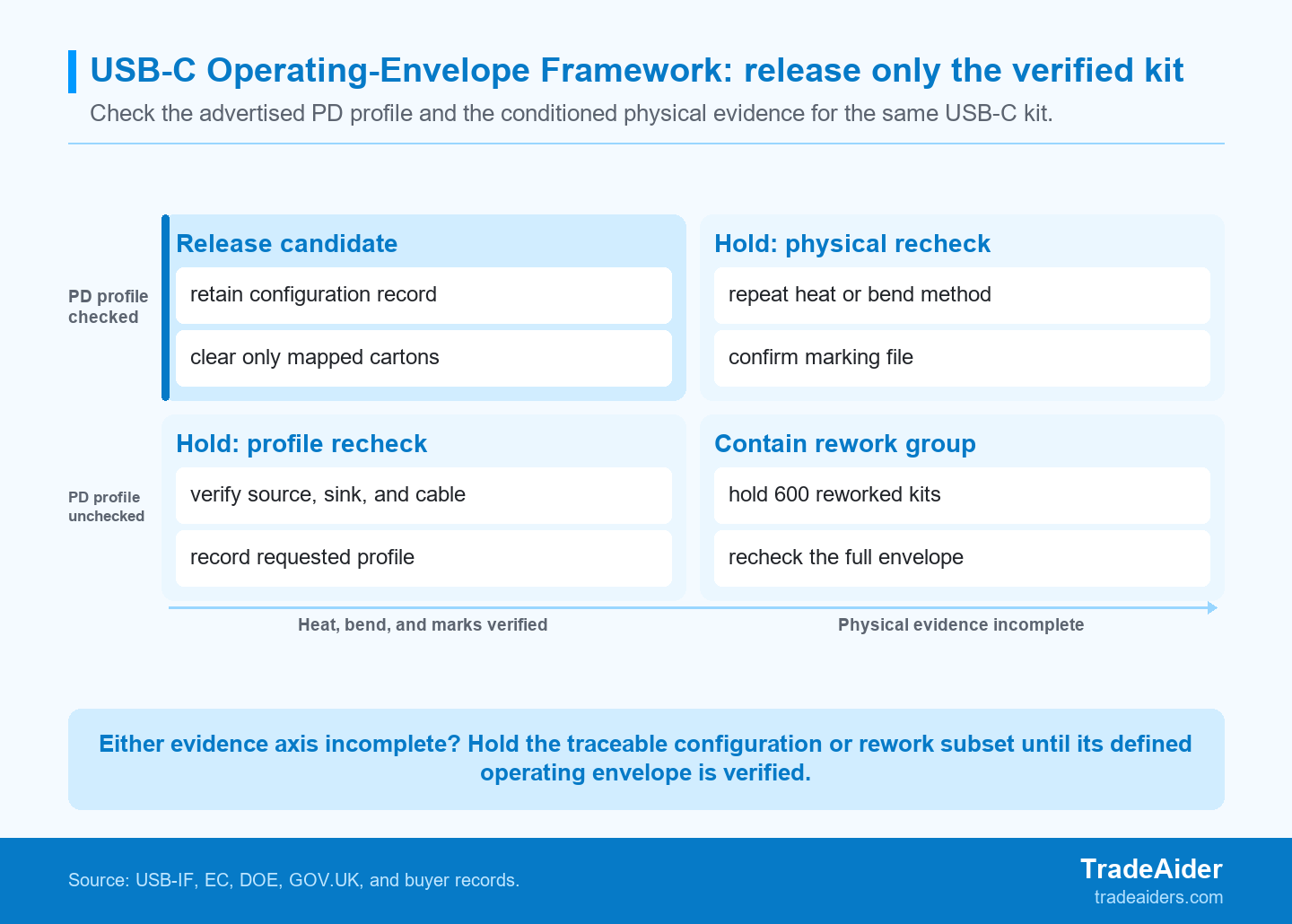
A USB-C kit is a release candidate only when its advertised profile and its conditioned physical evidence resolve to the same traceable configuration; the illustrative 600-kit rework group stays on hold until that happens.
The 600-Kit Rework Group Needs a Separate Recheck
In the illustrative scenario, the 600-kit rework group needs a separate recheck because its board revision is a traceable process-window change. That traceability creates a narrower and more useful decision than a full-order hold: the buyer can isolate the cartons associated with the revised board while preserving the earlier record for the separately identified population.
An importer is preparing a private-label 65W USB-C charger-and-cable kit for a named destination market. The buyer wants the final claim, cable, instruction booklet, and carton artwork to refer to the same finished configuration, so the inspection request requires a decision tied to the advertised kit rather than a generic powered-on sample. The illustrative order contains 2,400 kits. Of those, 600 contain a charger-board revision introduced after an internal heat-screening finding. The board code and carton range are traceable, which means the changed population can be handled as a specific process window rather than mixed invisibly into the order. Assembly is complete and the 600-kit group is separately identifiable in the packing record before export packing is closed. The supplier has an earlier five-minute functional record for the product family, while the buyer’s claim file requires the final charger-and-cable pairing to be identifiable at release.
The earlier record says that sampled units powered on, yet it does not state the requested USB PD profile, the matched cable identity, the receiving device, or the load condition. This leaves an information gap: the result cannot show whether the observed state was the same operating envelope as the advertised 65W kit. The reworked board group is traceable, but no profile-and-thermal observation under the buyer’s declared load is linked to its carton range. The cable lot and marking artwork are available for review, but the missing configuration record means those correct documents cannot by themselves clear the revised group. The earlier five-minute record is not worthless; it can show that the product family was energized under an unstated condition. It cannot clear the 600 kits because a buyer would have to assume that the board, cable, requested profile, load duration, and carton scope were all unchanged. That assumption is precisely what the operating-envelope framework is designed to remove.
Hold the 600 traceable rework kits and request a defined profile, thermal, cable, and post-bend recheck for that group. Do not use the situation to infer a defect rate for the other 1,800 kits, because their evidence boundary and production history are different. The immediate trade-off is a targeted delay for the affected cartons in exchange for a record that supports a defensible release decision. Create one recheck record that links the revised board code, paired cable lot, requested profile, input and load condition, test duration, temperature observations, bend method, marking artwork, and carton IDs. If a mismatch appears, document whether it belongs to the board revision, cable population, product claim, or packing range before widening the hold.
Release the reworked group only after the approved profile is observed under the declared condition, the planned physical checks are complete, and the record identifies the exact kit and carton range tested. If the test configuration changes again, reopen the defined envelope rather than carrying forward the prior result by assumption. This is an illustrative decision model only. It does not set a universal temperature limit, bend-cycle count, sample size, supplier defect rate, or market-conformity conclusion. The buyer still needs product-specific acceptance rules and the applicable destination-market route.
Hand Off a Testable Charger-and-Cable Brief
A testable charger-and-cable brief names the configuration, test condition, marking file, and packed-lot boundary before the order reaches final pack-out. Send this information as a short release packet, not as an open-ended request to “check charging speed.” The inspector or test provider can then report against a known configuration and distinguish an evidence gap from a true observed failure.
- Product: charger SKU, plug version, board revision, claimed output profile, and destination market.
- Power path: cable BOM or lot, claimed capability, connector variant, named sink, and requested profile.
- Method: declared input, load, duration, measurement points, bend fixture and cycles, and post-stress check.
- Release file: approved product, cable, package, port, and instruction markings; photos; carton range; and a buyer-approved acceptance rule.
For the finished population, use a Pre-Shipment Inspection to verify the packed charger-and-cable lot against that packet. If the configuration or rework status is still unclear, request a USB-C charger-and-cable inspection brief review before payment, booking, or final carton release. The goal is a scoped report that helps the buyer decide what can ship, what needs rechecking, and what must be referred to the appropriate technical or compliance evidence route.
Who Is TradeAider?
TradeAider is a quality inspection, testing, and certification service provider in China. Buyers can review its provider context as an Amazon Service Provider Network (SPN) partner. It supports buyers working with suppliers in Guangdong, Zhejiang, Jiangsu, Shandong, and Fujian, where a clear product file and lot boundary can make an inspection request easier to execute and review.
For Inspection & QA Services, TradeAider states a $199/man-day all-inclusive rate. Client-reported outcomes include an 18% return reduction and 23% improvements caught defects before shipment; these are client-reported results, not universal outcomes for every charger, cable, supplier, or market.
TradeAider also provides testing services, covering Hardline Products, Softline Products, Electrical & Electronic Products, and Industrial Products, enabling buyers to manage quality control and testing needs within a single service framework.
Provider support can help structure evidence and fieldwork, but it does not replace the product-specific conformity or legal assessment required for the destination market.
Buyer Questions Before USB-C Kit Release
Can a 65W Charger Pass With Any USB-C Cable?
No, a 65W charger result is only meaningful with the cable, sink, and profile conditions that match the advertised configuration. Record the cable identity or approved construction, not merely “USB-C cable,” and keep the receiving device and requested profile in the same test entry. A result for one pairing should not be copied into a release decision for an unverified cable lot or different device.
What Should a Charger Temperature-Rise Check Record?
A usable temperature-rise record identifies the charger revision, input condition, output profile, matched cable and sink, load duration, measurement points, and acceptance rule. Add the test date, sample identity, observer or instrument reference, and any instability seen during the run. The acceptance limit itself should come from the approved product and market file, rather than being invented after the reading appears.
Does a Bend Test Prove a USB-C Cable Is Safe?
No, a bend test only evaluates the buyer-defined mechanical stress condition and cannot substitute for the applicable electrical, safety, or conformity evidence. It can show how the selected cable performed at the stated bend point, fixture, direction, and cycle count, especially when paired with a post-bend functional check. It does not validate every use condition, product claim, electrical requirement, or destination-market obligation.
When Should Marking Defects Block Shipment Release?
Marking defects should block the affected shipment scope whenever the product, port, cable, packaging, or instruction markings no longer match the approved market file or buyer claim. Isolate the cartons tied to the mismatch, compare the actual revision against the approved file, and decide whether relabeling, rework, document correction, or further technical review is needed. Do not treat a correct electrical observation as permission to ship an unmatched market claim.
Related Articles


Grow your business with TradeAider Service
Click the button below to directly enter the TradeAider Service System. The simple steps from booking and payment to receiving reports are easy to operate.

