
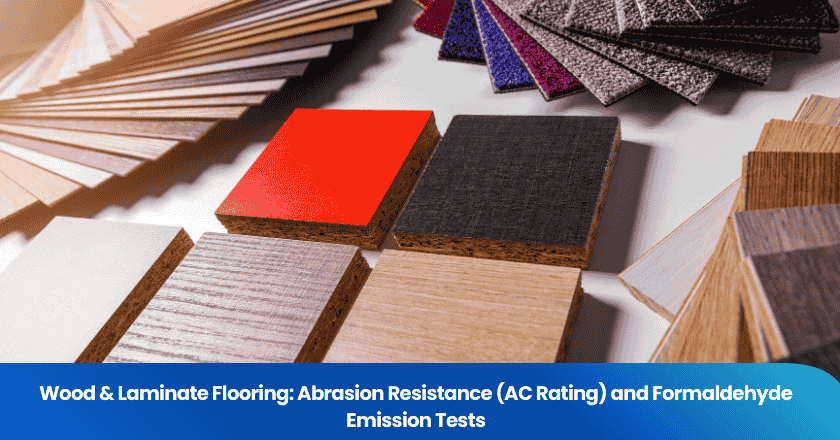
Two quality problems dominate the flooring import space from China. The first is visible but slow-moving: a laminate floor sold as commercial grade that scratches and wears through within months of installation — because the AC rating was misrepresented or not verified. The second is invisible and potentially serious: formaldehyde off-gassing from the composite wood core at levels that violate US EPA TSCA Title VI regulations or EU E1 standards. For importers sourcing laminate and engineered wood flooring from Chinese factories, understanding both the AC abrasion rating system and the formaldehyde compliance framework — and knowing how inspection and testing verify each — is essential protection before goods reach a container.
Key Takeaways
- AC Rating (Abrasion Class) is an internationally recognized durability classification defined by European standard EN 13329, ranging from AC1 (very light residential use) to AC6 (heavy industrial use). It measures resistance to abrasion, impact, staining, and fading — not just scratch resistance.
- Formaldehyde emissions from composite wood (HDF/MDF core, adhesives) are regulated in the US under EPA TSCA Title VI (40 CFR Part 770) and in Europe under E1/E0 standards. Since March 22, 2024, laminated flooring producers exporting to the US must comply with hardwood plywood panel producer requirements under TSCA Title VI.
- CARB ATCM Phase II — the California Air Resources Board standard — is the precursor to TSCA Title VI and is set at identical emission limits. US importers must now label products as TSCA Title VI compliant, not CARB Phase II.
- Formaldehyde emission limits: E1 (European) = 0.1 ppm (0.124 mg/m³); E0 = 0.07 mg/L in perforator test; TSCA Title VI for hardwood plywood = 0.05 ppm; for MDF = 0.11 ppm; for particleboard = 0.09 ppm.
- Factory inspection verifies AC class markings, wear layer thickness, and TSCA/CARB/E1 certification documentation. Laboratory testing provides independent quantification of formaldehyde emissions when certification records are not available or need spot-check verification.
The AC Rating System: What It Measures and Why It Matters
How AC Rating Is Determined Under EN 13329
The AC (Abrasion Class) rating for laminate flooring is determined through a comprehensive set of tests defined in European standard EN 13329, developed by the European Producers of Laminate Flooring (EPLF). It is not a single test result — it is a composite durability classification that a product must earn by passing multiple standardized performance tests simultaneously.
The primary component of the AC rating is the Taber abrasion test, which measures how many rotations of abrasive sandpaper wheels are required to wear through the laminate's surface layer (the decor layer) at at least three test locations. This rotation count — called the IP, or Initial Point — determines which AC class the floor achieves. The higher the IP, the higher the AC class. But the AC rating also requires passing tests for impact resistance (steel ball dropped from specified heights), stain resistance (24-hour exposure to common household chemicals), swelling at edges (resistance to moisture penetration at cut edges), and resistance to large and small burns. A floor that achieves excellent Taber abrasion results but fails the impact test would not be classified to the corresponding AC level.
AC Rating Classes: What Each Level Means in Practice
The AC rating scale runs from AC1 through AC6 in the EN 13329 system, though AC6 is rare and typically reserved for extreme industrial applications.
| AC Rating | EN 13329 Use Class | Suitable Environments | Typical Min. Taber IP |
|---|---|---|---|
| AC1 | Domestic Light | Bedrooms, guest rooms — very low traffic | ≥900 rotations |
| AC2 | Domestic General | Living rooms, dining rooms — average residential use | ≥1,500 rotations |
| AC3 | Domestic Heavy | All residential areas: kitchens, hallways, entryways | ≥2,000 rotations |
| AC4 | Commercial General | Offices, boutique retail, light hospitality | ≥4,000 rotations |
| AC5 | Commercial Heavy | High-traffic retail, department stores, public buildings | ≥6,000 rotations |
| AC6 | Industrial | Industrial facilities, extremely high abrasion environments | ≥10,000 rotations |
AC Rating vs. Wear Layer Thickness: Why One Number Isn't Enough
A critical distinction that many buyers miss: the AC rating measures the performance of the finished wear layer surface, not its thickness. A laminate with a thicker aluminum oxide wear layer generally achieves a higher AC rating, but wear layer thickness and AC rating are not perfectly correlated. Some manufacturers achieve higher Taber IP counts through the specific formulation of their aluminum oxide coating rather than purely through thickness. Conversely, a floor marketed with a thick overall thickness (12mm total product) may have a relatively thin wear layer delivering only AC3 performance. For buyers purchasing flooring from Chinese factories, specifying both the minimum AC rating AND a minimum wear layer thickness in your purchase order provides better protection than either specification alone.
The North American market also uses the NALFA LF-01 certification standard from the North American Laminate Flooring Association, which covers similar durability properties but uses a four-tier classification (Residential Light, Residential General, Heavy Residential, Commercial). NALFA certification considers impact, stain, and scratch resistance alongside wear — not just the Taber abrasion result.
Formaldehyde Emissions: The Non-Negotiable Compliance Requirement
Why Composite Wood Flooring Emits Formaldehyde
Laminate flooring and engineered wood flooring use composite wood cores — typically High-Density Fiberboard (HDF), Medium-Density Fiberboard (MDF), or plywood — bonded together with urea-formaldehyde (UF) resin adhesives. UF resins are preferred by manufacturers for their excellent bonding performance and cost efficiency, but they release formaldehyde gas slowly over time as the resin breaks down. Formaldehyde is classified as a known human carcinogen at sustained high concentrations, and its presence in flooring installed in enclosed living spaces is a documented indoor air quality concern.
Chinese laminate flooring has been the subject of significant regulatory scrutiny in the US and EU precisely because formaldehyde levels in some imported products have been found to exceed domestic standards. High-profile enforcement cases have involved Chinese-manufactured laminate flooring found to emit formaldehyde at multiples of the permitted CARB/TSCA levels. These incidents have driven increased regulatory attention, tighter enforcement at import, and growing consumer awareness that formaldehyde compliance is not assumed — it must be verified.
TSCA Title VI: The US Federal Formaldehyde Standard
EPA TSCA Title VI (40 CFR Part 770), which became fully effective for most composite wood product importers in March 2019, sets mandatory formaldehyde emission limits for hardwood plywood, MDF, and particleboard sold, supplied, or imported into the United States. The emission limits are: hardwood plywood — 0.05 ppm; MDF and thin-MDF — 0.11 ppm; particleboard — 0.09 ppm.
A significant compliance expansion took effect on March 22, 2024: laminated product producers — including manufacturers of engineered wood flooring that apply a wood veneer to a composite wood substrate — are now classified as hardwood plywood panel producers and must comply with the corresponding TSCA Title VI panel producer requirements, including EPA-recognized third-party certification (TPC), quarterly audits, and lot-by-lot testing with results reported to the certifier.
For US importers, compliance obligations are concrete: all regulated composite wood products and finished goods containing them must be certified as TSCA Title VI compliant by an EPA-recognized TPC, labeled with a TSCA Title VI compliance statement in English (and French for Canadian market), and accompanied by import certification documentation at the US border. Importers who sell or import non-compliant products face civil penalties under TSCA.
European Standards: E1, E0, and EN 16516
In Europe, formaldehyde emissions from wood-based panels are regulated under two frameworks. The traditional classification — E1 and E0 — uses the perforator test method (EN ISO 12460-5) to measure formaldehyde content in the board material. E1 requires formaldehyde content ≤8 mg/100g of board (dry); E0 requires ≤5 mg/100g. The corresponding air emission equivalent for E1 is approximately 0.1 ppm (0.124 mg/m³) — the limit referenced in product labeling. E0 is more restrictive at approximately 0.07 mg/L in the perforator test.
The newer EN 16516 standard uses a chamber emission test method that more closely reflects real-world indoor air conditions, and is increasingly referenced in EU construction product regulations. For buyers importing flooring to Germany or other EU markets that require LFGB-standard documentation, formaldehyde emission testing using EN 16516 may be the appropriate standard to specify alongside — or in place of — the traditional E1 perforator test.
The table below summarizes the emission limits by standard and market.
| Standard | Market | Limit (hardwood plywood / HDF) | Certification Required |
|---|---|---|---|
| TSCA Title VI | USA (federal) | 0.05 ppm (HWPW); 0.11 ppm (MDF) | EPA-recognized TPC; TSCA label required |
| CARB ATCM Phase II | California (same as TSCA) | Identical to TSCA Title VI limits | CARB-approved TPC; TSCA label required post-2019 |
| E1 | Europe (baseline) | ≤8 mg/100g (perforator) / 0.1 ppm air | CE marking; supplier test report |
| E0 | Europe (stricter) | ≤5 mg/100g (perforator) | Supplier declaration; lab test |
| F**** (Japan JAS) | Japan | ≤0.3 mg/L (desiccator method) | JAS-certified manufacturer or test lab |
Factory Inspection for Flooring Quality: What Gets Checked
AC Rating Verification at the Factory
Taber abrasion testing — the core of AC rating determination — requires specialized laboratory equipment and cannot be performed during a standard pre-shipment inspection visit. Factory inspection for AC rating compliance focuses on documentary verification and physical measurement. The inspector reviews the factory's EN 13329 test reports from an accredited laboratory for the specific product line, confirms that the declared AC class is consistent with the test results, and checks that product packaging and labeling accurately reflect the certified AC class. Physical inspection of the wear layer surface — thickness measurement using a caliper or micrometer on edge cross-sections, and visual assessment of surface uniformity — provides supporting evidence.
A common AC rating fraud in the laminate flooring industry is products labeled as AC4 or AC5 that have only been Taber-tested to AC3 levels — or that carry test reports from previous product runs that may not reflect current production. Inspectors verify that test reports are recent (dated within 12 months), issued by an accredited laboratory against the specific product code on the purchase order, and that the factory's current production records can be linked to the certified formulation. TradeAider's pre-shipment inspection for flooring includes documentary review of EN 13329 or NALFA certification records alongside physical product verification.
Formaldehyde Compliance Verification: Documentation and Sampling
Factory inspection of formaldehyde compliance is primarily a documentation and sampling exercise. The inspector verifies that the factory holds a valid TSCA Title VI compliance certificate issued by an EPA-recognized TPC (for US-market goods), or E1/E0 test reports from an accredited European laboratory (for EU-market goods). Compliance certificates must be current and reference the specific HDF/MDF panel specifications used in the flooring product being ordered. A certificate covering one panel formulation does not automatically cover a different formulation used in a cost-reduced production batch.
For independent verification, the inspector can collect board samples from the production batch for shipment to an accredited testing laboratory. Formaldehyde emission testing using the small-scale chamber method (ISO 12460-2) or perforator method (EN ISO 12460-5) provides objective emission measurement against the applicable standard. This approach is particularly important for: first orders from a new factory; orders where the factory's certification has not been recently updated; or any order where the buyer has reason to suspect that less-expensive adhesive formulations may have been substituted.
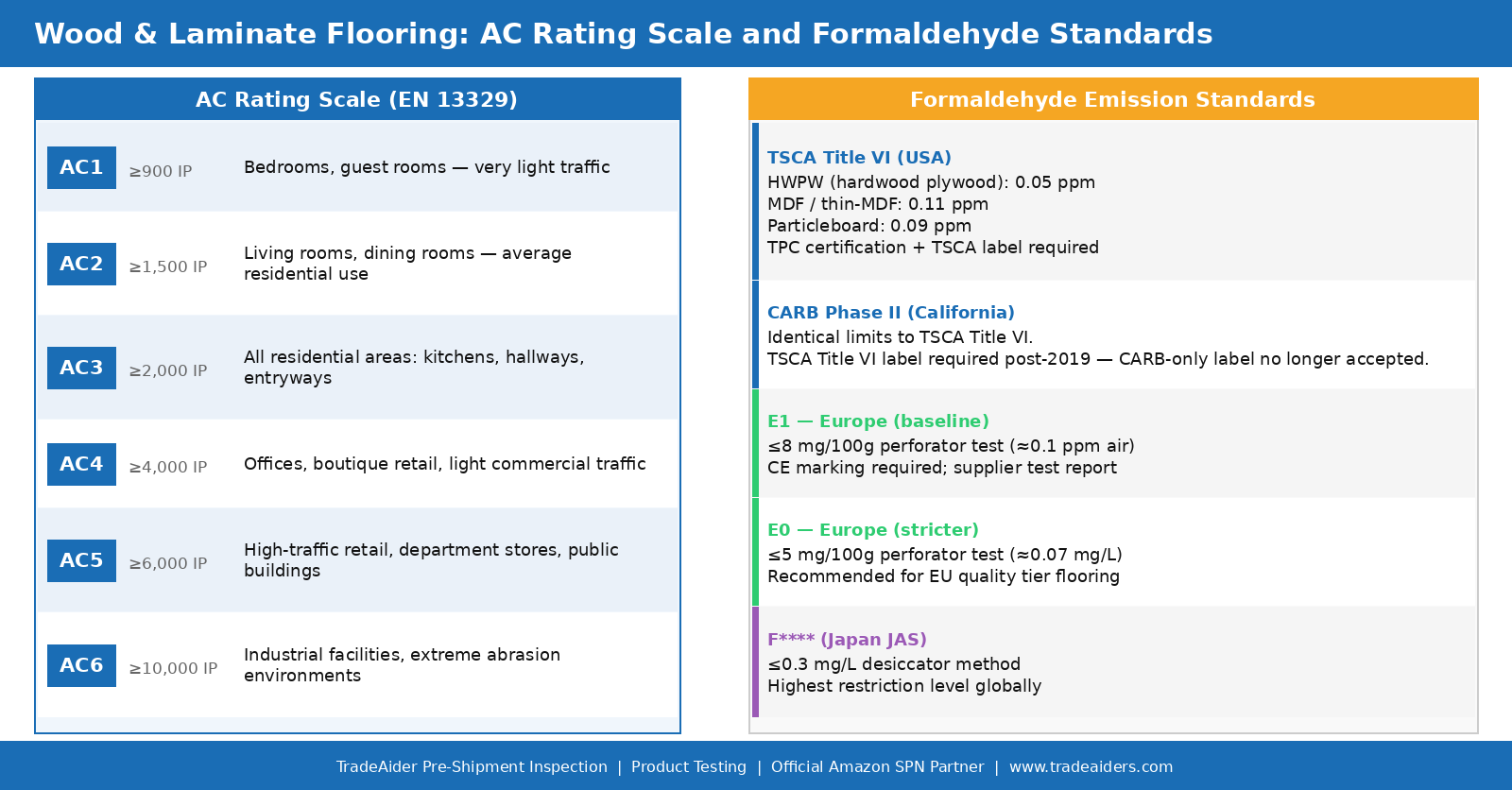
AC rating scale under EN 13329 and formaldehyde emission standards for wood and laminate flooring — key quality and compliance parameters for importers.
What Importers of Chinese Flooring Must Require Before Shipment
Documentation Package for TSCA Title VI Compliance
For flooring imported to the US market, the compliance documentation package should include: the factory's TSCA Title VI compliance certificate issued by an EPA-recognized TPC, including the certificate number and TPC identity; the most recent lot-level formaldehyde test report confirming the composite wood panel used in the product meets the applicable emission limit; the product label confirming the TSCA Title VI compliance statement (required to include fabricator name, production date in month/year format, and compliance statement); and, for shipments post-March 2024, confirmation that the laminated product producer is certified as a hardwood plywood panel producer under TSCA Title VI requirements.
Importers must also maintain import certification documentation — a written certification that the products comply with TSCA Title VI regulations — which must be available for inspection at the US border. Import certification requirements have been in effect since March 22, 2019. Products without TSCA Title VI labels and import certification can be detained or refused entry by US Customs.
For European Market Orders
For flooring exported to EU markets, require: the factory's formaldehyde test reports per EN ISO 12460-5 (perforator method) confirming E1 (≤8 mg/100g) or E0 (≤5 mg/100g) classification; CE marking documentation for the product as a construction material; and if the product will be sold in Germany or other markets where LFGB compliance is expected for direct food-contact flooring accessories, additional migration testing may be required. Specifying E0 rather than the baseline E1 provides a meaningful safety margin and aligns with the direction of EU regulation, which has been progressively tightening emission limits.
Specifying Flooring Quality in Your Purchase Order
A complete flooring purchase order specification should include: AC class minimum (e.g., "AC4 minimum per EN 13329, with supporting Taber test report from an accredited laboratory"), wear layer thickness minimum (e.g., "≥0.5mm aluminum oxide wear layer"), overall thickness, core type (HDF, MDF, or plywood — each has different stiffness and moisture performance characteristics), formaldehyde emission standard (e.g., "TSCA Title VI compliant, HDF core ≤0.11 ppm, with current TPC certificate"), surface finish and emboss specification, locking system type (click/lock, glue-down), and any installation environment requirements (moisture resistance for bathroom or kitchen use).
TradeAider's quality inspection standard provides the conformance framework that inspectors apply against your PO specifications. The Inspection Charge Calculator can estimate inspection costs for your flooring order.
Frequently Asked Questions
What is the minimum AC rating for residential laminate flooring in the US?
There is no single US federal minimum, but AC3 is the industry-recognized minimum for all residential applications including high-traffic areas like kitchens, hallways, and entryways. For light residential use (bedrooms, low-traffic areas), AC2 is technically sufficient. AC3 should be considered the practical baseline for any residential laminate floor sold in the US market, as installation in high-traffic rooms with an AC1 or AC2 floor can result in premature wear, customer complaints, and returns. For commercial applications — retail stores, offices, hospitality — AC4 is the minimum generally recommended.
What does TSCA Title VI compliant mean on laminate flooring packaging?
A TSCA Title VI compliant label on laminate flooring packaging means the composite wood panels used in the product have been tested and certified by an EPA-recognized third-party certifier (TPC) as meeting the US federal formaldehyde emission limits under Title VI of the Toxic Substances Control Act. The label must include the fabricator's name, the production date (month/year), and the compliance statement. Since March 22, 2019, only TSCA Title VI compliance labels are accepted for products entering the US market — labels referencing only CARB ATCM Phase II compliance are no longer sufficient. Importers and retailers who sell non-compliant products or products without proper labeling face enforcement action under TSCA.
How can I verify that a Chinese flooring factory's formaldehyde certification is real?
EPA maintains a public list of recognized TSCA Title VI third-party certifiers (TPCs). A factory's TSCA certificate should reference a TPC from this list, and you can contact the TPC directly to verify the certificate number and its current validity. For CARB-related certificates, CARB publishes a list of approved TPCs on its website. If a factory provides a certificate from a TPC not on either list, or one that cannot be independently verified, it should be treated as non-compliant documentation. Additionally, for independent verification of the actual emission level, a QC inspector can collect HDF/MDF panel samples during pre-shipment inspection and submit them to an accredited test laboratory for emission testing against TSCA Title VI or E1 limits.
What is the difference between AC rating and wear layer thickness in laminate flooring?
The AC rating measures the performance of the wear layer surface under standardized abrasion, impact, and stain tests — it is a tested outcome, not a physical dimension. Wear layer thickness is the physical measurement of the aluminum oxide-infused surface layer, typically reported in millimeters (e.g., 0.3mm, 0.5mm, or 1mm). A thicker wear layer generally enables a higher AC rating, but the relationship is not simple or guaranteed. Different aluminum oxide formulations and infusion densities can produce different Taber abrasion performance at the same physical thickness. For buyers, specifying both a minimum AC rating (performance) and a minimum wear layer thickness (physical specification) provides better protection than either alone — and gives the factory clear, verifiable targets for production.
Verify Your Flooring Compliance Before Shipment
A container of laminate flooring that misrepresents its AC rating or fails TSCA Title VI formaldehyde compliance is a liability that does not become apparent until it is in customers' homes or until US Customs runs a spot check. Both outcomes are expensive — and avoidable.
TradeAider's pre-shipment inspection for flooring verifies AC class documentation, wear layer measurements, product labeling compliance, and TSCA/E1 certification records — with real-time reporting during the inspection so you can take corrective action before your goods load into a container.
Book a flooring pre-shipment inspection → or request laboratory formaldehyde emission testing to independently verify your Chinese supplier's compliance certificates.
Related Articles
Grow your business with TradeAider Service
Click the button below to directly enter the TradeAider Service System. The simple steps from booking and payment to receiving reports are easy to operate.

