
A shipment of bath accessories—soap dishes, toothbrush holders, loofah organizers, shower caddies—arrives at a fulfillment warehouse after 28 days at sea. When the cartons are opened, several products show visible mold patches on their surfaces or inside their packaging. The shipment fails receiving inspection, the buyer files a claim, and the factory denies responsibility because they say the products were dry when they shipped. This scenario plays out routinely in bath accessory imports from China, and it's almost entirely preventable through a combination of factory-level quality checks and proper container preparation—both of which fall squarely within the scope of a professional 3rd party inspection in China.
Bath accessories are uniquely vulnerable to mold and mildew because they're designed for a wet environment. Many are made from organic or semi-organic materials—natural bamboo, rubberwood, rattan, cotton fabric components—that absorb moisture readily. Even products made from ABS plastic or ceramic can develop mold inside packaging if carton moisture content is too high when sealed. Understanding where the moisture risk originates and how a 3rd party inspector identifies and addresses it gives importers a practical framework for eliminating mold claims before they start.
Key Takeaways
- Mold on bath accessories almost always originates from excessive material or carton moisture at the time of packing—not from the ocean transit itself—making factory-level moisture checks the most important prevention tool.
- Relative humidity above 65% in a factory or warehouse environment creates conditions where mold spores can activate and grow on wood, cotton, and natural fiber bath products within days.
- Container desiccant is a critical layer of protection but not a substitute for dry goods at packing: inspectors should verify moisture content of materials and cartons before container loading is approved.
Why Bath Accessories Are High-Risk for Mold and Mildew
The mold risk in bath accessory shipments is concentrated at two points in the supply chain: the factory packing stage and the ocean container transit. Understanding which materials are most vulnerable at each stage determines how an inspection plan should be structured.
Material Risk: Wood, Bamboo, and Natural Fiber Components
Bamboo bath caddies, wooden soap dishes, and cotton-fabric hampers are among the highest-mold-risk bath accessories because their base materials are hygroscopic—they absorb and release moisture depending on surrounding humidity. A bamboo product that was machined and lacquered at 18% moisture content and then packed immediately into a sealed carton will continue to release moisture into the enclosed carton environment. If the carton is not properly ventilated during transport, this moisture has nowhere to go and provides the humidity that mold spores need to germinate. Importers shipping from Chinese factories to destinations like Chile or Northern Europe on transit routes exceeding 30 days face the highest risk, because the extended sealed-container time allows progressive moisture accumulation even when individual product moisture levels appear acceptable at loading.
A professional 3rd party inspector verifies material moisture content using a handheld pin-type or non-destructive moisture meter at the time of pre-shipment inspection. For wooden and bamboo bath accessories, the target moisture content at packing should be 10–14% for most destination climates—following the general recommendation used in furniture and wooden goods exports. Products measuring above 15% should be flagged as requiring additional drying before packing is permitted.
Carton and Packaging Risk
Corrugated cartons are made primarily from wood pulp—a hygroscopic material that acts as a moisture reservoir inside the container. When cartons are stored in a factory or warehouse with high ambient humidity before packing, they absorb moisture from the air. A carton that feels dry to the touch can have a moisture content well above safe levels. During ocean transit, as container temperatures fluctuate between day and night, this moisture is released into the container air and can condense onto cooler product surfaces—a phenomenon known as container rain.
The DIN 55474 standard provides the industry-accepted method for calculating desiccant requirements based on container volume, cargo moisture content, hygroscopic packaging weight, and transit duration. For bath accessory shipments from southern China during the April–September rainy season, when ambient factory humidity regularly exceeds 80% relative humidity, carton moisture control is particularly critical and inspectors should explicitly check carton moisture content in addition to product moisture levels.
What a 3rd Party Inspector Checks for Mold Risk
A properly scoped pre-shipment inspection for bath accessories in China includes several mold-specific checks that go beyond standard visual workmanship review. These checks apply regardless of material type but are weighted toward products with organic components.
Factory Environment Humidity Check
The inspector arrives at the factory with a digital hygrometer and records the ambient relative humidity in the packing area at the time of inspection. Relative humidity above 65% in a packing or storage environment is the threshold above which mold spore activation is accelerated across most organic materials. If the factory packing area exceeds 65% RH on the inspection day—common in Guangdong and Zhejiang during summer months—the inspector flags this condition and documents whether the factory has dehumidification equipment operating in the packing space.
For TradeAider's Pre-Shipment Inspection service, ambient humidity is recorded at the start of every bath accessories inspection during the April–September period, and packing-area humidity above 70% triggers an automatic advisory note in the inspection report recommending delayed packing until conditions improve or dehumidification is confirmed as operational.
Product and Carton Moisture Content Testing
Using a calibrated pin-type moisture meter, the inspector spot-checks wooden, bamboo, and rattan bath product surfaces at multiple points. For assembled products with lacquer or coating, a non-destructive capacitance-based moisture meter is used to detect moisture trapped beneath the surface finish—a common failure mode where a factory applies a lacquer coat over insufficiently dried wood to pass a visual inspection, only for the trapped moisture to continue migrating and eventually cause the lacquer to bubble or mold to develop inside the packaging weeks later.
The inspector also checks empty carton moisture content at several points before packing begins. A carton that measures above 12% moisture content at packing is at elevated risk for being a moisture source during transit and should either be replaced or air-dried to an acceptable level before use. This check is most important for buyers shipping during the Chinese rainy season, when factories in Guangdong, Fujian, and Zhejiang provinces routinely operate in warehouse conditions where carton moisture levels can reach 16–18% without triggering any internal quality alert.
Container Loading Supervision: Desiccant Verification
Even when product and carton moisture content is within acceptable limits at packing, container transit exposes goods to temperature fluctuations that cause residual moisture to migrate. Desiccant placement inside the container is the final layer of protection, and pre-loading verification ensures desiccant is correctly placed before the container doors are sealed.
Standard industry guidance for hanging calcium chloride desiccant strips recommends 6–8 strips for a 20GP container and 10–16 strips for a 40HQ container, distributed evenly along the container walls and particularly concentrated near the doors where condensation risk is highest. The CLS inspector verifies the quantity, placement, and condition of desiccant at loading, documents this with photographs, and confirms that cartons are stacked with adequate air circulation gaps between the load and container walls. Desiccant performance in real shipping conditions differs substantially from climate-chamber test ratings—a product rated at 400% absorption in a lab test may only absorb 150–200% in actual container conditions—so specifying sufficient quantity margin is important, particularly for long-haul routes to Europe or the US East Coast.
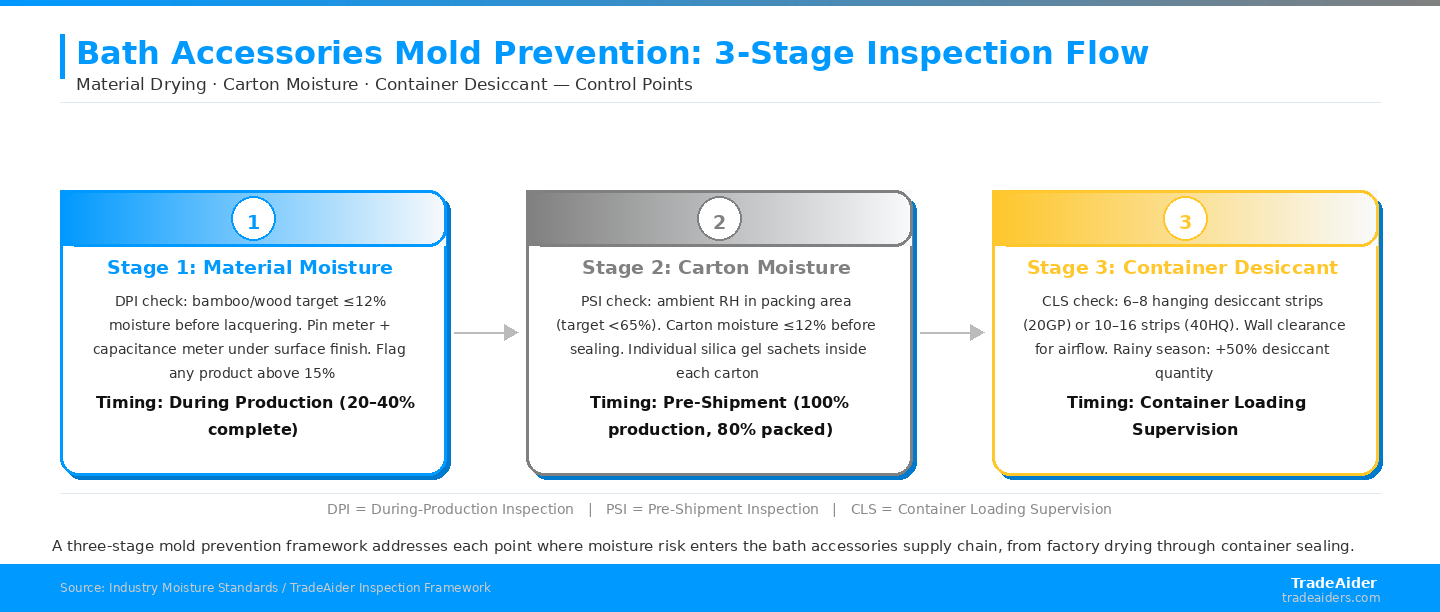
A three-stage mold prevention framework—covering material moisture at production, carton moisture at packing, and desiccant protection at container loading—addresses each point where moisture risk enters the supply chain.
Material-Specific Mold Prevention Checklist for Bath Accessories
| Material | Target Moisture % | Key Inspection Check | Additional Risk |
|---|---|---|---|
| Bamboo | ≤12% | Pin moisture meter at 3+ points per unit | Lacquer trapping subsurface moisture |
| Rubberwood / pine | ≤12% | Capacitance meter under finish layer | Knot areas retain more moisture |
| Rattan / wicker | ≤10% | Check interior weave intersections | Weave joints trap moisture internally |
| Cotton fabric inserts | ≤8% | Weight-based moisture test on sample fabric | Rapid mold growth at >12% moisture |
| ABS / PP plastic | N/A (non-hygroscopic) | Carton moisture check; visual for moisture inside packaging | Mold grows on carton, not product |
| Corrugated carton | ≤12% | Pin meter on carton walls before packing | Primary moisture source in plastic-product shipments |
Desiccant Quantity Planning for Bath Accessory Shipments
Calculating the correct amount of desiccant for a bath accessory container shipment involves accounting for four variables: the volume of the container, the expected moisture content of the cargo and packaging materials, the transit duration, and the climate of the shipping route. The choice between silica gel and calcium chloride desiccants affects performance significantly: silica gel maintains a more consistent absorption rate across temperature changes but has a lower total capacity, while calcium chloride has a higher total absorption capacity but transforms into a liquid gel as it saturates—making leak-proof desiccant bag quality an important specification point.
A practical planning guideline for bath accessory shipments: use approximately 5–10 grams of desiccant per cubic foot of container space as a baseline for standard 20–30 day routes, and increase to 15 grams per cubic foot for rainy season shipments from China to Northern Europe or North America on 35+ day routes. For shipments during May through September from Guangdong or Zhejiang, where factory ambient humidity is consistently highest, hanging calcium chloride container desiccant strips should be supplemented with individual carton-level silica gel sachets placed inside each outer carton, particularly for wooden or bamboo products.
Practical Example: A Home Brand's Bath Accessory Inspection Plan
Consider a direct-to-consumer home brand sourcing a 5-piece bamboo bath accessory set—soap dish, toothbrush holder, cotton-rope storage basket, bamboo shower caddy, and wooden mirror frame—from a Guangdong factory. Their order is 1,500 sets, shipping in August during peak rainy season humidity. This order has maximum mold risk: bamboo and wood are the two highest-risk materials, the cotton-rope basket adds a fabric moisture vector, and the August shipping date coincides with the highest factory ambient humidity period of the year.
The inspection plan for this order should include a DPI at 40% production to verify that the bamboo and wood components are being properly kiln-dried before assembly and lacquering. The PSI should include: ambient humidity measurement in the packing area, pin moisture meter checks on bamboo and wooden components from the AQL sample, carton moisture checks on a sample of 10 cartons before packing begins, and confirmation that the factory is placing individual silica gel sachets inside each product carton. For the container loading, a Container Loading Supervision inspection should verify that hanging calcium chloride desiccant strips are installed—minimum 14 strips for a 40HQ container given the August rainy season conditions—and that carton stacking leaves wall clearance for air circulation. For brands targeting the EU market, chemical compliance verification is also required: EU Cosmetics Regulation 1223/2009 prohibits heavy metals in personal care accessories including bath items with skin contact, and any surface finishes on wooden components must be tested for formaldehyde and VOC emissions before the product is listed on EU retail platforms. Use TradeAider's AQL calculator to determine the correct sample size for the moisture content verification checks based on your order quantity and target inspection level.
FAQ
How do I know if mold on my bath accessory shipment is the factory's fault or a shipping problem?
The key diagnostic is the location and pattern of mold growth. Mold that originates from product or carton moisture at packing typically appears uniformly across products from multiple carton positions in the container, and affects organic materials (wood, bamboo, cotton) more heavily than plastic products in the same carton. Mold caused by container rain or transit condensation typically appears more heavily on products near the container walls or doors, and often shows water staining on carton surfaces before mold is visible on products themselves. A pre-shipment inspection that documents product and carton moisture content at the time of packing creates a clear record that supports or refutes factory liability claims. Without pre-shipment moisture documentation, origin liability disputes are rarely resolved in the buyer's favor because the factory correctly notes that moisture accumulation after the container doors closed cannot be attributed to them.
Should I use silica gel or calcium chloride desiccant for bath accessory shipments?
For bath accessory shipments on 20–35 day ocean routes, calcium chloride hanging desiccant strips are the more effective choice for container-level moisture control because their higher total absorption capacity handles the moisture released by hygroscopic cargo and packaging better than silica gel at equivalent weights. Silica gel is better suited as a carton-level supplemental desiccant because it is stable, non-leaking, and performs consistently at the lower humidity levels found inside individual sealed cartons. Independent testing of desiccant performance in real shipping conditions consistently shows that calcium chloride products achieve higher useful absorption in actual container environments than silica gel products at equivalent rated capacity, making it the preferred choice for the primary container-level protection layer on moisture-sensitive cargo routes.
What moisture content should bamboo bath products have before packing?
The target moisture content for bamboo bath accessories at the time of packing is 10–12% for typical 15–30 day shipping routes to North America or Europe. This target accounts for some moisture gain during transit while remaining below the 15% threshold above which mold growth risk increases substantially. Products with lacquered or painted surfaces require an additional check: the moisture content should be measured before the surface finish is applied, because lacquer seals moisture into the substrate. A bamboo product lacquered at 16% moisture content may read as dry on the finished surface but will continue releasing moisture internally, eventually causing finish bubbling and mold growth underneath the coating—a failure mode that typically appears 4–8 weeks after the consumer receives the product. Specify pre-lacquer moisture content as a quality requirement in your purchase order and instruct your inspection provider to verify it during the DPI stage, before coating is applied. For comprehensive bath accessory inspection scope including moisture checks, TradeAider's inspection scope covers these material-level verifications as part of a standard home goods inspection plan.

Related Articles

Grow your business with TradeAider Service
Click the button below to directly enter the TradeAider Service System. The simple steps from booking and payment to receiving reports are easy to operate.

