
- About Us

- Our Services
- Your Industry
- Resources
- News & Blog
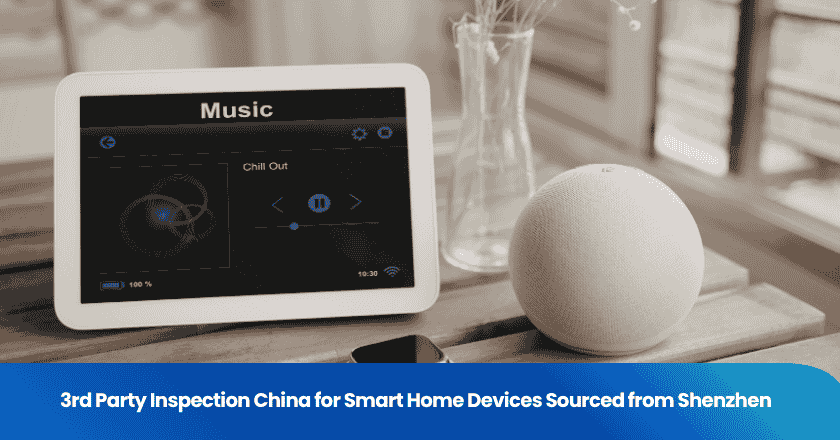
Shenzhen is the undisputed hub for smart home device manufacturing. Its ecosystem of component suppliers, PCB manufacturers, firmware developers, and contract assemblers allows buyers to source Wi-Fi-enabled plugs, smart locks, IoT sensors, and connected appliances at scale — but that same density creates quality risks that don't exist for simpler consumer goods. A 3rd party inspection for smart home devices in Shenzhen needs to go well beyond visual checks: it must verify wireless connectivity, firmware stability, app integration, EMC compliance, and safety certifications. This guide explains what a properly scoped third-party inspection covers for Shenzhen-sourced smart home products, and what buyers consistently miss.
Key Takeaways
- Smart home device inspection must include functional testing of wireless protocols (Wi-Fi, Bluetooth, Zigbee) — not just electrical safety and visual checks.
- Shenzhen manufacturers often share components across unrelated SKUs, creating traceability risks that a factory audit reveals but a product inspection alone doesn't.
- FCC (US), CE (EU), and China's CCC certification must be verified for the specific product version — not assumed based on generic module certifications.
- Firmware version control is a unique inspection item for smart home devices — an incorrect firmware version can disable intended features or create security vulnerabilities.
Why Shenzhen Smart Home Inspections Require a Different Approach
The Complexity Layered into Every Smart Home Device
A traditional home appliance has mechanical components, electrical circuitry, and a casing. A smart home device adds wireless communication hardware, embedded firmware, cloud connectivity, and a user-facing app layer — each of which is a potential failure point. When a smart plug fails to hold a Wi-Fi connection, the problem could lie in the wireless module's antenna design, the firmware's connection management logic, the router compatibility, or the cloud backend. A standard appliance inspector isn't equipped to distinguish between these causes — and without that distinction, an inspection result of "passed" means very little.
Shenzhen's manufacturing model compounds this complexity. Many smart home factories source modules (especially Wi-Fi/Bluetooth SoCs) from third-party suppliers and integrate them into their own PCBs. The module may carry its own FCC or CE certification, but the final product — once the module is integrated with the device's power supply, antenna, and casing — must be re-tested as a complete unit to confirm certification applies. Buyers who rely on module-level certifications without verifying finished product compliance are exposed to regulatory rejection at customs.
The Shenzhen Ecosystem: Advantages and Risks
Shenzhen's density is a genuine advantage — a factory can source components, manufacture PCBs, assemble products, and arrange testing and certification within a few kilometers. This compresses development timelines dramatically and makes Shenzhen a default choice for tech-forward consumer products. But that density also means factories can switch component suppliers quickly and without buyer notice. A component substitution — replacing a certified module with a similar but uncertified equivalent, or substituting a higher-grade capacitor with a lower-rated one — can happen between orders or even within an order. A 3rd party inspection with a component-level check (CDF — Component Data File verification) catches these substitutions before they leave the factory.
What a 3rd Party Inspection for Smart Home Devices Should Cover
1. Wireless Protocol Functional Testing
The core function of any smart home device is its wireless connectivity. Inspectors should test Wi-Fi, Bluetooth, or Zigbee pairing under representative conditions — not just in an ideal controlled environment. For Wi-Fi devices, this means testing connection stability at a moderate distance, verifying that the device connects to the correct network frequency band (2.4GHz vs. 5GHz per spec), and confirming that reconnection after a power cycle happens within the specified time window. For Bluetooth mesh devices (increasingly common in smart lighting and smart plugs), multi-node pairing should be tested if the product is sold as part of a mesh ecosystem.
2. App Integration Verification
Most smart home devices are sold with a companion app for setup and control. A functional inspection should confirm that the device pairs successfully with the manufacturer's app on at least two mobile operating systems (iOS and Android), that all advertised features accessible through the app function as specified, and that device status (on/off, energy consumption, scheduling) is reported accurately in real time. Discrepancies between the physical device state and the app-reported state — a common failure mode — indicate firmware or communication layer defects that will generate support tickets and reviews once the product reaches end users.
3. Firmware Version Control
Firmware version is a unique and frequently overlooked inspection item for smart home devices. Factories may ship products with an older firmware version than what was approved during development, either because the production batch was assembled before a firmware update, or because the factory is managing multiple SKUs and applied the wrong firmware. The wrong firmware version can disable specific features, alter the device's certification-required transmission parameters, or introduce known security vulnerabilities. Your inspection checklist should specify the approved firmware version number, and the inspector should verify it on a sample of units using the device's configuration interface or the companion app's device info screen.
4. EMC and Safety Compliance Verification
Smart home devices sold in the US require FCC authorization for intentional radiators (any device that transmits wirelessly). Devices sold in the EU require CE marking covering the Radio Equipment Directive (RED), which includes both radio performance and safety testing per EMC standards aligned with CISPR 14-1. China's CCC certification under the updated GB 4343.1-2024 (effective June 2026) now requires expanded EMC testing including new frequency ranges and wired network port emission limits — directly relevant to smart home devices with Ethernet or wired mesh capabilities.
An inspector cannot perform lab-level EMC testing in the field, but can and should verify that the certification marks on the product match the documentation on file, that the model number on the label matches the certified model, and that there have been no hardware changes (antenna type, power supply components) that would invalidate existing certification. For higher-value orders, pre-shipment testing at an accredited Shenzhen lab can confirm certification compliance before goods ship.
| Inspection Area | What's Checked | Why It Matters |
|---|---|---|
| Wireless Connectivity | Wi-Fi/BT/Zigbee pairing, signal stability, reconnection | Core product function — failure = returns |
| App Integration | iOS/Android pairing, feature accuracy, real-time status | User experience directly tied to reviews |
| Firmware Version | Version number vs. approved spec, feature parity | Wrong firmware disables features or creates security risk |
| Certification Marks | FCC/CE/CCC label vs. documentation match, model number | Customs rejection if marks don't match |
| Component Check (CDF) | Critical component marking vs. approved BOM | Substituted components invalidate certification |
| Electrical Safety | Hi-pot, insulation resistance, leakage current | Safety hazard if powersupply is substandard |
The Case for a Factory Audit Before Inspection
Why Smart Home Factories Warrant Upfront Due Diligence
For importers sourcing smart home devices from a new Shenzhen factory, a factory audit before placing a production order is particularly valuable. Shenzhen's smart home manufacturing segment includes a wide range of factory types — from sophisticated ODM operations with in-house testing labs and full-time firmware teams, to smaller contract assemblers sourcing most components from Huaqiangbei (Shenzhen's famous electronics market) and relying on third-party firmware. These factory types produce very different quality risk profiles, and a factory audit reveals which you're dealing with before you commit production capital.
Key areas a Shenzhen smart home factory audit should assess: Does the factory have in-house RF testing capability or rely on external labs? How is firmware version control managed across production runs? Does the factory maintain a component approved vendor list (AVL), and are substitutions subject to a formal approval process? What traceability exists from the PCB batch to the finished good? These questions directly determine the quality risk profile of your order, and they can only be answered through an on-site audit, not a product inspection.
Real-Time Audit Visibility for Remote Buyers
Most importers sourcing smart home devices from Shenzhen are based in the US, EU, or Australia and cannot attend factory audits in person. Real-time visibility during the audit closes this gap. TradeAider's platform lets buyers follow the audit as it happens — viewing the auditor's findings, photos, and assessments in real time, and asking questions or redirecting focus through the platform. For smart home factory audits, this means a buyer's technical team can review the firmware development environment, the PCB inspection setup, or the RF test results as the auditor documents them — not three days later when a PDF arrives. Learn how real-time visibility changes the audit experience for remote buyers.
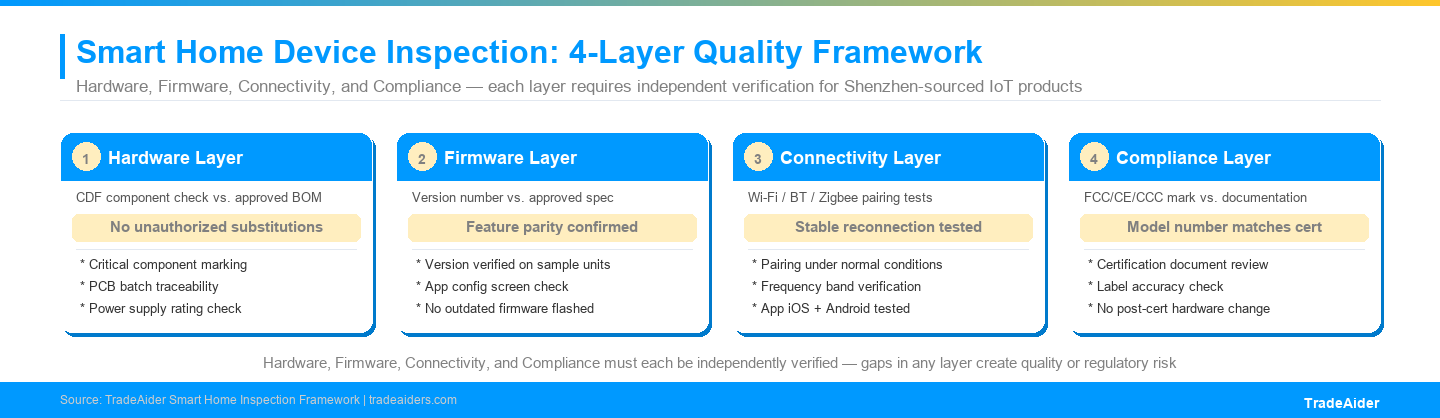
Smart home device inspection framework: four interlocking layers — hardware, firmware, connectivity, and compliance — must each be verified independently to produce a meaningful quality assurance result.
Timing Your Inspection for Maximum Effectiveness
Pre-Production Inspection (PPI): Validate Before Mass Production Begins
For smart home devices, a Pre-Production Inspection (PPI) before the production run begins is worth considering for new products or new suppliers. The PPI verifies that the factory has received correct components (matching the approved BOM), that the correct firmware version is staged for flashing, and that the production environment meets the requirements for handling PCBs and sensitive electronic components. Catching a firmware staging error or a component mismatch at this stage costs very little to correct; catching it after 10,000 units are assembled is a much larger problem. Learn more about Pre-Production Inspection (PPI) for electronics.
During Production Inspection (DPI): Catch Functional Failures Early
A During Production Inspection (DPI) for smart home devices ideally happens when the first 10–20% of the batch has been assembled and tested. At this stage, inspectors can catch systematic failures — a batch of units consistently failing to pair with the app, for example, or a Wi-Fi antenna that performs below spec due to a PCB layout issue — while the majority of production remains uncompleted and correctable. Given the complexity of smart home device assembly, a DPI often pays for itself several times over in avoided rework costs.
Frequently Asked Questions
Can a 3rd party inspector test Wi-Fi and Bluetooth performance in the field?
Yes — functional wireless testing in the factory environment is a standard component of smart home device inspections. Inspectors use consumer-grade test equipment (smartphones, test routers, reference apps) to replicate the conditions an end user would experience during setup and operation. This covers pairing success, reconnection behavior, and basic feature functionality. Full RF performance testing (transmission power, frequency accuracy, spurious emissions) requires lab-grade equipment and is done separately at an accredited testing facility.
How do I verify that my smart home device's FCC or CE certification is valid?
FCC ID numbers can be verified directly through the FCC's equipment authorization database at fccid.io or the official FCC GIDS portal. For CE, the manufacturer's Declaration of Conformity document should specify the standards tested and the testing lab. Your inspector can check that the FCC ID on the product label matches the authorized FCC ID in the documentation, and that the hardware configuration matches what was tested. Any hardware change — antenna type, power supply, PCB layout — that occurred after certification was issued should trigger re-testing.
What should I do if the inspection finds that the firmware version is wrong?
First, confirm the correct firmware version with your supplier and request a written commitment to reflash units before shipment. Second, arrange a re-inspection or at minimum a re-sample check after reflashing to confirm the correct version is installed across the batch. Third, consider adding a firmware version verification step to your factory's production test protocol — so this check happens on every unit during production, not only when an inspector is present.
Is one man-day enough for a smart home device inspection in Shenzhen?
For orders of 500–1,000 units with a straightforward product (single wireless protocol, basic app integration, standard electrical safety checks), one man-day is typically sufficient for a PSI. For more complex products — multiple wireless protocols, mesh networking, complex app feature sets — or for orders requiring both a functional test and a CDF component check, two man-days provides more complete coverage. Discuss the product complexity with your inspection company at the quoting stage to ensure adequate time is allocated.
Sourcing smart home devices from Shenzhen? Contact our team to schedule a factory audit or pre-shipment inspection — with real-time monitoring so you can follow the process live from wherever you are.
Related Articles

Grow your business with TradeAider Service
Click the button below to directly enter the TradeAider Service System. The simple steps from booking and payment to receiving reports are easy to operate.

