
- About Us

- Our Services
- Your Industry
- Resources
- News & Blog
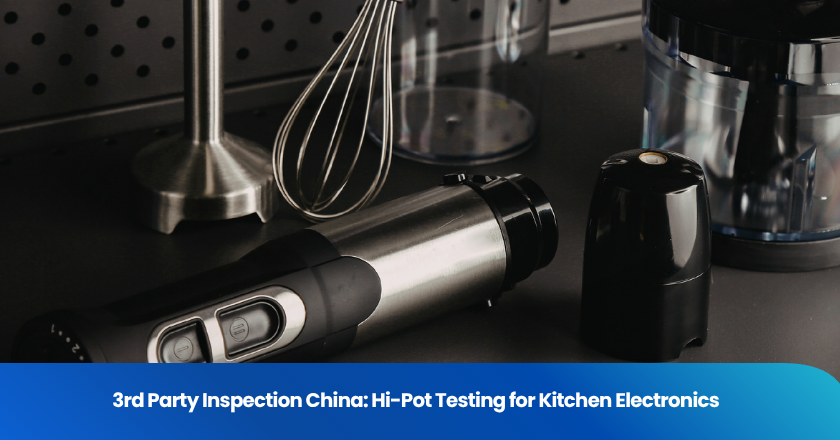
If you're importing kitchen electronics from China — toasters, rice cookers, electric kettles, blenders, air fryers — one test determines whether your shipment can physically leave the factory without killing someone: the hi-pot test. It's the single most consequential on-site test in any 3rd party inspection China program, and a single unit failing it triggers rejection of the entire batch. Yet many importers who've been ordering from China for years can't explain what it actually measures, which voltage level applies to their product, or what the pass/fail criteria is. This article closes that gap.
Key Takeaways
- Hi-pot testing (also called dielectric withstand testing) verifies that insulation prevents dangerous current from reaching a product's accessible surfaces.
- Class I appliances (with earth wire) use 1,500V AC; Class II appliances (double-insulated, no earth wire) use 3,500V AC during on-site inspection.
- A single hi-pot failure causes full batch rejection — no exceptions — because even one unit with compromised insulation is a fire and shock liability.
- Earth continuity testing is always paired with hi-pot testing for Class I appliances: resistance ≤ 0.1Ω at 25A for 1 second.
What Is Hi-Pot Testing and Why Does It Matter for Kitchen Electronics?
The Physics Behind the Test
Hi-pot is short for "high potential" — a deliberate application of voltage far above a product's normal operating range to stress-test the insulation separating live conductors from surfaces a user might touch. According to the comprehensive guide published by Vitrek, dielectric withstand testing applies voltages from 500V to 30kV depending on device type. For consumer kitchen electronics, the relevant range is typically 1,000V to 3,500V.
The test works by connecting the hi-pot tester between the product's live electrical circuit and its accessible external surfaces (metal chassis, control panels, any part a user could touch). A very high voltage is applied. If the insulation is intact, current flow will be minimal — below the defined leakage threshold. If insulation has been compromised — by a manufacturing defect, an assembly error, a pinched wire, or degraded material — current flows, the test fails, and the inspector marks the unit as a critical defect.
For a kitchen appliance like an electric kettle or air fryer, that manufacturing defect isn't a cosmetic annoyance. It's the difference between a product that works and one that electrocutes the person filling it with water.
Why Kitchen Electronics Are Particularly High-Risk
Kitchen electronics face a compound risk profile that makes hi-pot testing non-negotiable:
- Water proximity: Coffee makers, kettles, rice cookers, and steamers all work with liquid. Water dramatically reduces the resistance between exposed metal and the user's hands.
- High power: Many kitchen appliances draw 1,000–2,000W. Higher current means a compromised insulation failure is more consequential.
- Frequent use by non-technical users: Unlike industrial equipment, kitchen appliances are used daily by people with no electrical safety training.
- Variable assembly quality in high-volume production: A factory producing 50,000 units per month will have assembly variation. Hi-pot testing is the systematic catch for insulation failures that visual inspection can't see.
Class I vs Class II: Which Voltage Applies to Your Product?
The most common point of confusion for importers is that hi-pot test voltage isn't one fixed number — it depends on the product's insulation class. The BS EN 60335-1 production testing guidelines from Seaward specify different voltage requirements based on insulation type and operating voltage.
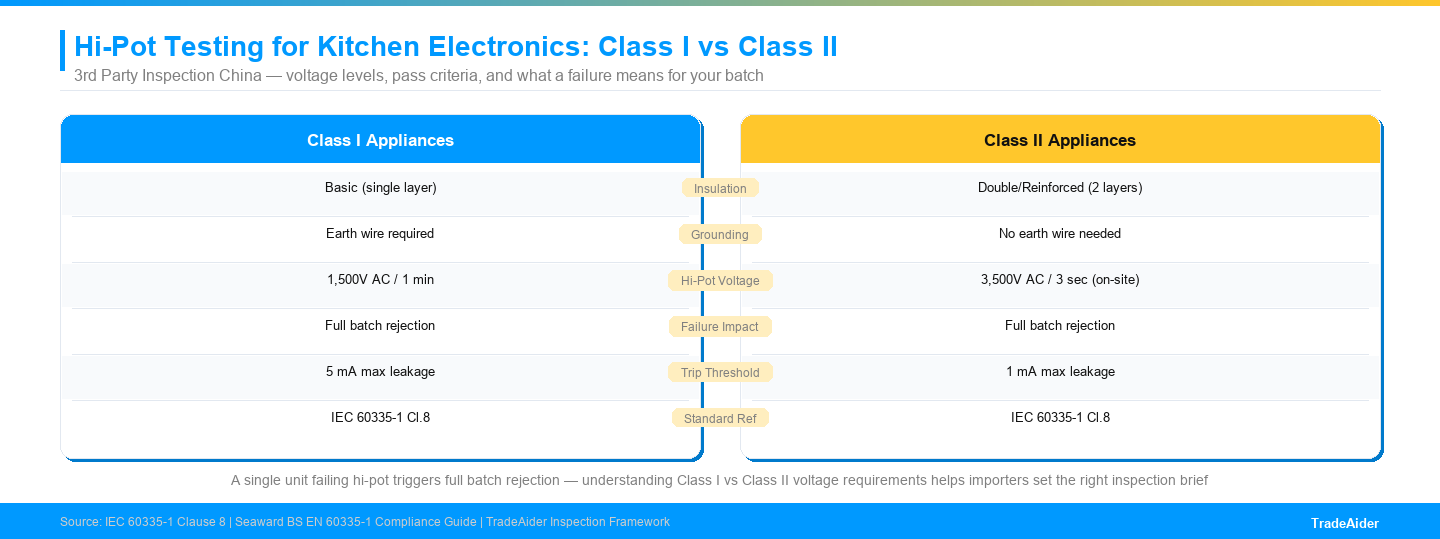
Class I and Class II appliances require fundamentally different insulation designs — understanding this distinction lets importers brief their 3rd party inspection China provider with the correct test parameters
Class I Appliances (Earthed)
Class I appliances rely on a combination of basic insulation and a protective earth connection. In the event of insulation failure, the fault current travels through the earth wire rather than through the user. Examples in the kitchen electronics category include most stand-alone toasters, some rice cookers, and professional-grade coffee machines. For Class I products, the hi-pot test applies 1,500V AC for 1 minute in laboratory conditions, or a shortened 3-second version in on-site PSI/DPI inspections. Earth continuity must also be verified separately: ≤ 0.1Ω resistance between accessible earthed metal parts and the ground pin, tested at 25A for 1 second.
Class II Appliances (Double-Insulated)
Class II appliances use double or reinforced insulation — two independent layers of insulation — as the safety mechanism, eliminating the need for an earth connection. This is the more demanding insulation standard, and it commands a correspondingly higher hi-pot test voltage: 3,500V AC. Many consumer kitchen electronics exported from China — cordless kettles, handheld blenders, most capsule coffee makers — are Class II designs. The on-site test runs at 3,500V for 3 seconds, with the unit connected to a current-sensing circuit that trips if leakage exceeds the threshold.
The Hi-Pot Test Procedure: What Happens On-Site
Equipment and Setup
A professional 3rd party inspection in China uses a calibrated hi-pot tester. The tester connects one terminal to the product's live circuit (typically at the power cord), and the other terminal to accessible external surfaces — metal housing, exposed screws, control buttons. For appliances with multiple isolated circuits, each circuit may need to be tested separately.
The In Compliance Magazine guide on hipot testing notes that equipment calibration is a standard requirement, with most certification bodies requiring daily functional tests of the hi-pot equipment and periodic NRTL-level calibration checks. An inspector using an uncalibrated tester can't produce a trustworthy result — which is why professional third-party inspection services maintain documented calibration records for all test equipment.
Sample Size and Pass/Fail Logic
Unlike AQL sampling (which accepts a statistically defined number of defects), hi-pot testing typically runs on the full sample drawn for inspection — or in some protocols, the full production batch. This is because the failure mode is not a minor cosmetic issue: it's a safety hazard with potential liability and recall implications. The pass/fail logic is absolute:
- One unit with leakage current exceeding the threshold = critical defect
- Critical defect = full batch rejection, regardless of other results
- No re-inspection of failed hi-pot units without complete insulation rework
For kitchen electronics destined for the EU, this connects directly to CE marking requirements under the Low Voltage Directive — a batch with documented hi-pot failures cannot legally be placed on the EU market without rectification.
The Three Tests Always Run Together
A complete electrical safety check for kitchen electronics runs hi-pot as part of a three-test sequence. According to the IEC 60335-1 compliance guide, the full electrical safety evaluation includes:
| Test | What It Measures | Pass Criteria | Applies To |
|---|---|---|---|
| Hi-Pot (Dielectric Withstand) | Insulation integrity under high voltage | No breakdown; leakage < 5mA (Class I) or < 1mA (Class II) | All classes |
| Earth Continuity | Resistance of earth path | ≤ 0.1Ω at 25A for 1 second | Class I only |
| Leakage Current | Current flow under normal operating conditions | ≤ 0.5mA (handheld) or ≤ 3.5mA (stationary) | All classes |
These three tests are not substitutes for each other — they measure different failure modes. A product can pass the hi-pot test (good insulation under high voltage) but still fail the leakage current test (small but continuous current flow under normal operation) if insulation has micro-degradation. Running all three gives a complete picture of the unit's electrical safety status.
For importers booking a pre-shipment inspection for kitchen electronics, TradeAider's Pre-Shipment Inspection (PSI) service includes all three electrical safety tests as standard for electrical appliances — not as an add-on.
What a Hi-Pot Failure Actually Tells You
When an inspector reports a hi-pot failure, it's not the end of the story — it's the beginning of a conversation with your factory. The failure indicates one or more of the following root causes:
- Pinched or damaged wiring: Assembly-line handling that cuts into wire insulation, often invisible externally
- Incorrect component substitution: A cheaper heating element or motor winding that doesn't meet the insulation rating specified in the approved BOM
- Contamination: Conductive debris (metal shavings from drilling or cutting) left inside the unit during assembly
- Moisture ingress: Inadequate sealing allows condensation during storage or transit, before the test is even run
- Design non-compliance: Insufficient creepage and clearance distances between live parts and accessible surfaces — a design flaw that affects the whole production run
The distinction between a production defect and a design defect matters enormously. A production defect may affect only a portion of units and can potentially be reworked. A design defect requires an engineering change and re-testing before any units can ship — which is precisely why Pre-Production Inspection (PPI) exists: catching design-level issues before mass production begins is dramatically cheaper than discovering them at the pre-shipment stage.
How to Brief Your 3rd Party Inspection Provider on Hi-Pot Requirements
When you book a 3rd party inspection in China for kitchen electronics, your checklist should explicitly state:
- Product insulation class: Class I (earthed) or Class II (double-insulated). This determines which voltage level the inspector applies.
- Target market: EU, US, UK, AU, or other — this affects which standard (IEC/UL/BS) the inspector references for pass criteria
- Required certifications to verify: CE marking (EU), UL mark (US), GS mark (Germany), or CCC (China domestic)
- Leakage current limit: Specify the applicable limit if your product type has a specific threshold under IEC 60335-2 sub-standards
- Earth continuity requirement: Confirm whether your product requires this test (Class I) or not (Class II)
A well-specified inspection brief costs you nothing extra and eliminates the ambiguity that leads to disputes about whether a failed unit should have been tested at 1,500V or 3,500V. TradeAider's inspectors are briefed with your product spec before arriving at the factory — the real-time platform means you can also monitor the electrical safety testing phase as it happens, not just receive a summary in a PDF report. Contact our team to discuss your kitchen electronics inspection requirements.
Frequently Asked Questions
Is hi-pot testing the same as the dielectric withstand test?
Yes. Hi-pot, hipot, dielectric withstand test, and flash test are all names for the same procedure: applying a voltage significantly above operating voltage to verify insulation integrity. The term "hi-pot" comes from "high potential" and is the most commonly used name in factory inspection contexts. "Dielectric withstand" is the technically precise IEC terminology.
Can hi-pot testing damage a product?
A properly calibrated hi-pot test on a compliant product should not cause damage — the test is designed with voltage levels that stress insulation without degrading it if the insulation is to specification. Products that are damaged by a hi-pot test were already non-compliant — the test revealed an existing weakness rather than creating one. This is why some factories resist hi-pot testing: it exposes pre-existing manufacturing defects.
What standard covers hi-pot testing for household kitchen appliances?
IEC 60335-1 (general requirements for household appliances) Clause 8 defines the electrical strength test. For specific product types, IEC 60335-2 sub-standards apply — for example, IEC 60335-2-15 for liquid-heating appliances like kettles and coffee makers, IEC 60335-2-9 for grills and toasters. US imports reference ANSI/UL equivalents of the same standards.
Does every unit need to be hi-pot tested, or is sampling sufficient?
Laboratory certification testing typically requires representative samples. However, for production-line end-of-line testing (per BS EN 60335-1 Annex A recommendations), testing 100% of units is strongly recommended. During a 3rd party pre-shipment inspection in China, the inspector applies hi-pot to the full sample size drawn for inspection — which for a standard AQL Level II check on a 5,000-unit batch is typically 200–315 units. Given that a single failure triggers full batch rejection, inspectors prioritize the full inspection sample rather than a sub-set.
What should I do if my kitchen electronics batch fails hi-pot?
First, don't panic — and don't accept the batch. Require the factory to identify the root cause before any rework. Request a corrective action report explaining whether the failure is a production defect (limited to specific units) or a design/component issue (affecting all units). After rework, request a re-inspection with electrical safety tests on the corrected batch. Get a quote for a TradeAider re-inspection and use TradeAider's real-time platform to monitor the rework verification in progress.
Related Articles

Grow your business with TradeAider Service
Click the button below to directly enter the TradeAider Service System. The simple steps from booking and payment to receiving reports are easy to operate.

