
- About Us

- Our Services
- Your Industry
- Resources
- News & Blog
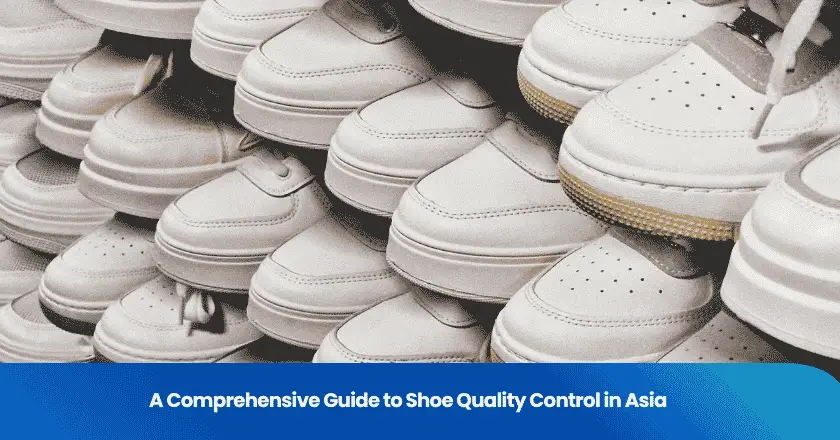
Shoe quality control (QC) in Asia is the set of checks that decide whether a footwear order meets the buyer's agreed requirements before it ships. Those checks run in stages — materials and samples before production, work in progress, finished goods, laboratory testing, and packing — and each stage is anchored to a named test method or a destination-market rule. Running the stages in the right order, to the right standard, is what keeps a footwear order from turning into a claim.
What Shoe Quality Control Covers Across the Production Cycle
Shoe quality control is the set of checks that decide whether footwear meets the buyer's agreed requirements before it ships. In an Asia-sourced order, those checks run at the factory, because a defect found before packing is cheaper to correct than one found after the container arrives.
A footwear order is protected by checks at several stages: materials and samples before production, work in progress, finished goods, laboratory testing, and packing. The stages are complementary rather than interchangeable, so a plan that runs only one of them leaves part of the order unverified.
| Stage | What it checks | Evidence it produces |
|---|---|---|
| Pre-production | Materials and the first build against the approved sample | Material and first-build check record |
| During production | Stitching, components and assembly on the running line | In-line check record |
| Final random inspection | Finished goods sampled against an AQL plan | Inspection report and defect counts |
| Laboratory testing | Performance and chemical properties of the material or product | Test report with method and result |
| Packing | Carton, marks, labels and barcodes before release | Packing and label check record |
Read the table as a plan rather than a menu. The pre-production and during-production stages produce process evidence, the final inspection produces the release sample, laboratory testing produces the performance and chemical results, and packing produces the carton and label record. A complete footwear QC plan names all five stages.
Pre-Production and Material Checks
Pre-production checks verify incoming materials and the first build against the approved sample and specification before the run starts. They compare the leather or textile against the approved material, confirm components such as eyelets, linings and the sole bond, and check that the first pair matches the approved sample in shape, color and size.
A sole bond is the adhesion that holds the upper and the outsole together. Bond failures come from process conditions — surface preparation, cement activation, pressing pressure and time — that a final visual check cannot see, so the material and first-build stage is the earliest place to catch them.
During-Production Checks
During-production checks catch assembly defects while the line can still correct them, which is cheaper than reworking finished goods. An inspector watches stitching, color consistency, component fit and assembly at a defined point in the run, and records the defects found.
In-line checks are not a substitute for the final inspection. They reduce the number of defects that reach the end of the line, but they sample work in progress, so the finished-goods check still decides what ships. The check is most useful when the buyer states what the inspector should watch for — a specific stitch density, a component that has failed before, or a color the factory has struggled to match — rather than asking for a general look at the line.
Final Random Inspection and AQL Sampling
A final random inspection samples the finished goods against an acceptance quality limit (AQL) plan and records the defects it finds. AQL is the defect level a sampling plan accepts for a lot; the inspector draws a defined sample, classifies defects as critical, major or minor, and compares the counts with the accept and reject numbers for that plan.
Timing matters as much as the sampling plan. A pre-shipment inspection is carried out when the order is 100% complete and at least 80% packed for export; the 80% figure concerns packing, not production completion. Inspecting before packing is finished leaves part of the order unchecked, so confirm the readiness condition before the inspector travels.
Laboratory Testing
Laboratory testing measures performance and chemical safety that a visual check on the line cannot see. It covers physical properties such as upper-to-sole adhesion, sole flexing and abrasion, and chemical properties such as restricted substances in leather or coated materials.
Testing is scheduled when the order claims a performance property or when a destination market sets a rule that a visual check cannot confirm. The sample must be drawn from the material or lot the report has to cover, because a report on a hand-made sample does not describe bulk production. TradeAider's product testing service sets out how a sample is identified, tested and reported, and that sequence is a useful model for any provider.
Packaging and Labeling Checks
Packaging and labeling checks confirm the carton, shipping marks, labels and barcodes match the order before the goods are released. The check covers the carton strength and count, the shipping marks against the packing list, the product labels and care information, and a barcode scan test where the buyer requires it.
Packing defects cause their own returns and compliance problems even when the shoes themselves pass. A label with the wrong size, origin or warning text can stop a shipment at the border, so the packing stage closes the QC loop rather than duplicating the product check.
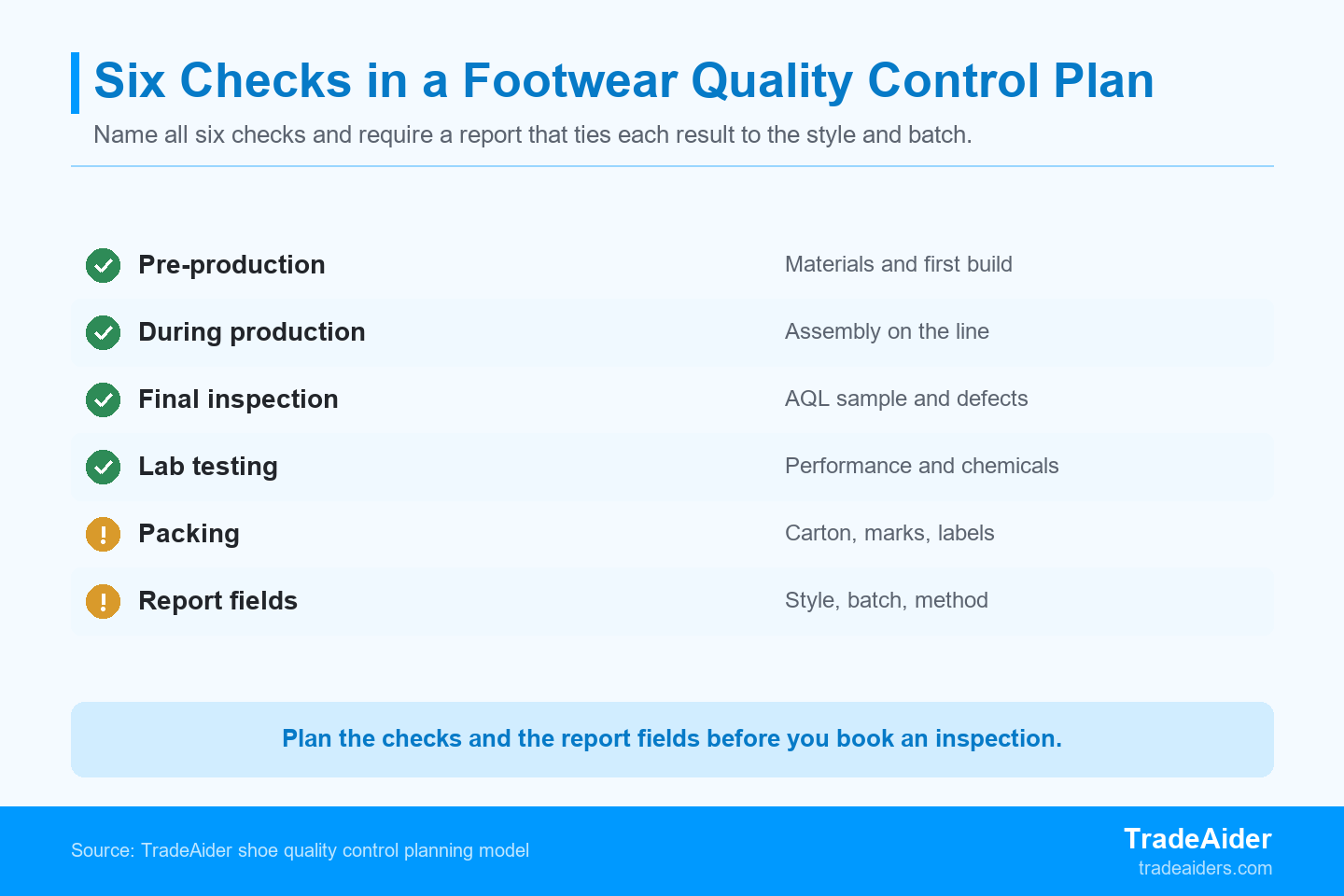
The six checks a footwear QC plan should name, from the material check to the report that ties results to the style and batch.
Key Standards and Regulations for Footwear Quality Control
Footwear quality control is anchored in published test methods and market rules, so the standard that applies depends on the product and the destination market. The same shoe can be checked against an international test method for performance and against a regional regulation for a restricted substance, and both are part of the evidence a buyer needs.
Two layers matter. The method layer tells the team how to measure a property, and the rule layer tells the buyer which limit or duty applies in a given market. A provider that names only a general standard has not shown which layer its checks cover.
International Test Methods and Standards
Footwear performance is measured through named test methods and published standards. SATRA has supplied the footwear industry with test methods for over a hundred years, and almost every footwear specification and international standard builds on SATRA test methods, as its test methods page explains. National and international bodies publish their own standards alongside these, and a provider may work to several.
A named test method fixes the conditions, the equipment and the acceptance value, so two providers' checks can be compared on the same basis. Ask for the physical and chemical methods behind a check — upper-to-sole adhesion, sole flexing, abrasion, slip resistance, restricted substances — and compare the list against a published inspection standard before you accept it.
Chemical and Children’s-Safety Rules
Leather footwear placed on the EU market must not contain chromium VI at or above 3 mg/kg of the total dry weight of the leather, and EN ISO 17075 is the recognised test method. Chromium VI is a form of chromium that can form in leather during tanning and can sensitize skin on contact, so the rule applies to leather parts that touch the skin. The limit is set in Commission Regulation (EU) No 301/2014, which amends REACH Annex XVII entry 47.
The wider framework is REACH, the main EU law on chemicals, which restricts substances of very high concern and gives consumers a right to know about harmful substances in products, as the REACH overview explains. A provider's chemical coverage should name the substance group, the method and the limit rather than offer "REACH compliance" as a phrase.
For the US, children's footwear adds its own rules. Toys and other articles intended for use by children must not bear lead-containing paint above 0.009 percent of the dried paint film, under 16 CFR Part 1303.
US rules also prohibit specified phthalates in children's toys and child care articles under 16 CFR Part 1307. Because children's footwear can be treated as an article intended for use by children, a plan for children's styles should show the lead-paint and phthalate lines explicitly, alongside the leather chemical line for any leather parts.
Safety and PPE Footwear
Safety footwear placed on the EU market as personal protective equipment must follow the PPE Regulation conformity route. Personal protective equipment (PPE) is equipment worn to protect the user from a risk, and protective footwear is PPE rather than ordinary apparel; its conformity assessment and documentation duties sit with the manufacturer under Regulation (EU) 2016/425.
Where a style claims protective performance, ask which performance standard applies. ASTM F2413 sets minimum design, performance, testing and classification requirements for protective toe-cap footwear, including impact and compression resistance, as its standard page sets out. A provider that covers safety footwear should connect the style to the standard and the test, not only to an appearance check.
Why Brands Outsource Footwear Quality Control in Asia
Many international brands manufacture footwear in Asia, so the quality checks have to run where the goods are made rather than only at the destination warehouse. A defect corrected at the factory costs less than the same defect found after the goods have crossed a border, and the correction is faster because the line is still set up.
Before you share product records with any provider, review who performs the work and how the engagement is scoped: see TradeAider's company background.
Where Footwear Is Made and What That Means for QC
A local QC team can inspect several factories in one trip, which lowers travel and inspection cost compared with sending staff from the destination market. The saving is largest when the order is spread across more than one factory or region, because one inspector can cover several sites in a single visit.
Local presence also shortens the feedback loop. When a defect is found, the team can return to the line the next day instead of waiting for a visit booked weeks in advance, so a corrective action is verified before the lot is packed.
Regional Expertise and Risk Management
A QC team based in the region brings knowledge of local suppliers, materials and market rules, and can flag production risks earlier. It knows which factories work with which materials, how local tanneries and component suppliers behave, and which market rules buyers most often miss.
This regional knowledge supports the buyer's own standard rather than replacing it. The team still works to the buyer's specification and the named test methods; what it adds is faster recognition of the risks those methods are meant to catch. When a supplier changes a material or a component, a team that works in the region can often see the change on the line before it reaches the final inspection, and can raise it while the buyer can still decide how to respond.
How to Choose a Reliable Footwear Quality Control Partner in Asia
A reliable footwear QC partner is chosen by evidence — methods, coverage and reporting — not by a service list or a certificate alone. A service list tells you what a provider sells; the evidence tells you what it can do for your shoe types, your materials and your destination markets.
Verify Methods and Coverage
Verify a partner's footwear test methods and its coverage of your shoe types, materials and destination markets before you engage it. Write your order profile first — shoe types, materials, constructions and markets — then ask the provider to map each line to the methods and experience it can evidence.
Coverage is judged against your order, not against a general list. A provider strong in textile sneakers may have little experience with cemented leather shoes, and a provider that handles adult casual shoes may not cover children's sizing or safety footwear. The gap is the answer you need. Once the sampling plan is agreed, use the AQL calculator to set the sample size and the accept and reject numbers for each lot.
Check Certification, Accreditation and the Lab Handoff
Accreditation is an independent assessment that a laboratory is competent to perform a named test, and it is different from a management-system certificate. A certificate such as ISO 9001 describes how an organization manages its processes; accreditation describes which specific tests a laboratory is competent to perform, as UKAS explains.
Ask for the accredited method scope and check that it covers the method the report used, not only the laboratory's name. A laboratory can be accredited for some methods and not others, so a general certificate does not confirm the specific test. Keep the scope reference with the report so the coverage can be re-checked when the order repeats.
Confirm Reporting Transparency and Traceability
A usable report names the style or version, the material batch, the method and the sample source, so the sample can be traced to the goods being released. Before you accept a report, check that the sample was drawn from the material or lot it has to cover, because a report on a hand-made sample does not describe bulk production.
Ask for the sample-submission record as well as the report, so you can see who drew the sample, when it was drawn and which lot it came from. If the provider cannot produce that record, treat the report as partial evidence and decide what additional coverage the release needs. For a multi-lot order, keep one traceability record per lot rather than one per style.
Build a Footwear Quality Control Plan for Your Order
- Name all five stages: pre-production, during production, final inspection, laboratory testing and packing.
- Attach a named test method and, where a market rule applies, the rule and its limit to each check.
- Match the partner's methods and coverage to your shoe types, materials and destination markets.
- Require a report that names the style, the material batch, the method and the sample source.
A written QC plan that lists the stages, the named methods, the market rules and the report fields lets a buyer compare providers and release goods on evidence. Build the plan before you request quotes, so every provider answers the same questions. Send the order profile — shoe types, materials, destination markets, order quantity and the current plan — with a request for a scoped proposal, and ask the provider to state the report fields you will receive. To scope that work, contact TradeAider about your footwear QC plan.
Illustrative Example: A Mixed Order With a Plan Gap
In this illustrative example, a brand sources a mixed footwear order in Asia: two leather casual styles for the EU and one children's textile sneaker for the US, from two factories. The order totals 12,000 pairs across three styles, one production lot per style. The brand has a QC plan that lists the inspection stages, but it names no test methods and no market-rule checks, and the factory has started packing.
The in-line and final visual checks passed with no major defects. The children's sneaker carries a lead-paint and phthalate test report for the US market, but the two leather styles have no chromium VI test against the EU leather limit, and the inspection report names the style but not the material batch.
Visual checks cannot cover the named chemical and market rules, and a report that omits the material batch cannot be tied to the packed goods. The brand releases the children's style with its US test evidence and holds 2 of the 3 styles — the two leather styles — until their EU chromium VI test and batch traceability are produced.
The brand adds the named methods to the plan, books the chromium VI test for the leather styles, and requires the report to name the style, batch, method and sample source. Each held style is released only when the report names the style, the material batch, the method and the accredited lab scope that covers it. This is an illustrative planning example, not measured defect data, a client result, or automatic approval of later lots.
Frequently Asked Questions
What does shoe quality control include in a footwear order?
Shoe quality control includes pre-production material and sample checks, during-production checks, a final random inspection, laboratory testing, and packaging and labeling checks. Each stage produces a different kind of evidence, so a complete plan names all five rather than relying on a single inspection of the finished goods. The depth used at each stage is chosen to match the shoe type, the materials and the destination market.
Do all shoe orders need laboratory testing?
No; laboratory testing is added when a performance claim or a market rule requires it, such as chromium VI in EU leather or lead and phthalates in US children's footwear. A plain casual shoe with no performance claim may need only visual and packing checks, while a safety or children's style usually needs a test report. Confirm the market rules for each destination before you decide which tests to book.
Why is footwear quality control usually carried out in Asia?
The checks have to run where the goods are produced, because defects are cheapest to correct at the factory before the goods are packed and shipped. A local team can also visit several factories in one trip and return quickly to verify a corrective action. Keeping the checks close to the line means the buyer's standard is applied by people who can see the shoes, the materials and the packing as they are made, rather than from a sample sent to the destination market.
How do I choose a footwear quality control company in Asia?
Choose on evidence: the footwear test methods the team uses, its coverage of your shoe types and markets, and the report fields that let you trace a sample to your goods. A service list or a management-system certificate alone does not show that the team can test your styles to the rules your markets require.
Related Articles
Grow your business with TradeAider Service
Click the button below to directly enter the TradeAider Service System. The simple steps from booking and payment to receiving reports are easy to operate.

