
- About Us

- Our Services
- Your Industry
- Resources
- News & Blog
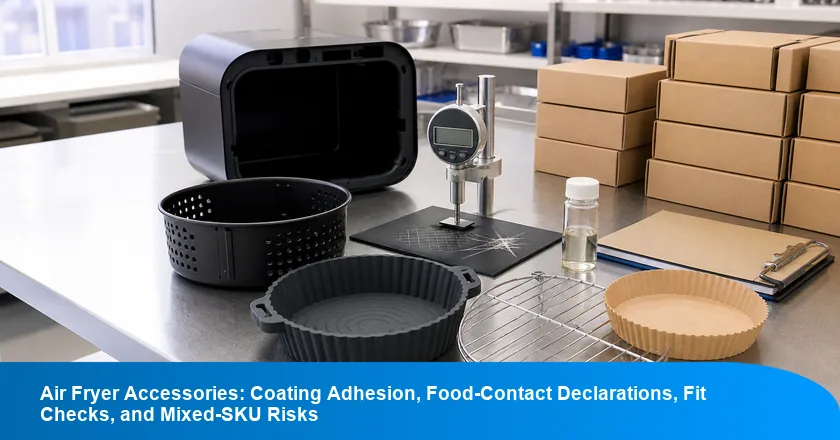
Air fryer accessories are often bought as a simple category, then sold against a specific basket shape, food-contact use, and retail pack. That creates a release problem: a liner, rack, insert, or paper pack can look acceptable in isolation while the shipped set does not match the approved appliance claim or material record.
Accessory-to-appliance release is a buyer control process that confirms one accessory SKU, one named appliance model or model family, and one identifiable packed configuration before that population is released.
The practical objective is not to prove every possible use of an accessory. It is to make the claim, evidence, and packed product point to the same release unit.
The Release Unit Is the Accessory, Model, and Pack Together
The release unit is the accessory-model-pack combination, not the generic category name. A buyer should release a silicone liner only when its material record, named basket geometry, and retail or inner-pack identity all describe the same item. This prevents a broad “fits air fryers” label from hiding a different depth, rim, coating, or inner-pack version.
Start the inspection brief with a release-unit line for every sellable configuration: accessory SKU, material code, claimed appliance model, dimensions, artwork version, inner-pack quantity, and carton code. A single approved sample is useful, but it is not a substitute for this map. If any of those fields changes, the buyer can decide whether to recheck only the affected family instead of treating the whole category as unchanged.
That framing also separates three questions that are regularly confused: whether the item fits a basket, whether a coating remains attached under an agreed method, and whether the food-contact documentation matches the intended use. Each question needs its own evidence. The packed SKU identity is the thread that connects those answers to the goods actually moving to a marketplace or retailer.
- Release the named accessory SKU, appliance model, and packed version as one unit.
- Keep food-contact records, fit checks, coating observations, and carton identity on separate evidence routes.
- Segregate any product family whose inner-pack identity cannot be tied back to the checked configuration.
Use the Accessory-to-Appliance Release Framework
The Accessory-to-Appliance Release Framework separates material declaration, model fit, coating integrity, and SKU pack-out. It gives the buyer four routes to review before deciding whether a defined product family can move. A finding on one route should not be used as proof for another route.
Use the framework at sample approval, during production, and final pack-out. It is deliberately narrow: it tells the team what record to request, what physical observation to make, and what identity must be retained. It does not turn an inspection observation into a regulatory certification or a universal appliance-performance claim.
| Route | Control point | Release evidence | If it does not match |
|---|---|---|---|
| Material | Declaration matches the article and intended use | Current declaration and material code | Hold the affected material family |
| Fit | SKU fits the named basket geometry | Model-fit matrix and agreed checks | Remove or revise the model claim |
| Coating | Agreed adhesion method reaches its criterion | Method, substrate, result, and sample identity | Escalate or rework the coating route |
| Pack-out | Checked configuration remains identifiable in the carton | Inner-pack and carton identity map | Segregate and relabel the unknown population |
Document the four routes in the inspection standard for documented acceptance criteria. The framework is strongest when the supplier knows in advance which photographs, measurements, records, and pack codes will be checked. TradeAider can translate that information into a defined inspection scope while keeping testing and legal questions on their own route. It then becomes possible to release clearly identified goods while keeping an evidence gap contained.
When product construction is still being approved, Pre-Production Inspection can establish the approved sample, material code, artwork version, and fit references before production starts. That early reference makes a later pack-out change easier to identify.
Material Route: Match the Declaration to the Article and Its Use
Food-contact substance examples include food preparation surfaces and cookware. According to FDA (n.d.), this scope can include the surfaces used to prepare food, so a liner or insert should not be documented only by its generic product name.
EU food-contact guidance identifies kitchenware and tableware as food contact materials. According to the European Commission (n.d.), these materials are within the EU food-contact framework, which is why an EU-facing accessory brief should identify the article, material, supplier, and market route rather than rely on a “food grade” print claim.
A declaration of compliance is a written document that identifies a material or article and the compliance basis claimed for it. Request the version number, issue date, material or resin code, article description, supplier identity, intended food-contact conditions, and any stated limits or restrictions. Then compare those fields with the actual liner, insert, or rack SKU and the artwork used in the packed order.
FDA lists cooking at temperatures exceeding 250°F as one food-contact condition of use. According to FDA (n.d.), the food type and use condition matter in the evaluation, so an air-fryer heat statement needs a stated use condition instead of a loose temperature claim. The inspection scope can confirm marking and document identity; a material or migration question belongs on its own evidence route.
Fit Route: Verify the Named Basket Geometry, Not a Category Claim
A multi-model compatibility claim should be converted into one checkable SKU-model pairing per claimed model. Build a model-fit matrix: a list pairing each accessory SKU with each claimed appliance model and its approved fit checks. Include basket opening, usable base area, wall taper, rim position, handle or vent clearance, and the accessory’s stated orientation.
For a silicone liner, check the seated position, folded rim, contact with the basket wall, and whether the chosen placement blocks the intended clearance. For a crisper insert or rack, check length, width, corner profile, feet, and stability in the named basket. Record the appliance reference used for the check; a measurement copied from a retail listing is not the same as a physical model reference.
When tooling, dimensions, or claimed models are still changing, use During Production Inspection for model-fit control before all accessories are packed. The result should say what was checked and on which model, not merely that the product “fits.” That distinction makes a revised listing claim or a targeted hold easier to manage.
Coating Route: Agree the Adhesion Method and the Acceptable Result
ASTM D3359 assesses coating adhesion through pressure-sensitive tape over cuts and states a 125 μm (5 mil) method boundary. According to ASTM International (2023), the method uses tape over cuts and distinguishes method boundaries by coating thickness. That makes the coating, metallic substrate, cut pattern, tape, result criterion, and sample identity part of the inspection instruction.
Do not replace that method with a vague “scratch resistant” check. Agree the observation point, sample count, lighting, before-and-after images, and what result triggers a hold or supplier review. A tape-adhesion observation can show the agreed result for the observed samples; it cannot establish a food-contact authorization, a migration limit, or long-term appliance performance.
Keep coating findings distinct from sharp-edge and deformation checks. A crisper insert may show no visible coating loss while a raised edge, warped foot, or changed profile still creates a fit problem. The Accessory-to-Appliance Release Framework works because each route retains its own decision boundary.
Pack-Out Route: Protect SKU Identity Through the Inner Pack and Carton
Mixed-SKU risk begins when the inner pack or carton label no longer identifies the accessory configuration that was checked. The risk is not limited to a wrong count: a deep liner can be packed in artwork for a shallow model, or a revised insert can share a master-carton code with the approved version.
Map each retail pack to an inner-pack label, carton label, quantity, artwork revision, and accessory SKU. When a carton contains more than one configuration, label the family as mixed until it is sorted; do not infer identity from the carton count alone. Photograph the external label, a representative inner pack, and the product inside it so the fit and material records can be traced back to the shipped population.
Artwork deserves the same control as dimensions. A model list, food-contact statement, or pack count printed on the box is a claim carried into the customer journey. If it changes after approval, compare the changed version against the model-fit matrix and the declaration before a release decision is made.
Route Each Finding to the Evidence That Can Answer It
A food-contact material's status is dictated by its individual substances and intended use conditions. According to FDA (n.d.), the overall status follows the individual substances and their intended use, not a generic accessory label. A visual check therefore cannot close a documentation question by itself.
Set an evidence owner before the inspection: the supplier supplies the declaration and material identity; the buyer confirms the named models and claim boundary; the inspection team records dimensions, pack-out, labels, and agreed visual conditions; and a testing route addresses questions outside visual verification. For a food-contact question that needs material or migration evidence, plan product testing for material and food-contact questions rather than stretching a factory observation beyond its scope.
Article 15 requires a written declaration of compliance for specified plastic materials and articles at non-retail stages. According to Regulation (EU) No 10/2011 (2011), that written declaration applies to the specified plastic materials and articles at non-retail stages. A material-code or production change should trigger a review of whether the document still maps to the actual article and intended market.
The Commission summary lists overall migration limits of 60 mg/kg food or 10 mg/dm² contact material. According to the European Commission (n.d.), those figures describe an overall migration limit in the plastic food-contact materials framework. They are not an adhesion acceptance criterion, so a coating that remains attached is not thereby shown to meet a migration requirement.
A concise finding log keeps the decision clean: record the observed mismatch, the affected SKU and carton population, the missing or conflicting evidence, the owner, and the next verification gate. That log is more useful than a single pass/fail label because it tells the buyer which product family is still unknown and why.
Worked Scenario: Mixed Inner Packs Turn a Fit Claim Into a Conditional Release
A mixed-SKU carton group can be conditionally released only after the affected product family is segregated, relabeled, and rechecked. The key is to preserve a verified population without treating unidentified cartons as equivalent. The following illustrative case shows how the release boundary can be set around the pack identity.
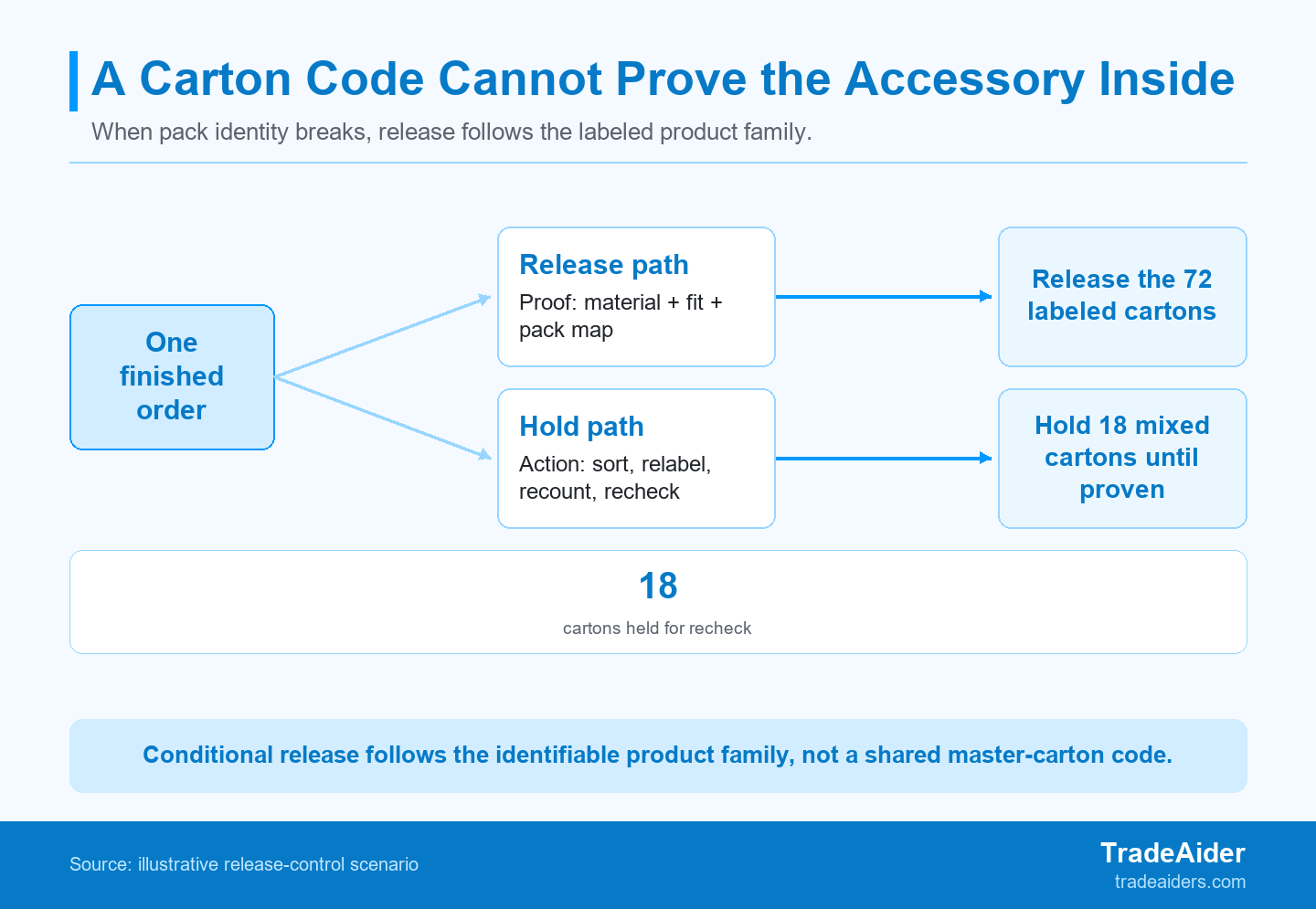
Conditional release follows the identifiable product family, not a shared master-carton code.
Before marketplace handoff, use e-commerce quality checks for the labeled accessory population to keep the released and held families distinct.
Situation, Problem, Action, and Result
The illustrative mixed-pack scenario requires sorting, relabeling, recounting, and model-fit rechecks before the affected product family can be conditionally released. It is a release-control example, not a universal sampling plan or a compliance conclusion.
Situation: An Amazon FBA seller is preparing four air fryer accessory SKUs: a silicone liner, coated crisper insert, stainless rack, and paper-liner pack. The illustrative order contains 3,600 accessory sets in 90 export cartons. Eighteen cartons contain two inner-pack artwork versions after a late pack-out change. The goods are packed, while the buyer has approved dimensions for three named air fryer models and one declaration covering the original silicone-liner material code.
Problem: Four of twelve opened sets from the affected cartons contain a deep silicone liner in a retail pack labeled for the shallow basket model. The affected cartons share a master-carton code but do not identify the inner-pack artwork version on their outside labels. This is a mixed product-family problem. The buyer cannot infer appliance fit from the carton count, and the original material record does not identify the substituted inner-pack configuration. The completed order must be split into identifiable families before a conditional release is possible.
The decision is to hold the 18 mixed-SKU cartons and preserve the 72 clearly identified cartons as a separate population. Release for the held group depends on re-sorted SKU labels, model-fit rechecks, and the current material record for each affected liner version. Action: The supplier segregates the affected cartons, relabels the inner packs, rebuilds the carton map, and repeats the agreed fit and count checks on the re-sorted sets.
Result: The 72 clearly identified cartons can remain in a separate release population, while the 18 mixed cartons carry the cost and delay of sorting and rechecks. The held product family can be reconsidered only when every re-sorted carton identifies one accessory SKU, one intended appliance-model claim, and the matching material and pack-out records. The quantities and checks are illustrative. They do not prescribe a universal sampling plan, appliance clearance, coating grade, or target-market compliance conclusion.
Build a Conditional Release Packet Before Marketplace Handoff
A conditional release packet should name the accessory-model pair, material record, coating result, and SKU/carton map for the finished population. It should also state the released quantity, held quantity, unresolved evidence, and the exact condition that will close the hold. This lets warehouse, marketplace, and supplier teams work from the same bounded decision.
For each released family, attach the current artwork, carton map, model-fit matrix, dimension record, coating observation where applicable, and declaration reference. For each held family, record the reason for hold and the owner of the corrective action. Keep the files versioned so a later substitute material, change in artwork, or rework result cannot be confused with the version already checked.
Pre-Shipment Inspection for the finished accessory lot can focus on the completed, packed population when the brief already defines those evidence links. If the claimed models, material codes, and pack configurations need to be translated into a product-specific scope, request a model-specific accessory inspection brief.
Who Is TradeAider?
TradeAider can use the buyer's supplier packet to scope inspection observations and separate testing escalations. For air fryer accessories, that means turning the model-fit matrix, material declaration, coating method, and pack-out map into a defined on-site observation plan. Questions that need laboratory or legal evidence remain separate from inspection observations. TradeAider supports sourcing and quality work across Guangdong, Zhejiang, Jiangsu, Shandong and Fujian, with $199/man-day all-inclusive for Inspection & QA Services. Client-reported outcomes include an 18% reduction in returns and a 23% improvement in defects caught; results depend on the product, scope, and corrective-action follow-through. It is an official Amazon Service Provider Network (SPN) partner.
Frequently Asked Questions for Air Fryer Accessory Release
The FAQ clarifies document, coating, fit, and mixed-SKU boundaries without replacing the evidence route in the main body. Use the answers to complete the supplier brief, then keep the release decision tied to the identified product family.
What should an air fryer accessory food-contact declaration identify?
A useful declaration should identify the material or article, the supplier, the applicable compliance basis, and the intended conditions of use. It should map to the actual accessory SKU and material code, not merely to “silicone liner” or “air fryer accessory.” Ask for the document version and issue date, then compare it with the sample, artwork, and packed-product identity. Keep the declaration with the approved supplier packet so a later substitute is visible. Where the target market or material changes, obtain a qualified review of the applicable documentation.
Can a coating tape test prove food-contact compliance?
No, a tape test can show an agreed adhesion result, but it does not by itself establish a food-contact authorization or declaration. Its useful role is narrow: it records how the coating behaved under a specified method on identified samples. The brief should name the substrate, coating, method, result criterion, and evidence to capture. It should also say whether the result triggers a hold, rework review, or added sampling. Treat migration, material composition, and intended-use documentation as separate evidence questions.
How should suppliers prove fit across several air fryer models?
Suppliers should provide a model-by-model fit matrix backed by stated dimensions, approved appliance references, and agreed functional clearance checks. Each claimed model needs its own SKU-model pairing and a record of the actual basket or reference used. Include the orientation, rim position, base area, taper, and any clearance that affects use. Record the artwork version that carries the model list, because packaging can preserve an outdated claim. If a model cannot be checked, the claim should remain unapproved or be removed from the labeled configuration.
When should a mixed-SKU accessory order remain on hold?
A mixed-SKU order should remain on hold when the buyer cannot identify which cartons contain each approved accessory configuration and pack-out result. A carton count or master-carton code does not fix an unmarked inner-pack change. Segregate the affected family, sort and relabel it, rebuild the carton map, and repeat the agreed checks. Keep the unaffected cartons physically and documentarily separate from the unknown family. Conditional release becomes possible only after the corrected pack identity reconnects to the fit and material records.

Related Articles


Grow your business with TradeAider Service
Click the button below to directly enter the TradeAider Service System. The simple steps from booking and payment to receiving reports are easy to operate.

